When the adult Bald Eagle later named Aspen arrived for treatment from Jefferson County, Wisconsin, the rehabilitation team already knew the bird faced a difficult recovery.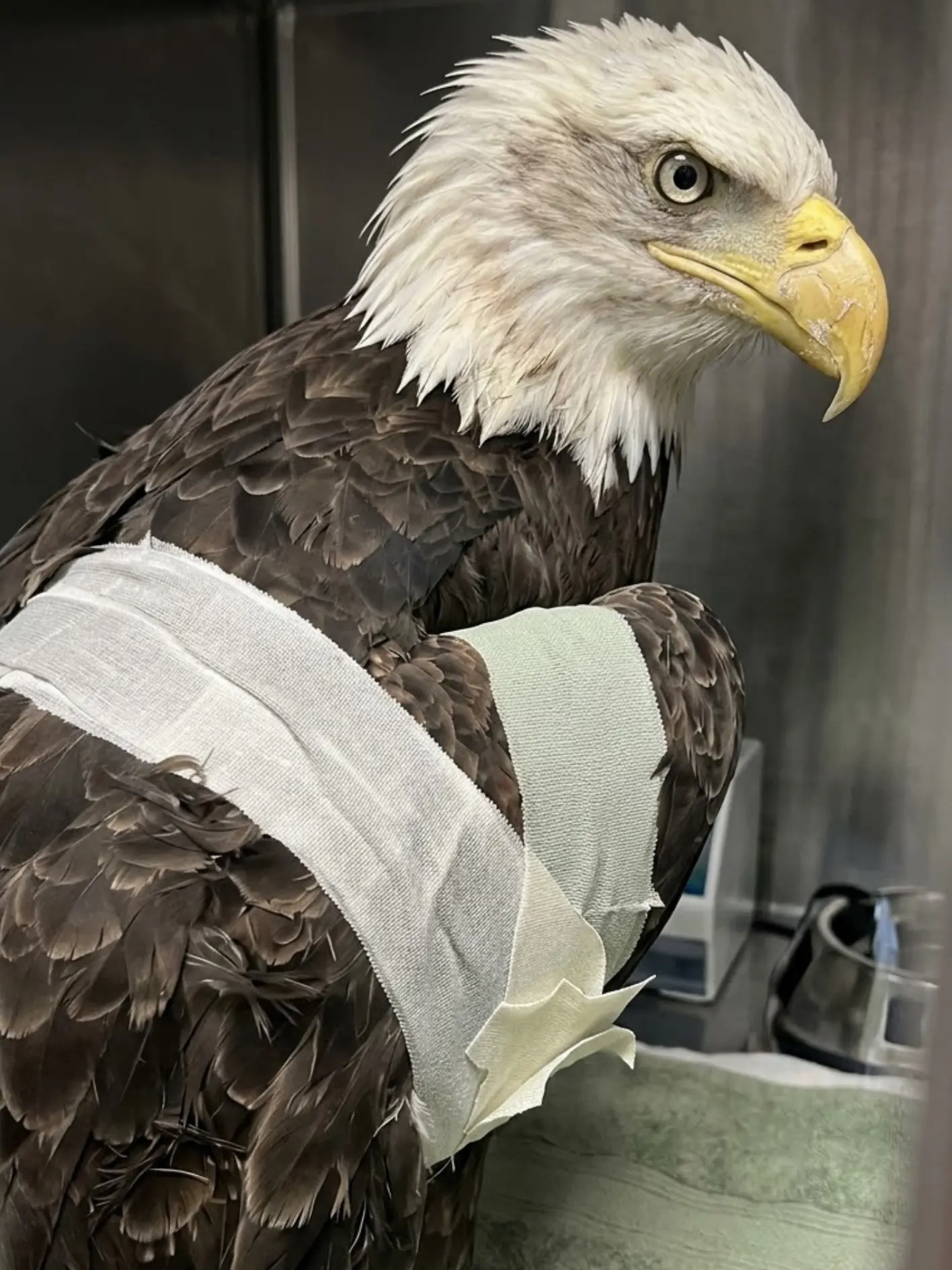
One wing was injured and could not be used normally. Aspen was weak, underconditioned, and unable to fly. The bird could still stand and remained alert enough to watch the people around it, but its posture and limited movement made clear that something serious had happened.
Radiographs soon provided part of the answer.
The injured wing contained a fracture, and several small metallic-density fragments were visible around the damaged area. Their appearance and distribution were considered consistent with ammunition fragments.
But the X-rays were only the beginning.
As part of Aspen’s intake evaluation, the veterinary team also collected blood to assess the eagle’s overall health and screen for lead exposure. That test revealed another problem that could not be seen from the outside: moderate lead toxicosis, at a level significant enough to require medical treatment.
The eagle was therefore facing two different challenges at the same time.
One was mechanical and visible — a damaged wing that needed to heal in precise alignment if Aspen was ever going to fly normally again.
The other was systemic and largely invisible — lead circulating through the body, capable of affecting strength, appetite, coordination, and neurological function.
For the rehabilitation team, the goal was no longer simply to stabilize an injured bird.
They had to rebuild an eagle.
A Grounded Eagle With an Injured Wing
Aspen was first reported after being seen on the ground near the edge of an open rural area in Jefferson County.
The eagle appeared alert, but something was wrong with one wing.
Witnesses watched the bird attempt to move away without achieving a normal takeoff. Rather than launching strongly and clearing the area, Aspen remained grounded.
That behavior alone justified intervention.
A healthy Bald Eagle can spend time on the ground while feeding, but an adult bird that repeatedly fails to fly away when approached may be injured, debilitated, poisoned, or neurologically compromised.
Wildlife responders were contacted.
Once trained personnel arrived, the eagle was safely restrained, with particular attention paid to controlling the feet. Even a weakened Bald Eagle can cause serious injury with its talons.
The wings were supported against the body to avoid worsening any existing trauma, and Aspen was placed in a padded carrier for transport to a licensed wildlife rehabilitation hospital.
No one attempted to force the bird to fly.
That was important.
Until the wing could be examined and imaged, there was no way to know whether an uncontrolled flight attempt could cause additional damage.
The Initial Examination Raised Immediate Concern
At intake, Aspen remained responsive but subdued.
The injured wing was painful and showed reduced range of motion. Swelling was present around the affected region, and the bird did not use the wing symmetrically.
Veterinary staff examined the rest of the body as well.
The eyes were assessed.
The feet and legs were checked.
The spine and pelvis were palpated.
The chest and shoulder girdle were examined for additional trauma.
The team also evaluated hydration, body condition, grip strength, and neurological responses.
Aspen’s overall condition was below ideal. The bird was not yet in the kind of physical state expected from a strong free-ranging adult eagle.
That meant the team needed to determine whether the weakness came entirely from the injury or whether another medical problem was contributing.
Radiographs and bloodwork were ordered.
Both would prove important.
The X-Rays Changed the Case
Radiographs confirmed a fracture involving the injured wing.
For any flying bird, that is a serious diagnosis.
For a Bald Eagle, it can determine whether release will ever be possible.
A wing fracture does not need to be catastrophic to threaten a bird’s future. Even a small change in alignment can affect aerodynamics, wing extension, muscle function, or joint movement. A bone may heal and still leave the bird unable to generate the symmetrical lift and control needed for sustained flight.
The imaging also showed something else.
Several small metallic fragments were present in and around the injured region.
Their density and appearance were considered consistent with ammunition fragments.
That finding made simple collision trauma less likely as the complete explanation for the injury.
The veterinary team documented the radiographs carefully.
Because imaging cannot identify who fired a projectile or establish the precise circumstances of an injury, staff avoided speculation about intent or responsibility. But medically, the evidence indicated that projectile trauma was a serious concern.
The wing would need treatment designed not merely to close a wound, but to preserve future flight.
The Specialized Wrap Was Part of That Plan
Once the wound was addressed and the fracture evaluated, Aspen’s wing was placed into a specialized wing-and-body wrap.
Photographs from the early treatment period show the eagle standing upright with broad white bandaging securing the injured wing close to the body.
The wrap serves several purposes.
It restricts unnecessary movement across the fracture.
It helps maintain the wing in a more appropriate anatomical position.
It reduces painful motion.
And, importantly, it protects the alignment needed if the wing is eventually going to return to functional flight.
In raptor rehabilitation, stabilization is not simply about immobilizing an injury as tightly as possible.
The position matters.
The duration matters.
Joint mobility matters.
Feather condition matters.
A wing can heal structurally and still fail functionally if the surrounding tissues become excessively stiff or muscles deteriorate too severely.
That is why the wrap would need to be monitored and adjusted as Aspen’s recovery progressed.
Then the Blood Test Revealed a Second Threat
While the team was addressing the wing, Aspen’s blood results returned.
Lead was present at a level considered clinically significant enough to require treatment.
The diagnosis explained why Aspen’s recovery could not focus on orthopedic trauma alone.
Moderate lead toxicosis can affect a raptor in several ways.
Affected birds may become weak or lethargic.
Appetite can decline.
Grip strength may decrease.
Coordination can become abnormal.
Neurological responsiveness can deteriorate.
In more severe cases, birds may lose the ability to stand or fly altogether.
Aspen had not reached the most extreme presentation, but the level was high enough that the team could not safely ignore it.
“The wing injury was obvious,” a rehabilitation veterinarian explained. “The lead burden was not. Without blood testing, we would have been treating only part of the patient.”
Where the Lead Came From Could Not Be Proven
The exact source of Aspen’s exposure was unknown.
That is common in wildlife cases.
Bald Eagles range widely and may feed in many locations before becoming ill. By the time a bird is admitted, the original source may be miles away or long gone.
Still, one route of exposure is well documented in scavenging raptors.
Bald Eagles frequently consume carrion.
When game animals are shot with lead ammunition, tiny fragments can remain in tissue or discarded remains. Some fragments are so small they are impossible for a scavenger to detect visually.
An eagle feeding normally can therefore swallow lead without ever encountering a recognizable bullet.
Once ingested, the metal can be absorbed and enter the bloodstream.
Aspen’s medical team could not say that this was definitively what happened in this particular case.
But scavenging ammunition-contaminated animal remains is considered a well-recognized pathway of lead exposure in Bald Eagles and other scavenging wildlife.
One Eagle, Two Ammunition-Related Problems
Aspen’s case was especially striking because the bird showed two different medical problems potentially associated with ammunition.
The first was direct trauma.
Metal fragments were embedded around an injured, fractured wing.
The second was toxic exposure.
Lead was circulating through the bloodstream at a level requiring treatment.
Those two findings do not necessarily prove they came from the same event.
The lead could have been ingested days, weeks, or even longer before the wing injury occurred.
That distinction is important.
But from a clinical perspective, both problems existed simultaneously, and both could affect Aspen’s ability to recover.
Lead Treatment Began Alongside Orthopedic Care
Because the lead concentration required intervention, Aspen was started on chelation therapy.
Chelating medications are used to bind lead and help the body eliminate it.
Treatment is not instantaneous.
The body still requires time to clear the metal, and repeated testing may be needed to make sure concentrations remain controlled after treatment.
Aspen also received supportive care tailored to the bird’s condition.
Hydration was addressed.
Pain associated with the wing injury was managed.
The eagle was housed in a quiet environment to reduce unnecessary stress.
Neurological status was monitored closely.
Grip strength, posture, appetite, and responsiveness became useful daily indicators.
The veterinary team also planned repeat blood testing.
A bird that looks brighter does not automatically have a safe lead concentration.
Objective measurements matter.
Nutrition Became an Important Part of Recovery
Aspen’s body had been through significant stress.
The bird was injured, exposed to lead, and not in ideal condition when admitted.
Rather than immediately offering large meals, the rehabilitation team began with small, frequent feedings.
That approach allowed Aspen’s digestive system to adjust gradually while providing a steady supply of calories and protein.
The goal was not simply to fill the eagle’s stomach.
It was to rebuild a body capable of healing.
Adequate nutrition supports:
bone repair,
muscle recovery,
immune function,
wound healing,
and the energy demands of rehabilitation.
Each meal was therefore part of the medical plan.
Staff tracked appetite and body weight carefully.
They watched for changes in droppings and digestive tolerance.
They monitored whether Aspen was becoming more interested in food independently.
Over time, the eagle began responding.
Appetite Was One of the First Encouraging Signs
At first, Aspen ate cautiously.
Then food intake improved.
The eagle began finishing small portions consistently.
As the body adapted, meal size could be adjusted gradually.
Aspen became more alert.
The bird held a stronger posture and paid closer attention when staff entered the enclosure.
Eventually, the eagle started showing a behavior rehabilitation teams often welcome:
irritation.
A healthy wild Bald Eagle should not enjoy being handled.
As Aspen’s strength returned, restraint became more difficult. The feet gripped more strongly. The head remained upright. The bird reacted quickly to movement.
Those changes were encouraging.
“Aspen was becoming increasingly unwilling to cooperate,” one rehabilitator said. “For us, that was good news.”
The Wing Still Had a Long Way to Go
Improved appetite and lower lead levels would mean little for release if the wing did not heal properly.
Aspen remained in the specialized wrap while the fracture stabilized.
The bandage was checked regularly.
Veterinary staff monitored:
wing position,
swelling,
circulation,
skin condition,
feather integrity,
and signs of discomfort.
The team wanted enough stability for the bone to heal without creating unnecessary restriction elsewhere.
Repeat radiographs were scheduled to evaluate progress.
Eventually, the imaging began to show early bone healing.
Alignment remained acceptable.
Soft-tissue swelling was improving.
Those findings allowed the team to begin thinking beyond immobilization.
That meant physical therapy.
Healing the Bone Was Only Half the Job
A wing held still for weeks does not emerge ready for flight.
Muscles lose strength.
Joints stiffen.
Connective tissues adapt to restricted motion.
For an eagle, these changes can be as important as the original fracture.
That is why Aspen’s rehabilitation required carefully staged physical therapy.
Once the fracture was stable enough, staff began controlled range-of-motion work.
The movements were measured and gentle.
The objective was not to force the wing through a full flight stroke.
It was to gradually restore mobility while protecting the healing bone.
The shoulder was assessed.
The elbow was monitored.
The wrist and distal wing structures were evaluated.
Any sign of pain or instability would have changed the plan.
“Fixing the fracture is only one part of returning a bird to flight,” the veterinarian said. “The wing also has to become a wing again.”
Physical Therapy Became a Routine
Aspen’s rehabilitation sessions continued as healing progressed.
The team worked to maintain and gradually expand normal movement.
As external support was reduced, the eagle began using the wing more independently.
Natural stretching became particularly valuable.
A bird’s own controlled movements can reveal what it is comfortable doing without forcing the joint or fracture beyond tolerance.
Staff watched for symmetry.
Did both wings extend equally?
Was the injured side carried lower after exercise?
Did Aspen hesitate before stretching?
Was there swelling afterward?
These observations were documented alongside repeat imaging.
Gradually, the injured side improved.
Lead Levels Were Monitored at the Same Time
Aspen was essentially undergoing two rehabilitation programs simultaneously.
While the wing healed mechanically, the lead burden was being treated medically.
Follow-up blood testing showed improvement.
That was encouraging, but clinicians continued monitoring because lead concentrations can change over time.
The team wanted evidence that the eagle remained clinically stable after treatment.
They also watched closely for neurological abnormalities.
Could Aspen stand normally?
Was the grip symmetrical?
Did the eagle track movement appropriately?
Was balance stable on a perch?
All of those questions mattered before flight rehabilitation could begin.
Aspen Was Proving to Be a Determined Patient
As the weeks progressed, Aspen’s personality became increasingly obvious.
The bird was watchful.
Defensive.
Uninterested in human contact.
Strong enough to make examinations more challenging.
For wildlife rehabilitators, these traits were reassuring.
The purpose of treatment is not to tame an eagle.
A bird destined for release should remain wary of people.
Aspen did.
The eagle’s improving attitude became an informal measure of progress alongside blood tests and radiographs.
The stronger Aspen became, the more clearly the bird communicated a desire to be left alone.
That was exactly the direction staff wanted to see.
A Low Perch Came Before a Flight Pen
Once Aspen could stand normally and the wing showed adequate structural progress, the eagle was given access to a low perch.
This may sound like a small step, but it tests several systems at once.
Balance.
Grip.
Posture.
Endurance.
Neurological coordination.
Aspen climbed onto the perch and remained stable.
The feet closed strongly around the surface.
There was no obvious loss of balance.
The eagle also held both wings in a more symmetrical resting position.
Repeated observations confirmed the improvement.
Only then could the rehabilitation team consider increasing space and activity.
The First Flight Was Not the Finish Line
Eventually, Aspen progressed to a larger rehabilitation enclosure.
For the first time since the injury, the eagle would be able to demonstrate whether the repaired wing could generate real lift.
Staff watched from a distance.
Aspen opened both wings and launched.
The bird became airborne.
That alone was a significant milestone.
But the flight was short.
The previously injured side appeared somewhat weaker than the opposite wing, and Aspen landed sooner than a fully conditioned adult eagle should.
The bird had flown.
It had not yet proven itself ready for release.
That distinction matters enormously in professional wildlife rehabilitation.
“It was encouraging,” staff said, “but encouraging and releasable are not the same thing.”
Conditioning Continued
Aspen remained in rehabilitation.
The bird was given time to rebuild the muscles that had weakened during immobilization.
Short flights became longer ones.
Repeated takeoffs helped restore power.
Turns challenged coordination.
Different perch heights required greater control during approach and landing.
Staff also observed Aspen after exercise.
A damaged wing may look acceptable during a single flight but begin drooping afterward if the muscles fatigue or pain develops.
Aspen’s recovery continued without major setback.
Flight became more symmetrical.
Endurance improved.
Landings became more controlled.
The wing increasingly behaved like the other wing.
Landing Was Especially Important
A strong takeoff attracts attention, but landing often reveals subtle problems.
A Bald Eagle must adjust wing angle, reduce speed, extend the legs, judge distance, and grip a perch at precisely the right moment.
Residual neurological effects from lead exposure could interfere with that sequence.
A weak wing could affect braking.
Poor coordination could cause the bird to miss the perch.
For that reason, the rehabilitation team watched Aspen’s landings as closely as the flights themselves.
Repeatedly, the eagle demonstrated increasing control.
That was one of the strongest functional signs that both the orthopedic and neurological aspects of the case were improving.
Final Medical Clearance Would Require More Than Appearance
By this stage, Aspen looked substantially healthier than at admission.
But appearance alone does not determine whether a wild eagle can be released.
The final evaluation would need to combine:
radiographic evidence of appropriate healing,
acceptable blood lead results,
normal body condition,
strong grip,
full wing movement,
sustained flight,
accurate turns,
controlled landings,
and appropriate wild behavior.
Any significant failure could delay release.
That standard may seem strict.
It needs to be.
Once the carrier door opens, there is no rehabilitation team in the field to correct a weak landing or provide another meal.
The bird has to be ready.
Aspen’s Case Carries a Broader Conservation Message
The medical story is compelling because it illustrates two separate ways ammunition can affect wildlife.
A projectile can injure a bird directly.
Lead can also enter a food web indirectly.
A scavenging eagle does not need to be shot with a lead bullet to suffer from lead exposure. It may only need to consume tissue containing tiny fragments.
That means prevention can occur at more than one point.
Responsible target identification helps prevent protected raptors from being struck.
Choosing non-lead ammunition can reduce toxic fragments left behind in harvested animals.
Managing carcass remains responsibly can reduce exposure opportunities.
And rapid reporting can give injured wildlife a better chance when prevention fails.
Conservation and Lawful Hunting Are Not Opposing Goals
The rehabilitation team emphasized that responsible hunting and raptor conservation can coexist.
Hunters have long played important roles in North American wildlife management.
The issue is not whether hunting exists.
The issue is whether preventable toxic material remains available to scavengers and whether protected wildlife is properly identified and avoided.
Non-lead ammunition provides one practical tool for reducing secondary exposure.
Accurate target identification provides another.
The result benefits wildlife without requiring people to treat conservation and hunting as mutually exclusive.
Supporting Rehabilitation Is Another Part of the Equation
Aspen’s recovery requires far more than the bandage visible in a photograph.
There are radiographs.
Blood tests.
Chelation therapy.
Medications.
Food.
Housing.
Protective equipment.
Physical therapy.
Follow-up imaging.
Flight conditioning.
And countless hours of staff observation.
Specialized wildlife care is resource-intensive.
When communities support licensed rehabilitation organizations, that support translates directly into diagnostic tests, treatment, food, and time — the resources animals like Aspen need to recover.
The rescue may happen in a single afternoon.
Rehabilitation can take weeks or months.
The Goal Has Changed From Survival to Flight
When Aspen first arrived, the immediate concerns were straightforward.
Could the bird be stabilized?
Could the fractured wing be protected?
Could the lead poisoning be treated?
Could the eagle regain enough strength to eat and stand normally?
Those early questions are now giving way to a more demanding one:
Can Aspen return to the wild as a fully functional Bald Eagle?
That is a much higher standard.
And it is exactly the standard the rehabilitation team intends to use.
One Patient, Many Small Victories
Aspen’s progress has come through a series of incremental steps.
A meal finished independently.
A stronger grip.
A more upright posture.
A falling blood lead concentration.
An X-ray showing continued fracture healing.
A controlled wing stretch.
A stable perch.
A first short flight.
A better landing.
None of these moments alone represents recovery.
Together, they tell a very different story from the one that began with a grounded eagle and a fractured wing.
They show a bird steadily reclaiming the functions that make survival possible.
Still Under Care — But Moving in the Right Direction
Aspen remains under professional observation while rehabilitation continues.
The specialized wrap that once held the injured wing tightly against the body has done its job during the critical early healing period.
The fracture has progressed.
Lead treatment has reduced the hidden toxic burden.
Small, frequent meals helped a compromised body adapt again to normal nutrition.
Physical therapy has helped restore mobility.
Flight conditioning is rebuilding strength.
And Aspen has proven to be exactly what rehabilitation staff hope for in a wild eagle patient:
determined.
Watchful.
Strong-willed.
And increasingly difficult to handle.
There are still milestones ahead, and wildlife professionals will not promise release until the bird demonstrates consistent, normal function.
But Aspen has already moved beyond the point where the question was simply whether the eagle would survive.
The question now is whether the wing can carry the bird home.
If the answer ultimately becomes yes, the final measure of success will be remarkably simple.
The bandages will be gone.
The blood tests will be finished.
The rehabilitation enclosure will no longer be necessary.
A carrier door will open.
And Aspen will have to do the one thing this entire recovery has been designed to make possible:
fly away.