What began as a routine winter bird count along Pine Creek in Lycoming County, Pennsylvania, turned into an emergency wildlife rescue after surveyors discovered a young Bald Eagle lying among rocks beneath a large riverside tree.
The bird was alive, but something was clearly wrong.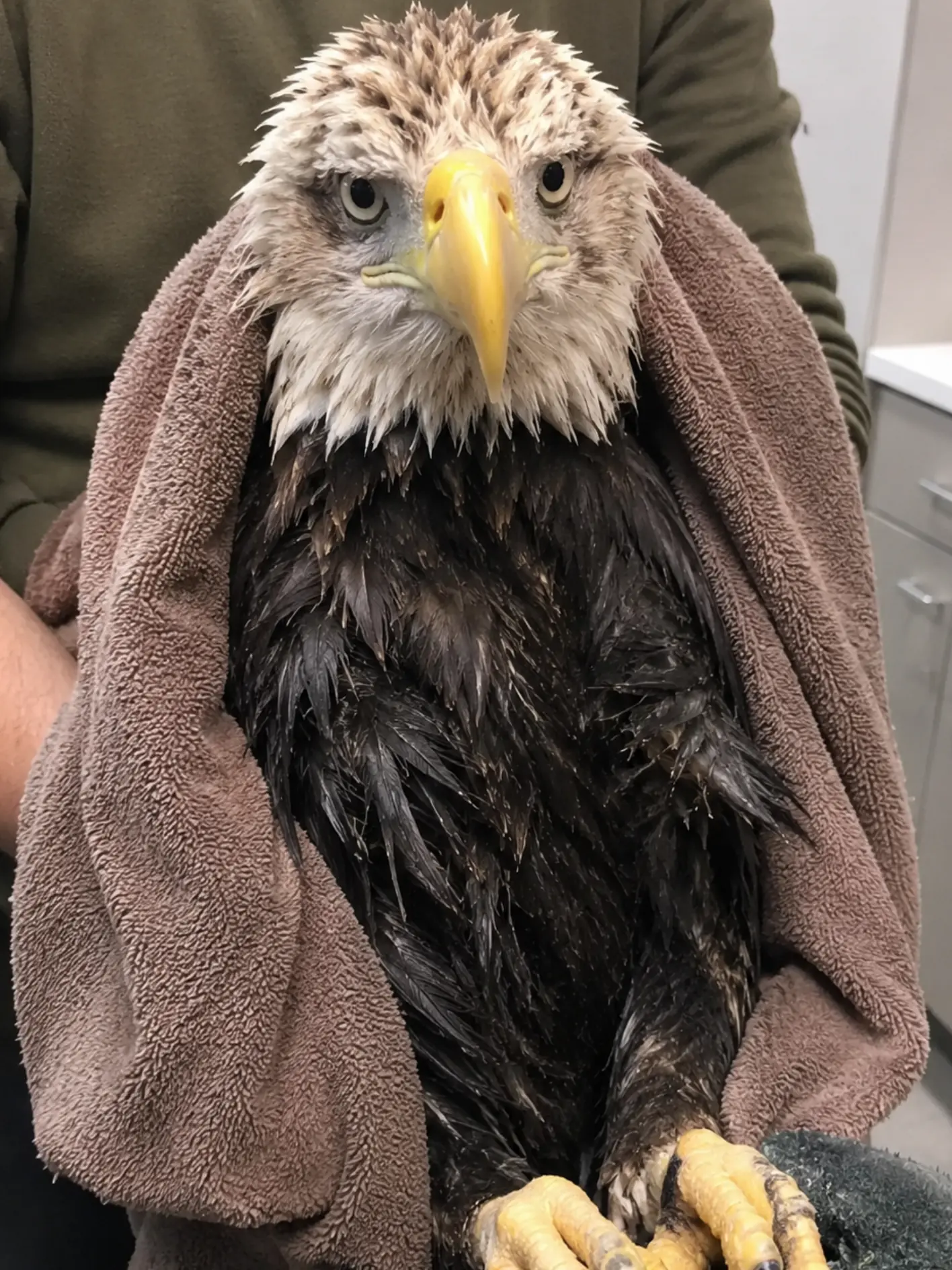
Instead of taking flight when the survey team approached, the eagle remained on the ground with little effort to escape. Its posture was low, its movements were weak, and feathers along the chest were disturbed and stained around an area of visible trauma.
The bird was estimated to be approximately four years old based on its transitional plumage, and its size and body measurements were most consistent with a female.
At that age, a Bald Eagle is no longer an inexperienced fledgling. It should be capable of strong, sustained flight and should ordinarily move away quickly when people approach.
This one did not.
A wildlife responder was contacted, and the eagle was safely contained and transported to a regional raptor rehabilitation hospital for emergency evaluation.
The injuries initially seemed to tell a straightforward story.
There was trauma to the chest.
The bird had apparently landed hard among rocks.
There was concern for internal bruising.
Perhaps the eagle had simply collided with something or fallen during an aerial encounter.
But bloodwork quickly revealed a second problem — and one that may have started before the fall ever happened.
The eagle’s blood lead concentration was extremely high, well above the level associated with clinical lead toxicosis in raptors.
That result changed the medical interpretation of the case.
Veterinarians began to consider whether the visible injuries might not explain why the eagle had fallen.
They might instead be the consequence of something already happening inside the bird.
Lead poisoning can interfere with neurological function, muscle strength, coordination, grip, appetite, and the ability to remain perched normally.
No one witnessed the eagle fall from the tree, so the exact sequence cannot be confirmed.
But given the severe lead exposure, the bird’s profound weakness, the location beneath a large tree, and the injuries consistent with a hard impact onto rocks, veterinarians considered one possibility medically plausible:
The eagle may have become so weakened by lead toxicosis that it lost its balance or grip while perched and fell onto the rocks below.
The poisoning may have come first.
The trauma may have followed.
A Bird Count Became a Rescue
The survey team had not expected to handle wildlife that morning.
Their job was to count.
Winter bird surveys help biologists and conservation groups document how many Bald Eagles, waterfowl, and other large birds are using important river corridors.
Observers move along predetermined routes, recording birds seen perched, flying, feeding, or resting.
Pine Creek and the surrounding river valleys provide excellent habitat for Bald Eagles.
Fish, waterfowl, carrion, wooded shorelines, and tall mature trees make the area attractive throughout much of the year.
Seeing an eagle during the count was not unusual.
Seeing one lying beneath a tree and failing to move away was.
“We were supposed to be counting eagles that morning, not rescuing one,” one survey volunteer recalled. “When this bird didn’t try to leave as we approached, we knew immediately that something was wrong.”
The team stopped the survey.
Instead of recording another bird on the list, they began watching its breathing, posture, and ability to move.
The eagle remained conscious.
Its eyes were open.
It reacted to nearby activity.
But it did not behave like a healthy wild raptor.
The Plumage Suggested a Bird About Four Years Old
The eagle had much of the pale head coloration associated with adulthood but still showed transitional mottling.
Bald Eagles do not acquire the fully white head and tail of mature adults immediately.
Their plumage changes gradually over several years.
By roughly four years of age, many birds are approaching adult appearance but may still retain darker feathers around the head, tail, or body.
Based on the feather pattern, staff estimated this eagle to be approximately four years old.
Body size and morphometric measurements suggested the bird was most likely female.
Female Bald Eagles are generally larger than males, although there is overlap.
The estimate was therefore based on multiple physical characteristics rather than appearance alone.
The age mattered clinically.
This was not a young bird still learning basic flight.
A four-year-old Bald Eagle should already possess the strength, coordination, and experience necessary to perch securely and navigate the landscape.
Its condition could not reasonably be explained by juvenile inexperience.
The Chest Injuries Were Immediately Concerning
At intake, the veterinary team documented trauma along the chest and keel region.
The feathers were disrupted.
There was bruising.
A superficial wound was visible.
The bird was painful during portions of the examination.
The location of the injuries raised concern for a high-energy impact.
If the eagle had fallen from a tree onto rocks, the chest would be one of the areas expected to absorb force.
But exterior wounds never tell the whole story.
Birds can sustain significant internal trauma with relatively limited skin damage.
The veterinary team therefore became concerned about deeper injury involving the chest and abdominal structures.
Potential complications included:
- soft-tissue bruising,
- pulmonary contusion,
- injury to internal organs,
- internal bleeding,
- or trauma to the air-sac system.
The bird needed imaging and bloodwork before anyone could determine how serious those injuries were.
Radiographs Looked for Fractures
The wings, legs, pelvis, and shoulder girdle were examined carefully.
Radiographs were taken to look for skeletal injuries.
A major fracture would have changed both the treatment plan and the prognosis.
The images did not identify a major long-bone fracture.
There was no obvious catastrophic wing break.
No large displaced leg fracture was found.
That was encouraging.
The absence of a major fracture meant the eagle had avoided one of the most common reasons injured raptors cannot return to the wild.
But the bird was still far too weak.
The medical team needed another explanation.
Bloodwork Provided It
A blood sample was collected early in the evaluation.
For a grounded Bald Eagle with unexplained weakness, lead screening is a critical diagnostic step.
The result was striking.
The eagle’s blood lead concentration was extremely high.
The level was well above what veterinarians would consider background exposure and was consistent with clinically significant lead toxicosis.
“The trauma was concerning, but the blood lead result changed the entire case,” the attending veterinarian said. “At concentrations this high, lead can profoundly affect strength, coordination, and the ability to remain perched. We cannot prove that poisoning caused the fall, but it is a medically plausible explanation.”
The eagle had not simply suffered an impact.
It was also dealing with a toxic exposure capable of weakening the entire body.
Why Lead Is So Dangerous to Bald Eagles
Lead affects several physiological systems at once.
It can interfere with neurological signaling.
It can alter muscle function.
It can damage the gastrointestinal system.
It can interfere with red blood cell production.
In severe cases, affected birds may develop:
- profound weakness,
- poor balance,
- loss of grip strength,
- abnormal posture,
- inability to perch,
- inability to fly,
- loss of appetite,
- gastrointestinal dysfunction,
- tremors,
- and other neurological abnormalities.
A bird can therefore become physically compromised long before a human observer notices anything visibly wrong.
That may be particularly important in this case.
The eagle might still have been capable of reaching a perch even as lead exposure was reducing its strength.
But remaining on that perch requires constant muscular and neurological control.
If the feet weaken or coordination deteriorates, a normally secure position can become dangerous.
Could Lead Poisoning Have Caused the Fall?
No one saw the eagle come out of the tree.
That limits what can be stated with certainty.
The bird could have fallen for another reason.
It might have collided with a branch.
It might have been involved in an interaction with another eagle.
It could have already been on the ground before moving among the rocks.
But several facts made the fall hypothesis reasonable.
The eagle was found directly below a large tree.
Its injuries were consistent with blunt-force impact.
It did not have a major fracture suggesting a different obvious mechanism.
And its blood lead concentration was high enough to cause significant weakness and neurological impairment.
Veterinarians therefore considered it possible that lead poisoning had compromised the bird before the trauma occurred.
The poisoning may have reduced grip strength or balance.
The bird may then have slipped or fallen from the perch.
The rocks below may have caused the chest injuries.
That interpretation remains a hypothesis, not a proven reconstruction.
But medically, it fits the evidence.
The Most Likely Lead Exposure Route Could Not Be Confirmed
Bald Eagles are opportunistic scavengers.
They readily consume carrion.
That feeding behavior creates one recognized pathway for lead exposure.
When animals are shot using lead ammunition, projectiles can fragment.
Very small pieces may remain in tissue.
If carcasses, gut piles, or unrecovered remains are later eaten by scavengers, those fragments can be swallowed.
A Bald Eagle does not need to ingest a whole bullet.
Small particles may be enough to produce toxic exposure.
In this case, however, no specific carcass was identified.
No feeding event was witnessed.
The rehabilitation team could not determine exactly where or when the eagle encountered lead.
The most accurate conclusion was therefore limited:
The bird had severe lead exposure.
Scavenging remains containing lead ammunition fragments was one possible source.
The precise source was unknown.
The First Hours Were Focused on Stabilization
The eagle was placed in a quiet intensive-care environment.
Handling was minimized.
The bird needed to recover from the combined effects of trauma and poisoning.
Fluid therapy was started to support hydration and circulation.
Pain medication was used as clinically appropriate for the chest injuries.
Supplemental oxygen was available if respiratory effort became compromised.
The bird was kept warm and monitored closely.
Staff watched:
- breathing,
- body temperature,
- alertness,
- foot strength,
- posture,
- appetite,
- and signs of internal bleeding.
The chest wounds were cleaned.
Damaged skin was treated.
But the medical team understood that the visible injuries represented only one part of the case.
The toxic exposure required treatment of its own.
Chelation Therapy Was Started
Because the blood lead concentration was so high, the eagle was started on chelation therapy.
Chelating medications bind lead and help the body eliminate it.
But chelation does not instantly reverse neurological dysfunction.
The lead concentration in the bloodstream may begin to decrease before strength and coordination fully return.
Some lead can also remain stored in tissues and bone.
That means one course of treatment may not be the end of the problem.
Repeat testing is essential.
A later blood sample can show whether the concentration is declining or whether additional treatment may be needed.
The rehabilitation team therefore followed both the laboratory values and the bird’s behavior.
Blood Numbers Alone Could Not Determine Recovery
A falling lead level is encouraging.
But it does not automatically make an eagle releasable.
The bird must regain function.
It has to stand.
Grip.
Perch.
Eat.
Fly.
Turn.
Land.
And perform those tasks repeatedly without neurological abnormality.
Lead can affect each of those functions.
For this eagle, the rehabilitation team needed to see laboratory improvement and physical improvement occurring together.
If the blood value dropped while neurological weakness persisted, the prognosis would remain uncertain.
If the bird became stronger while lead levels remained dangerously high, release would still be premature.
Both sides of the case mattered.
The Internal Trauma Required Separate Monitoring
Chelation therapy could address lead.
It could not repair chest injuries.
The veterinary team therefore continued monitoring the trauma independently.
The eagle’s packed cell volume was checked to look for evidence of significant blood loss or anemia.
Respiratory effort was observed.
Abdominal and thoracic discomfort were reassessed.
The superficial wounds were monitored for infection.
If the bird developed increasing weakness, changes in breathing, or evidence of internal bleeding, the trauma plan would need to change.
Fortunately, the absence of major fractures allowed the team to concentrate on supportive care rather than emergency orthopedic surgery.
The First Day Remained Guarded
At admission, the prognosis was guarded.
That description reflected several concerns at once:
- extremely high blood lead,
- generalized weakness,
- chest trauma,
- possible internal injury,
- and uncertainty about neurological damage.
A Bald Eagle can survive lead poisoning and still be left with permanent deficits.
A bird can also survive blunt trauma but remain unable to fly normally.
The rehabilitation team therefore resisted predicting the outcome too early.
The first objective was simply to get the eagle through the acute phase.
The Photograph Shows a Subdued but Alert Patient
Images taken after rescue show the young eagle wrapped securely in a towel while being held for evaluation and transport.
The head is largely pale but still shows the mottling expected in a bird transitioning toward full adult plumage.
The eyes are open.
The bird is alert enough to watch its surroundings.
The feet and talons remain powerful despite the overall weakness.
That contrast is common in injured raptors.
A severely compromised eagle may still be dangerous to handle.
The towel helps support the body and reduce wing movement while trained personnel maintain control of the feet.
The image does not reveal the lead poisoning.
It cannot.
That was the hidden part of the case.
Appetite Was Initially Poor
Severe lead toxicosis often affects the gastrointestinal system and appetite.
The eagle showed limited interest in food during the early phase of hospitalization.
That was not surprising.
Pain, stress, toxicity, and unfamiliar surroundings can all suppress feeding behavior.
Staff monitored food intake closely.
If voluntary feeding was inadequate, nutritional support could be provided.