When Linda Parker first noticed a young Bald Eagle standing behind the fence in her backyard near Green Bay, Wisconsin, she assumed the bird was simply taking a break.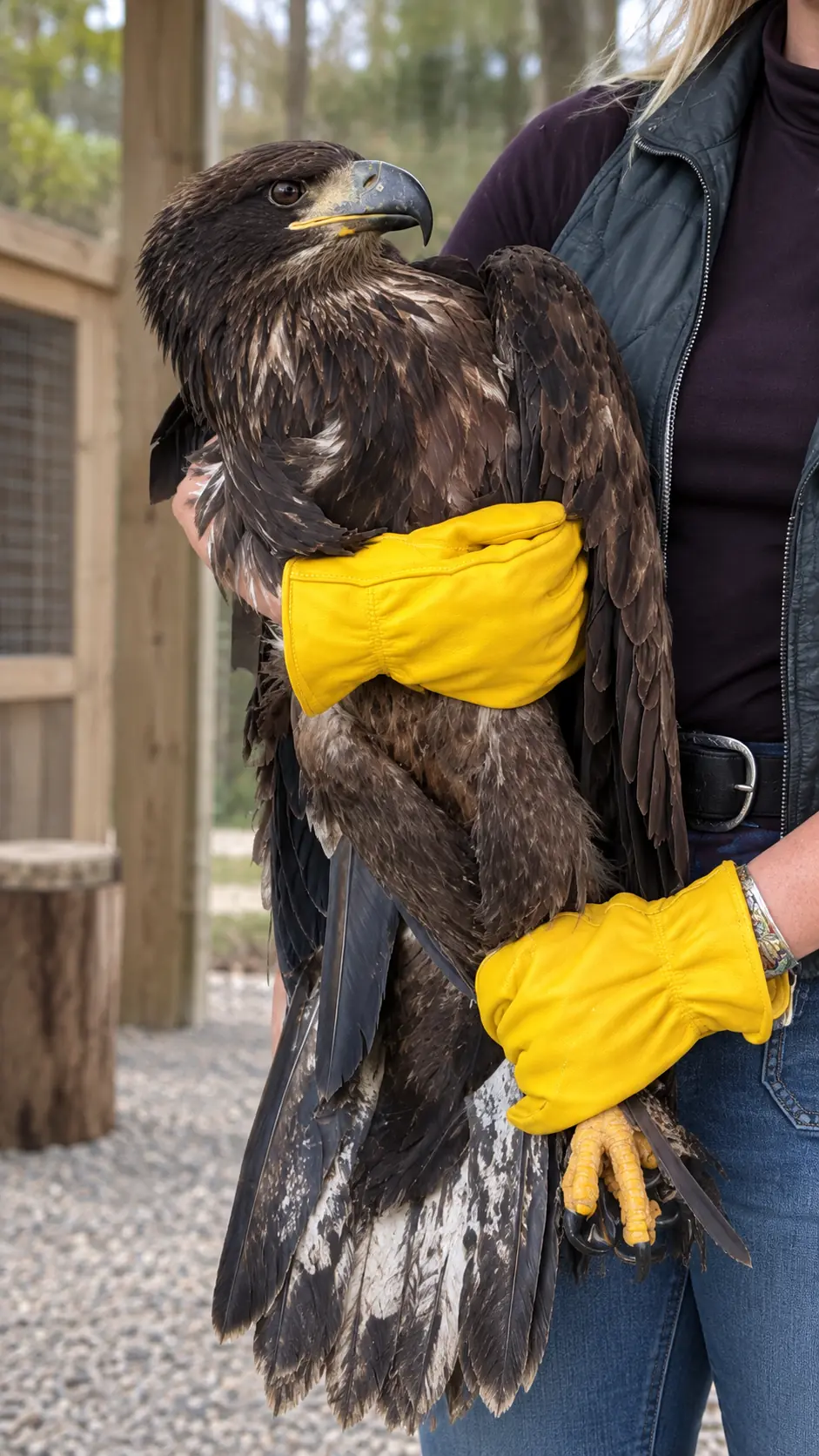
Bald Eagles were not unusual in the broader area. A nearby shoreline provided fish, carrion, and resting places, and both adult and immature eagles could occasionally be seen moving between trees and open water.
The young bird did not immediately look like an emergency.
It was upright.
Its eyes were open.
It watched the house whenever someone approached a window.
Parker kept her distance and expected that by morning, the eagle would be gone.
It wasn’t.
The next day, the bird was still there.
It had shifted only a short distance, moving from the fence line to a sheltered corner near several shrubs. Its feathers looked disordered. It spent long periods sitting low rather than perching high in the trees.
Most importantly, it still was not leaving.
By the third day, Parker knew something was wrong.
What she did not yet know was that several people near the shoreline had recently seen a young Bald Eagle being repeatedly driven away by larger birds.
The eagle in Parker’s backyard appeared to be the same one.
Wildlife responders would later determine that the juvenile was dehydrated, underweight, and carrying several wounds across its upper back and shoulder.
No one could prove that every injury had been caused by another eagle.
But the wounds were compatible with the kind of trauma that can occur during aggressive encounters between large raptors.
The backyard where the young bird had taken refuge may have kept it visible long enough for someone to realize that what looked like an unusual visitor was actually an exhausted wildlife patient running out of strength.
The eagle was later given the temporary rehabilitation name Scout.
Residents Had Seen a Young Eagle Being Chased Near the Shoreline
In the days before Scout appeared in Parker’s yard, several people in the area had noticed repeated aerial interactions involving an immature Bald Eagle and larger birds near a feeding and roosting area.
The younger eagle would approach.
One or more larger eagles would respond.
The juvenile would be forced away.
Such encounters are not unusual.
Bald Eagles can compete aggressively for food, preferred perches, roosting sites, and access to territory. Younger birds do not have the same social position or experience as established adults and may be displaced from productive areas.
That does not mean every chase becomes a serious fight.
Many encounters end without significant injury.
But aerial conflicts between large raptors can involve talons, high-speed pursuit, abrupt maneuvers, and falls.
For a young eagle already struggling to compete for food, repeated displacement can create another problem even when no major wound occurs:
energy loss.
A bird forced repeatedly from feeding opportunities may burn calories while gaining very little in return.
If it is also injured, the disadvantage becomes much greater.
Scout’s exact experience could never be reconstructed completely.
No one had followed the eagle continuously from the shoreline to Parker’s property.
But the timing and location made the reports relevant to the veterinary history.
The Backyard Became an Unusual Refuge
On the first day, Parker did what wildlife professionals generally hope residents will do when a wild raptor stops briefly on private property:
she left it alone.
She kept her dogs indoors.
She avoided walking directly toward the bird.
She watched from inside the house.
There was no reason to assume that every eagle sitting on the ground required intervention.
Young Bald Eagles may rest.
They may feed on the ground.
They may pause during poor weather.
They may spend time in places that look unusual to people.
The problem was persistence.
Scout remained in the yard far longer than expected.
The eagle moved, but only short distances.
It did not fly up to the larger trees.
It did not return toward the shoreline.
It spent increasing amounts of time low to the ground.
“A healthy wild eagle might stop in a yard,” Parker later recalled. “What worried me was that this one seemed to be making the yard its entire world.”
By the second day, she noticed damaged feathers over the upper back.
The bird also appeared thinner than she would have expected.
By the third day, Scout seemed more subdued.
Parker contacted a licensed wildlife rehabilitation organization.
The Eagle Still Had Enough Strength to Resist Rescue
A wildlife responder arrived later that day.
Scout was not motionless.
It remained alert.
When approached, the eagle attempted to move away.
The bird opened its wings and made a short escape effort, but it failed to gain meaningful altitude.
That behavior immediately changed the situation.
A Bald Eagle that can stand but cannot generate sustained flight may have an orthopedic injury, soft-tissue trauma, severe weakness, neurologic impairment, or several problems occurring at the same time.
The responder also noted areas of disturbed plumage across the upper back and shoulder.
Scout remained defensive.
Its feet were still powerful enough to require careful handling.
That was encouraging in one sense: the bird was not completely collapsed.
But wild raptors can remain defensive even when medically compromised.
The eagle was safely contained and transported to the fictional Great Lakes Raptor Rehabilitation Center.
The First Examination Showed That Scout Had Been Struggling for Some Time
At admission, veterinarian Dr. Megan Walsh began with a complete physical examination.
Scout was an immature Bald Eagle, estimated to be roughly two to three years old based on plumage characteristics.
The bird had not yet developed the fully white head and tail of a mature adult.
Its overall body condition was below ideal.
The breast muscles were reduced.
The bird was dehydrated.
The feathers were dirty and disorganized in several areas.
Across the upper back and shoulder region, the team found multiple superficial and deeper soft-tissue injuries.
Some were puncture-like.
Others were abrasions.
Several feathers had been broken or pulled away.
There was bruising beneath portions of the plumage.
No single wound was catastrophic.
Taken together, however, they told a larger story.
Scout had experienced enough trauma and stress to interfere with normal life.
“The injuries were compatible with an aggressive encounter involving another large raptor,” Walsh said. “But compatibility is not proof. We could not determine exactly when each wound occurred or say that every injury came from the same event.”
That distinction remained important throughout the case.
The team could document trauma.
They could not manufacture a certainty the evidence did not provide.
The First Good News Came From the X-Rays
Because Scout had been unable to fly normally, radiographs were obtained.
The veterinary team evaluated the wings, shoulder girdle, spine, and other areas of concern.
They were looking for fractures.
A broken humerus, radius, ulna, shoulder injury, or spinal trauma could drastically change the prognosis.
The films brought encouraging news.
No major fracture or dislocation was identified.
The primary wing bones were intact.
There was no obvious catastrophic injury to the shoulder.
The spinal structures visible on the study did not show a major acute fracture.
For Walsh, the results were important.
Scout had escaped without the kind of orthopedic injury that would require major surgical decision-making.
But the absence of broken bones did not mean the bird was healthy.
“The eagle had avoided a major fracture,” Walsh said. “But it had not escaped without a cost.”
That cost could be seen in its body condition, dehydration, wounds, and lack of flight strength.
Exhaustion Was Becoming as Important as the Wounds
Scout had likely been spending more energy than it was replacing.
A wild eagle must maintain a difficult balance.
Flying requires energy.
Competing for food requires energy.
Escaping larger birds requires energy.
Healing wounds requires energy.
Cold or wet weather increases energy requirements further.
If an eagle is injured and repeatedly displaced from food, the deficit can grow quickly.
Scout’s pectoral muscles were reduced.
These large breast muscles power flight.
Even without a fracture, a bird with insufficient muscle condition may not be capable of sustained takeoff or endurance.
That helped explain why Scout could open its wings but could not simply leave Parker’s backyard.
The wings were structurally intact.
The body behind them was depleted.
The First Phase of Treatment Was Quiet and Uneventful by Design
Scout was placed in a quiet enclosure.
The rehabilitation team did not immediately test flight.
There was no reason to ask an exhausted bird to demonstrate an ability it clearly did not have.
The wounds were cleaned and evaluated.
Pain management was provided as appropriate.
Staff monitored for infection, swelling, and tissue breakdown.
Hydration was corrected carefully.
Food was introduced in appropriate amounts.
The team also monitored droppings, posture, appetite, respiratory effort, and neurologic function.
The first few days were deliberately uneventful.
For a wildlife patient, that can be a good thing.
Scout needed calories more than excitement.
Sleep more than exercise.
Time more than stimulation.
Small Meals Began Rebuilding the Bird
The young eagle did not immediately eat a large meal.
That was not the goal.
A weakened wildlife patient needs nutrition, but feeding must be appropriate to its clinical condition.
Scout was offered food in controlled amounts and monitored.
The bird ate.
Not aggressively at first.
But enough.
Over the next several days, appetite became more consistent.
Scout began feeding independently.
That changed the trajectory of the case.
Food supplied the protein needed for tissue repair.
It supplied energy for immune function.
It provided the calories necessary to rebuild lost muscle.
The team tracked body weight carefully.
One measurement mattered less than the trend.
At first, the goal was simply to stop the decline.
Then the number stabilized.
After that, it began moving upward.
The Wounds Did Not Become Infected
The injuries over Scout’s back and shoulder were monitored daily.
The team watched for heat, swelling, discharge, odor, tissue deterioration, or other signs of infection.
The wounds remained stable.
Inflammation decreased.
Puncture-like areas began closing.
Bruising slowly faded.
Damaged feathers remained visible.
Some would not look normal again until future molt.
But feather appearance was less important than what was happening underneath.
The soft tissues were healing.
Scout also began preening.
That was one of the first behavioral signs that the bird was becoming less focused on simply surviving each hour.
“The First Major Change Wasn’t Flight”
Walsh remembered one early improvement clearly.
Scout began behaving more like a wild eagle.
It watched staff closely.
It moved away when someone entered the enclosure.
It became more defensive during necessary handling.
It started preening regularly.
Its posture changed.
“The first major change wasn’t flight,” Walsh said. “It was seeing the bird behave like an eagle again.”
That distinction mattered.
Flight would come later.
First, the animal needed enough strength and awareness to resume normal daily behaviors.
The rehabilitation team wanted Scout to dislike people.
They wanted the eagle to choose distance.
A young bird that became comfortable around humans during rehabilitation would face another problem after release.
Scout showed no sign of wanting that relationship.
That was good.
A Low Perch Came Before Any Flight Test
Once the wounds had progressed and Scout could stand reliably, the team introduced a low perch.
This simple step tested several functions at once.
Grip.
Balance.
Coordination.
Confidence.
Basic wing stabilization.
Scout stepped onto the perch.
Both feet closed around it.
The eagle maintained balance.
At first, the bird spent long periods resting there.
Later, it began moving between different positions inside the enclosure.
The low perch was eventually replaced or supplemented with higher options as strength improved.
Each movement required a little more work.
But the progression remained gradual.
The team was rebuilding an athlete that had arrived depleted.
Voluntary Wing Stretching Was the Next Important Milestone
One morning, staff observed Scout perform a full stretch.
One wing opened.
Then the other.
The movement was broad and symmetrical.
The bird folded both wings normally afterward.
No persistent droop developed.
No obvious pain response followed.
This was encouraging because voluntary motion reveals something that passive examination cannot.
The eagle was choosing to use the wings.
It was beginning to trust its own body again.
Over the next several days, Scout began making short hops.
It flapped between low positions.
The bird’s activity increased.
Still, these movements were not the same as sustained flight.
The rehabilitation team waited.
The Outdoor Aviary Changed Everything
When Scout’s wounds had healed sufficiently and body condition had improved, the eagle was moved to a larger outdoor flight enclosure.
The space allowed much greater movement while still providing a controlled environment.
Human contact was reduced.
Perches were placed at different heights.
Scout initially remained relatively low.
The young eagle watched the space.
Then it launched.
The first flight was not impressive.
Scout crossed only part of the enclosure before losing altitude.
The bird reached a lower perch and stopped.
There was no crash.
No obvious wing collapse.
But the flight lacked power.
For the rehabilitation team, this was not unexpected.
The X-rays had already shown that the bones were intact.
The problem was conditioning.
The wings were structurally sound. The muscles simply had not caught up yet.
A Weak First Flight Was Not a Failure
Wildlife rehabilitation is full of milestones that look disappointing if viewed without context.
A short flight after weeks of weakness can be progress.
A low perch can be progress.
One normal meal can be progress.
Scout had not flown strongly on the first attempt because it was not yet ready to fly strongly.
That was precisely why the bird remained in rehabilitation.