Animal Control Found Them in the Same Small Area They Had Been Using for Shelter
Ruth and Eli did not enter the shelter as strays with no known connection to anyone.
Animal control had been called to a temporary camping area after the family who had been staying there lost their housing and had to leave.
By the time officers arrived, most of the site had already been cleared.
Two dogs remained.
Ruth was an older hound with obvious difficulty rising and walking.
Eli was a younger mixed-breed dog, much thinner than he should have been.
They were found together in one of the few protected areas left at the site.
After several days of unstable weather, much of the ground was damp.
The dogs had positioned themselves in a small dry corner beneath partial cover.
Ruth was lying farther back.
Eli was curled near the outer edge.
We knew the basic circumstances that led to the family leaving the campsite, but we did not know every detail of what happened in the hours or days afterward.
We could not say exactly when the dogs had last seen their family.
We could not know whether anyone intended to return.
We could only document what animal control found.
Two dogs.
One dry corner.
And the younger dog lying between the older one and the exposed side of the shelter.
Ruth Could Stand, but Every Movement Cost Her Effort
When officers approached, Eli rose first.
He did not charge or bark aggressively.
He simply stood between the officers and Ruth.
His body was tense, but he remained responsive to calm voices and food tossed at a distance.
Ruth lifted her head but did not immediately stand.
That concerned the officers more than Eli's posture.
They slowed the approach.
One officer crouched sideways instead of facing Eli directly.
Another placed several small pieces of food on the ground and stepped back.
Eli investigated.
Ruth remained down.
After several minutes, Eli's posture softened enough for a slip lead to be placed without forcing contact.
Once he was secured, officers approached Ruth more carefully.
She tried to stand.
Her front end came up first.
Her hindquarters followed several seconds later.
Her rear legs were stiff, and she shifted her weight repeatedly before taking the first step.
She could walk.
But it was immediately clear that walking was painful and difficult.
The vehicle was brought as close as possible.
Ruth was supported with a sling under her abdomen for the short trip from the campsite to the transport crate.
Eli followed.
When Ruth stopped, he stopped.
When she entered the vehicle, he climbed in after her.
Their Intake Exams Confirmed Two Very Different Problems
Both dogs received veterinary examinations shortly after arrival.
Ruth's most urgent concern was mobility.
She was an older hound, and her gait reflected long-standing orthopedic disease rather than a new traumatic injury.
Her rear legs moved stiffly.
She had difficulty rising after rest.
Flexing several joints caused discomfort.
Her hips and knees were evaluated carefully, and her spine was palpated for areas of pain.
Radiographs were obtained because of the severity of her stiffness.
The imaging showed chronic degenerative changes consistent with significant osteoarthritis.
There was no evidence that she had sustained a fresh fracture at the campsite.
Her problem was chronic.
And it was advanced enough that unmanaged pain could significantly affect her quality of life.
Eli's physical examination told a different story.
He was young enough that severe age-related disease was unlikely to explain his condition.
He was simply far too thin.
His ribs and spine were prominent.
There was noticeable muscle loss, particularly over his hindquarters.
His coat was dull.
He was alert and interested in food, but his body condition suggested that his nutritional needs had not been met for some time.
That observation did not tell us why.
We did not assign blame or invent a cause.
The family's housing crisis, interrupted access to resources, stress, illness, or other circumstances could all have played a role.
Veterinary medicine needed facts, not assumptions.
Eli's Weight Loss Needed More Than a Bigger Bowl
A severely underweight dog should not automatically be given unrestricted food.
Eli underwent bloodwork to evaluate his overall health before his feeding plan was advanced.
A fecal sample was tested for intestinal parasites.
Urinalysis was included because his recent history was uncertain and the team wanted a broader picture of hydration and organ function.
Nothing in the initial testing suggested an immediate medical emergency.
There was no dramatic hidden diagnosis that explained everything.
That was actually useful.
It meant nutritional rehabilitation could become the main focus.
Eli was started on measured portions divided across several meals per day.
Staff monitored his appetite, stool quality, water intake, energy, and weight trend.
He ate quickly.
Very quickly.
That behavior made supervised feeding important.
He was not aggressive around his bowl, but once his portion disappeared, he searched for more.
Ruth ate much more slowly.
The two dogs therefore needed separate feeding areas.
Not because they were incompatible.
Because Ruth deserved to finish her meal without Eli investigating it.
Ruth's Treatment Focused on Comfort Before Exercise
The first goal for Ruth was not rehabilitation.
It was pain control.
Her veterinarian selected medication based on her examination and screening bloodwork, with a plan for continued monitoring because older dogs on long-term pain medication require follow-up.
She was given thick bedding.
Nonslip flooring was placed around her kennel.
Her water and food were kept within easy reach.
Bathroom trips were short.
Staff used a support sling when she seemed particularly stiff.
Nobody tried to "walk off" her arthritis.
That would not have been appropriate.
Once her pain was better controlled and she was moving more comfortably, we could begin thinking about gentle strengthening.
For the first days, rest mattered more.
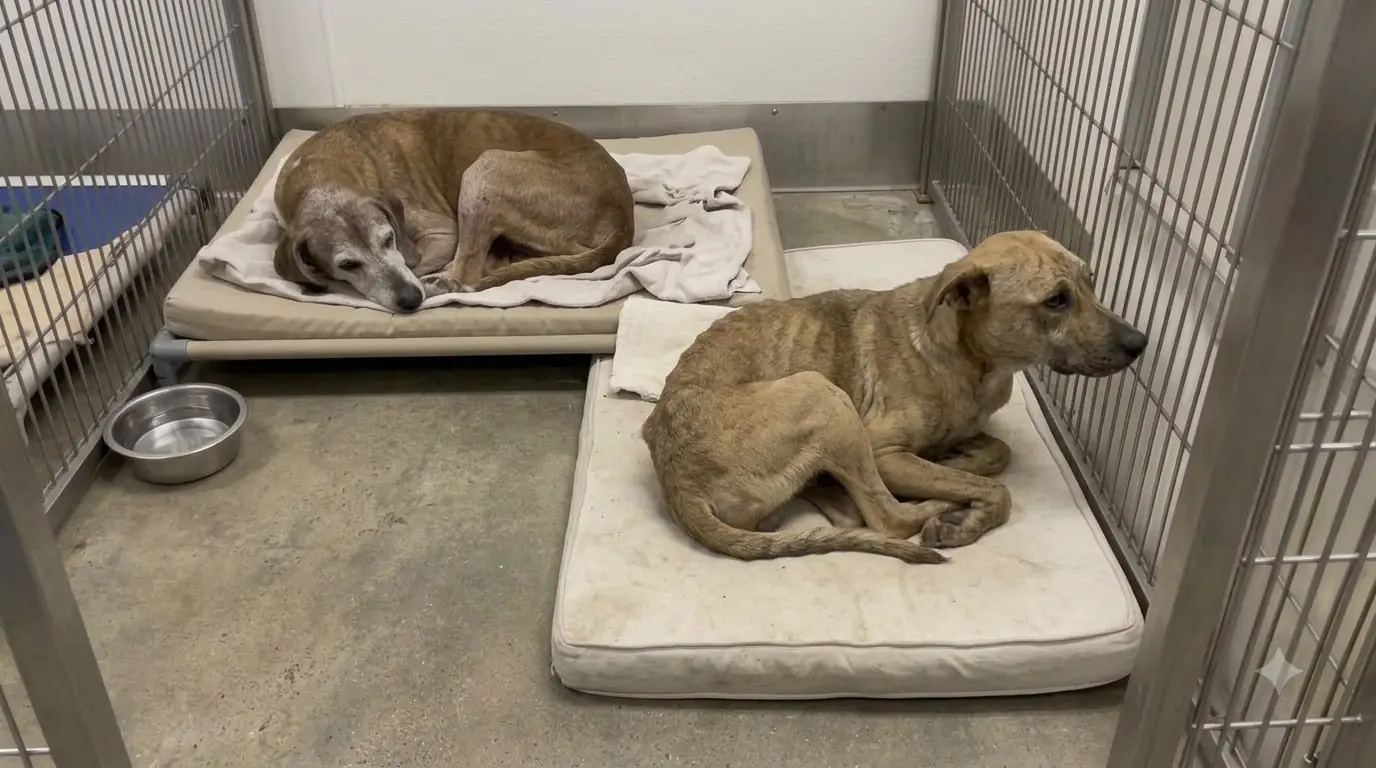
The Shelter Gave Them Two Beds
Because Ruth and Eli had arrived together and showed no concerning behavior toward one another, they were housed in the same quiet recovery area.
The kennel was larger than a standard temporary space.
Ruth was given a low orthopedic bed that she could step onto without lifting her legs high.
Eli received a separate padded mat.
The beds were intentionally placed apart.
We wanted each dog to have its own resting space.
The first evening, that arrangement lasted less than an hour.
A caregiver returned during the final nighttime check and found Eli's mat moved across the kennel.
It was lying on the floor directly beside Ruth's bed.
Eli was curled on it.
Not in the middle.
At the outside edge.
His body faced the open part of the kennel.
Ruth was behind him, closer to the wall.
The position looked familiar.
It Was Almost Exactly How Animal Control Had Found Them
The intake photos from the campsite showed the same basic arrangement.
Ruth had been lying in the protected corner.
Eli had been positioned near the exposed edge.
Now, in a dry, heated shelter kennel with clean bedding and locked doors, he had recreated it.
Nobody had placed him there.
Nobody had encouraged the behavior.
He had been given a separate bed.
He moved it.
Then he took the outside position again.
We could not know what Eli thought that position meant.
We could not state that he believed he was "guarding" Ruth in a human sense.
What we could say was that the arrangement repeated.
And it repeated again the next night.
Staff Stopped Moving His Bed Back
At first, caregivers reset the kennel after cleaning.
Ruth's bed went against the wall.
Eli's mat went several feet away.
Each night, Eli shifted it.
Sometimes he pushed it with his shoulders.
Sometimes he pawed and pulled the edge.
Sometimes he simply abandoned it and lay on the bare floor beside Ruth until staff moved the mat closer.
By the third night, we stopped placing it across the enclosure.
There was no medical reason to insist on separation.
So Eli's mat remained beside Ruth's bed.
That simple change made the space calmer.
Ruth did not have to maneuver around him.
Eli no longer spent time rearranging bedding.
And both dogs settled more quickly.
Ruth's Sleep Improved as Her Pain Was Managed
During the first nights, Ruth changed positions frequently.
Older dogs with severe arthritis often struggle to find a comfortable posture.
She would lie down.
Shift.
Lift her head.
Try to roll slightly.
Then reposition again.
As her medication began helping, those movements decreased.
She started sleeping for longer stretches.
Eli usually remained beside her.
Sometimes he curled tightly.
Sometimes he stretched along the outer edge of the mat.
If Ruth stood during the night to drink, Eli often woke.
He did not always follow her.
But he watched until she settled again.
Gradually, Ruth began choosing deeper sleep.
She stretched onto her side more often.
Her muscles appeared less tense.
Pain control was doing most of that work.
But the consistent environment seemed to help too.
Eli's Progress Could Be Seen in the Bowl Before It Could Be Seen on His Body
Weight gain takes time.
For the first week, Eli still looked dramatically underweight.
What changed sooner was his response to feeding.
At intake, he ate as if the bowl might vanish.
He swallowed rapidly.
He searched the floor afterward.
He watched caregivers carrying food.
Staff used measured portions and slow-feeding strategies where appropriate.
The amount increased only according to his veterinary plan and digestive tolerance.
Over several days, his stool remained stable.
His hydration improved.
His energy increased.
He began gaining weight gradually.
Not pounds overnight.
A steady upward trend.
That was exactly what we wanted.
Ruth Started Standing More Easily
Pain medication did not make Ruth young again.
It did make ordinary movement more comfortable.
Within the first week, staff noticed that she no longer needed multiple attempts every time she stood.
She still moved slowly.
Her rear legs remained stiff.
But she spent less time shifting weight before taking the first step.
That allowed short controlled walks to begin.
The goal was not distance.
The goal was maintaining muscle and mobility without triggering unnecessary soreness.
Some walks lasted only a few minutes.
Ruth was allowed to sniff.
She chose the pace.
If her gait became shorter or she appeared tired, the session ended.
Eli often waited near the kennel door when she returned.
We Began Giving Them Short Periods Apart
Their repeated sleeping arrangement made their bond obvious.
But we needed to understand whether either dog could tolerate being separated safely.
That mattered for veterinary care.
It mattered for foster planning.
And it mattered because maintaining a bond should not mean creating dependence.
Eli was taken out alone for brief enrichment sessions.
Ruth remained in the kennel.
At first, Ruth watched the doorway.
She did not bark continuously or panic.
She simply stayed alert.
When Eli returned, she lifted her head.
He approached her bed.
They sniffed.
Then both settled.
Eli was similarly able to remain calm when Ruth left for veterinary checks.
He paced briefly the first time.
Then lay down.
That told us something useful.
They strongly preferred each other's company.
But neither appeared incapable of functioning without the other for short periods.
Their Story Was Not About One Dog Saving the Other
It would have been easy to frame Eli as Ruth's protector and stop there.
That would have simplified two complicated dogs into one emotional image.
The reality was more interesting.
Ruth influenced Eli too.
When he became restless before meals, she often remained completely still.
When he returned from an enrichment session excited, he frequently slowed down after reaching her bed.
If Ruth stood to go outside, Eli oriented toward her.
Their relationship appeared reciprocal.
They were not medically dependent on each other.
They were behaviorally connected.
That difference mattered.
Ruth Had a Bad Morning During the Second Week
Recovery from severe arthritis is not linear.
One rainy morning, Ruth was much stiffer than she had been the day before.
She tried to stand and immediately lowered herself again.
Staff notified the veterinary team.
Her examination did not reveal a new injury.
Her joints were simply more uncomfortable.
Her activity was reduced.
She received her prescribed treatment and was allowed additional rest.
Eli remained beside the bed for most of the morning.
When lunch arrived, he stood immediately.
Ruth did not.
Eli ate his meal in his separate feeding area, returned, and lay beside her.
By afternoon, Ruth was moving somewhat better.
The next morning was easier.
That setback reinforced an important point for future placement.
Ruth would have good days and bad days.
A permanent home would need to understand that.
Foster Care Offered Something the Shelter Could Not
Once Eli's weight was improving reliably and Ruth's pain-management plan was stable, we began searching for a foster home that could accommodate them together.
The household needed several practical things.
Nonslip flooring.
Minimal stairs.
A low-entry bed for Ruth.
Separate feeding areas.
A caregiver willing to monitor Eli's weight without overfeeding him.
Enough patience for senior-dog mobility.
A foster family experienced with older dogs offered to take them.
Before the dogs arrived, runners were placed across slick flooring.
Ruth's bed was set near the living room wall.
Eli's mat was placed several feet away.
The family had heard the story about the campsite and shelter.
They were curious what he would do.
Eli Moved the Mat on the First Evening
It took less than one night.
After exploring the house, Eli ate dinner and wandered into the living room.
Ruth was already on her bed.
Eli circled his mat once.
Then he grabbed the edge with his mouth.
He pulled.
The mat folded.
He dropped it, repositioned himself, and dragged it farther.
His foster caregiver did not interfere.
Eventually the mat was beside Ruth.
Eli curled on the outer edge.
The orientation matched the shelter kennel.
Ruth was closer to the wall.
Eli was between her and the open room.
Again, nobody needed to assign motive.
The repeated behavior was enough.
Ruth Became More Mobile in the House
The foster home offered longer periods of controlled movement than the shelter environment could.
Ruth was never forced to exercise.
Instead, ordinary household activity became rehabilitation.
Standing to go outside.
Walking across a runner.
Turning through a doorway.
Moving between bed and water.
Short walks on level ground.
Her foster caregiver also followed the veterinary team's recommendations for gentle strengthening.
Over the following weeks, Ruth gained some muscle.
Her arthritis did not disappear.
She still needed medication.
She still rose slowly after long naps.
But her endurance improved.
She could spend more time outside sniffing without immediately needing to lie down.
She also began choosing a second bed during the day.
That was a small but meaningful change.
At the shelter, she almost always remained in the safest low bed.
In foster care, she began moving between resting areas.
Eli's Body Began Catching Up With His Energy
As his nutrition improved, Eli changed visibly.
His spine became less prominent.
His hips developed more muscle.
His coat improved.
His stamina increased.
But weight restoration was monitored carefully.
Once he approached a healthier condition, portions were adjusted.
The goal was not to keep increasing his weight simply because he had once been thin.
A lean, healthy condition would support his long-term mobility far better than overfeeding.
His food behavior also became less urgent.
He still loved meals.
He still arrived quickly when he heard a bowl.
But he stopped searching the entire kitchen afterward.
One afternoon, he finished eating and walked directly back to Ruth.
He did not inspect her feeding area.
His foster caregiver noted the change because it was the first time.
The Family Learned to Leave the Beds Alone
At first, the foster caregiver straightened Eli's mat every morning.
By evening, it was usually beside Ruth again.
Eventually they stopped resetting it.
Ruth's bed remained in a protected position against the wall.
Eli's mat stayed near the front edge.
Sometimes he slept there.
Sometimes he chose the couch-side rug.
Sometimes Ruth slept while he played elsewhere.
They did not maintain the arrangement every minute.
But at night, they usually returned to it.
That consistency mattered more because it was voluntary.
Their Known History Made the Story More Complicated, Not Less
Rescue stories are often told as simple narratives.
A dog was abandoned.
A dog was saved.
A dog found a new home.
Ruth and Eli's circumstances did not fit neatly into that structure.
Their family had lost housing.
They had been forced to leave a temporary campsite.
We did not have complete information about why the dogs remained there.
Housing instability can create devastating choices for people and animals alike.
Our role was not to construct villains.
It was to care for the dogs in front of us.
That meant acknowledging what was known.
Their family had experienced displacement.
Ruth and Eli were later found still at the campsite.
Ruth had significant untreated or inadequately controlled arthritis when she arrived.
Eli was severely underweight.
Those were facts.
Anything beyond them needed caution.
Adoption Planning Focused on Keeping Them Together
As the weeks passed, it became clear that Ruth and Eli were physically stable enough to begin permanent-home planning.
We considered their needs individually.
Ruth required ongoing arthritis treatment and regular veterinary monitoring.
Her future family would need to understand that medication might need adjustment over time.
She would need appropriate flooring, moderate exercise, weight management, and accommodations as her mobility changed with age.
Eli needed a stable feeding routine and continued monitoring to maintain healthy body condition.
He also needed ordinary young-dog training.
His earlier malnutrition did not mean he should be treated as fragile forever.
Behaviorally, we saw no reason to separate them.
They consistently chose proximity.
Their nightly resting pattern survived every environment.
The campsite.
The shelter.
The foster home.
So we listed them as a pair.
The Right Family Understood That Ruth Would Not Get Younger
A prospective family eventually spent time with both dogs.
They did not expect Ruth to become an athletic dog.
They watched her stand.
They walked with her at her pace.
They learned how her stiffness looked after rest.
They reviewed her medication schedule.
They discussed the possibility of future veterinary changes as arthritis progressed.
They also spent time with Eli separately.
He was affectionate and increasingly playful.
He still checked on Ruth frequently, but he could engage with people without remaining attached to her side.
The family understood that adopting two dogs at different life stages would require flexibility.
That was exactly what we were looking for.
Their Trial Placement Started With the Same Two Beds
When Ruth and Eli moved into the prospective home, their familiar bedding went with them.
The family positioned Ruth's low bed beside a living-room wall.
Eli's mat was placed nearby.
Not because we wanted to force the old arrangement.
Because familiar objects can make transitions easier.
Within the first night, Eli shifted the mat closer anyway.
He curled along its outer edge.
Ruth settled behind him.
New home.
Same basic configuration.
Something Changed Several Weeks Later
The family sent us an update one evening.
Ruth had gone to bed early.
Eli was still in the living room chewing a toy.
Normally, he would eventually carry himself back to Ruth's side.
That night, he fell asleep where he was.
Ruth remained alone in the bedroom.
She slept.
No pacing.
No repeated attempts to find him.
No distress.
Later, Eli woke, walked into the room, and lay beside her.
That moment was important because it showed the bond changing with security.
Neither dog needed to maintain constant contact to feel safe.
They could choose proximity instead of depending on it.
Ruth Began Using More of the House
Months earlier, at the campsite, Ruth's world had narrowed to one protected corner.
At the shelter, it had expanded to a medical kennel.
In foster care, it became several rooms.
In her new home, the family gradually gave her access to more space.
She learned where the rugs were.
She knew which doorway led outside.
She had a bed in the living room and another in the bedroom.
On good mornings, she walked from one to the other without assistance.
On stiff mornings, she moved more slowly.
The family adjusted.
Her world did not need to be large to be good.
It needed to be comfortable and predictable.
Eli Stopped Sleeping at the Outer Edge Every Night
One of the most subtle changes came later.
The family noticed that Eli no longer always took the outside position.
Sometimes he slept beside Ruth.
Sometimes near her feet.
Sometimes on his own bed across the room.
One night, he climbed onto his mat and curled against the wall while Ruth slept closer to the doorway.
The pattern that had once been nearly fixed was loosening.
We could not say why.
But the timing made sense.
There were locked doors now.
Dry floors.
Predictable meals.
People who returned every evening.
No exposed campsite.
No shelter hallway.
Maybe there was simply less reason for either dog to choose the same exact arrangement.
The Image From the Campground Still Matters
The photograph animal control took when Ruth and Eli were found remains one of the clearest records of their arrival.
Ruth is lying in the only dry protected corner.
Eli is curled at the outer edge.
His body is between hers and the open side.
It is tempting to tell that image as if we know exactly what it means.
We do not.
What we know is that the position repeated.
In the shelter, despite two separate beds, Eli moved his mat beside Ruth and lay at the outside edge again.
He repeated it in foster care.
He repeated it in the new home.
For a long time, it seemed to be the arrangement that made sense to him.
Their Recovery Was Mostly Ordinary Work
There was no single rescue procedure that transformed Ruth and Eli.
Ruth's improvement came from pain management, appropriate diagnostics, nonslip footing, controlled movement, weight management, rest, and patient observation.
Eli's recovery came from veterinary screening, measured nutrition, supervised meals, gradual weight restoration, and time.
Neither dog needed a dramatic surgery.
Neither experienced a miracle cure.
Their progress was built from routine.
Meals.
Medication.
Short walks.
Clean beds.
Follow-up examinations.
Predictable nights.
That is often what real rescue work looks like.
The Dry Corner Became Two Beds in a Quiet House
Ruth is still an old hound with significant arthritis.
She still rises slowly.
She still has days when her legs need more time.
Her family watches her comfort closely and keeps her veterinary team updated.
Eli is no longer severely underweight.
His meals are measured for maintenance now rather than recovery.
He has enough energy for play, training, walks, and the occasional burst through the yard.
They remain together.
Most nights, Ruth goes to bed first.
Eli follows eventually.
His mat is still close.
But he does not always lie at the outer edge anymore.
Sometimes he stretches on his back.
Sometimes he sleeps several feet away.
Sometimes Ruth chooses the more open position.
The arrangement no longer seems fixed.
That may be the quietest sign of progress we could have asked for.
When animal control found them, Ruth and Eli had reduced their world to the only dry corner they could find.
At the shelter, Eli recreated that corner beside her bed.
Now there are dry rooms everywhere.
There is food coming again tomorrow.
There are people coming home.
And two dogs who no longer have to fit themselves into one protected space just to make it through the night.