The manager noticed the hat first.
It was impossible not to.
The enormous white brim seemed to float beneath the warm champagne lights of the Beverly Hills jewelry boutique, casting a soft shadow over the face of the Black woman standing at the central glass display.
Everything about the woman suggested deliberate elegance.
Her sculptural white evening dress had been cut with architectural precision, fitted closely through her waist before opening into clean dramatic lines. A white fur coat rested over her shoulders without being fully worn, as though the February afternoon outside had been only a brief inconvenience between a chauffeured car and the boutique entrance.
Diamonds flashed at both wrists.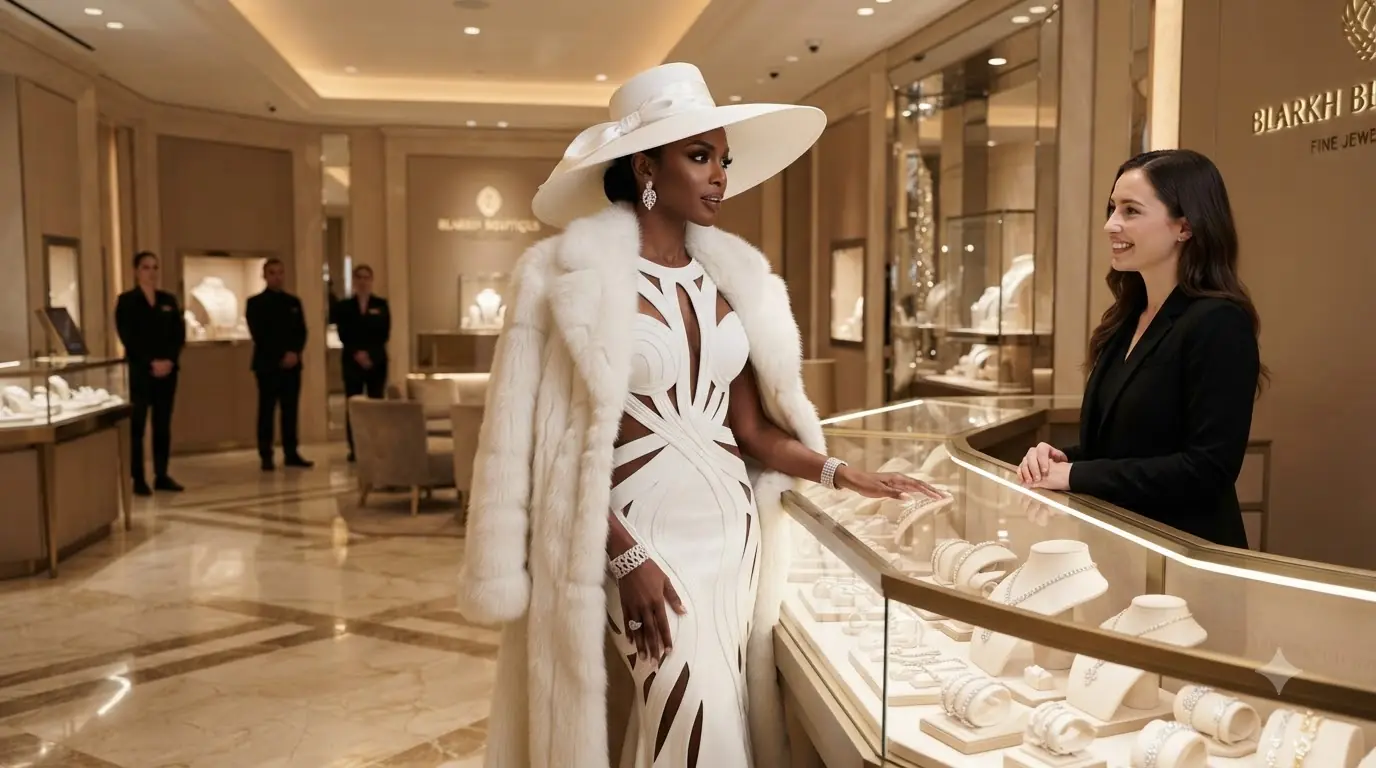
Another small stone rested against one ear.
Her skin was deep brown and luminous beneath the lights.
She carried no shopping bags.
No assistant followed her.
No visible security detail waited at the door.
And that, more than anything else, was what the store manager noticed.
The manager stood behind the main counter in a perfectly tailored navy suit, white silk blouse, navy heels, and pearl earrings. Her blonde hair had been pulled into a severe bun that had not moved since eight that morning.
For twenty-two years, she had worked inside luxury retail.
For fourteen of those years, she had managed this particular boutique.
She believed she could identify purchasing power before a customer even reached the counter.
Shoes mattered.
Watch mattered.
Bag mattered.
Whether someone walked quickly or slowly mattered.
Whether a driver waited outside mattered.
Whether an assistant accompanied them mattered.
The manager had built an entire career on reading those signals.
She told herself it was sophistication.
Experience.
Client qualification.
Efficiency.
Never prejudice.
Never assumption.
Certainly never discrimination.
Those were words used by people who did not understand how expensive merchandise had to be protected.
At least, that was what she told herself.
The Black woman had been inside for exactly four minutes when the manager decided she was not a serious buyer.
The woman had stopped first beside a display of estate pieces from the 1920s.
Then she examined a sapphire bracelet without asking the price.
Then she crossed to the private collection counter where the boutique’s most valuable necklace lay beneath museum glass.
That was where the manager finally approached.
“Good afternoon.”
The woman looked up.
“Good afternoon.”
Her voice was calm.
Low.
Controlled.
The manager offered the polished smile she had practiced for thousands of customers.
“Are we looking for something special today?”
The woman looked back at the necklace.
It was an extraordinary piece.
Forty-three diamonds graduated around a platinum setting, with a rare blue diamond resting at the center like frozen light.
The asking price was just under six million dollars.
The woman tilted her head slightly.
“I’d like to see that necklace.”
The manager’s smile changed by perhaps half a degree.
Most people would never have noticed.
The woman did.
“Of course,” the manager said.
But she did not reach for the key.
Instead she looked toward the woman’s hands.
No handbag rested on the counter.
No visible credit card.
No appointment card.
Nothing connected her to one of the private-client profiles stored inside the boutique’s system.
“Do you have an appointment with one of our private jewelers?”
“No.”
“I see.”
The manager paused.
“Our private collection is normally shown by appointment.”
The woman continued looking at the necklace.
“Normally?”
“Yes.”
“Meaning not always.”
The manager’s smile tightened.
“For established clients, we can sometimes make exceptions.”
The woman turned toward her.
“And how does someone become established?”
The manager felt something she disliked immediately.
The woman was not embarrassed.
She was not apologizing for entering without an appointment.
She was not trying to impress anyone.
She was simply asking questions.
“Purchase history,” the manager answered.
“References. Existing relationships with the house.”
The woman nodded once.
“Then today can be the beginning of mine.”
The manager nearly laughed.
Instead she placed both hands lightly against the edge of the glass.
“Perhaps.”
The Black woman looked directly at her.
“May I see the necklace?”
Another customer entered near the front.
The manager glanced toward the door.