The first thing Victoria Sinclair noticed about the man at the corner table was that he had left the chair opposite him empty.
Every other chair in the café seemed to belong to someone.
Young professionals hunched over laptops. Two nurses in navy scrubs shared a slice of cheesecake near the front window. A gray-haired couple occupied a table meant for four and appeared completely indifferent to the crowd forming around them. Near the espresso bar, three university students had spread books, chargers, notebooks, and enough loose paper across two tables to establish territorial sovereignty.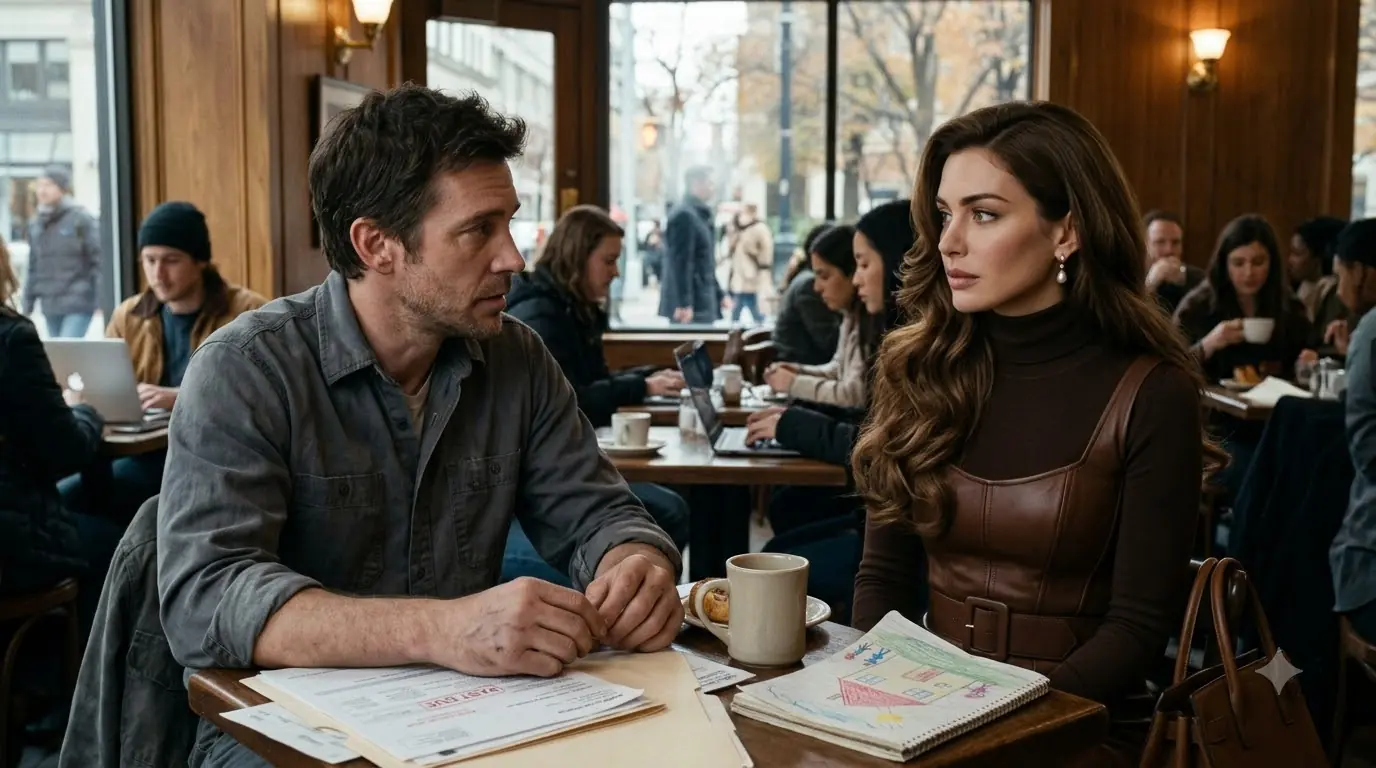
Outside, November rain swept through downtown Chicago in silver sheets.
Victoria stood just inside the café entrance with one hand around the handle of her structured brown leather handbag and the other still holding the door behind her.
The room was warm.
Too warm after the wind outside.
Her thick chocolate-brown hair had been arranged that morning in glossy waves, but moisture had loosened several strands around her face. She wore a fitted dark-brown turtleneck beneath an elegant leather bodice and a long structured brown skirt, an outfit her executive assistant had selected because Victoria had been scheduled to appear at a luncheon where photographs were inevitable.
The luncheon had ended two hours ago.
The photographs were finished.
The arguments were not.
For the first time that day, nobody in the room appeared to know who she was.
Victoria liked that more than she expected.
She scanned the café again.
Still no chair.
Then she saw the man beside the window.
Late thirties.
Dark-brown hair that looked as though he had run his hands through it too many times.
Light stubble.
Gray work shirt rolled to the forearms.
Hands marked with the faint grease stains that survived ordinary soap.
A thick folder sat open in front of him.
So did a coffee that appeared to have gone cold.
A small piece of paper covered in a child’s crayon drawing protruded from beneath his notebook.
He was reading what looked like an overdue utility notice.
The empty chair across from him held nothing.
No coat.
No bag.
No invisible claim.
Victoria almost left.
There were other cafés.
Other buildings.
A car waiting less than a block away.
A penthouse apartment large enough to contain entire rooms nobody used.
But the thought of going back to the car meant going back to her assistant.
Her assistant meant phone calls.
Phone calls meant the foundation board.
The board meant another discussion about “strategic philanthropy,” “measurable impact,” and “brand-aligned allocation.”
Victoria had spent the afternoon listening to people explain compassion with presentation slides.
She could not do another minute of it.
So she crossed the room.
The man noticed her only when she stopped beside the chair.
His eyes lifted.
Blue-gray.
Tired.
Kind, she thought immediately.
Then hated herself for deciding something so quickly from a face.
She touched the back of the chair.
“Can I sit with you?”
The man looked toward the crowded room.
Then at the empty chair as though he had forgotten it existed.
“Of course.”
He immediately began gathering the papers spread across his side of the table.
“You don’t need to move everything.”
“I absolutely do. Half of this is paperwork pretending to be important.”
Victoria smiled faintly.
He pulled the chair out.
Not dramatically.
Not with the exaggerated manners of men who wanted to make sure a woman noticed their manners.
He simply made room.
Victoria sat.
“Thank you.”
“No problem.”
He pushed his folder farther toward his side and looked toward the coffee line.
“You already order?”
“No.”
“Line’s worse than airport security.”
“I noticed.”
He started to stand.
Victoria looked up.
“What are you doing?”
“Getting you coffee.”
“You don’t know what I drink.”
“Then this plan has weaknesses.”
For the first time since noon, Victoria laughed.
It surprised both of them.
The man smiled.
“There. Better.”
“What?”
“You looked like somebody had just fired the entire accounting department.”
Victoria’s smile disappeared.
Not because he had offended her.
Because it was uncomfortably close to her afternoon.
“Something like that.”
He sat again.
“You want coffee?”
“I can get it.”
“So can I.”
“You were here first.”
“That doesn’t make coffee territorial.”
Victoria studied him.
“You do this with strangers often?”
“Argue about beverages?”
“Help them.”
He shrugged.
“You asked for a chair.”
“That hardly qualifies.”
“Good. Then I’m not in danger of becoming heroic.”
A barista called a name.
The man stood.
“I’m going anyway. What do you want?”
Victoria almost refused again.
Instead: