It was its color.
Pastel blue plastic covered the handle. Transparent magenta panels glittered beneath the bright Georgia sunlight. A white plastic nozzle protruded from the front, and a tiny molded star decorated one side.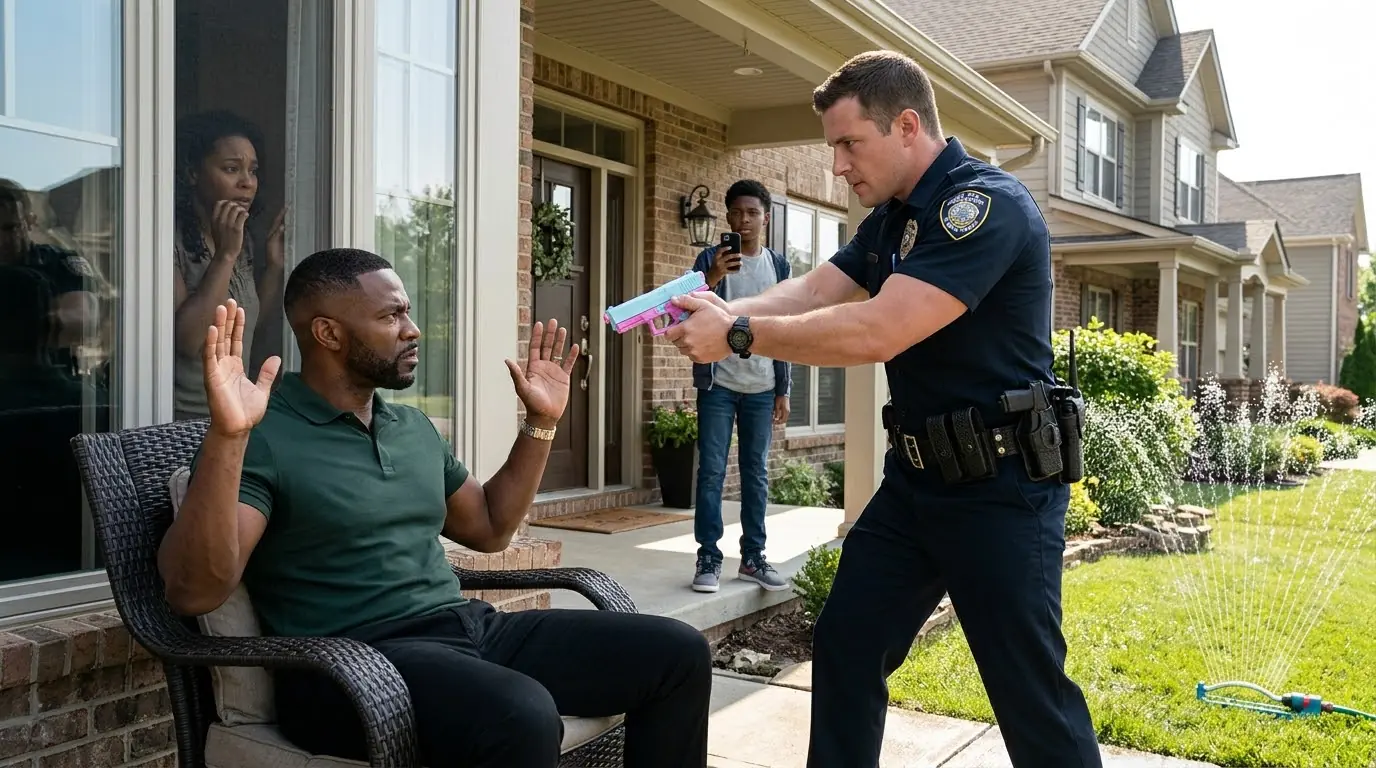
It was the sort of toy a seven-year-old girl might carry around the backyard while pretending to be a space explorer.
Marcus knew that particular toy better than almost anything else on his front porch.
He had bought it for his daughter three weeks earlier.
She called it her Rainbow Blaster.
And now a uniformed police officer was pointing it directly at his chest as though it were evidence of a serious crime.
"Hands where I can see them!"
Officer Derek Mason's voice cracked across the peaceful Sunday morning.
Marcus sat motionless in a cushioned patio chair outside his upscale suburban home in Maple Grove, Georgia. He was forty-six years old, broad-shouldered, with deep-brown skin, closely faded black hair, and a neatly trimmed beard beginning to show a few threads of gray.
He wore a fitted forest-green polo shirt, black trousers, and a stainless-steel wristwatch.
A folded newspaper rested across his lap. Beside him sat a white ceramic mug filled with coffee that had barely begun cooling.
The sprinkler system clicked rhythmically across the front lawn.
Birds moved through the trees.
A delivery van rolled quietly past the neighboring houses.
Everything about the neighborhood was ordinary.
Everything except the white police officer standing six feet away with a child's plastic toy aimed at a Black homeowner who had been doing absolutely nothing more threatening than reading the morning news.
"Officer," Marcus said carefully, raising both hands, "that belongs to my daughter."
Derek tightened his grip on the toy.
"I didn't ask who it belongs to."
"Then perhaps you should."
"Watch your mouth."
Marcus kept his hands visible.
"You're pointing a plastic toy at me on my own property."
Derek took another step forward.
"A neighbor reported an armed suspect."
Marcus looked at the toy.
"Armed with that?"
"Don't get smart."
The officer shifted his stance. His real service pistol remained secured in the holster on his right hip, but his left hand drifted toward his duty belt as his face reddened.
Marcus recognized the movement.
He had spent years as a federal prosecutor examining body-camera recordings, police reports, witness statements, and use-of-force investigations.
He knew how quickly an unreasonable encounter could become dangerous when an officer became more concerned about controlling the conversation than understanding the facts.
He lowered his voice.
"I'm not resisting you. My hands are visible. I live here. My identification is inside the house."
Derek glanced toward the expensive front door.
"Of course you live here."
The sarcasm was unmistakable.
Marcus stared at him.
"What's that supposed to mean?"
The officer sneered.
"Means I've heard that story before."
Marcus felt a familiar, unwelcome pressure settle behind his ribs.
He had heard variations of that sentence throughout his adult life.
At university.
In courthouse corridors.
Outside expensive restaurants.
In neighborhoods where people occasionally treated his presence as something requiring an explanation.
But he had never expected to hear it while sitting outside the home he owned, on a street where he had lived for eleven years.
"My name is Marcus Williams," he said.
Derek rolled his eyes.
"Congratulations."
"I'd like your name and badge number."
The officer smiled coldly.
"You can get those at the station."
Marcus glanced at the badge.
"Derek Mason."
The smile disappeared.
"What did you say?"
"That's your name, correct?"
Derek stiffened.
"How do you know my name?"
Marcus looked at the badge again.
"You're wearing it."
For half a second, the officer seemed embarrassed.
Then his embarrassment became anger.
"Stand up."
Marcus remained still.
"I'd rather not make any sudden movements while you're behaving this way."
"I said stand up!"
Marcus glanced toward the police cruiser parked along the curb.
Its emergency lights flashed silently.
There were no other police vehicles.
No ambulance.
No frightened neighbors running from houses.
No apparent emergency.
Only an officer who had arrived after a suspicious-person complaint and immediately decided the Black man seated on the porch was the person he had been sent to confront.
"Officer, tell me exactly what you believe I've done."
Derek looked toward the newspaper.
Then the coffee.
Then the colorful plastic toy in his hand.
"You were watching houses."
Marcus blinked.
"From my porch?"
"Someone called it in."
"I've been sitting here drinking coffee."
"You're making this harder than it needs to be."
Marcus lifted his eyebrows.
"How?"
Derek stepped forward abruptly.
His boot struck the front leg of the patio chair.
The metal scraped against the concrete.
Marcus grabbed the armrest instinctively to keep his balance.
"Hands up!" Derek shouted.
Marcus immediately raised them again.
"Don't kick my chair."
"Then do what you're told!"
The officer shoved Marcus's shoulder with his free hand.
The chair rocked backward.
Coffee sloshed from the mug and spilled across the newspaper.
Marcus caught himself against the armrest.
For one brief moment, anger nearly overwhelmed his judgment.
He wanted to stand.
He wanted to tell Derek exactly how foolish he was behaving.
He wanted to demand that the officer leave his property.
But he saw Derek's hand settle closer to the holster.
So Marcus stayed seated.
He raised his hands again.
And he spoke in the calmest voice he could manage.
"Officer, I am not threatening you. Stop putting your hands on me."
Derek's jaw tightened.
"You think you can tell me what to do?"
"No. I think you can choose to stop escalating this."
"Wrong answer."
The officer snatched the newspaper from Marcus's lap and threw it onto the lawn.
Several wet pages opened across the grass.
Then he jabbed the colorful toy toward Marcus again.
"This is evidence."
Marcus stared at it.
"Evidence of what?"
"An armed disturbance."
Marcus almost laughed from disbelief.
Instead, he took a breath.
"That's a blue-and-pink plastic water toy."
Derek's eyes narrowed.
"Replica weapons are dangerous."
"Then stop pointing it at people."
The officer's expression changed.
For a moment, Marcus wondered whether Derek might actually understand how ridiculous the situation had become.
But the officer's response was worse.
He leaned forward.
"You're about one second away from being dragged off that chair."
Behind Marcus, a floorboard creaked.
He turned his head slightly.
A teenage boy stood near the porch railing, holding a smartphone.
The boy's name was Evan. He lived two houses down and occasionally helped Marcus carry gardening supplies or wash the family vehicles.
He was sixteen years old, thin, with brown hair and a gray T-shirt.
His face was pale.
He was recording.
Derek saw him.
"Put that phone away!"
Evan flinched.
Marcus spoke immediately.
"He's standing on private property. Leave him alone."
The officer turned back.
"You're giving me orders again?"
"I'm asking you not to threaten a teenager."
Derek moved toward the boy.
Marcus's voice sharpened.
"Officer. Look at me."
Derek stopped.
The change in Marcus's tone seemed to surprise him.
Marcus held both hands above his shoulders.
"I'm the person you're speaking to. The boy isn't involved."
Derek stared.
Then he turned toward the teenager.
"Keep recording and I'll take that phone."
Evan lowered it slightly.
But he didn't stop.
Across the porch, behind a tall window framed by white curtains, Marcus's wife stood watching.
Her name was Renee.
She was forty-three, a pediatric physical therapist who had spent most of her career helping children recover from serious injuries.
She had seen frightened families.
She had managed medical emergencies.
She was not easily intimidated.
Yet now her right hand covered her mouth.
With her left, she was dialing a telephone number.
Marcus saw her.
For the first time that morning, genuine fear entered his expression.
Because his daughter was inside.
And the man standing in front of him was growing more unpredictable by the second.
Derek followed Marcus's gaze toward the window.
"Who's that?"
"My wife."
"Tell her to stay inside."
"She's inside."
"Then tell her to stop watching me."
Marcus looked back.
"Officer, this is our house."
Derek's grip tightened.
He stepped so close that the colorful plastic muzzle nearly touched Marcus's shirt.
"You think owning a fancy house makes you special?"
Marcus stared directly into his eyes.
"No."
"Then why are you acting like you're above the law?"
"I'm not."
Derek leaned closer.
"Then stand up."
Marcus took a slow breath.
He looked toward the police cruiser.
Then at the officer's badge.
And finally at the boy recording from the porch.
"Officer Mason," Marcus said quietly, "you should have read your morning briefing."
Derek blinked.
"What?"
"The one sent to every patrol supervisor at six-thirty."
The officer stared.
Marcus continued.
"My appointment was announced this morning."
Derek's expression tightened.
"What appointment?"
Marcus lowered his voice.
"The city's new Director of Civilian Police Oversight."
For the first time, Derek stopped moving.
Marcus held his gaze.
"That's me."
The officer looked at him.
Then laughed.
It was a short, nervous laugh.
"You're lying."
Marcus didn't answer.
"You're telling me you're that Marcus Williams?"
"Yes."
"The former federal prosecutor?"
"Yes."
Derek swallowed.
The officer had seen the name before.
He remembered an email.
A departmental notice.
A photograph attached to a briefing circulated at the beginning of the shift.
But he'd barely looked at it.
He'd been irritated by the announcement that civilian investigators would be reviewing unresolved complaints and officer conduct records.
He remembered joking with another patrolman that the department had hired another outsider to tell police officers how to do their jobs.
And now that outsider was sitting in front of him with both hands raised.
The toy gun suddenly felt absurd in Derek's grip.
But fear did not make him sensible.
It made him defensive.
"Anybody can claim to be somebody important."
Marcus nodded.
"That's true."
"So I don't have to believe you."
"No."
"Then stop pretending."
Marcus looked toward the street.
"Verify it."
Derek hesitated.
Before he could answer, the low rumble of approaching engines broke the silence.
A black SUV turned onto Maple Grove Drive.
Then another.
Two additional vehicles followed at a distance.
They moved past the neighboring houses and stopped near Marcus's driveway.
Derek stepped backward.
The driver's door of the first SUV opened.
A woman in a navy business suit emerged.
She carried a slim leather folder and wore an identification badge clipped inside her jacket.
Two men stepped out of the second vehicle.
A third person remained near the curb, speaking into a phone.
The woman approached the porch quickly.
"Officer Mason!"
Derek turned.
"Ma'am, stay back."
She stopped at the walkway.
"Put that toy down and move away from the homeowner."
Derek looked toward Marcus.
Then back at her.
"Who are you?"
"Deputy Director of the City Inspector General's Office."
Derek's face went pale.
The woman looked at Marcus.
"Director Williams, are you injured?"
"I'm all right."
"Has the officer detained you?"
"He's threatened to."
She turned back toward Derek.
"Officer, secure that object safely and keep your hands away from your firearm."
The officer slowly lowered the colorful toy.
His breathing had changed.
He looked from the woman to the vehicles.
Then toward Marcus.
"Sir, I was responding to a complaint."
The woman studied him.
"I understand."
Derek relaxed slightly.
Then she asked one question.
"Who specifically told you to come to this address?"
The officer blinked.
"Dispatch."
She opened her folder.
"Dispatch sent you to investigate an armed suspect?"
"Yes."
She glanced toward Marcus.
Then back to Derek.
"What address did they give you?"
The officer hesitated.
"Forty-eight seventeen Maple Grove Drive."
The woman looked at the folder.
Then she slowly raised her eyes.
"Officer, that's not the address in the original call."
Derek stopped breathing for a moment.
Marcus leaned forward.
"What?"
She turned toward him.
"Director, the complaint was redirected after dispatch received it."
A silence settled over the porch.
Derek looked toward his cruiser.
Marcus lowered his hands slightly.
The woman's next words came slowly.
"And the person who requested that redirection knew exactly who lived here."
For several seconds, nobody spoke.
The sprinkler continued spraying across the lawn.
A newspaper page fluttered against the flowerbed.
The tiny blue-and-pink toy hung from Derek's lowered hand.
And Marcus understood something that made the entire encounter far more disturbing than a reckless officer mistaking a homeowner for a suspicious stranger.
Someone inside the police department had wanted a patrol officer to arrive at his house.
Someone had supplied his address.
Someone had known his official appointment would begin the next morning.
And someone may have been counting on an angry confrontation before Marcus could even enter his new office.
The woman in the navy suit looked toward the teenage witness.
"Is that recording still running?"
Evan nodded.
"Yes, ma'am."
She looked at the phone.
Then toward the police cruiser.
"Good."
Derek swallowed.
"Why?"
Her answer was almost a whisper.
"Because someone is going to have to explain why you were sent here."
Marcus had spent nearly twenty years questioning people who believed the truth could be made to disappear if they spoke loudly enough.
He knew the signs.
A witness who answered too quickly.
A supervisor who explained what happened before anyone asked.
A person who became angry the instant a simple question threatened a carefully constructed story.
But he had never expected to study those signs while sitting on his own front porch with coffee drying across his trousers.
The woman in the navy suit was Deputy Director Anna Price, a former state investigator who had recently joined the city inspector general's office.
She and Marcus had been scheduled to meet that morning to prepare for the oversight program's first week.
The two other vehicles belonged to municipal investigators and administrative staff who had been traveling with her from a nearby briefing location. When Renee called to report the confrontation, Anna had diverted the group to the house and contacted the police department's operations desk to clarify the incident.
The preliminary information she'd received was troubling.
The original caller had reported a suspicious person near a vacant property several blocks away.
The location had later been changed in a supplemental dispatch entry.
There was no reliable explanation yet for the alteration.
Anna knew better than to draw conclusions from an incomplete log.
But she knew enough to preserve it.
She looked toward Derek.
"Officer, is your body camera operating?"
He hesitated.
"Yes."
"Good. Don't turn it off. Your supervisor is being contacted."
Derek looked toward Marcus.
"Sir, I can explain."
Marcus lowered his hands.
"Then begin by explaining why you kicked my chair."
Derek's mouth opened.
Nothing came out.
"Explain why you shoved me."
"Your movements were—"
"My hands were raised."
Derek swallowed.
Marcus continued.
"Explain why you threatened the boy who was recording."
"He was interfering."
Evan spoke from the porch railing.
"I didn't say anything."
Derek turned sharply.
"Stay out of this!"
Anna immediately stepped forward.
"Officer, do not address the witness that way."
Derek looked at her.
His expression shifted between frustration and fear.
Marcus could see the effort he was making to recover control of the situation.
The officer was accustomed to being the person asking questions.
Now everyone was asking questions of him.
He glanced toward his cruiser.
"Can I radio my supervisor?"
Anna nodded.
"You may contact your supervisor through the normal channel. The incident is already being reported."
Derek backed away toward the walkway.
The colorful toy remained in his left hand.
Anna pointed to it.
"Please place that object on the porch table before you move."
Derek hesitated.
Marcus spoke quietly.
"It's my daughter's property."
The officer looked down.
The little plastic gun seemed even smaller now.
Its pink panels glowed in the sunlight.
There was no metal barrel.
No realistic ammunition chamber.
No attempt to resemble an ordinary police firearm.
It looked exactly like what it was.
A child's water toy.
Derek placed it on the table beside the spilled coffee.
Then he walked toward the cruiser.
Marcus remained seated until the officer had moved several yards away.
Only then did he lower his hands completely.
He noticed they were trembling.
Anna noticed too.
"Marcus?"
He looked up.
"I'm fine."
She crouched beside him.
"That wasn't what I asked."
For a moment, he tried to smile.
Then the expression disappeared.
He looked toward the window.
Renee was still standing inside.
Their daughter had appeared beside her.
The child wore pink pajamas decorated with stars, and her hair was gathered into two fluffy ponytails.
She stared at the porch through the glass.
Marcus's heart tightened.
"She saw it."
Anna followed his gaze.
He stood slowly.
His knees felt strangely weak.
"I'm going inside."
Anna nodded.
"Of course."
He turned toward the teenager.
"Evan."
The boy looked up.
"Yes, sir?"
"Thank you for staying calm."
Evan swallowed.
"I thought he was going to hurt you."
Marcus paused.
The words struck him more deeply than he expected.
He placed a hand gently on the boy's shoulder.
"You did the right thing by keeping your distance and documenting what you saw."
Evan nodded.
Marcus continued.
"Your parents should know what happened. And investigators may need to speak with you, with their permission."
"Okay."
The boy looked toward Derek's cruiser.
"Is he going to take my phone?"
"No," Anna answered from behind them. "Your recording can be preserved properly, and nobody should pressure you to erase it."
Evan finally exhaled.
Then Marcus opened the front door.
His daughter ran toward him.
"Daddy!"
He dropped to one knee.
She threw her arms around his neck.
He held her tightly.
"Daddy, that police man took my blaster!"
Marcus closed his eyes.
"I know, baby."
"Did he think it was real?"
Marcus hesitated.
"I don't know what he thought."
She pulled back.
Her eyes were wide.
"Was he going to take you away?"
Marcus felt something painful tighten in his chest.
He could not promise that police officers never made mistakes.
He could not promise that people wearing uniforms would always behave fairly.
He could not give her the innocent reassurance he desperately wanted her to have.
So he answered carefully.
"He's not taking me away."
She looked over his shoulder.
"Mommy was scared."
Marcus glanced toward Renee.
She stood near the kitchen entrance with tears on her cheeks.
His daughter whispered, "I was scared too."
He held her again.
"I'm sorry you had to see that."
She pressed her face against his shoulder.
After a moment, she asked, "Can I have my toy back?"
Marcus almost laughed.
Then he nearly cried.
He kissed her forehead.
"Yes, sweetheart. We'll make sure you get it back."
Outside, Derek Mason sat in his patrol cruiser with both hands on the steering wheel.
He was no longer laughing.
Derek had joined the Asheford Police Department six years earlier.
He was thirty-two years old, physically fit, and proud of his reputation for aggressive enforcement.
His personnel record contained commendations for responding quickly to a serious traffic accident and helping locate a missing elderly resident.
It also contained several complaints.
Two involved rude or unnecessarily confrontational behavior during traffic stops.
Another concerned his handling of a teenage pedestrian who had been questioned outside a convenience store.
A fourth alleged that Derek had threatened arrest when a resident asked to record an encounter.
None had resulted in serious discipline.
Some complaints lacked sufficient evidence.
Others had been reviewed by supervisors who concluded the officer's actions fell within policy.
Derek interpreted those outcomes as proof that the complaints were ridiculous.
He rarely considered the possibility that an investigation might be incomplete.
During roll calls, he joked about people who knew their rights.
He disliked officers who spent too long explaining procedures.
He believed that hesitation encouraged defiance.
His patrol supervisor, Lieutenant Grant Weller, generally approved of his assertive style.
Weller was fifty-four, with a thick neck, silver-streaked hair, and a reputation for rewarding officers who produced high enforcement numbers.
He had spent nearly three decades in law enforcement.
Younger officers called him old-school.
Critics called him inflexible.
Weller called himself practical.
In his office, a framed photograph showed him accepting a departmental award fifteen years earlier. Beside it hung a certificate recognizing the unit for exceptional productivity.
To Weller, productivity meant arrests, citations, traffic stops, and visible enforcement.
He was less interested in how residents described their encounters.
When complaints arrived, he often asked whether the officer had technically violated policy.
If the answer wasn't clear, he closed the matter.
He had trained Derek.
He had recommended him for specialized assignments.
And several months earlier, he had helped Derek avoid formal discipline after a disputed traffic stop.
Derek respected him more than any other supervisor.
That Sunday morning, Derek had received a message from Weller shortly before beginning patrol.
Watch your assigned district. Dispatch may send you a priority suspicious-person call. Handle it firmly.
The message had not seemed unusual.
But after the incident on Marcus's porch, Derek read it differently.
He sat inside his cruiser and stared at the screen.
His radio crackled.
"Unit Twelve, supervisor responding. Maintain your location."
Derek lifted the microphone.
"Copy."
He looked toward the house.
Marcus stood behind the living room window, holding his daughter.
The sight made Derek uncomfortable.
For the first time, he realized how the encounter might look to anyone who watched the recording.
A Black father sitting on his porch.
A colorful toy.
A police officer kicking a chair.
A teenager filming.
And a child watching her father being threatened outside the family home.
He had not considered any of that when he arrived.
He had considered only the complaint.
And the way Marcus had questioned him.
Derek told himself he'd been following orders.
Then he remembered something Weller had once said.
If you let people talk, they'll control the encounter.
Derek had believed it.
He had repeated it.
Now he wondered whether he could explain it to investigators.
He opened the messaging application.
His thumb hovered over Weller's name.
Then he typed:
Supervisor, serious problem. Homeowner says he's the new oversight director.
The reply arrived less than a minute later.
Don't discuss anything with outsiders. Wait for department command.
Derek frowned.
Another message followed.
And don't mention my earlier text unless you're specifically required to.
He stared at the words.
For the first time that morning, suspicion began moving in a different direction.
Why would his lieutenant care whether investigators knew about an ordinary scheduling message?
Back inside the Williams home, Renee placed a glass of water in front of Marcus.
He sat at the kitchen island.
His daughter had gone upstairs with her grandmother, who arrived soon after Renee called.
The house was quiet now.
But Marcus still felt the confrontation in his body.
His shoulder ached where Derek had shoved him.
His forearms felt tense.
Every time a vehicle passed outside, he glanced toward the window.
Renee sat opposite him.
"You should get checked."
"I'm okay."
She gave him a look he'd known for twenty years.
"That's not the same as being okay."
Marcus sighed.
"I know."
She reached across the counter and took his hand.
"Do you understand what I saw?"
He looked at her.
"I saw a police officer threaten you with our daughter's toy. Then he put his hand on his actual gun."
Marcus lowered his eyes.
Renee continued.
"I wanted to run outside."
"I'm glad you didn't."
"I know."
Her voice broke.
"But I watched you sitting there with your hands up, and I didn't know whether he was going to hurt you."
Marcus squeezed her hand.
"I'm here."
She nodded.
Then looked toward the staircase.
"She keeps asking whether police officers can take parents away for owning toys."
Marcus closed his eyes.
For years, he'd spoken publicly about oversight, fairness, and community trust.
He'd testified before legislative committees.
He'd reviewed use-of-force policies.
He'd helped prosecute officials who abused their authority.
But he'd never felt so unprepared to answer a child's question.
Renee studied him.
"Don't turn this into a work problem just yet."
He looked up.
"What?"
"You're already thinking like an investigator."
He gave a tired smile.
"Occupational hazard."
"Marcus, you were frightened."
He looked away.
She continued.
"You don't have to pretend you weren't."
He stared at the counter.
After a long silence, he whispered, "I saw his hand moving toward his holster."
Renee's eyes filled.
Marcus swallowed.
"And I thought about our daughter watching from the window."
He pressed his lips together.
"I kept thinking, don't give him a reason. Don't move too quickly. Don't let your anger get bigger than your judgment."
Renee walked around the counter.
She wrapped her arms around him.
He leaned against her.
For a long time, neither spoke.
Then Marcus said something he had rarely admitted in public.
"I knew I wasn't doing anything wrong."
Renee held him tighter.
"And I still felt like I had to prove I deserved to be safe."
She kissed his forehead.
"You did deserve to be safe."
He closed his eyes.
"I know."
But knowing something intellectually was different from feeling it while another person held the power to turn an ordinary morning into a tragedy.
The first official account of the incident reached department headquarters at 10:41 a.m.
It was brief.
Officer Derek Mason had responded to a suspicious-person complaint. He had encountered an adult male outside a residence. A replica weapon was recovered, and a verbal confrontation occurred. There were no reported injuries or arrests.
The summary contained little detail.
It did not mention the chair being kicked.
It did not mention the shove.
It did not mention the threat toward the teenage witness.
It also did not explain why the officer had been sent to the wrong address.
By noon, a supervising captain had requested the full body-camera footage.
At 12:17 p.m., Anna Price called Marcus.
"I've got preliminary information."
He was sitting in his home office.
"Go ahead."
"The officer's original call was for a suspicious person near an unoccupied residence on Willow Creek Lane."
Marcus frowned.
"That's four blocks away."
"Correct."
"Was there an armed-person report?"
"The caller said they thought somebody might have been holding an object. No weapon was confirmed."
Marcus leaned back.
"Then why was the call upgraded?"
"That's what we're trying to establish."
He waited.
Anna continued.
"A supplemental entry changed the location to your address and described the person as potentially armed."
"Who entered it?"
"We don't have a verified answer yet."
"Was it dispatch?"
"The change appeared in the dispatch system, but we need the underlying records and operator statements before attributing it."
Marcus nodded.
"Good."
Anna paused.
"There's something else."
He stared at the wall.
"What?"
"The unit assignment was changed shortly before Officer Mason received it."
Marcus frowned.
"From whom?"
"Another patrol unit was closer."
"Why wasn't it sent?"
"The record lists supervisory reassignment."
He sat forward.
"Which supervisor?"
Anna hesitated.
"Marcus, we need to confirm that."
He closed his eyes.
"You're right."
"I know you're upset."
"That doesn't give me permission to jump ahead of the evidence."
There was silence.
Then Anna said, "That's why I wanted you to hear it directly."
Marcus looked toward his daughter's photograph on the desk.
"Anna, if somebody intentionally sent an officer to my house, we need to know whether the officer understood what he was doing."
"Agreed."
"And if he didn't, we need to know why the person directing him thought he'd respond the way he did."
Anna sighed.
"Agreed."
Marcus stared at the photograph.
His daughter wore a bright yellow dress and stood beside him at a school science fair.
She held a cardboard volcano in both hands.
The picture had been taken only two months earlier.
He remembered how excited she'd been when the project erupted with red foam.
Now he wondered whether she would look at police officers differently for the rest of her childhood.
He spoke quietly.
"Do it properly, Anna."
"We will."
"Don't protect me because I'm the director."
A pause.
"Marcus—"
"Protect the integrity of the investigation."
Anna's voice softened.
"That's the plan."
He ended the call.
Then he opened a notebook.
At the top of the page, he wrote three questions.
Who changed the address?
Who selected the officer?
Who expected the encounter to happen?
He stared at the words.
The original incident had lasted only minutes.
But its explanation might reach much further back.
The person who first noticed the irregular dispatch assignment wasn't a detective.
She was a twenty-nine-year-old civilian communications analyst named Claire Bennett.
Claire had worked at Asheford's emergency communications center for six years. She was quiet, precise, and known for noticing small inconsistencies in records that other people overlooked.
She had once discovered that a software update was incorrectly recording duplicate timestamps on certain ambulance dispatches.
Another time, she noticed a pattern of incomplete location data that helped the department identify a faulty mapping interface.
She wasn't interested in office politics.
She liked systems because systems left records.
People could forget what they said.
Computers could make mistakes.
But properly preserved records could show the sequence of events more clearly than anyone's memory.
That Sunday, Claire was reviewing the incident because a command supervisor had requested clarification about the location change.
She opened the call history.
The original complaint had arrived at 9:07 a.m.
A woman living near Willow Creek Lane reported seeing an unfamiliar man walking beside a vacant house.
She couldn't provide a detailed description.
She wasn't certain whether the man had entered the property.
She mentioned that he might have been holding something.
The dispatcher documented the uncertainty.
At 9:09, the call was entered as a routine suspicious-person complaint.
The closest available patrol unit was Unit Seven.
At 9:11, a supplemental note appeared.
The location changed.
The address became 4817 Maple Grove Drive.
The description became more specific.
A male subject was reportedly seated outside a residence, possibly armed, and watching nearby properties.
At 9:12, the unit assignment changed.
Unit Twelve was selected.
Officer Derek Mason.
Claire stared at the screen.
The timing was unusual.
She opened the audit record.
The supplemental note had been entered through a supervisory account rather than through the original dispatcher's workstation.
That alone wasn't proof of wrongdoing.
Supervisors could correct locations, reassign units, and update information when new details emerged.
But the system normally recorded a reason for significant changes.
Here, the explanation contained only three words.
Updated caller information.
Claire returned to the original call recording.
The caller had never mentioned Maple Grove Drive.
There was no second recorded conversation before the address changed.
She checked the supplemental contact history.
Nothing.
She checked whether another communications channel had supplied the update.
A supervisor-to-dispatch telephone entry appeared, but the attached details were incomplete.
Claire frowned.
She replayed the original complaint.
Then she checked the time again.
The location had changed two minutes after the initial report.
She printed the audit summary and carried it to the communications floor supervisor.
"I think we need to preserve this."
The supervisor looked at the paper.
"Why?"
"The address change doesn't match the caller's information."
He frowned.
"Could be a simple correction."
"Maybe. But the system shows a supervisory update, and I can't find the source."
The supervisor took the pages.
"Who accessed the record?"
Claire pointed.
"The account belongs to Lieutenant Weller."
The supervisor stared at the name.
Then toward the communications floor.
"Are you sure?"
"I'm sure that's the account recorded. I don't know who was physically using it."
He nodded slowly.
"That's an important distinction."
Claire agreed.
He looked at the pages again.
Then said, "Make an incident preservation request."
She returned to her workstation.
Within minutes, the relevant logs and associated communications were placed under an administrative preservation hold.
The action would later become crucial.
Because someone was already asking questions about whether the records could be corrected after the fact.
Lieutenant Grant Weller learned about the incident while standing in the kitchen of his suburban home.
He had been making lunch when his phone rang.
Derek Mason's name appeared.
Weller answered impatiently.
"What?"
"Lieutenant, we have a problem."
Weller listened as Derek described the confrontation.
The toy gun.
The homeowner.
The arriving investigator.
The oversight director's identity.
With every sentence, Weller's expression grew more rigid.
When Derek finished, there was a long silence.
Then Weller said, "Tell me exactly what you said to him."
Derek hesitated.
"Which part?"
"All of it."
Derek began explaining.
Weller interrupted twice.
He wanted to know whether Marcus had physically resisted.
Whether any arrest had occurred.
Whether Derek had activated his body camera.
Whether he had drawn his actual firearm.
And whether witnesses had recorded the encounter.
When Derek mentioned the teenager, Weller swore.
Then he lowered his voice.
"Listen carefully. Don't make any statements outside the formal process."
Derek sounded frightened.
"Lieutenant, did you know who lived at that house?"
Weller froze.
"What?"
"The homeowner says he's the new oversight director."
"I heard you."
"But you told me to watch for that call."
Weller gripped the counter.
"I told you to do your job."
"Why was I assigned there?"
"Because dispatch assigned you."
Derek hesitated.
"They said the address was changed by a supervisor."
Weller's eyes narrowed.
"Who told you that?"
"The woman from the inspector general's office."
Weller looked toward the kitchen window.
His wife was gardening outside.
A dog barked somewhere down the street.
Ordinary suburban sounds continued while Weller considered how much Derek might discover.
He spoke carefully.
"Don't speculate."
Derek went quiet.
Weller continued.
"Follow the department's reporting requirements and speak with the appropriate investigator or representative."
Then he ended the call.
For nearly a minute, he stood motionless.
Finally, he called another number.
A man answered.
"What?"
"We have a situation."
"How bad?"
"The patrol officer confronted Williams."
A pause.
"At the residence?"
"Yes."
"Was Williams arrested?"
"No."
The other man exhaled sharply.
"Then what happened?"
Weller rubbed his forehead.
"The officer took a toy gun from the porch and pointed it at him. There was physical contact. Witness video."
Silence.
Then the man on the other end spoke in a voice so cold that Weller's stomach tightened.
"You were supposed to arrange a complaint. Not create a disaster."
Weller closed his eyes.
"You said you wanted him distracted before Monday."
"I said I wanted him occupied."
"That's what I tried to do."
The voice hardened.
"You sent Mason?"
Weller hesitated.
"Yes."
Another silence.
Then the man whispered, "You idiot."
The call ended.
Weller stared at his phone.
For the first time, he understood that the person who had encouraged him to interfere with the oversight director's weekend might have no intention of protecting him if the scheme became public.
Marcus had accepted the civilian oversight position for reasons that had little to do with prestige.
The city had suffered through several years of controversies involving police conduct.
Some complaints had been handled appropriately.
Others had exposed serious weaknesses in supervision, training, recordkeeping, and accountability.
The city council eventually approved an independent oversight structure designed to review patterns of misconduct and recommend improvements.
The position required legal experience, investigative judgment, and the ability to work with people who held deeply different views about law enforcement.
Marcus had been approached twice before accepting.
At first, he refused.
He had already spent years working on difficult cases.
He had left federal prosecution because he wanted more time with his family.
He enjoyed teaching occasional law-school seminars and advising nonprofit organizations on governance.
His daughter was growing quickly.
He wanted to attend her dance recitals.
He wanted to coach her soccer team.
He wanted Sunday mornings that belonged to his family rather than to emergency telephone calls.
Then he attended a community meeting where an elderly woman described trying for nearly two years to obtain a clear answer about her son's complaint against a patrol officer.
The complaint involved a late-night vehicle stop.
The woman's son had not been arrested.
No charges were filed.
Yet his car had been towed, and he had been required to pay substantial fees before recovering it.
He believed the stop had been unjustified.
The department concluded that the officer had acted within policy.
The family asked for more information.
They received a brief letter.
When they asked how the determination was reached, they were told the matter was closed.
Marcus listened as the mother spoke.
She wasn't demanding that every officer be punished.
She wasn't arguing that police should stop enforcing the law.
She wanted somebody to explain the evidence and show that her son's complaint had been treated seriously.
After the meeting, Marcus approached her.
He introduced himself.
She looked tired.
"Are you a lawyer?"
"Yes, ma'am."
"Then tell me something."
He waited.
"How is a person supposed to trust a decision nobody will explain?"
Marcus had no satisfying answer.
He later reviewed the city's existing oversight procedures.
The system contained dedicated professionals who genuinely wanted to act fairly.
But it also contained gaps.
Complaints moved slowly.
Different divisions recorded incidents inconsistently.
Some supervisors relied too heavily on an officer's written account without adequately comparing available evidence.
Residents often received little explanation when a complaint was closed.
And several recurring patterns seemed to escape attention because each case was reviewed in isolation.
Marcus concluded that the city didn't simply need someone to identify bad decisions after they occurred.
It needed a structure capable of recognizing patterns early enough to prevent repetition.
He accepted the appointment.
His wife was cautious.
"Do you remember why you left prosecution?"
"Yes."
"Do you remember what you promised our daughter?"
"Yes."
Renee sat beside him on the sofa.
"I'm proud of you. But I don't want this job taking all of you."
Marcus nodded.
"I won't let it."
She smiled sadly.
"You always say that before something important takes over your life."
He kissed her hand.
"Then remind me."
His daughter had been delighted by the idea that her father was getting a new office.
She asked whether it would have a spinning chair.
Marcus told her probably.
She asked whether she could visit.
He said yes.
Then she asked the question that stayed with him.
"Does your job help people who are scared of police?"
Marcus thought carefully.
"That's one of the things we're trying to do."
She nodded.
"Then it's a good job."
He smiled.
"I hope so."
Now, sitting in the same house where he'd made that promise, Marcus wondered whether the work had reached his daughter in the worst possible way.
She had watched a police officer threaten him.
She had seen a grown man use her toy as an excuse for aggression.
And she had discovered that the badge she'd been taught to trust did not always guarantee safety.
Marcus felt the weight of that experience more heavily than he felt the pain in his shoulder.
He could investigate a police department.
He could propose reforms.
He could review patterns and procedures.
But he couldn't give his daughter back the innocence of the morning before the officer arrived.
By Monday, the story had reached local news outlets.
The first report was short.
A newly appointed civilian oversight director had been involved in a confrontation with a police officer outside his home.
An internal review was underway.
Video footage reportedly existed.
No arrests had occurred.
That alone attracted attention.
Then someone posted a brief clip from the encounter.
The video showed Derek standing near Marcus's patio chair.
It showed the bright blue-and-pink toy in the officer's hands.
It showed Marcus with his palms raised.
And it captured Derek kicking the chair before shoving the homeowner's shoulder.
The clip ended before Anna arrived.
Within hours, thousands of people had watched it.
Some expressed outrage.
Others questioned whether the clip showed everything that happened.
Several defended the officer's decision to investigate a report involving a possible weapon but criticized his subsequent behavior.
Others insisted that toy guns could sometimes create uncertainty in police encounters, although the footage made clear that the object in Derek's hands was visibly colorful plastic.
Marcus did not respond publicly.
He had already been contacted by several reporters.
Marcus did not respond publicly.
Not that afternoon. Not the following morning. And not when the first television station parked a white news van outside the entrance to Maple Grove and sent a reporter knocking on doors, asking neighbors whether they had ever seen the new civilian oversight director behave suspiciously.
He had spent twenty years watching public controversies turn complicated human experiences into arguments between strangers. He knew how quickly an incomplete recording could become ammunition for people who had already decided what they wanted to believe. He also knew how much damage careless publicity could do to a family, especially when a child had watched the incident from her bedroom window.
His first responsibility was no longer to the cameras gathering outside.
It was to the little girl sitting at the kitchen table, staring at a box of crayons she hadn't opened all morning.
She had barely spoken since the police officer left.
Renee had tried asking whether she wanted pancakes. Her grandmother had offered to take her to the park. Evan, the teenage neighbor who had recorded the confrontation, had even dropped off a small package of cookies with a note saying he hoped she felt better.
Nothing seemed to help.
Marcus approached the kitchen table carrying two glasses of orange juice.
"Mind if I sit with you?"
His daughter shrugged.
He sat opposite her and placed one glass nearby.
She looked at it but didn't touch it.
For several minutes, they remained silent.
Then she asked, "Daddy, did I do something wrong?"
Marcus felt his heart tighten.
"What makes you think that?"
She stared at the crayons.
"Because of my blaster."
He leaned forward.
"Sweetheart, that toy didn't do anything wrong."
"But the policeman said it was dangerous."
Marcus took a breath.
"He said a lot of things that weren't right."
She looked up.
"Then why did he get mad?"
Marcus considered his answer carefully.
"Sometimes grown-ups make decisions before they understand what's happening. And sometimes, instead of admitting they're mistaken, they get angrier."
His daughter frowned.
"But policemen are supposed to know."
"They're supposed to learn, follow rules, and treat people fairly."
She thought about that.
"Did that one forget?"
Marcus looked toward the window.
"I think he made some very bad choices."
The girl picked up a purple crayon.
Then she put it down again.
"Are you going to jail?"
"No, baby."
"Promise?"
He reached across the table.
"I haven't done anything wrong, and I'm not being taken to jail."
She nodded slowly.
Then she asked the question he had been dreading.
"Was he going to hurt you?"
Marcus looked into his daughter's frightened eyes.
He wanted to say no.
He wanted to tell her there had never been any danger, that everything was under control, and that her father had known exactly what to do.
But she had seen the chair move.
She had heard Derek shouting.
She had watched a police officer put his hands on the man who tucked her into bed every night.
Lying to her would not make those memories disappear.
"I was worried," Marcus admitted.
Her eyes filled.
"Me too."
He moved around the table and knelt beside her chair.
"I'm sorry you saw that."
She wrapped her arms around his neck.
He held her carefully.
For a long time, she didn't let go.
Then she whispered, "I don't want you to do that police job anymore."
Marcus closed his eyes.
He had accepted the oversight position because he believed the city needed someone willing to insist on accountability. He had thought about the residents whose complaints had disappeared into confusing administrative procedures and the families who had never received clear answers.
But he hadn't considered that his daughter might associate his new job with the most frightening morning of her life.
He held her a little tighter.
"We can talk about that, sweetheart."
She pulled back.
"Can you help people without getting hurt?"
Marcus swallowed.
"That's what I'm going to try to do."
She studied him.
Then she nodded.
It wasn't reassurance.
Not yet.
But it was a beginning.
At police headquarters, the investigation had already become considerably more serious.
The original complaint was traced to a resident on Willow Creek Lane, four blocks from Marcus's property.
The woman had reported seeing an unfamiliar person near a vacant house. She told dispatch that the person appeared to be carrying something, but she couldn't identify the object. She also said she had not seen a crime.
The call was ordinary.
It might have resulted in an officer checking the area, speaking with the person, and determining whether anything required further attention.
Instead, somebody had transformed it into an urgent suspicious-person complaint at an entirely different address.
The audit records showed that the change occurred through an account assigned to Lieutenant Grant Weller.
Investigators still needed to determine who had actually used that account.
The communications analyst who discovered the discrepancy was careful about that distinction.
Claire Bennett sat opposite an independent investigator in a small conference room, explaining the sequence displayed on her laptop.
"The original caller never supplied the Maple Grove address," she said.
The investigator studied the records.
"And the location changed two minutes later?"
"Yes."
"Could another caller have provided the update?"
"I checked the available recordings and associated entries. I found no documented caller providing that information before the change."
"Could it have been a dispatcher error?"
Claire considered the question.
"Anything is possible until we finish reviewing the evidence. But the supplemental entry wasn't made through the original dispatcher's account."
She pointed toward the audit summary.
"It was entered through a supervisory credential."
The investigator leaned closer.
"Weller's?"
"The account assigned to him."
"And Unit Twelve was selected immediately afterward."
"Correct."
The investigator looked at the screen.
"Was Unit Twelve the closest available patrol car?"
"No."
"Which unit was?"
"Unit Seven."
"Then why was Twelve assigned?"
Claire opened another record.
"The assignment change was marked as supervisory discretion."
The investigator stared at the timestamp.
Nine-twelve in the morning.
By nine-twenty, Derek Mason had reached Marcus's house.
Within minutes, the officer had kicked a chair, shoved a homeowner, threatened a teenage witness, and created a confrontation that might have ended very differently if anyone involved had made one additional reckless decision.
The investigator looked toward Claire.
"Preserve everything connected to that entry."
"Already done."
"Good."
Claire hesitated.
"There's one more thing."
He looked up.
"The system recorded an administrative request to modify the incident narrative after the confrontation became public."
The investigator straightened.
"Modify it how?"
"I haven't verified the full purpose of the request. But someone asked whether the updated location could be removed from the summary view."
"Who?"
Claire turned the laptop slightly.
"The same supervisory account."
The room fell silent.
The investigator studied the record.
Then he closed his notebook.
"Thank you. We need an independent preservation order for the remaining records."
Claire nodded.
For the first time since she noticed the anomaly, she felt the weight of what she'd discovered.
She had thought she was examining a dispatch irregularity.
Now she was looking at a possible attempt to hide how an innocent homeowner had become the target of a police encounter.
Lieutenant Weller received the formal notice of investigation shortly after lunch.
He was ordered to preserve communications, report for an interview, and refrain from accessing records connected to the incident except as authorized.
His access to certain supervisory systems was temporarily restricted pending review.
He read the notice in his office, jaw tightening with every paragraph.
Then he picked up his phone.
He called the man he had spoken to the previous day.
No answer.
He called again.
Nothing.
A third attempt went directly to voicemail.
Weller stared at the screen.
For years, he had been accustomed to making problems disappear through influence.
A disputed traffic stop could become a misunderstanding.
An incomplete report could be returned for correction.
A civilian complaint could be treated as insufficiently supported.
He had convinced himself that controlling the paperwork was the same as controlling the truth.
But now somebody else had the records.
And he no longer controlled the investigation.
He walked to his office window.
Outside, several patrol cars moved through the headquarters parking lot.
He wondered whether the officers driving them had already heard what happened.
Then his phone vibrated.
A message appeared.
Do not contact me again.
Weller stared at it.
The message came from Deputy Chief Charles Benton, the senior department official who had spoken to him before the incident.
Benton had overseen several administrative divisions during a period when the city was struggling to resolve a backlog of misconduct complaints.
He had publicly supported the creation of civilian oversight.
Privately, he resented the authority the new office would have to request records, examine complaint-handling procedures, and identify recurring supervisory failures.
Several unresolved cases involved decisions he'd approved.
If those records were examined carefully, questions would be asked about why certain complaints had been closed without adequately reviewing available evidence.
Benton didn't want those questions asked.
Not immediately.
He had hoped the new director would spend his first days defending himself against accusations of hostility toward police officers instead of examining the department's history.
Weller had been useful because he knew which patrol officers were likely to respond aggressively to perceived disrespect.
Derek Mason had seemed like the perfect choice.
Weller had expected an argument.
Perhaps a disorderly-conduct accusation.
Perhaps a brief detention that could be presented publicly as evidence that Marcus believed himself above ordinary police procedures.
He had not anticipated the colorful toy.
He had not anticipated the teenager recording.
And he had not anticipated Derek making the entire encounter so plainly unreasonable.
Now Benton wanted distance.
Weller looked again at the message.
Do not contact me again.
He sat down.
Then, slowly, he opened his laptop and began searching through old communications.
If Benton intended to make him the only person responsible, Weller wanted to know exactly what the records would show.
Derek Mason's administrative interview took place two days later.
He arrived wearing civilian clothing.
A representative sat beside him, and an investigator explained the scope of the questioning.
The first questions were straightforward.
What information had he received before responding?
What did he observe upon arrival?
What caused him to identify Marcus as a suspicious person?
Why did he take possession of the toy?
Why did he kick the chair?
Why did he make physical contact with the homeowner?
Derek answered slowly.
At first, he relied on explanations he'd used before.
He believed the subject might be armed.
He considered the encounter potentially dangerous.
He thought Marcus was refusing to cooperate.
He interpreted some comments as challenges to his authority.
Then the investigator played the body-camera recording.
Derek watched himself approaching the porch.
He heard Marcus asking reasonable questions.
He saw the moment he lifted the plastic toy.
He watched himself kick the chair.
And he heard his own voice threatening to drag the homeowner away.
The investigator paused the footage.
"What specific action by the homeowner made physical force necessary at that moment?"
Derek stared at the screen.
"He wasn't standing up."
"Was he physically threatening you?"
"He was refusing commands."
"That wasn't the question."
Derek swallowed.
"No."
The recording continued.
The investigator paused again after the officer threatened the teenager.
"What did the teenager do to interfere with your duties?"
Derek looked at his hands.
"He was filming."
"Did he approach you?"
"No."
"Did he obstruct your movement?"
"No."
"Did he threaten anyone?"
"No."
The investigator nodded.
"Then what was the basis for threatening to take his phone?"
Derek remained silent.
For the first time, he seemed to understand how little of his behavior could be justified by the facts visible in the recording.
He had not been responding to a violent attack.
He had not discovered a dangerous weapon.
He had not been physically assaulted.
He had allowed a homeowner's questions to become a personal contest.
And he had used the authority of his uniform to try to win it.
The investigator turned to another page.
"Did Lieutenant Weller contact you before the dispatch assignment?"
Derek hesitated.
Then nodded.
"Yes."
"What did he say?"
"That there might be a priority suspicious-person call."
"Did he identify the address?"
"Not in that message."
"Did he tell you anything about the people who might be involved?"
Derek stared toward the door.
The investigator waited.
Finally, Derek whispered, "He told me not to let the subject control the encounter."
The investigator wrote something.
"Did you know the homeowner was the newly appointed oversight director?"
"No."
"Did Lieutenant Weller tell you?"
"No."
Derek lowered his eyes.
Then he added something the investigator hadn't asked.
"I think he knew."
The investigator stopped writing.
"Why?"
Derek reached into his pocket.
He placed his phone on the table.
"Because after it happened, I asked him why I was sent there."
He looked toward the paused recording.
"And he told me not to mention the message he'd sent that morning."
The investigator examined the phone.
Then asked Derek to preserve the original communications.
Derek nodded.
His face had lost much of its color.
He finally understood that his superior might have used him to create a confrontation.
But that discovery did not relieve him of responsibility.
Weller had not kicked the chair.
Weller had not shoved Marcus.
Weller had not threatened the teenager.
Those choices had belonged to Derek.
And now he would have to answer for them.
By the end of the week, the investigation had expanded.
The city appointed outside counsel to review the circumstances surrounding the altered dispatch record, while the appropriate prosecutorial authorities were notified of the evidence suggesting possible misuse of official systems.
The police department initiated separate administrative proceedings concerning Derek's conduct.
Marcus was informed of the developments but did not direct the investigation.
Anna insisted on that separation.
During a meeting in his home office, she placed a folder on the desk.
"You need to formally remove yourself from decisions concerning this case."
Marcus nodded.
"I agree."
"I'm serious."
"So am I."
She looked at him.
"The department can't accuse you of using your new position to punish an officer simply because you were the person involved."
Marcus leaned back.
"And nobody should have to wonder whether the investigation is being influenced by me."
"Exactly."
He looked toward the folder.
"Then handle it independently."
Anna nodded.
She paused.
"There's something else."
"What?"
"We've identified older complaints involving the same supervisory chain."
Marcus's expression tightened.
"How many?"
"Enough to warrant a broader review."
He looked out the window.
The morning sunlight touched the front porch.
The chair Derek had kicked was still there, although Marcus had moved it away from its original position.
He had considered throwing it out.
Then decided against it.
There was nothing wrong with the chair.
The problem had been the person who kicked it.
He turned back.
"Don't build the broader review around what happened to me."
Anna nodded.
"We won't."
"Build it around the records."
"That's the plan."
Marcus took a breath.
"And if the evidence clears somebody, say so."
Anna smiled faintly.
"I know how investigations work."
He smiled back.
"I just needed to hear myself say it."
She stood.
Before leaving, she looked toward the porch.
"How's your daughter?"
Marcus's smile faded.
"Still asking questions."
"That's understandable."
"She wants to know whether every police officer thinks her toy is dangerous."
Anna sighed.
"What do you tell her?"
"The truth. Most officers aren't going to behave the way this one did."
She nodded.
"But?"
Marcus looked down.
"But she saw one who did."
Anna remained quiet.
Then she said, "Maybe one day she'll be able to see the difference."
Marcus looked toward the family photographs.
"I hope so."
The evidence that finally connected Deputy Chief Benton to the altered dispatch did not come from Weller's confession.
It came from a message Benton had forgotten existed.
Three weeks before Marcus was scheduled to begin his appointment, Benton attended a closed administrative meeting with several senior police officials.
The meeting concerned the transfer of complaint records to the new oversight office.
During the discussion, a department attorney explained that the oversight director would receive access to properly preserved historical records, including complaints that had been closed without formal discipline.
Benton objected.
He argued that opening older cases would undermine morale and distract officers from current responsibilities.
The attorney disagreed.
The purpose of the review was not to presume that every complaint was justified. It was to determine whether existing procedures had produced reliable, consistent decisions.
Benton left the meeting furious.
That afternoon, he contacted Weller.
Investigators later obtained the relevant communications through authorized legal procedures.
One message was particularly revealing.
Williams starts Monday. Need him dealing with his own controversy before he starts digging through ours.
Weller replied.
What kind of controversy?
Benton's answer was brief.
Something that makes him look hostile to patrol officers.
The message did not directly order an illegal traffic stop or an assault.
But it established a motive.
Other records supplied the missing context.
There were communications about Marcus's home address, references to Derek's patrol assignment, and a discussion of how a complaint involving a suspicious person could be handled.
One message referred to Derek as an officer who "never backs down when challenged."
Investigators compared the communications with the dispatch audit trail.
The timing was difficult to dismiss.
Benton's messages preceded Weller's access to the call record.
Weller's access preceded the altered address.
The altered address preceded Derek's assignment.
And Derek's assignment led him directly to Marcus's porch.
The investigation still required witness interviews and verification of the records' authenticity.
But the emerging picture was clear enough to justify serious administrative action.
Benton and Weller were relieved of their supervisory duties pending further proceedings.
When the news became public, the city reacted with shock.
For days, people had debated whether Derek was reckless, prejudiced, poorly trained, or simply too aggressive.
Now they faced a more disturbing possibility.
A senior police official may have deliberately manipulated an ordinary dispatch call to create a confrontation with the person appointed to review police misconduct.
The story was no longer about one officer and one homeowner.
It was about the machinery of authority itself.
And whether people entrusted with that authority could be permitted to use it against someone they considered inconvenient.
The original caller from Willow Creek Lane learned about the investigation through a local news report.
She was an elderly white woman who had lived in Asheford for more than forty years.
Her husband had died the previous winter, and she still felt uneasy whenever unfamiliar people walked near the vacant property next door.
When she called police that Sunday, she believed she was reporting something ordinary.
She had not intended to accuse Marcus.
She had never seen him that morning.
She didn't even know who he was.
When investigators contacted her, she was horrified.
"I never said Maple Grove Drive," she insisted.
The investigator reassured her.
"We're reviewing how your original information was handled. You're not accused of wrongdoing."
The woman looked shaken.
"I said I saw somebody near an empty house."
"That's what the recording reflects."
"I didn't say he had a gun."
"We understand."
She pressed a hand against her chest.
"I wouldn't want someone hurt because I made a phone call."
The investigator explained that reporting a genuine concern did not give others permission to falsify or misuse the information.
The woman nodded.
But she continued worrying.
Several days later, she wrote Marcus a letter.
She did not ask him to forgive the officer.
She did not defend the department.
She simply explained that her original complaint had been made in good faith and that she was deeply sorry her call had been redirected toward his home.
Marcus read the letter at his dining room table.
Then he wrote back.
He thanked her for clarifying what happened.
He told her she had not caused Derek to kick his chair or threaten his family.
And he assured her that people should still be able to contact emergency services when they genuinely believed something required attention.
The problem was not that a resident had made a report.
The problem was that officials had apparently changed the report to serve a purpose that had nothing to do with public safety.
Marcus kept a copy of the letter.
Not as evidence.
As a reminder that the truth was often more complicated than the public arguments surrounding it.
The disciplinary proceedings concluded months later.
The independent administrative review found that Derek had used unjustified physical force, made inappropriate threats toward a witness, and failed to de-escalate an encounter involving a cooperative homeowner and a plainly identifiable toy.
The department terminated his employment after the required process.
A separate prosecutorial review considered whether the evidence supported criminal charges arising from the physical confrontation.
Marcus followed those proceedings through his attorney.
He refused invitations to celebrate Derek's dismissal.
He didn't consider the destruction of another person's career a personal victory.
But he also refused to excuse what happened.
Derek had been entrusted with powers ordinary citizens did not possess.
He had a duty to exercise those powers lawfully.
He failed.
Consequences were appropriate.
The findings concerning Weller and Benton were more extensive.
The administrative investigation concluded that Weller had improperly altered dispatch information and selected a particular patrol unit for reasons unrelated to the original caller's report.
Benton's communications demonstrated that he had encouraged an attempt to manufacture public controversy around the incoming oversight director.
Both officials disputed portions of the conclusions.
Their attorneys challenged interpretations of certain messages and argued that investigators had misunderstood their intentions.
But the documented sequence of communications and dispatch changes was substantial.
Ultimately, neither remained in a position of police command.
The evidence concerning potential criminal violations was referred for independent prosecutorial consideration, and the city began reviewing whether related complaints had been affected by the same officials' decisions.
Marcus received the final administrative findings on a Thursday afternoon.
He sat alone in his office and read them carefully.
When he finished, he closed the folder.
For a moment, he felt nothing.
No excitement.
No satisfaction.
No sudden relief.
Then he looked toward the framed photograph of his daughter on his desk.
The one taken at her school science fair.
He thought about the morning she'd watched through the window.
And he felt an enormous sadness.
All of this had begun because powerful men had been afraid of questions.
The questions weren't even accusations.
They were requests for records.
Requests for explanations.
Requests for evidence that decisions had been made fairly.
Instead of answering them, officials had tried to make the person asking look like the problem.
Marcus shook his head.
Then he picked up the telephone and called Renee.
"The administrative findings are complete."
She remained silent for a moment.
"And?"
"The people responsible are being held accountable through the appropriate processes."
Renee exhaled.
"How do you feel?"
Marcus looked toward the window.
"I don't know yet."
She understood.
After a moment, she asked, "Are you coming home for dinner?"
He looked at the clock.
It was nearly five.
"Yes."
"Good."
He smiled faintly.
"What's for dinner?"
"Chicken."
Marcus laughed.
"Then I'd better not be late."
The return of the toy gun happened on a Saturday.
By then, the plastic blaster had been photographed, documented, and released from its limited evidentiary hold.
Anna arranged for the item to be returned through an appropriate representative.
Marcus could have collected it alone.
But his daughter had been asking about it for months.
He decided to tell her when it arrived.
She was sitting on the living room floor building a castle from colorful plastic blocks when he entered carrying a small paper bag.
"Got something for you."
She looked up.
"What?"
He sat beside her.
Then he opened the bag.
The pastel-blue handle appeared first.
Then the bright magenta panels.
Then the little white nozzle.
His daughter's eyes widened.
"My Rainbow Blaster!"
She grabbed it with both hands.
For a moment, she looked delighted.
Then her smile disappeared.
She stared at the toy.
Marcus watched her carefully.
"What's wrong?"
She ran one finger over the plastic star.
"That policeman held it."
"Yes."
She lowered her eyes.
"I don't want him to touch it again."
Marcus felt his chest tighten.
"He won't."
She looked at him.
"Did he break it?"
"No. It's okay."
She examined the toy.
Then she placed it on the carpet.
"I don't want to play with it."
Marcus nodded.
"That's all right."
She looked surprised.
"You're not mad?"
"Of course not."
"But you bought it for me."
He smiled gently.
"And you can decide whether you want to play with it."
The girl thought about that.
Then she pushed the toy beneath the coffee table.
"Maybe later."
Marcus nodded.
"Maybe later."
He didn't force her to reclaim it.
He didn't tell her the investigation was over and therefore she should stop being afraid.
He didn't explain the administrative findings as though they could erase the memory of a police officer shouting at her father.
He simply accepted that she needed time.
And in the weeks that followed, he gave her as much as he could.
The new civilian oversight office officially began its first full year with thirty-two employees, a small investigations unit, a civilian advisory panel, and a commitment to publish regular summaries of its work.
Marcus insisted on a structure that protected investigators from political pressure.
He also insisted that officers accused of misconduct receive fair procedures.
Some community activists criticized him for emphasizing fairness to officers.
Some police representatives criticized him for reopening questions about past practices.
Marcus listened to both groups.
Then he explained his position.
"An investigation isn't fair because the result satisfies one side. It's fair when the evidence is gathered honestly, the procedures are consistent, and the conclusions are supported."
He understood that people who had experienced mistreatment sometimes wanted immediate consequences.
He also understood that officers could be wrongly accused.
A credible oversight system needed to recognize both possibilities.
Otherwise, it would become another instrument of power rather than a safeguard against its misuse.
During the first year, the office reviewed hundreds of complaints and identified recurring administrative problems.
Some allegations were substantiated.
Others were not.
Several cases revealed shortcomings in training or supervision rather than deliberate wrongdoing by an individual officer.
A smaller number raised serious concerns about dishonesty, improper force, or retaliation.
Marcus made sure the findings were explained clearly.
He wanted residents to understand why decisions were reached.
And he wanted officers to know the office would assess evidence rather than punish them for simply being named in a complaint.
The most difficult meetings involved families who had already lost faith in the department.
Some arrived angry.
Others arrived exhausted.
A few expected Marcus to promise results before reviewing anything.
He never did.
Instead, he listened.
He asked questions.
He explained what the office could investigate and what remained outside its authority.
And when he couldn't provide an answer, he said so.
One afternoon, an elderly Black man entered the office carrying a folder filled with documents.
He had spent three years trying to resolve a complaint involving his son's arrest.
The underlying criminal case had ended without a conviction, but the family remained concerned about the officer's conduct and the way the complaint had been reviewed.
The man placed the folder on Marcus's desk.
"Are you going to tell me it's too late?"
Marcus opened the file.
"I can't tell you what we can do until we've reviewed the records and the applicable procedures."
The man looked disappointed.
"That's what everybody says."
Marcus nodded.
"I understand."
The man stared.
"Do you?"
Marcus hesitated.
Then he answered.
"I know what it feels like to have an officer decide who you are before asking a question."
The man's expression changed.
He recognized him.
"You're the man from that porch video."
"Yes."
The elderly man leaned back.
"Then maybe you'll listen."
Marcus looked at the folder.
"That's what I'm here to do."
The man remained silent.
Then he nodded.
It wasn't trust.
Not yet.
But it was an opportunity to earn it.
Marcus had learned that trust rarely returned through speeches.
It returned through repeated actions.
Through honest answers.
Through investigations that followed the evidence.
And through the willingness to acknowledge mistakes without waiting for a public scandal.
One afternoon, nearly a year after the confrontation, Marcus attended a community safety event at his daughter's elementary school.
The event brought together firefighters, medical professionals, school counselors, and several police officers who volunteered to explain their work to children.
Marcus had initially been reluctant to attend.
His daughter knew police officers would be there.
He didn't want her to feel pressured to participate.
But she surprised him.
"Can we go?"
He looked up from his laptop.
"Are you sure?"
She nodded.
"Some of my friends are going."
Marcus smiled.
"Then let's go."
The school gymnasium was filled with tables and displays.
A firefighter showed children how protective equipment worked.
A paramedic demonstrated how to call for help during an emergency.
A police officer explained the importance of asking a trusted adult for assistance when frightened.
Marcus watched from a distance.
His daughter stayed close to him at first.
Then a female police officer approached with a friendly smile.
"Hi there."
The little girl became still.
Marcus noticed immediately.
The officer noticed too.
She stopped several feet away.
"My name is Officer Taylor. I'm helping with the safety demonstrations."
The child nodded.
The officer looked toward Marcus.
"Would she like to see the patrol car outside?"
Marcus looked down at his daughter.
"Your choice."
She hesitated.
Then asked, "Do police officers get in trouble when they do bad things?"
The question surprised the officer.
But she didn't become defensive.
"Yes," she answered. "Police officers have rules to follow, just like everyone else. If an officer breaks those rules, the department should investigate what happened."
The girl looked at Marcus.
Then back at the officer.
"What if they don't listen?"
Officer Taylor considered her answer.
"Then you should tell a trusted adult. And adults need to take your concerns seriously."
The child thought about that.
Then she asked, "Can police officers make mistakes?"
"Yes."
"Do they have to say sorry?"
The officer smiled gently.
"When we've done something wrong, we should take responsibility and try to make it right."
Marcus felt something loosen inside his chest.
His daughter studied the uniform.
Then she asked, "Can I see the car?"
Officer Taylor stepped aside.
"Of course."
They walked outside together.
The girl climbed into the back seat of the parked patrol car while the officer explained how the doors, radios, and safety equipment worked.
Marcus remained nearby.
At one point, his daughter asked whether the officer had children.
The officer smiled.
"Two."
"Do they have toy guns?"
"One of them has a bright orange water blaster."
The little girl looked surprised.
"Really?"
"Really."
She thought for a moment.
Then said, "Mine is blue and pink."
The officer smiled.
"That sounds pretty."
For the first time, Marcus's daughter smiled back.
It wasn't a complete recovery from what she'd witnessed.
But it was a moment in which a uniform no longer meant only fear.
And Marcus was grateful for that.
That evening, Renee found her husband sitting alone on the front porch.
He wore the same forest-green polo shirt he'd worn the morning of the confrontation.
The fabric had faded slightly from repeated washing.
His stainless-steel watch rested against the arm of the chair.
A mug of coffee sat beside him.
The lawn sprinkler clicked softly in the distance.
Renee stepped onto the porch.
"You're awfully quiet."
Marcus smiled.
"Thinking."
"About work?"
"A little."
She sat beside him.
Their daughter was inside, finishing a drawing.
For several minutes, they watched the sunset move across the neighboring rooftops.
Then Renee reached for his hand.
"Do you remember the first time we looked at this house?"
Marcus laughed.
"Of course."
"You hated the kitchen."
"I hated the cabinets."
"You said they looked like something from a dentist's office."
"They did."
She smiled.
"And you insisted the backyard was too small."
"It was."
"We bought it anyway."
Marcus nodded.
Renee looked toward the front lawn.
"You told me you wanted a place where our children could feel safe."
His smile faded.
"I remember."
She squeezed his hand.
"You still gave them that."
Marcus looked at her.
"For a while, I wondered whether I'd failed."
Renee shook her head.
"You can't control every terrible thing that happens outside these doors."
He looked toward the driveway.
"No."
"But you can decide what happens afterward."
Marcus considered her words.
Renee continued.
"You listened to our daughter. You didn't pretend she was fine just because you wanted her to be. You let other people investigate what happened instead of trying to control the result."
She smiled softly.
"And you came home every night."
Marcus looked down.
"I almost quit."
Renee turned.
"The oversight job?"
He nodded.
"After the incident. I thought about walking away."
"Why didn't you?"
He stared toward the street.
"Because I kept thinking about the people who don't have a title or an office full of investigators."
Renee remained quiet.
Marcus continued.
"I had witnesses. I had access to legal advice. I knew what questions to ask. And I still felt powerless sitting in that chair."
He shook his head.
"Imagine how it feels when you don't have any of those things."
Renee rested her head against his shoulder.
"Then make the office work for them."
Marcus smiled faintly.
"That's the plan."
They sat together until the porch light turned on automatically.
Then the front door opened.
Their daughter stepped outside.
She wore pink pajamas decorated with stars.
In one hand she held a drawing.
In the other was the little blue-and-pink plastic blaster.
Marcus noticed it immediately.
"Hey, sweetheart."
She smiled.
"Hi, Daddy."
He glanced at the toy.
"Found that again?"
She nodded.
"I decided I want to play with it."
Marcus smiled.
"That's good."
She approached.
Then she placed the drawing on his lap.
It showed their house beneath a bright blue sky.
Three stick figures stood on the porch.
A father.
A mother.
A little girl.
There were flowers beside the steps and a bright green lawn.
Above the house she'd written:
MY HAPPY HOME.
Marcus stared at the paper.
His throat tightened.
"It's beautiful."
She smiled proudly.
"That's you."
She pointed toward the tallest figure.
"That's Mommy."
Another figure.
"And that's me."
Marcus looked at the drawing again.
There were no police cars.
No frightened faces.
No officer standing in the yard.
Just a family.
Together.
He looked toward his daughter.
"Can I hang this in my office?"
She shook her head.
Marcus blinked.
"No?"
She smiled.
"No. It's for the refrigerator."
Renee burst out laughing.
Marcus laughed too.
"Fair enough."
His daughter pointed toward the garden.
"Can we play now?"
Marcus stood.
"Of course."
She ran onto the grass.
Then turned and raised the colorful water toy.
"Hands up, Daddy!"
Marcus stopped.
For one brief instant, the words carried him backward.
The officer.
The chair.
The shouting.
The fear.
His daughter noticed the change in his expression.
She lowered the toy.
"Daddy?"
Marcus looked at her.
Then took a breath.
He smiled.
"How about we play space explorers instead?"
Her face lit up.
"Okay!"
She raised the blaster toward the sky.
"The aliens are coming!"
Marcus laughed.
"Then we'd better protect the planet."
He followed her onto the grass.
Renee watched from the porch.
The little girl raced between the flowerbeds while Marcus pretended to dodge imaginary spaceships.
They laughed.
They shouted.
They ran through the mist of the sprinkler.
And for the first time since that Sunday morning, Marcus heard his daughter playing with the toy without fear.
Eventually, she stopped beneath the big oak tree.
"Daddy?"
He turned.
"Yes?"
She looked at the plastic blaster.
"Can I ask you something?"
"Anything."
"Was that policeman bad because he was a policeman?"
Marcus knelt beside her.
"No, sweetheart."
"Then why?"
He thought carefully.
"Because he made bad choices and treated someone unfairly."
She nodded slowly.
"Can people change?"
Marcus considered Derek.
Then Weller.
Then Benton.
He thought about the investigations.
The consequences.
The people who had tried to hide what happened.
And the people who had worked hard to uncover the truth.
"Some people can," he answered.
"How?"
"They have to admit what they did, accept the consequences, and work to do better."
She thought about that.
Then asked, "Did he do that?"
Marcus looked toward the house.
"That's something he'll have to decide."
The girl nodded.
Then she held up the toy again.
"Want to save the galaxy?"
Marcus smiled.
"Absolutely."
She ran toward the sprinkler.
And Marcus followed.
One year after the confrontation, the city released its first comprehensive civilian oversight report.
It documented complaint trends, investigative findings, procedural weaknesses, and reforms recommended to improve accountability.
Some of the recommendations were adopted quickly.
Others required negotiations, training, revised agreements, or legislative action.
Several were criticized.
Some remained unfinished.
Marcus made sure the report acknowledged those limitations.
He refused to call the program a complete success.
Real change, he understood, was not a single impressive announcement.
It was a continuing obligation.
During the public presentation, a reporter asked whether he considered the department's response to his own incident proof that the new oversight system worked.
Marcus paused.
Then answered.
"My experience demonstrated both the need for oversight and the importance of independent investigations. But one case cannot tell us whether every resident is being treated fairly."
Another reporter raised her hand.
"Do you believe Officer Mason was deliberately sent to your house?"
"The independent investigation established that supervisory personnel improperly redirected the call and assigned the responding unit. The responsible authorities have addressed those findings through the relevant processes."
"Was the purpose to intimidate you?"
"The evidence concerning intent was examined independently. I won't go beyond the supported findings."
A third reporter asked whether he had forgiven the officer.
Marcus considered the question.
"I don't think public accountability should depend on whether an individual victim chooses forgiveness."
The room became quiet.
He continued.
"People deserve lawful treatment regardless of whether they forgive someone who mistreats them. And officials who misuse their authority should face appropriate consequences regardless of whether a victim is willing to move on."
He looked toward the audience.
"That's what institutions are supposed to provide: standards that apply to everyone."
After the presentation, he walked outside.
The afternoon was bright.
Traffic moved along the street.
People crossed the sidewalk carrying groceries, backpacks, and briefcases.
Some recognized him.
A few nodded.
Others passed without looking.
Marcus preferred that.
He had never wanted fame.
He had wanted to help build a system people could trust.
His phone vibrated.
A message from Renee appeared.
Dinner at six. Don't be late.
Beneath it was a photograph.
Their daughter stood in the backyard wearing a purple astronaut helmet made from cardboard.
She held the blue-and-pink blaster in one hand and gave the camera an enormous smile.
Marcus laughed.
He typed a reply.
Wouldn't miss it.
Then he slipped the phone into his pocket and walked toward his car.
For a moment, he thought about the strange journey that had begun with a police officer standing on his front porch.
He had spent years reviewing other people's encounters with authority.
Then, in a matter of minutes, he'd become the frightened homeowner trying to convince an aggressive officer that he had the right to sit outside his own house.
The incident had taught him something he could never fully learn from case files.
When fear entered an encounter, a person's title could become irrelevant.
His education could become irrelevant.
His career could become irrelevant.
Even his own name could become irrelevant.
What mattered was whether the person holding authority remembered that the person standing before them was human.
Marcus opened his car door.
Then he stopped.
Across the street, an elderly man was struggling to lift a grocery bag from the sidewalk.
Marcus crossed over.
"Need a hand?"
The man looked up.
"Wouldn't mind one."
Marcus picked up the bag.
They walked together to a parked car.
The man thanked him.
Marcus smiled.
"Have a good afternoon."
Then he returned to his vehicle.
It was a small act.
Nobody recorded it.
Nobody applauded.
No television camera captured the moment.
But as Marcus drove home, he thought about how many ordinary opportunities people had to treat one another with dignity.
A respectful question.
A moment of patience.
An explanation.
A willingness to listen before assuming the worst.
Those things seemed insignificant until they were absent.
And when they were absent from an encounter involving power, the consequences could be devastating.
At six o'clock, Marcus pulled into his driveway.
The house stood exactly where it always had.
White porch columns.
A brick walkway.
Flowerbeds beside the steps.
A big front window through which his daughter sometimes watched the neighborhood.
The same porch chair rested beneath the shade of the roof.
Its metal frame still bore a small scratch from the officer's boot.
Marcus had decided not to replace it.
He didn't want to preserve the scratch as a monument.
He simply refused to let somebody else's misconduct determine which ordinary objects belonged in his home.
He carried his briefcase toward the front door.
Before reaching it, he heard his daughter shouting from the backyard.
"Daddy! Hurry!"
He smiled.
Renee appeared in the doorway.
"You're early."
"Five minutes."
"Still counts."
She kissed him.
Then stepped aside.
The smell of dinner filled the house.
Marcus set down his briefcase.
He heard his daughter laughing outside.
A dog barked somewhere down the street.
The sprinkler clicked softly.
And the world continued.
He walked toward the backyard.
The little girl spotted him.
She ran across the grass and threw herself into his arms.
He lifted her.
"How's my astronaut?"
"Good!"
"Save any planets today?"
"Three!"
"Only three?"
She giggled.
"Four if you help."
Marcus smiled.
"Then we've got work to do."
He carried her toward the lawn.
Behind them, Renee stood in the doorway, watching.
The evening sun touched the trees.
The flowers moved gently in the breeze.
And the little blue-and-pink plastic toy lay beside a cardboard spaceship, no longer a symbol of fear.
It was simply a child's toy again.
That was the victory Marcus valued most.
Not that an officer had been dismissed.
Not that two senior officials had lost their positions.
Not that investigators had uncovered the altered dispatch call.
Those outcomes mattered.
They mattered enormously.
But the most personal victory was quieter.
His daughter could laugh on the lawn again.
She could see a police uniform without believing every officer wanted to hurt her family.
She could ask difficult questions and receive honest answers.
And she could look at her father without seeing only the frightened man who once sat with his hands raised on the front porch.
She could see the man who came home.
The man who listened.
The man who kept his promises.
As the sun lowered beyond the neighboring houses, Marcus helped his daughter place a cardboard flag on top of their imaginary spaceship.
She looked up at him.
"Daddy?"
"Yes, sweetheart?"
"Do you think everybody deserves to feel safe in their own house?"
Marcus looked toward the front porch.
He remembered the officer's voice.
The scrape of the chair.
The colorful toy pointed at his chest.
The trembling hands he had tried to hide.
Then he looked back at his daughter.
"Yes," he answered.
"Everybody?"
"Everybody."
She smiled.
"Then that's a good rule."
Marcus felt his eyes sting.
He pulled her into a hug.
"Yes, baby."
He looked toward Renee, standing beside the open back door.
"That's a very good rule."
The little girl wriggled free.
Then she grabbed her plastic blaster and ran toward the cardboard spaceship.
Marcus followed, laughing as she shouted instructions about imaginary aliens approaching from the garden.
The grass was cool beneath his shoes.
The evening air smelled of fresh flowers and dinner.
For the first time in a long while, he wasn't thinking about reports, hearings, investigations, or the terrible things that could happen when authority was abused.
He was simply a father playing with his daughter.
And there was no official title he valued more.
Because the truth that emerged from that Sunday morning was never that Marcus Williams happened to be powerful enough to challenge a police officer.
It was that he should never have needed power to deserve fair treatment.
He should never have needed an important job.
Or influential colleagues.
Or an expensive home.
Or a teenage witness with a camera.
He should have been able to sit on his own porch, drink his coffee, and enjoy the morning without being threatened.
Just like every other person.
And somewhere in the quiet streets of Maple Grove, as the sun disappeared behind the rooftops, a little girl was laughing again.
Her father was beside her.
Her mother was waiting with dinner.
And the house that had once become the center of a frightening public confrontation was once more what it had always been intended to be.
A home.
THE END.