The first farmer laughed before the auctioneer had even finished calling the lot number.
The second farmer laughed when he saw who was bidding.
By the time the thirteen-year-old boy raised his hand for the third time, nearly everyone gathered behind the weathered machinery barn had turned to watch.
It was the kind of attention a boy usually dreamed about receiving at a farm auction.
Just not like this.
The auction was being held on a cold, clear Saturday morning in the autumn of 1978 on the edge of a small farming town in western Kansas. The sky was a hard October blue, the grass around the old equipment yard had already turned yellow, and a steady wind carried the smell of dust, grease, dried corn leaves, and coffee from the church women’s concession stand.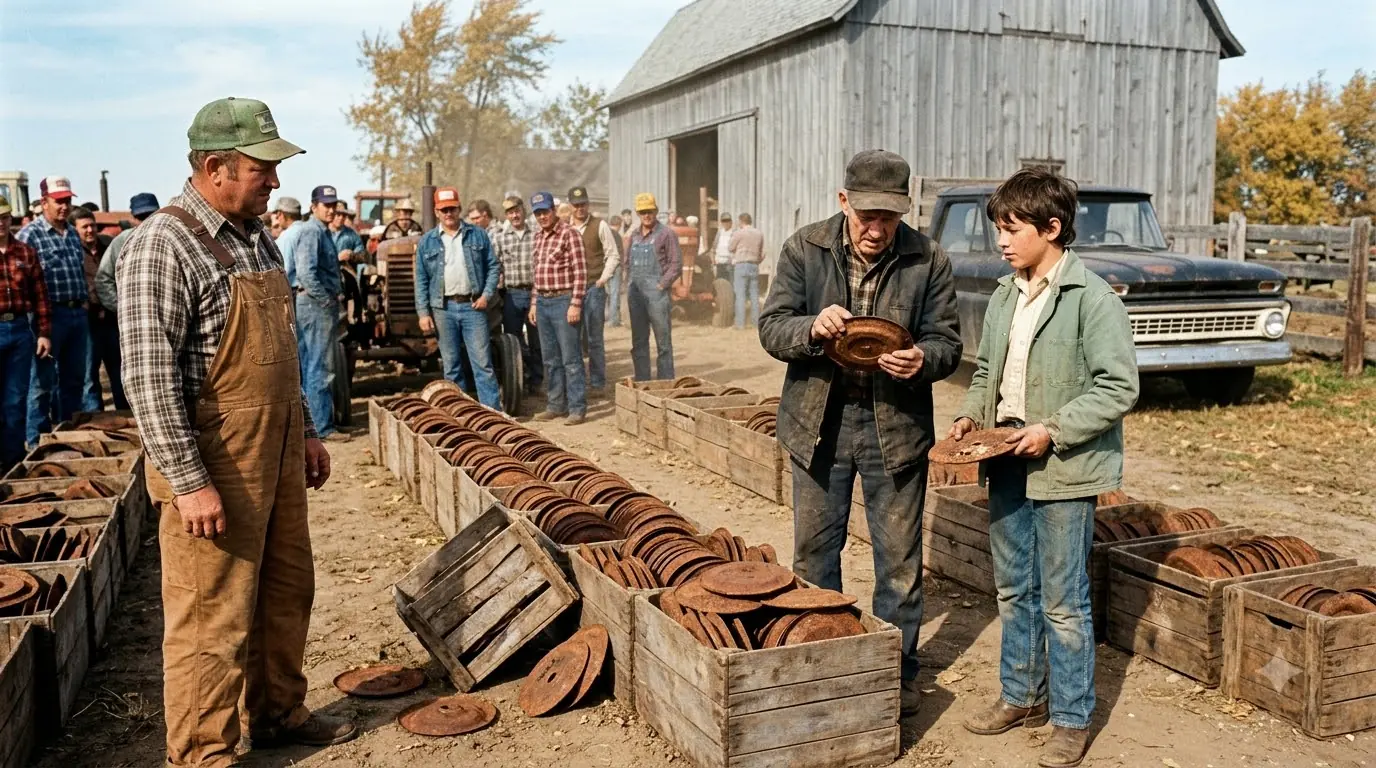
Rows of machinery stretched across several acres.
Rusting cultivators.
Old grain drills.
Two manure spreaders.
A hay rake missing half its teeth.
Three tractors that looked as though they had been parked there before the boy was born.
Stacks of wooden fence posts.
Broken wagon wheels.
Boxes of bolts.
Buckets of chains.
And behind the gray machinery barn, nearly forgotten beneath a sagging blue tarp, sat nine long rows of wooden crates filled with circular pieces of rusted iron.
Most of the farmers had barely glanced at them.
The auction catalog listed the entire lot simply as:
OLD PLANTER PLATES AND PARTS — APPROX. 900 PIECES — AS IS.
To most people there, that description meant one thing.
Scrap.
The auctioneer had opened at five hundred dollars.
Nobody bid.
He dropped to three hundred.
Silence.
Two hundred.
Still nothing.
Finally he laughed into the microphone and said, “Somebody give me fifty dollars before I have to haul this junk home myself.”
That was when the boy raised his hand.
The auctioneer blinked.
Several farmers turned.
The boy stood between his father and the weathered side of the machinery barn, wearing a faded sage-green chore jacket that had once belonged to an older cousin, worn jeans, and brown work boots that were already too small for him.
He was thin but strong from chores.
His dark-brown hair had been cut at home and refused to lie flat.
Freckles crossed his nose.
His hands were already stained with rust because he had spent twenty minutes before the auction digging through the crates while everyone else inspected tractors.
His father looked down at him.
“What are you doing?”
The boy kept his hand raised.
The auctioneer pointed.
“Fifty dollars from the young gentleman.”
Someone laughed.
The older farmer in brown overalls standing near the crates shook his head.
“That kid buying scrap now?”
The auctioneer continued.
“Do I hear seventy-five?”
A scrap dealer near the rear lifted two fingers.
The boy looked toward him.
The dealer smiled.
He was not interested in planter plates.
He was calculating weight.
Nine hundred cast-iron plates might bring enough by the ton to justify hauling them away.
The boy raised his hand again.
“One hundred from the young man.”
His father grabbed his sleeve.
“Stop.”
The boy whispered, “Dad.”
“One hundred dollars is not a game.”
“I know.”
“That’s your money.”
“I know.”
“You’ve been saving it almost two years.”
“I know.”
The auctioneer called:
“One twenty-five?”
The scrap dealer nodded.
The boy hesitated.
His entire savings sat inside a worn leather wallet in his jacket.
Money from hauling hay.
Cleaning chicken houses.
Repairing bicycles.
Selling two bottle calves.
Helping an elderly neighbor stack firewood.
Birthday money from his grandmother.
One hundred eighty-three dollars and forty cents.
He knew the number exactly.
The boy raised his hand.
“One fifty!”
His father stared.
The crowd was watching openly now.
A man near the fence called:
“Let him buy it! He’ll learn something.”
Laughter.
The scrap dealer lifted his hand.
“One seventy-five.”
The boy’s stomach tightened.
The auctioneer looked toward him.
His father said quietly:
“Don’t.”
The boy looked once more at the crates.
Not at all nine hundred pieces.
At one.
A circular plate lying near the top of the third crate.
Ten inches across.
Twenty-four evenly spaced openings around the edge.
Three mounting holes around the center.
And beneath the rust, barely visible where he had rubbed it with his thumb, a stamped number.
12-S.
Then another marking.