The auctioneer laughed before anyone else did.
“Fifty-five dollars?”
His voice echoed beneath the high timber roof of the machinery barn, bouncing between rusted cultivators, cracked tractor seats, bent gates, stacks of hand tools, and nearly two hundred people wearing work coats against the November cold.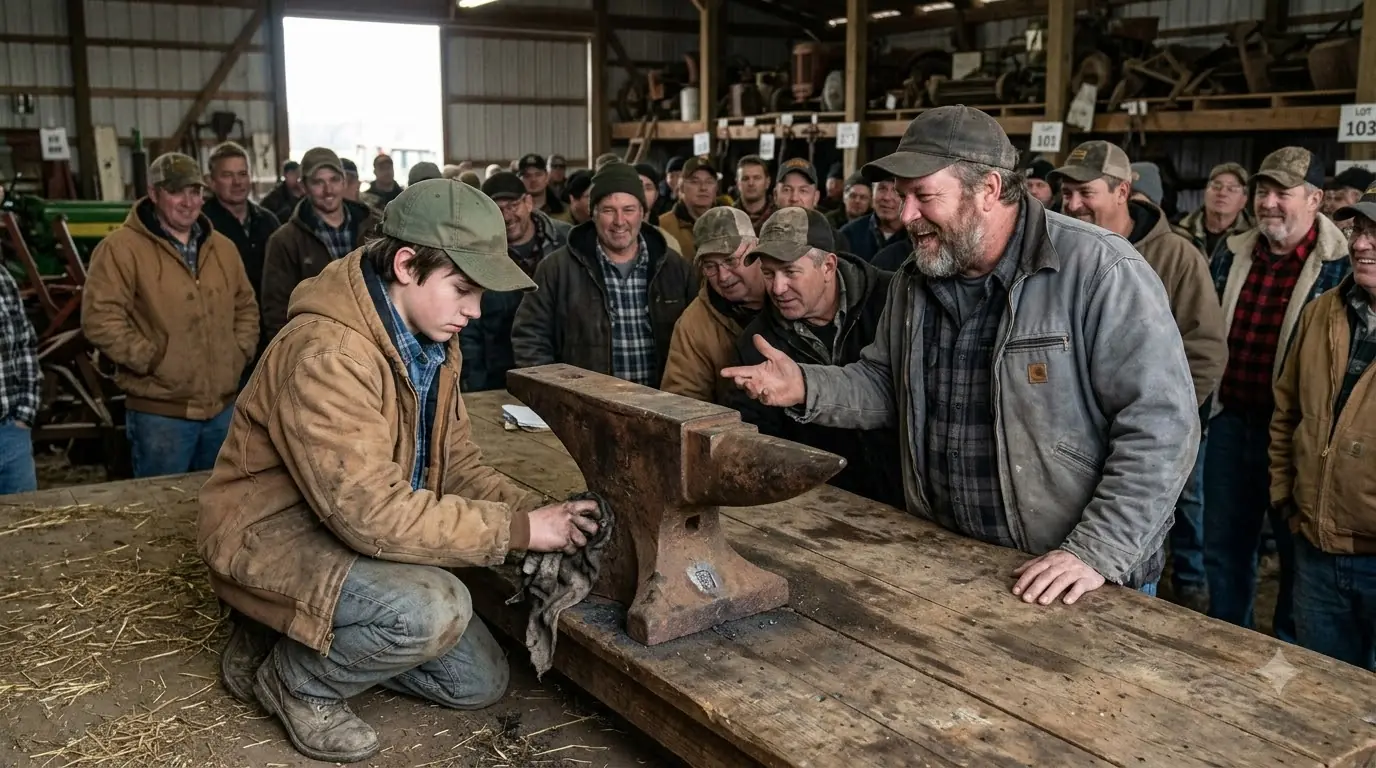
Fourteen-year-old Noah Walker kept his hand raised.
“Fifty-five.”
The auctioneer stared at him.
Noah knew what the man saw.
A skinny farm boy in a faded green cap.
Brown canvas jacket one size too large because it had belonged to his father.
Blue plaid shirt.
Mud dried around the cuffs of his jeans.
Forty-three dollars in one pocket.
Twelve in the other.
Exactly fifty-five dollars.
Every cent he had brought.
The auctioneer glanced toward the object sitting on the heavy wooden table between them.
Five hundred pounds of black-brown iron.
Or maybe four hundred.
Nobody seemed to know.
Its horn was scarred.
The face looked dull.
The edges had chips.
Rust covered the waist and feet.
Someone had painted one side red decades ago, then apparently changed his mind halfway through the job.
The paint that remained looked like dried blood beneath grease.
A man near the front laughed.
“That kid just bought the world's biggest paperweight.”
Several people chuckled.
Noah did not lower his hand.
The auctioneer looked around.
“Anybody give me sixty?”
Nobody moved.
“Sixty dollars?”
Silence.
A broad man standing opposite Noah folded his arms.
He wore a faded gray work jacket over a charcoal plaid shirt, dark jeans, and an old gray cap with the logo nearly worn away.
His beard was thick.
His stomach pushed against the zipper of his jacket.
His name was Dale Rourke.
Everyone around Harrison County knew Dale.
He bought farm machinery cheap, repaired what was worth repairing, stripped everything else, then sold the pieces for more than most people would have believed possible.
Dale looked toward Noah and smiled.
“Let him have it.”
The men beside him laughed.
“Boy needs to learn somehow.”
The auctioneer grinned.
“Last call.”
Noah swallowed.
He could hear his mother’s voice inside his head.
Do not buy junk just because it's cheap.
Then another voice.
His father.
Cheap and worthless are not the same thing.
Noah kept his hand up.
The auctioneer pointed.
“Sold.”
The wooden handle of his gavel struck the folding table.
“Fifty-five dollars to the young gentleman in the green cap.”
Applause broke out.
Not respectful applause.
The kind people gave when somebody fell into a pond without getting hurt.
Noah lowered his arm.
His stomach felt hollow.
Fifty-five dollars.
Three months of sharpening mower blades for neighbors.
Six Saturdays splitting firewood.
Two old bicycle repairs.
One afternoon helping Mr. Haskins clear a clogged grain auger.
Gone.
For an anvil nobody else wanted.
Dale stepped closer.
“Congratulations.”
Noah looked at him.
Dale gestured toward the anvil.
“What are you going to do with it?”
“Use it.”
“For what?”
“Blacksmithing.”
That produced another round of laughter.
Dale tilted his head.
“You a blacksmith now?”
“No.”
“Then what?”
“Learning.”
Dale slapped one broad hand against the table.
“Son, you don't learn piano by buying a broken piano.”
Noah looked at the anvil.
“You don't know it's broken.”
Dale laughed harder.
“I've bought more anvils than you've seen birthdays.”
“Then why didn't you buy this one?”
That stopped him for half a second.
Not long.
But Noah noticed.
Dale smiled again.
“Because I know scrap when I see it.”
Noah looked at the anvil.
Then at Dale.
“Good.”
“What?”
“Means I didn't have to bid against you.”
A few people laughed.
This time at Dale.
His smile tightened.
Noah turned away before his own nervousness could show.
He had no idea whether he had made the smartest purchase of his life or the dumbest.
Probably the second.
But he had wanted an anvil for nearly a year.
His family's farm had been full of improvised repairs as long as Noah could remember.
Bent brackets heated with a torch and straightened against tractor drawbars.
Gate latches repaired over old railroad plates.
Broken mower guards hammered flat on concrete blocks.
His father, Adam Walker, could fix almost anything, but he had never owned a proper anvil.
“Too expensive,” Adam used to say.