The laughter began before May Cutler had fully raised the bidder’s paddle above her head.
It came from the front row first.
A sharp bark from one farmer, then another, then a rolling wave of amusement that moved through the old auction barn until men who had not even been paying attention turned around to see what had become so funny.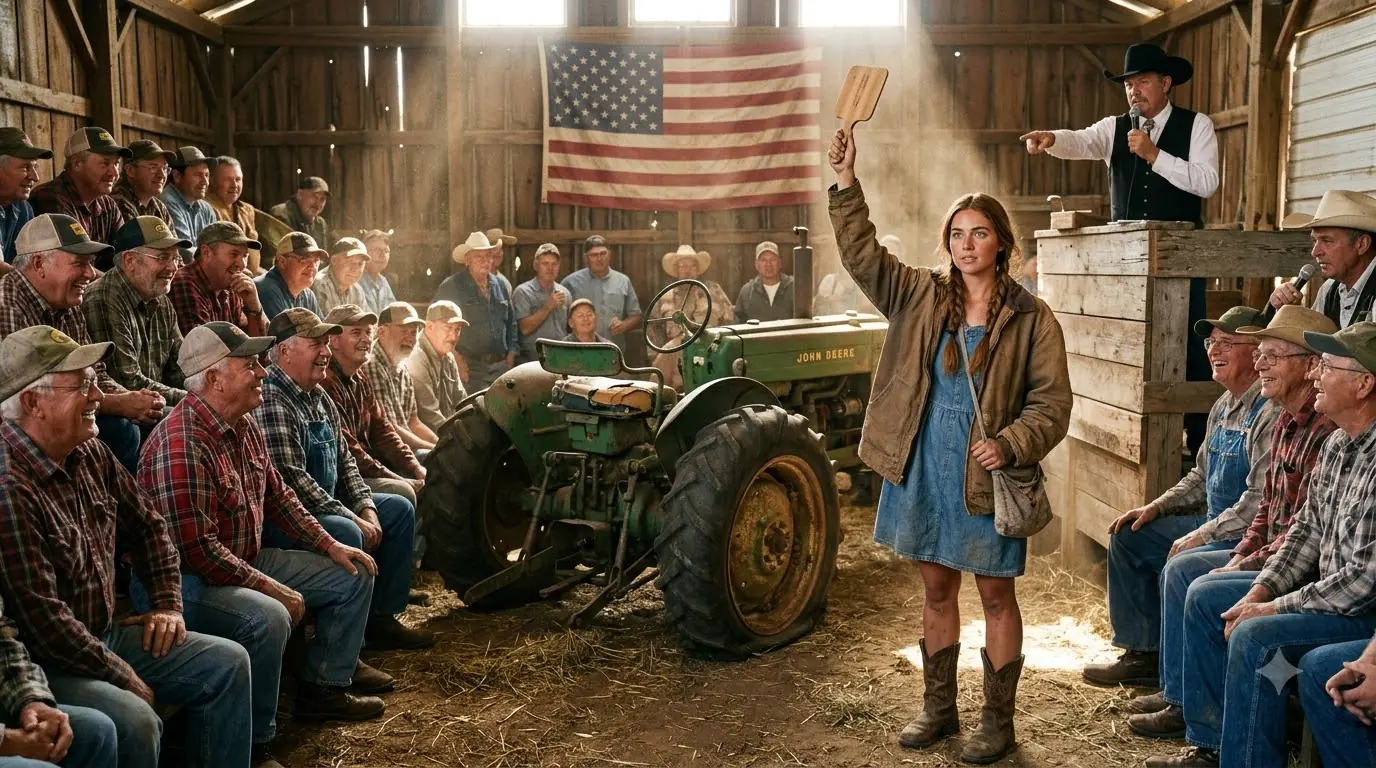
May stood near the rear wall with her shoulders squared and the paddle still raised.
She was twenty years old, though strangers often guessed younger because of her freckled face and the two auburn braids hanging over the shoulders of her faded brown work jacket. Beneath it she wore a plain blue farm dress, not because she thought dresses belonged at machinery auctions, but because it was the cleanest thing she owned that morning.
Her leather boots were scuffed white at the toes.
Her hands were rough from fencing, feeding chickens, and repairing irrigation pipe.
Inside the cloth purse hanging from her wrist was every dollar she could spend without leaving herself unable to buy groceries before the end of the month.
Eighty-six dollars and thirty-five cents.
The tractor sitting in the middle of the barn looked worth less.
That was precisely why everyone was laughing.
Its green paint had faded almost to gray. Rust climbed over the hood and around the grille. One rear tire sagged toward the dirt floor. The seat had split open years earlier, exposing stuffing blackened by rain and mice. Dead weeds remained tangled around the rear axle as if the machine had been dragged directly out of an abandoned field.
The auction catalog had devoted exactly one line to it.
OLD JOHN DEERE TRACTOR. NONRUNNING. PARTS OR SCRAP.
Lot 214.
Nothing more.
No model number.
No manufacturing year.
No provenance.
No mention of where it came from.
Auctioneer Vernon Pike stood behind a raised wooden podium beneath a large American flag. He was a broad man with a black cowboy hat, a polished bolo tie, and the theatrical voice of someone who believed silence existed mainly so he could fill it.
He lowered his microphone and peered toward May.
“You lost, little lady?”
Fresh laughter broke across the benches.
May felt heat rise into her cheeks.
She hated that reaction.
Her father had always told her embarrassment was simply fear wearing nicer clothes, but knowing that did not make it less uncomfortable when a hundred adults looked at her as though she had wandered into the wrong building.
“No, sir,” she said.
Vernon cupped one hand behind his ear dramatically.
“What was that?”
“I said no, sir.”
A farmer in front laughed.
“She knows where she is, Vern. She just doesn’t know what she’s buying.”
More laughter.
May kept looking at the tractor.
That was important.
Not Vernon.
Not the crowd.
The machine.
Her father had taught her that too.
People lie with their mouths because mouths are easy.
Machines usually need help before they lie.
Samuel Cutler had repaired farm equipment for nearly thirty years from a corrugated-metal shop behind their Nebraska farmhouse. By the time May was eight, she knew which wrenches belonged on the pegboard by shape alone. At ten, she could clean a carburetor. At twelve, she learned why engines needed compression, fuel, timing, and air.
At fifteen, Samuel taught her something more useful than any repair.
Never trust appearance.
Fresh paint could hide cracked castings.
A terrible-looking machine could contain excellent metal.
A clean auction description could be wrong.
And when everyone else had already decided what something was worth, that was exactly when you should inspect it yourself.
Samuel died two winters earlier.
Pneumonia.
Quick enough that May still sometimes caught herself turning toward the workshop expecting to see him bent over a bench.
He had left behind tools, debts, a half-empty farm, and shelves of machinery books filled with his handwriting.
May had spent the first year after his death trying not to open them.
The second year, she began reading every page.
That was why she was here.
“Twenty dollars,” Vernon called.
No bids.
Nobody wanted Lot 214.
Vernon sighed.
“Come on, gentlemen. There’s at least twenty dollars of scrap steel sitting there.”
May raised her paddle.
The barn erupted.
Vernon leaned forward.
“You’re serious?”
“Yes.”
He glanced at the crowd and grinned.
“All right. We’ve got twenty dollars from the young lady in the back. Anybody want to rescue this tractor before she takes it home and plants flowers in it?”
Laughter again.
May’s grip tightened.
A man near the aisle raised two fingers.
“Thirty.”
He said it as a joke.
His friends laughed.
Vernon pointed.
“Thirty dollars. Do I hear thirty-five?”
May lifted her paddle.
“Thirty-five.”
The joking bidder turned around.
May looked straight back.
He lowered his hand.
“Forty?” Vernon asked.
Silence.
Then another farmer called:
“Forty. My wife needs a lawn ornament.”
Laughter.