Twenty-eight-year-old Hannah Cole has spent her entire life on Red Willow Farm in western Kansas, where her family has raised cattle for three generations. She is beautiful, athletic, stubborn, and far more skilled at reading soil, livestock, and machinery than most neighboring farmers are willing to admit. But after the worst drought in decades burns the valley brown, Hannah finds herself facing a crisis she cannot outwork.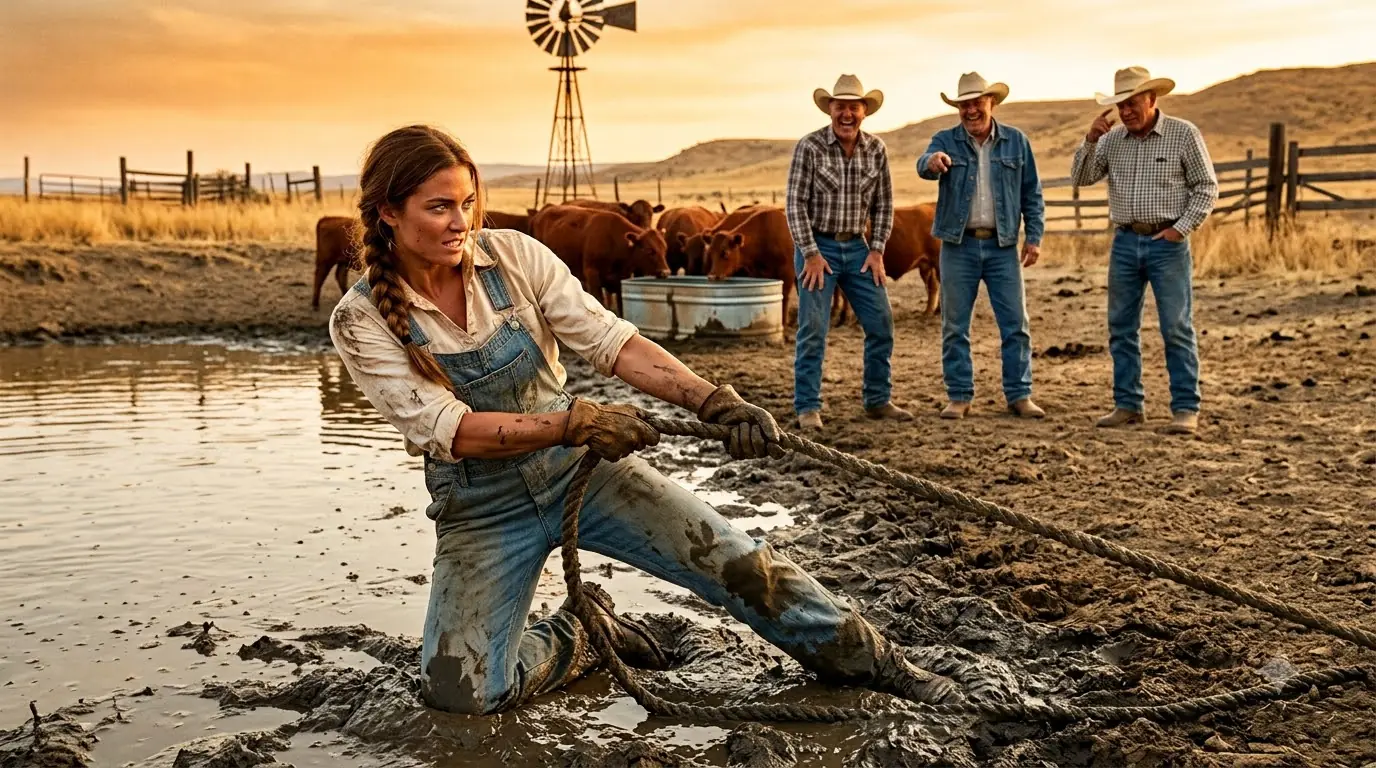
Her cattle pond is disappearing.
The wells are weakening.
The pasture has turned brittle beneath the summer sun, and the bank has given Hannah thirty days to make an overdue payment before beginning foreclosure proceedings.
Three older neighboring farmers, Wade Mercer, Otis Bell, and Frank Danner, have already begun reducing their herds. They tell Hannah she should accept reality and sell Red Willow Farm to wealthy agricultural investor Clayton Vale, who has been quietly purchasing distressed farms throughout the county.
Hannah refuses.
Then, while cleaning out her late grandfather’s workshop, she discovers an old notebook containing a strange drawing of the pond. Beneath a faded sketch of a stone-lined shaft is a sentence written in her grandfather’s hand:
If Red Willow ever dies, pull what they buried beneath it.
Hannah remembers something else.
For years, a thick rope has protruded from the mud near the deepest end of the pond.
Everyone assumed it was attached to an old fence post or abandoned farm equipment.
As the drought lowers the water farther than anyone has seen in generations, more of that rope becomes visible.
One afternoon, with the neighboring farmers standing on the cracked bank laughing at her, Hannah climbs into the mud and begins pulling.
They mock her.
They call the rope junk.
One farmer jokes that she might drag a rainstorm from the dirt if she pulls hard enough.
Hannah keeps pulling.
After nearly an hour, the rope suddenly shifts.
What comes out of the mud is not a log.
It is a massive iron ring connected to a buried wooden-and-steel mechanism.
When Hannah yanks it free, the bottom of the dying pond begins trembling.
Bubbles appear.
Then clear water explodes upward through the mud.
The farmers stop laughing.
Within minutes, water spreads across the cracked basin.
Half buried beside the opening is a cast-metal plate bearing the mark of the original Red Willow Cooperative, proving that Hannah has uncovered the emergency release for an underground artesian spring sealed nearly fifty years earlier.
But the discovery creates a larger mystery.
Why was a spring capable of supplying much of the valley deliberately sealed?
And why do modern county records contain no mention of it?
Hannah begins searching old deeds, irrigation maps, newspaper archives, and her grandfather’s private papers.
She discovers that the spring once fed a network of channels serving seven farms. In 1974, after a series of suspicious land purchases, the spring was officially listed as “collapsed and permanently unusable.”
That report was false.
The spring had been sealed.
The original water agreement had also disappeared from county records.
As Hannah follows the paper trail, she discovers that Clayton Vale’s father was involved in the company that purchased several farms after the supposed collapse.
Now Clayton is attempting to repeat the same strategy during the present drought: acquire distressed land cheaply, combine the parcels, and secure exclusive control of a planned industrial groundwater project.
The old farmers who laughed at Hannah are forced to confront their own families’ history.
Wade discovers his father signed a document he never understood.
Otis finds receipts proving farmers were paid to abandon water claims.
Frank remembers seeing men working near the pond as a child on the night the spring supposedly collapsed.
Together, they begin helping Hannah reconstruct what happened.
Clayton responds aggressively.
He challenges ownership of the spring.
He pressures the county.
He offers Hannah enough money to erase every debt she has.
She refuses.
Then someone damages the reopened gate during the night.
The water begins falling again.
This time Hannah is not alone.
The same farmers who once laughed beside the pond arrive with tractors, pumps, tools, and their sons and daughters.
For three days, the valley works together to restore the old channels.
When the original 1936 cooperative charter is finally found inside a rusted courthouse archive box, it proves the underground spring was never privately owned.
It belongs collectively to the participating farms and cannot legally be sold separately from them.
Clayton’s acquisition plan collapses.
The valley survives the drought.
But Hannah refuses to treat the discovery as her personal victory.
She creates a modern water cooperative based on the original agreement, ensuring no single farm, company, or family can control the spring again.
Years later, children swim in the restored pond where Hannah once knelt in mud while three farmers laughed.
Beside the rebuilt spring gate stands a simple metal plaque.
It does not carry Hannah’s name.
It reads:
WATER KEPT FOR EVERYONE LASTS LONGER THAN WATER KEPT FOR ONE.
The pond had been shrinking for ninety-three days when Hannah Cole finally saw the rope.
Not the first six inches.
Those had been visible for years.
She saw all of it.
Or at least enough to understand that the thing disappearing into the cracked mud was not what everyone had always assumed.
Red Willow Pond had once covered almost four acres at the southern edge of Hannah’s farm.
As a child, she had learned to swim there.
Her father taught her to cast a fishing line from the eastern bank.
Her grandfather had built a narrow wooden dock that lasted until Hannah was seventeen, when an ice storm finally tore it apart.
The pond had watered cattle through hot summers, frozen solid enough for skating during hard winters, and reflected so many Kansas sunsets that Hannah sometimes believed the sky itself belonged partly to the farm.
Now it looked like a wound.
Mud occupied most of the basin.
The remaining water was a brown oval barely deep enough for cattle to drink without stirring silt.
The shoreline had retreated more than sixty yards.
Dead reeds stood where water used to reach Hannah’s waist.
A cracked turtle shell lay beside one exposed stone.
Hannah stood on the bank with both hands resting on her hips.
She was twenty-eight years old, five feet eight, lean and strong from years of lifting feed sacks, wrestling fence posts, repairing pumps, riding horses, and doing nearly every job people still liked to tell her required a man.
Her chestnut hair was tied into a thick braid.
Dust darkened the knees of her jeans.
A faded blue work shirt clung damply between her shoulder blades.
The temperature had reached one hundred and four degrees before noon.
There was no wind.
That was the worst part.
Wind at least made drought feel alive.
Still heat made the land seem abandoned.
Behind Hannah, forty-three Angus cows moved slowly across a pasture that no longer deserved the name.
Grass had become brittle stems.
The herd used to number seventy-six.
She had sold twenty-seven in June.
Six more would leave Friday.
Every animal sold bought the farm another little piece of time.
Diesel.
Feed.
Electricity.
Interest.
Time.
Always time.
Never enough of it.
Her phone vibrated inside her back pocket.
She ignored it.
It vibrated again.
Hannah already knew who it was.
First Plains Agricultural Bank.