The storm had begun before sunset, rolling down from the Wyoming peaks in dark, bruised clouds that swallowed the last of the daylight. By midnight, the wind was howling through the narrow mountain passes, driving snow against the cabin windows and burying the trail beneath drifts deep enough to conceal a horse's legs. The old log cabin stood alone among the pines, its thick walls shuddering whenever a gust struck from the north.
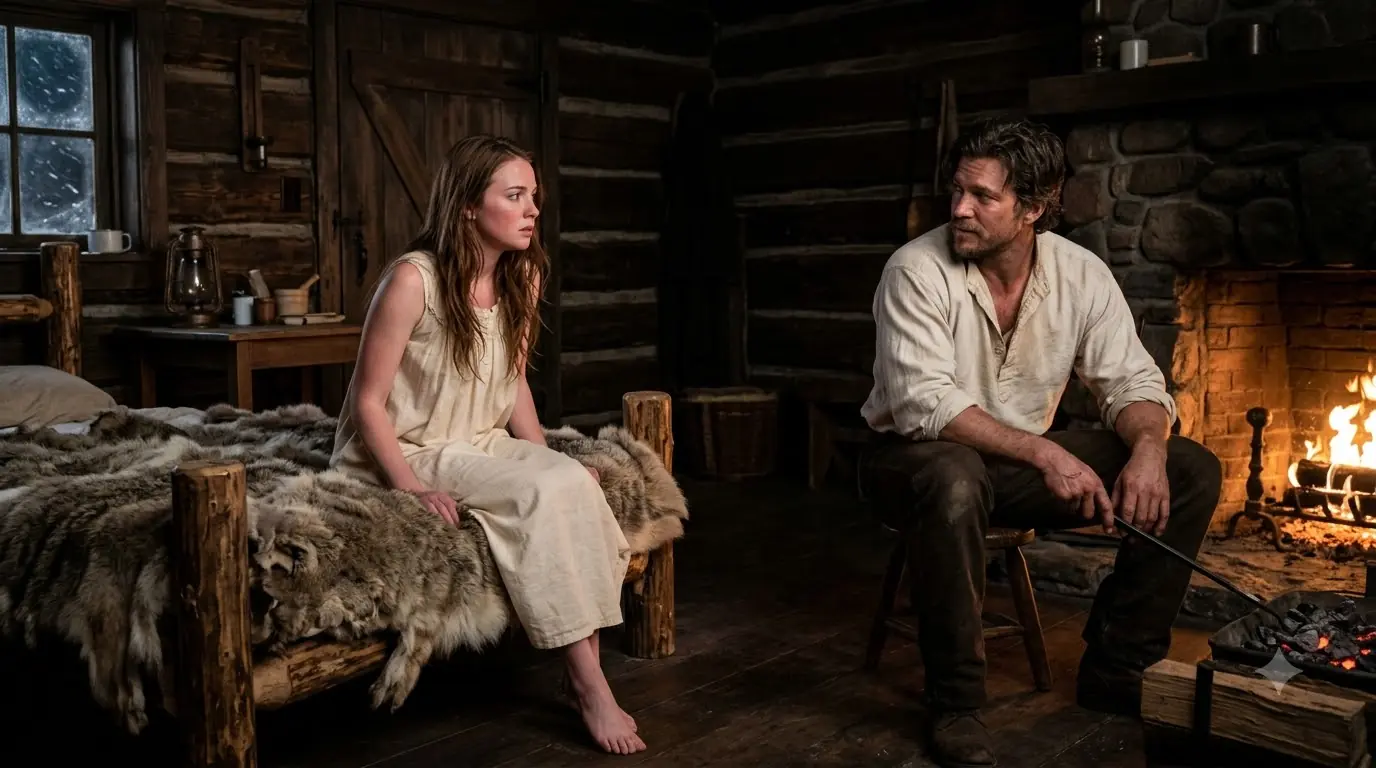
Inside, the stone fireplace cast a restless orange glow across the room.
Josie sat on the edge of the rough wooden bed, wrapped in thick wolf furs, her bare feet tucked beneath the heavy blankets. Her cream frontier nightdress was modest and soft, its sleeves loose around her wrists. Long chestnut-brown hair fell untidily around her shoulders, and the heat from the fire had brought a flush to her fair cheeks. Her hazel eyes remained fixed on the man beside the hearth.
Caleb was thirty-five, tall and powerfully built, with the weathered features of someone who had spent most of his life outdoors. His dark hair was tousled from the long day, and a short beard shadowed his jaw. Old scars crossed his hands and disappeared beneath the loose sleeves of his off-white work shirt. Another pale mark showed near his collar, where the fabric had shifted as he leaned forward to stir the coals with an iron poker.
He had not looked at her for several minutes.
That was what unsettled her.
Only an hour earlier, she had told him that being close to him hurt. She had said it quietly, almost apologetically, with her eyes lowered and her hands clenched in the blankets. She had expected anger. She had expected him to remind her that he had paid for her passage west, that she was now his wife, or that she had no right to refuse the closeness marriage supposedly required.
Instead, Caleb had immediately stepped away.
He had covered her with the wolf furs, asked whether she needed water, and then moved to the fireplace. He had not argued, questioned her, or tried to persuade her to change her mind. When she told him she wanted him to stay in the room, he had agreed, but he had chosen the chair beside the hearth and kept the space between them clear.
Now the silence seemed larger than the cabin.
Josie watched the firelight travel over his shoulders. He was wearing the same dark trousers he had worn while chopping wood, and his boots stood near the hearth to dry. His rifle rested on the wall within reach, though he had made no move toward it since sitting down.
She remembered the first time she had seen him.
It had been at the Chicago railway station, where the air smelled of coal smoke, wet wool, and the sharp metallic tang of the tracks. She had been standing beneath the station clock with a small carpetbag at her feet, clutching a letter that had become soft and creased from being read too many times. Her aunt had arranged the journey. The marriage had been presented as a practical solution to a situation that had become increasingly difficult for her in the city.
Caleb had arrived in a weather-stained coat, carrying a leather case and wearing a hat that had seen better seasons. He had looked at the letter, confirmed her name, and offered to carry her bag.
He had not smiled much.
At the time, she had mistaken his quietness for indifference and his broad frame for a threat. When he told her that the journey would be long, she had nodded without asking what awaited her at its end.
She had known almost nothing about him.
She knew only that he had sent money for her passage, that a minister in Wyoming had agreed to perform the marriage, and that she would be living in a cabin far from the city. Her aunt had insisted that the arrangement was respectable. The man who had helped negotiate it had called Caleb a reliable mountain settler, someone who could provide a home and a steady life.
No one had asked Josie what sort of life she wanted.
She had gone because the alternative seemed worse.
The first weeks in Wyoming had been difficult. The cabin was smaller than she had imagined, the nights colder, and the nearest town a long ride away. Caleb rose before dawn, worked until dusk, and spoke little unless there was something practical to discuss. He showed her where he kept the flour, how to use the stove, and which path led to the spring. He taught her to recognize the sound of a storm moving over the ridge and warned her never to cross the creek when the snowmelt was high.
He never mocked her when she struggled.
He also never seemed to know what to say when she was frightened.
Their marriage had begun with a ceremony conducted in a small wooden church, with two ranch hands as witnesses and the minister's wife arranging a modest supper afterward. Caleb had stood beside her in a clean shirt, his expression serious, his hands clasped behind his back. When the minister declared them husband and wife, Caleb had offered her his arm for the walk back to the wagon.
He had not kissed her.
At the time, Josie had been grateful for the restraint, though she had not understood it. She had thought perhaps he was disappointed, perhaps he had expected a different sort of bride, perhaps he regretted the money he had spent bringing her west.
During the following days, she had tried to make herself useful. She cooked, swept, mended his shirts, and helped stack the smaller pieces of firewood beneath the porch roof. Caleb thanked her each time, sometimes with a nod, sometimes with a quiet word, and never with the impatient criticism she had grown accustomed to hearing from the men in her former life.
Yet the uncertainty between them remained.
He was her husband, but she did not know what he expected from her.
She had spent much of her life being told that a woman's safety depended upon pleasing the men who controlled her circumstances. In Chicago, she had learned to measure a man's mood by the sound of his footsteps and to prepare an explanation before he asked a question. Her first guardian had called obedience gratitude. Her second had called it good sense.
Caleb's silence had confused her because it offered no obvious demand.
And then, earlier that evening, he had come to the bed after helping her carry a basket of laundry inside from the freezing porch. She had been exhausted, chilled, and embarrassed by how little she understood about the expectations of married life. When he sat beside her, she had felt the familiar tension rise in her shoulders.
He had asked whether she was comfortable.
She had said yes, though she was not.
When he leaned closer, she had turned her face away and admitted that the thought of being touched frightened her. She had tried to explain that she wanted to be a good wife, but that she did not know how to stop the old fear from taking hold.
Caleb had withdrawn at once.
He had looked at her for a long moment, then said, “All right.”
Nothing more.