In the winter of 1864, with war draining towns of food, horses, labor, and hope, thirty-two-year-old Clara Whitmore is fighting to keep her isolated Pennsylvania farm alive after the death of her husband. The apple trees behind her cabin are bare, the root cellar is nearly empty, and almost every useful animal or crop has either been sold, requisitioned, stolen, or consumed.
What Clara still possesses is stubbornness.
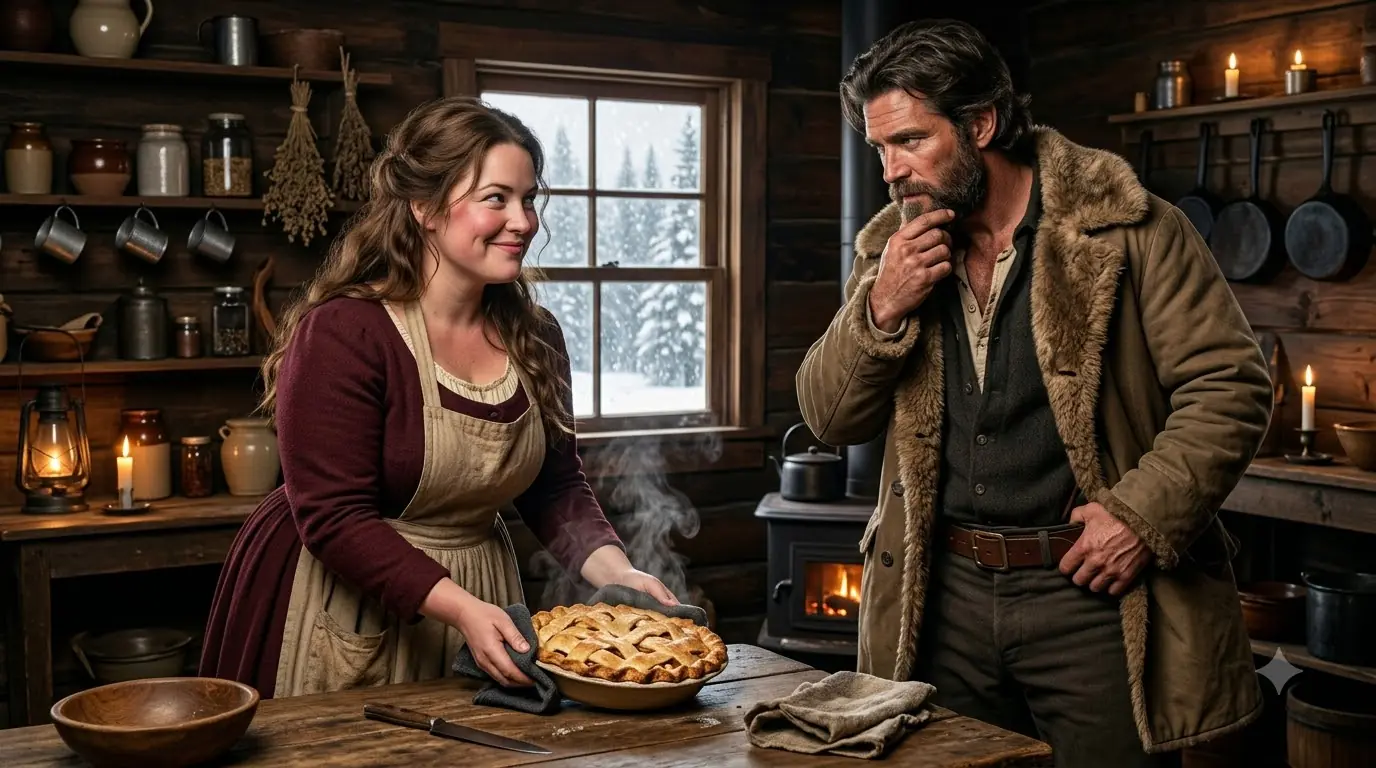
She has learned to turn scarcity into survival. Old bread becomes thickening. Rendered fat becomes pastry. A spoonful of vinegar can imitate the sharpness of fruit. Cinnamon, when used carefully, can persuade the nose before the tongue has time to object.
One freezing evening, Elias Mercer, a thirty-eight-year-old Union courier returning from months of brutal travel, reaches Clara's cabin during a snowstorm. He is exhausted, hungry, half-frozen, and carrying a sealed leather dispatch case he refuses to explain.
The first thing he smells when Clara opens the door is apple pie.
That should be impossible.
There have not been fresh apples in the valley for months.
Clara refuses to explain.
Instead, she feeds him soup, lets him dry his clothes by the stove, and places the steaming pie between them. Their first conversation is guarded and sharp. Elias is accustomed to people fearing his size and worn appearance. Clara is accustomed to men assuming a woman alone must either need saving or belong to somebody.
Neither makes a good first impression.
But when Clara cuts the pie, Elias becomes convinced she has hidden away precious apples.
She lets him believe it.
Their attraction grows through teasing exchanges, shared work, and long winter evenings. Elias discovers Clara is not merely surviving. She has been secretly feeding several neighboring families whose supplies were destroyed or seized. Clara learns that beneath Elias's rough exterior is a man carrying enormous guilt over surviving when younger soldiers did not.
The pie becomes their private joke.
Every time Elias asks what is inside it, Clara tells him he has not earned the answer.
Their fragile peace is threatened by Silas Crowe, a prosperous local grain merchant who has profited from wartime shortages. Silas once loaned Clara's husband money and now claims the Whitmore farm as security for a debt Clara insists was already paid.
Silas does not merely want repayment.
He wants Clara's land.
The farm sits beside an old mill road that has become increasingly valuable as military contracts expand through the county. If Clara cannot produce documentation proving the debt was satisfied, Silas intends to take possession before spring.
Elias initially tries to intervene.
Clara furiously refuses.
She will not exchange one controlling man for another.
Elias backs away.
That decision changes their relationship. Instead of rescuing Clara, he helps when she asks. He repairs a broken pump, cuts firewood, and assists her in delivering food to neighbors, but never assumes ownership of her fight.
Meanwhile, Silas becomes suspicious of Elias's sealed dispatch case. Rumors spread that it contains military payroll or confiscation orders. One night, Silas's hired men break into Clara's barn looking for it.
What they find instead exposes something unexpected.
Clara's late husband had kept detailed records showing Silas manipulated weights at his grain warehouse and deliberately underpaid struggling farmers. Those records could destroy him financially.
Silas becomes desperate.
During the final confrontation, he offers Clara a choice: surrender the records and leave the farm quietly, or watch everything she has protected disappear.
Clara refuses.
Elias stands beside her but does not speak for her.
Then his own secret is revealed.
The leather dispatch case never contained military money.
It contains federal contracts, transportation records, and an investigation order naming Silas Crowe as a suspected participant in fraudulent wartime grain sales.
Elias had been sent to find evidence.
He did not know Clara already possessed the missing piece.
Silas is arrested after his own accounting books confirm the fraud.
The farm survives.
But Elias still intends to leave once his duty is complete.
The night before his departure, Clara makes the mysterious pie again.
This time, she finally tells him the truth.
There are no apples.
The filling is made from humble pantry scraps carefully softened in sweetened water, vinegar, cinnamon, and spice until the senses believe what scarcity cannot provide.
Elias laughs because Clara has fooled him for weeks.
Then she tells him the deeper reason she made it.
During the worst years of her life, she learned that sometimes survival means refusing to let hardship decide what something is allowed to become.
A crust can become dinner.
Scraps can become pie.
A stranger can become home.
Elias does not leave the next morning.
And years later, when real apples finally hang heavy from Clara's orchard again, she still occasionally makes the appleless pie.
Because the first one did something real apples never could.
It convinced two people who had nearly given up on the future that something missing did not mean something beautiful could not still be made.
Snow had been falling for three hours when Clara Whitmore heard the horse.
Not saw it.
Heard it.
The wind had swallowed most ordinary sounds. It pressed against the cabin walls and hissed beneath the eaves. Snow rattled against the shutters like handfuls of thrown grain.
But a tired horse had a rhythm no storm could completely erase.
Four uneven hoofbeats.
Pause.
Four more.
Clara stopped stirring the pot above the stove.
She listened.
There.
Closer now.
She placed the wooden spoon beside the iron pot and reached for the shotgun above the mantel.
It was unloaded.
The powder had gone damp two weeks earlier.
The weapon remained useful anyway.
Most strangers behaved differently when they saw one.
Clara walked toward the front door.
She was thirty-two years old, with long chestnut hair pinned loosely behind her head and the sleeves of her burgundy dress rolled above her wrists. Flour marked one cheek.
The apron tied around her waist had once been cream-colored.
Years of washing had turned it something between gray and memory.
The horse stopped outside.
A man's voice followed.
“Hello?”
Clara said nothing.
Another pause.
Then:
“I'm not looking for trouble.”
She checked the latch.
“Most trouble doesn't announce itself as such.”
Silence.
Then the man laughed.
It was a tired laugh.
“You have a point.”
“Who are you?”
“Elias Mercer.”
“That name means nothing to me.”
“I'd be surprised if it did.”
“What do you want?”
“Right now?”
“Yes.”
“A roof.”
Clara tightened her grip around the shotgun.
“And after that?”
“Maybe feeling in my fingers.”
His humor irritated her because it made him sound human.
Human was harder to refuse than stranger.
She looked through the narrow crack between shutter and frame.
A large man stood beside a dark horse.
He wore a heavy coat with snow crusted across the shoulders. His beard was thick, nearly black except where frost had caught in it. Long hair curled around the collar.
A leather case was strapped across his chest.
The horse looked worse than he did.
That decided it.
Clara opened the door three inches.
The man looked toward the opening.
His eyes were gray.
Tired.