The first coin Nora Pierce found beneath the vending machine was a nickel.
She had to flatten herself almost completely against the hot concrete to reach it.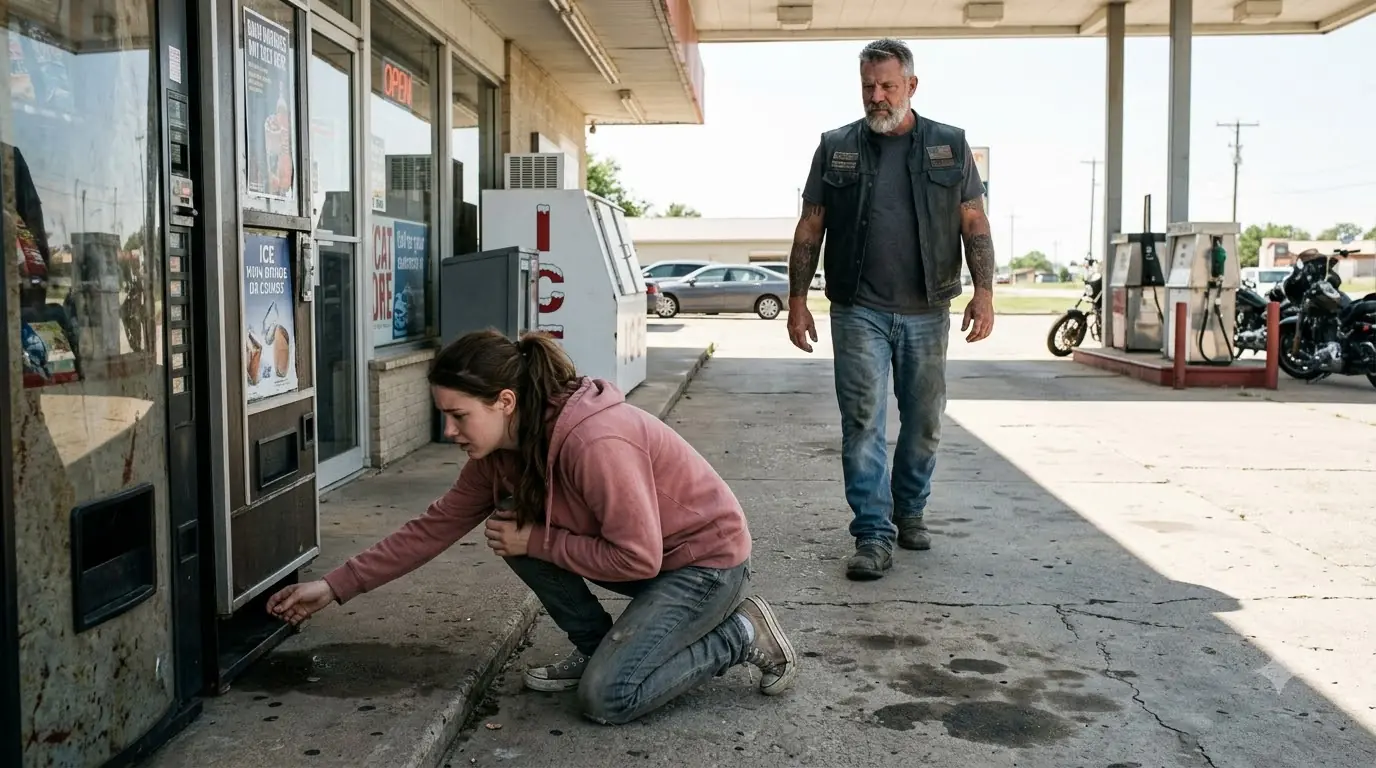
Her faded pink hoodie bunched beneath her ribs. Gravel pressed into one elbow. A loose strand of dark-brown hair stuck to the sweat on her cheek as she stretched her right arm into the narrow black gap beneath the machine and swept her fingers blindly across dust, wrappers, dead leaves, and something sticky she immediately decided she did not want identified.
Her fingertips struck metal.
Nora froze.
She reached farther.
The nickel scraped across the concrete.
She hooked it with one fingernail and pulled it toward herself.
Five cents.
She sat back on her heels and opened her left hand.
Three pennies.
One nickel.
Eight cents.
Not enough.
Not close.
Through the gas-station window twenty feet away, she could see the refrigerated case where the milk was kept.
The smallest carton cost two dollars and nineteen cents.
She knew because she had checked twice.
Her mother had not asked her to find money.
That part mattered.
Nora understood enough to know she was doing something she probably should not be doing.
But her little brother had been crying in the minivan for almost half an hour, and the sound had changed.
At first Eli had cried loudly.
Angrily.
The way sixteen-month-old children cried when the world failed to understand that they wanted something immediately.
Now he was making smaller sounds.
Tired ones.
He had already eaten the last applesauce pouch before they reached the gas station. The crackers in Nora’s backpack were too hard for him without soaking. The bottle of water her mother kept beside the driver’s seat was warm enough to taste like plastic.
And Eli kept saying the only word he had learned clearly enough for strangers to understand.
“Milk.”
Their mother had whispered:
“I know, baby.”
Then she had stared at the gas gauge.
That was when Nora understood they had another problem.
There were too many problems lately.
She had begun sorting them in her head.
Some were small.
Her favorite sneakers had a split near one toe.
The zipper on her school backpack sometimes jammed.
The charger for her tablet only worked if the cord was bent around a cereal box.
Then there were medium problems.
Their minivan made a clicking sound every time her mother turned left.
The storage unit was three weeks overdue.
Nora had heard the woman at the motel office say they could not stay another night unless her mother paid before noon.
Then there were the problems adults thought children did not understand.
The apartment was gone.
Mom had no job anymore.
Dad was dead.
Those were the problems that changed the shape of everything around them.
Nora closed her fingers around the eight cents.
She crawled to the second vending machine.
This one stood beside an ice freezer.
There was less space underneath.
She lay on one side and pushed her fingers beneath the metal edge.
Nothing.
She shifted.
A car door slammed somewhere behind her.
She ignored it.
Her fingers found a bottle cap.
Then something round.
Her heart jumped.
She pulled it out.
Quarter.
Thirty-three cents.
Better.
Still terrible.
Nora had once watched her father empty his pockets onto the kitchen counter after work.
Coins everywhere.
Quarters.
Dimes.
Pennies.
He complained that cash was disappearing but somehow his pockets stayed heavy.
Nora had helped him sort them into an old pickle jar.
He called it the emergency dinosaur fund because at the time Nora was six and saving for a plastic Tyrannosaurus rex she had seen at Target.
The jar had eventually paid for a tire instead.
Dad had apologized.
Nora had told him tires were more important than dinosaurs.
Then she cried in her bedroom where he could not see.
He found out anyway.
The following Saturday he brought home a secondhand dinosaur from a yard sale.
One arm was missing.
Nora loved it more because of that.
She wondered where the coin jar was now.
Probably in the storage unit.
Or maybe her mother had used it already.
Nora reached deeper beneath the vending machine.
A shadow moved across the pavement.
She thought someone had walked between her and the sun.
Then the shadow stopped.
Boots appeared in front of her.
Large black leather boots.
Scuffed at the toes.
Nora froze.
A deep male voice said:
“Lose something?”
She pulled her arm out immediately and sat up.
The man standing over her was enormous.
Not fat.
Not exactly muscular in the way superheroes were drawn.
Just large everywhere.
Broad shoulders.
Thick arms.
Heavy hands.
A black leather vest covered a charcoal-gray T-shirt. Faded tattoos wrapped both forearms. His beard was mostly gray, though darker streaks remained around his mouth. Sunglasses sat on top of his closely cropped hair.
Behind him, three motorcycles stood near the pumps.
Two more men in leather were walking toward the store.
Nora looked down at the coins in her palm.
“No.”
The biker raised one eyebrow.
He glanced toward the vending machine.