For fifteen minutes, a five-year-old girl held on to the largest, roughest-looking man in our store as though he were the only safe thing left in the world.
And for most of those fifteen minutes, we treated him like he was the danger.
My name is Rachel Morgan.
I had worked behind the customer-service counter at the Westfield Supercenter outside Oklahoma City for eleven years by the afternoon Lucy Carter disappeared from her mother.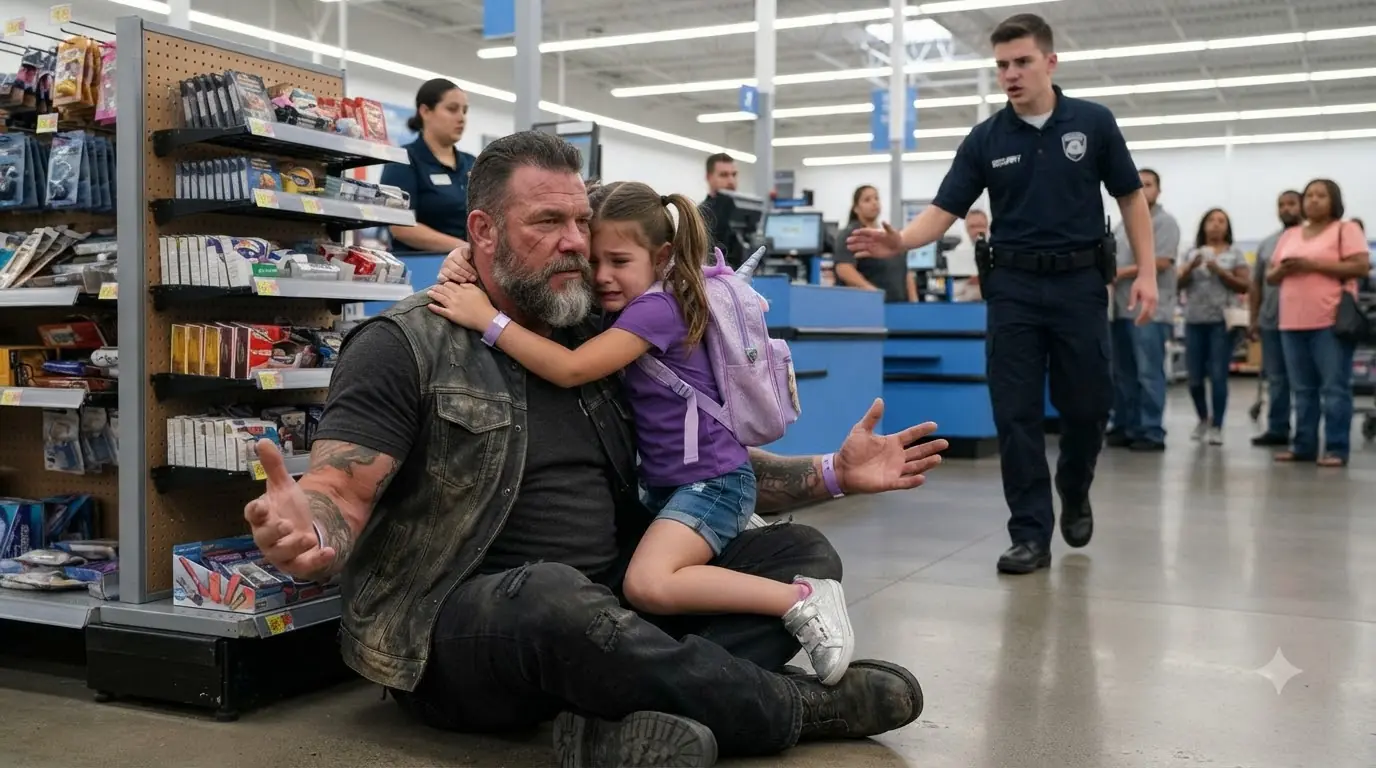
Eleven years behind that counter had convinced me I was good at reading people.
That was my first mistake.
The store was packed that Saturday.
Outside, the Oklahoma heat had turned the parking lot into a sheet of shimmering asphalt. Inside, families pushed overloaded carts through air-conditioned aisles beneath rows of fluorescent lights.
Children cried over candy.
Parents argued over shopping lists.
Cashiers called for price checks.
The pharmacy line stretched nearly to cosmetics.
At 3:18 p.m., one of our cashiers brought a little girl to the customer-service desk.
She was tiny even for five.
Brown hair had been pulled into two uneven ponytails, one already loosening near her ear. She wore a purple T-shirt, denim shorts, silver sneakers, and a purple backpack covered in cartoon unicorns.
Her eyes were swollen from crying.
“Found her near frozen foods,” the cashier told me.
I stepped from behind the counter.
“Hey, sweetheart.”
The girl looked at me but said nothing.
I crouched until we were nearly eye level.
“My name is Rachel.”
I touched my name badge.
“What’s yours?”
Her mouth trembled.
“Lucy.”
“Lucy what?”
“Carter.”
“Okay, Lucy Carter. You’re not in trouble.”
That mattered with children.
Adults hear lost child and understand emergency.
Children sometimes hear it and assume punishment.
“Do you know where Mommy is?”
Lucy shook her head.
“Do you know Mommy’s name?”
“Mommy.”
I smiled gently.
“Her other name.”
Lucy thought hard.
“Mommy Carter.”
The cashier looked away to hide a smile.
I didn’t.
“That makes sense.”
Lucy relaxed for perhaps two seconds.
Then her face folded again.
“I want Mommy.”
“I know.”
“We’re going to find her.”
“I want Mommy now.”
“I know.”
I held out my hand.
Lucy stared at it but did not take it.
That should have told me something.
She wasn’t a child who attached herself easily to strangers.
I didn’t understand how important that would become.
We initiated the missing-child procedure.
The front entrances were notified.
Garden center was notified.
Management was notified.
Associates began checking restrooms, apparel, grocery, pharmacy, fitting rooms, seasonal, electronics, and the parking lot.
We made an announcement asking Lucy Carter’s parent or guardian to report to customer service.
Nothing happened.
Three minutes passed.
Then five.
Lucy became more frightened each minute.
“What color shirt was Mommy wearing?” I asked.
“Blue.”
“Blue like mine?”
“No.”
“Dark blue?”
She shook her head.
“Light blue?”
Lucy’s eyes filled again.
“I don’t know.”
“That’s okay.”
“I forgot.”
“You didn’t do anything wrong.”
“I forgot Mommy.”
The sentence broke something in me.
“You did not forget your mommy.”
I reached toward her carefully.
She stepped backward.
So I stopped.
“All right. No touching.”
Lucy stared.
“I’ll stay right here.”
She nodded.
That seemed to help.
At 3:26, assistant manager Marcus Lee came over.
“Any update?”
“Nothing.”
He looked toward Lucy.
“We checking cameras?”
“Security is on it.”
Marcus crouched.
“Hi, Lucy.”
She turned away.
He stood again.
“She say where she got separated?”
“Frozen foods. Maybe cereal. Her answers change when she gets upset.”