The handcuff had not yet clicked shut when the bride spoke.
“Sergeant, before you close that cuff, ask dispatch who signed the federal order sitting in your precinct this morning.”
The sentence carried across the lawn without needing to be shouted.
One hundred and sixty guests stopped breathing at almost the same time.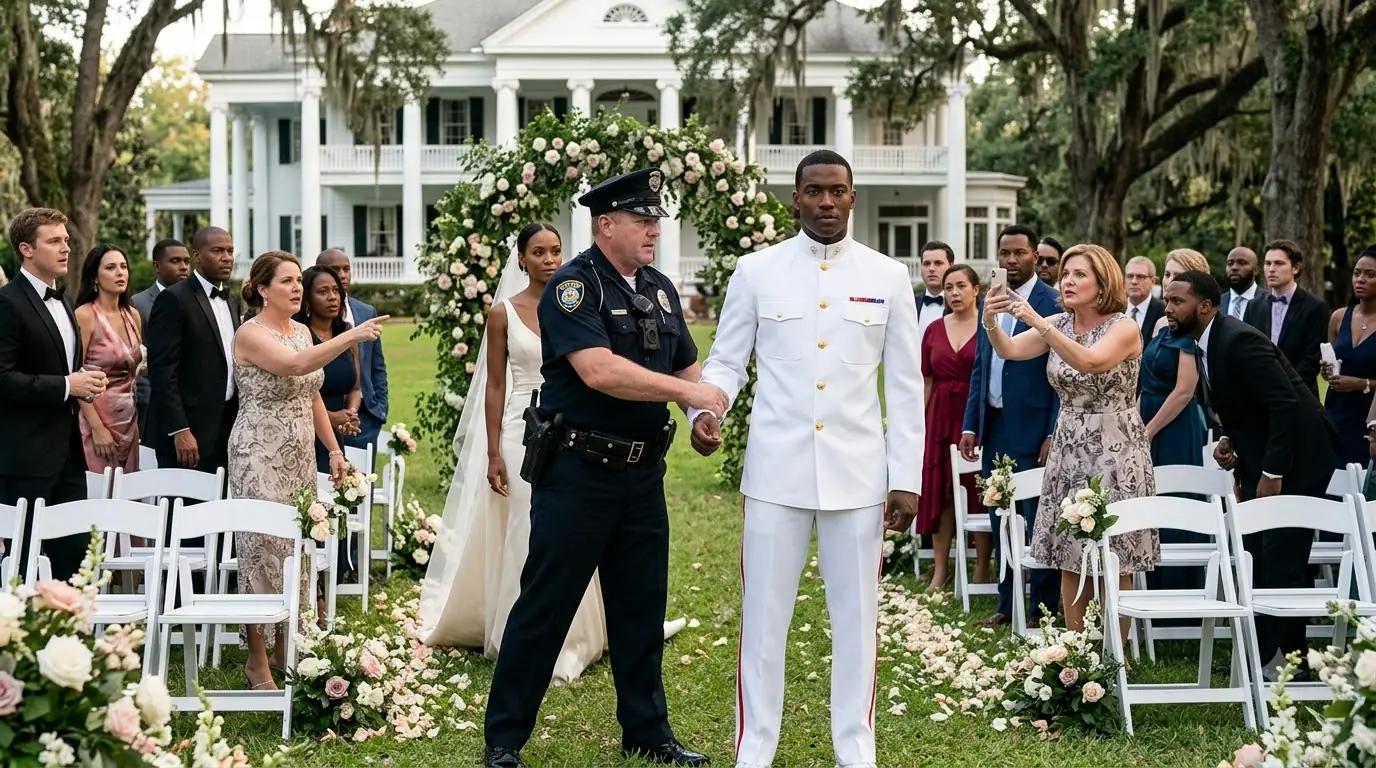
The string quartet had gone silent several minutes earlier. White rose petals lay scattered along the grass. Half-drunk glasses of champagne sat abandoned on linen-covered tables beneath the live oaks. Beyond them, Spanish moss moved lazily in the warm Georgia breeze as though the afternoon itself had failed to notice that a wedding had just become something else.
At the center of the aisle stood the groom.
Tall.
Thirty-four.
Black.
His white ceremonial uniform was immaculate except where the police sergeant had twisted one sleeve while pulling his arm behind his back.
The groom had not resisted.
Not once.
That fact would matter later.
His jaw was clenched hard enough to make the muscles jump beneath his skin, but his hands remained open.
Behind him stood the bride.
Thirty-nine years old.
Black.
An ivory gown fitted cleanly through the waist before falling into a long, understated train. No giant crown. No theatrical veil. Only a narrow line of silk pinned beneath an elegant low bun, diamond earrings from her mother, and the expression of a woman who had spent most of her adult life listening carefully before deciding what mattered.
Her name was known in federal courthouses across three states.
But not to the police sergeant.
Not yet.
The sergeant was forty-seven, broad through the shoulders, with a shaved head beneath a black patrol cap and the weathered face of a man who had worn a badge for more than twenty years. His body camera sat centered on his chest, its red light glowing.
His right hand held the open cuff.
His left controlled the groom’s wrist.
Five feet away stood the neighbor who had called police.
She was smiling.
Not broadly.
That would have made the moment simpler.
Her satisfaction appeared only at the corners of her mouth.
She was fifty-six, white, wealthy, and dressed in pale blue silk despite having received no invitation to the wedding.
One hand held her phone.
The other pointed toward the groom.
She had spent the last ten minutes insisting the wedding party had ignored “multiple lawful warnings,” that the music was “out of control,” and that the groom had become “aggressive” when asked to stop.
The bride had heard enough.
The sergeant looked toward her.
“What did you say?”
The bride stepped closer.
Her expression remained controlled.
“You heard me.”
“Ma’am, stay back.”
“No.”
Several guests shifted.
The groom spoke for the first time since the officer had taken his arm.
“Let her talk.”
The sergeant tightened his grip.
“I wasn’t speaking to you.”
The groom’s eyes hardened.
The bride stopped three feet away.
“You arrived here in response to a noise complaint.”
The sergeant said nothing.
“You were shown the event permit.”
Still nothing.
“You were shown the property survey.”
Silence.
“You were shown the sound-monitoring log.”
The neighbor interrupted.
“That meter is fake.”
The bride did not look at her.
“You were also told that the person who called you does not own this property, does not represent the county, and has no authority to order guests off private land.”
The sergeant’s nostrils flared.
“I am handling this.”
“No.”
The bride’s voice remained quiet.
“You are escalating it.”
Several phones had begun recording.
The sergeant noticed.
His gaze moved around the lawn.
That was when a crackle came through the radio clipped to his shoulder.
“Unit Twelve, supervisor requesting status.”
The sergeant pressed the button.
“Noise disturbance escalated. One subject being detained for obstruction.”
The bride’s eyebrows rose.
“Obstruction?”
The groom laughed once.
It was not amusement.
The sergeant glared at him.
“You refused a lawful instruction.”
“I asked you what law I was violating.”
“You argued.”
“That is not a crime.”
The neighbor took another step forward.
“This is exactly what I told you. They’ve been impossible all day.”
The bride finally turned toward her.
“You called police at 3:14.”
The neighbor blinked.
“So?”
“The ceremony began at three.”
The neighbor looked confused.
The bride continued.
“The first amplified music started at 3:07.”
She glanced toward the small quartet platform.
“Strings and piano.”
“No drums.”
“No speakers over the permit limit.”
She looked back at the neighbor.
“You called police seven minutes after the ceremony began.”
The neighbor crossed her arms.
“They were already loud before that.”