In 1887, thirty-eight-year-old rancher Grant Mercer believes he understands hunger. He has survived drought, cattle losses, winters when flour was measured by the handful, and years when feeding his orphaned ten-year-old nephew Samuel mattered more than feeding himself.
Then Eliza Harrow becomes his wife.
Their marriage begins through letters rather than courtship. Grant needs a partner who can endure the isolation of Red Willow Ranch in western Kansas. Eliza writes that she wants a home where usefulness matters more than elegance. She never tells him exactly what she is escaping.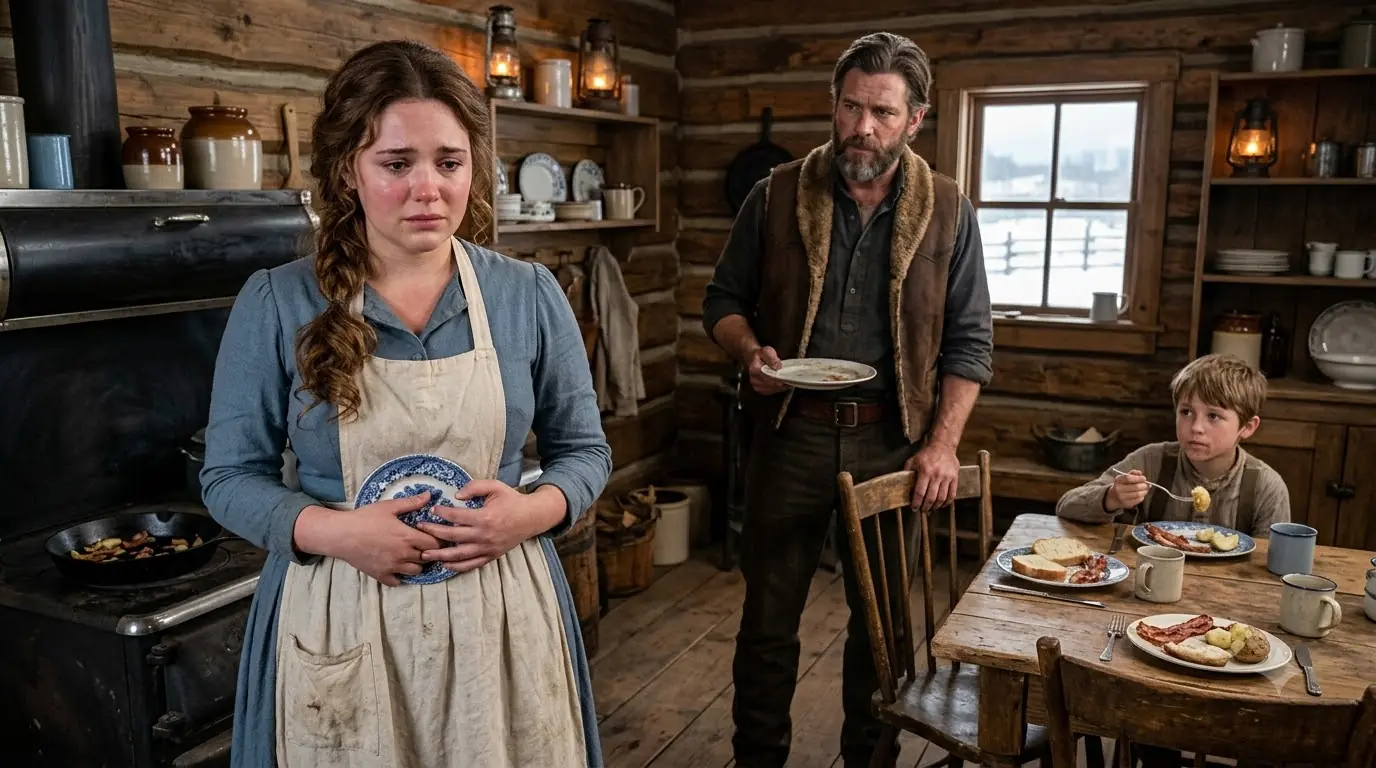
On the evening of their wedding, Eliza cooks supper for Grant and Samuel. When the men sit down, Grant notices there are only two plates.
Eliza has prepared nothing for herself.
Instead, she stands beside the stove holding a chipped saucer and quietly asks whether she may eat the burned potatoes and bacon grease left in the skillet.
Grant initially thinks she is being overly polite.
Then he pushes back his chair.
Eliza flinches before he even speaks.
Her shoulders fold inward. Her eyes drop. She looks exactly like someone preparing to be punished for admitting she is hungry.
Grant realizes this is not modesty.
It is training.
He places his untouched plate in front of her, pulls out a third chair, and tells her that nobody living under his roof will survive on scraps while food remains on the table.
Eliza cries after the first bite.
Over the following weeks, Grant discovers more disturbing habits. Eliza hides biscuits inside napkins because she fears food may disappear tomorrow. She apologizes before taking butter. She refuses second portions even when hungry. When Grant catches her eating alone after midnight, she immediately begins explaining how much work she completed that day, as though meals must be earned.
Yet Eliza is not weak.
She is clever with accounts, fearless with difficult horses, capable in the kitchen, and sharp enough to challenge Grant whenever his protective instincts become controlling. Their arranged marriage slowly becomes something far more intimate. Grant learns to ask before helping. Eliza learns that desire does not have to be payment for kindness.
Their attraction becomes impossible to ignore.
One night Eliza catches Grant staring at her mouth across the supper table and teases him that food clearly is not what he is hungry for. Grant tells her that if she keeps looking at him that way, neither of them is getting much sleep.
For the first time in Eliza's life, wanting something feels exciting instead of shameful.
Then an expensive carriage arrives at Red Willow Ranch.
The man inside is Augustus Harrow, Eliza's father.
Grant is stunned.
He had assumed Eliza grew up poor.
Augustus is one of Missouri's wealthiest grain merchants.
Eliza never starved because her family lacked food.
Their home possessed overflowing pantries, servants, imported fruit, fresh meat, and enough grain to feed entire towns.
Her father deliberately denied food to her.
After Eliza's mother died, Augustus became obsessed with his daughter's naturally full figure. He decided appetite reflected moral weakness. Whenever Eliza gained weight, questioned him, embarrassed him socially, or refused an arranged match, he removed her chair from the family table.
She was forced to serve everyone else and wait until the meal ended.
Only then could she eat what remained.
Sometimes nothing remained.
That is why Eliza asked Grant for scraps.
Augustus has not come merely to retrieve his daughter. Eliza's late mother left her a substantial inheritance to be released when Eliza married or reached twenty-five. Augustus had planned to keep control of that money by marrying her to his business associate.
Eliza ruined the plan when she secretly answered Grant's matrimonial advertisement and married a stranger hundreds of miles away.
Augustus offers Grant money to send her back.
Grant refuses.
Then he makes one mistake.
He tells Augustus that Eliza is staying before asking Eliza what she wants.
Eliza turns on her husband.
She tells him that defending her by taking away her decision is only a gentler version of the same cage.
Grant immediately understands.
He steps aside.
And asks his wife what she wants.
Eliza chooses Red Willow Ranch.
Not because Grant rescues her.
Because nobody there requires her to become smaller before she is allowed to belong.
When records from her mother's estate finally arrive, they reveal one last secret: her mother had known exactly what Augustus was doing. Before dying, she created a separate trust specifically so Eliza would someday possess enough money to leave any household where food, shelter, or affection were used to control her.
Augustus had hidden the documents.
Eliza claims the inheritance in her own name.
She refuses to use it merely to make Grant wealthy. Instead, she becomes an equal financial partner in Red Willow Ranch on written terms she negotiates herself.
Years later, Samuel remembers the night Eliza first came to the ranch not because of the wedding.
He remembers the third chair.
Three plates.
Three cups.
And a woman who eventually stopped waiting for everyone else to finish before deciding she was allowed to eat.
The first thing Grant Mercer noticed was the missing plate.
Not Eliza's expression.
Not the chipped blue saucer in her hands.
Not even the strange way she remained beside the stove after serving supper.
The plate.
Two sat on the table.
One in front of Grant.
One in front of Samuel.
Both held thick slices of bacon, fried potatoes browned at the edges, beans warmed with onion, and biscuits that smelled better than anything Grant had eaten inside his own house in months.
Two cups stood beside them.
Two forks.
Two cloth napkins.
Two chairs had been pulled away from the table.
The third chair remained pushed against the wall.
Grant looked at it.
Then at his new wife.
Eliza Harrow Mercer stood beside the black iron stove with a little saucer held against her waist.
She had changed out of the traveling coat she wore during the ride from town, but she was still wearing the dark blue dress from their wedding ceremony that afternoon.
Her chestnut hair had loosened from its pins.
One curl rested against her cheek.
She looked exhausted.
Beautiful.
Nervous.
And hungry.
Grant had noticed the last thing before.
At the hotel after the wedding.
At the station.
During the wagon ride.
Whenever food appeared, Eliza looked toward it before deliberately looking somewhere else.
He had assumed nerves.
Everything about their marriage involved nerves.
They had known each other through letters for five months.
In person, less than eight hours.
Samuel sat across from Grant with his fork halfway toward his mouth.
The ten-year-old boy looked from Eliza to the table.
Then back.
He had noticed too.
Eliza cleared her throat.
“Is everything all right?”
Grant looked at his plate.
“Yes.”
Her shoulders relaxed slightly.
“I wasn't sure how crisp you liked the potatoes.”
“They look fine.”
“And the bacon?”
“Fine.”
Samuel said, “It's really good.”
Eliza smiled.
A real smile.
Small.
“Thank you.”