Dr. Simone Carter had been walking through Ashford Heights for fourteen minutes when Officer Daniel Mercer decided she looked suspicious.
There had been nothing dramatic about those fourteen minutes.
No argument.
No confrontation.
No running.
No shouting.
Simone had simply walked.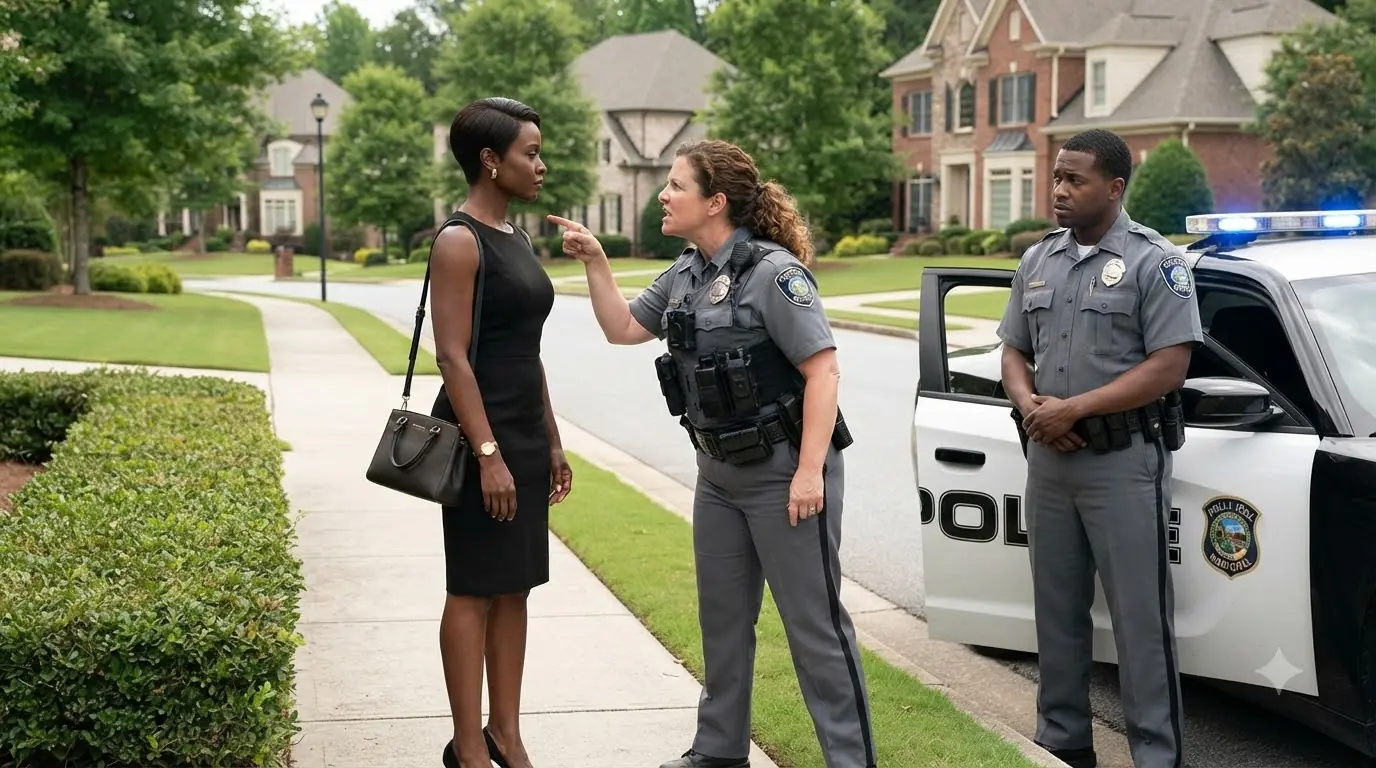
She started at the corner of Ashford Drive and Bellemont Lane shortly after ten on a clear Thursday morning, carrying a structured brown leather handbag on one shoulder and a slim government folder tucked beneath her arm.
The neighborhood looked almost aggressively peaceful.
Large Mediterranean-style homes stood behind trimmed hedges and decorative iron gates. The sidewalks were spotless. Sprinklers swept slowly over lawns so green they looked painted. White stone mailboxes carried brass numbers polished enough to catch sunlight.
A landscaping crew worked quietly near one driveway.
A woman in yoga clothes walked a small terrier.
Two contractors unloaded tile from a white van.
Nothing about the street suggested danger.
That was precisely why Simone was there.
Ashford Heights had generated eleven formal civil-rights complaints against the Riverton Police Department during the previous eighteen months.
Eleven complaints from one neighborhood was unusual.
The allegations were even more specific.
Pedestrian stops.
Vehicle questioning.
Requests for identification.
Questions about where people lived.
Questions about who they were visiting.
Questions about what work they were doing.
No arrests in nine of the incidents.
No citations in eight.
No contraband recovered.
Yet the people stopped shared a pattern.
Delivery drivers.
Contractors.
Home health aides.
A college student visiting a friend.
A Black attorney walking back from a neighborhood association meeting.
A Latino father waiting for his daughter outside a tutoring center.
A maintenance worker photographing a leaking irrigation line.
Different days.
Different times.
Different officers.
But four of the complaints contained the same badge number.
Officer Daniel Mercer.
Simone had read his name so many times during the previous week that she could recognize the shape of it before consciously processing the letters.
Mercer, Daniel J.
Badge 4172.
Seven years with Riverton Police.
No sustained disciplinary findings.
Two commendations.
One community-service award.
Three internal complaints closed as insufficient evidence.
Four external complaints currently under review.
On paper, he looked ordinary.
That was exactly the problem.
Civil-rights investigations rarely arrived with villains who announced themselves.
Most arrived as patterns.
Small decisions.
Discretion.
Repeated phrases.
A person stopped here.
Another questioned there.
An officer explaining that residents had been concerned.
A supervisor saying the officer had acted within broad policy.
Then everyone moved on.
Simone’s job was to determine whether moving on had become the problem.
At thirty-eight, she had worked for the state Civil Rights Oversight Bureau for almost nine years.
She had begun as an attorney.
Then moved into pattern-and-practice investigations.
Now she directed the bureau’s law-enforcement review unit.
Her doctorate was in public policy rather than medicine, though most people heard “Dr. Carter” and assumed physician until she corrected them.
She rarely bothered correcting strangers immediately.
Titles were useful.
They were also dangerous.
People behaved differently when they knew exactly which title could affect them.
That morning, Simone wanted something simpler.
Observation.
She wanted to walk the routes described in the complaints.
See sightlines.
Check distances.
Understand whether a person standing on one sidewalk could reasonably have appeared to be trespassing on another property.
Examine which homes had private security cameras.
Compare body-camera timestamps with locations.
No undercover operation.
No deception.
She wore her own clothes, carried state identification, and had notified the Riverton Police Department that state investigators would be conducting field work somewhere in the city that week.
She simply had not announced which investigator would be on which street at which hour.
The department knew.
The patrol officer running toward her apparently did not.
“Ma’am!”
Simone heard the shout behind her.
She continued two steps before stopping.
“Ma’am, stop right there!”
The second command was louder.
Sharper.
Simone turned.
A uniformed officer was moving quickly down the sidewalk toward her.
White male.
Mid-thirties.
Athletic build.
Dark hair clipped short.
Gray patrol shirt.
Black tactical belt.
Right hand near his radio.
Left hand extended toward her.
She did not need to see the badge number yet.
She knew.
Daniel Mercer.
Interesting.
He closed the distance.
Simone remained where she was.
A woman watering pink flowers two houses away looked up.