The sound was surprisingly small.
After twenty-two years in the United States Army, Sergeant Major David Hayes had heard artillery crack across desert valleys, rotor blades beat the air until conversation became impossible, rifle fire snap against concrete, and the concussive roar of an armored vehicle exploding close enough to throw grown men onto their backs.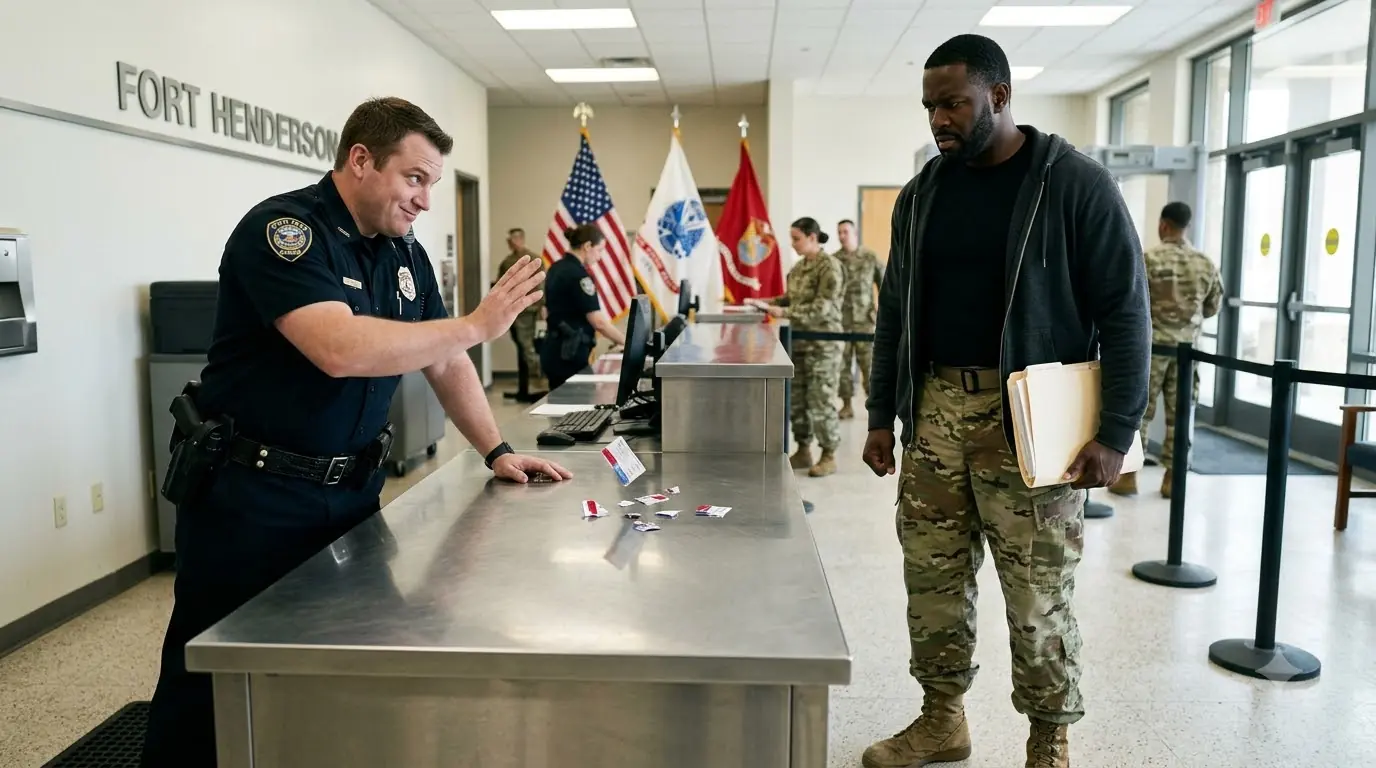
Yet the sound he would remember from his final week in uniform was nothing like any of those things.
It was the quiet tearing of laminated paper.
Rrrrip.
Officer Greg Jenkins looked down at the military retirement credential between his hands, tore it once more through the center, and dropped the pieces onto the stainless-steel security counter.
“There,” Jenkins said. “Now you can stop pretending.”
David did not move.
The bright lobby of Fort Henderson’s Central Administrative Annex continued functioning around them.
Soldiers crossed the polished floor carrying folders.
Civilian employees passed through metal detectors.
A young lieutenant hurried toward an elevator with coffee in one hand and a phone in the other.
Two American flags stood near the far wall beside the dark blue Army flag.
A television above the reception desk silently displayed installation announcements.
Everything looked normal.
That was what made the moment feel unreal.
David stared at the pieces of his credential.
His photograph had been torn directly through the left eye.
The Army seal remained on one half.
His name remained on the other.
DAVID E. HAYES.
SERGEANT MAJOR.
UNITED STATES ARMY.
RETIREMENT TRANSITION ACCESS.
Jenkins brushed the pieces toward him with two fingers.
“Take your souvenir and leave.”
David slowly raised his eyes.
He was forty-two years old.
Tall.
Broad through the shoulders.
Deep-brown skin.
Closely cropped black hair beginning to silver near the temples.
A short beard that Army regulations would have required him to shave if he were still reporting daily in uniform.
He was on terminal leave now.
That was why he wore a dark charcoal hoodie over a black thermal shirt instead of OCPs.
His trousers were still Army camouflage, old combat pants he used whenever he had errands on post.
The fabric had faded at the knees.
One cargo pocket had been repaired twice.
His tan boots were older than some of the soldiers walking past him.
Under one arm, David carried a worn brown folder containing medical evaluations, final transition documents, and one sealed envelope he had not yet decided whether he would open.
He had expected the morning to take twenty minutes.
Drop off the medical packet.
Sign two forms.
Return home.
Change into his dress uniform.
Attend his retirement ceremony at 1400.
Twenty-two years of service would end in a ballroom full of people he knew.
His wife would cry.
His daughter would pretend she was not crying.
His son would make an inappropriate joke at exactly the wrong moment.
David would receive a folded flag, say a few words, shake hands, and walk out of Fort Henderson without belonging to the Army for the first time since he was twenty.
That had been the plan.
Instead, he stood behind a security counter watching a white civilian police officer destroy a credential issued by the installation itself.
David placed the folder on the counter.
“Officer Jenkins.”
Jenkins’s expression changed slightly.
David had read his nameplate.
That seemed to irritate him.
“Yes?”
“Run the credential number.”
“I already told you it’s fraudulent.”
“You looked at it for six seconds.”
“I know what these are supposed to look like.”
“Then run the number.”
Jenkins leaned back.
He was thirty-eight, maybe forty.
Large neck.
Close-cropped light-brown hair.
Red complexion.
The thick forearms of a man who either lifted weights regularly or wanted people to think he did.
He wore the dark navy uniform of a Department of the Army civilian police officer, body armor under the shirt, badge centered above one pocket, nameplate over the other.
A black duty belt circled his waist.
The sidearm remained holstered.
David had noticed it anyway.
David always noticed weapons.
Twenty-two years had taught his eyes where danger lived before his mind consciously registered it.
Jenkins tapped the desk.
“I don’t take orders from people coming through my checkpoint.”
David’s jaw tightened.
“I didn’t give you an order.”
“Sounded like one.”
“I asked you to verify an identification card before destroying it.”
Jenkins gave him a thin smile.
“You came onto a military installation with questionable identification.”
“I entered through the main gate fifteen minutes ago.”
“That doesn’t mean anything.”
“The gate scanned my CAC record.”
“You don’t have a CAC.”
“I surrendered my active CAC yesterday. This is my transition credential.”
Jenkins looked at the shredded card.
“Was.”
David stared at him.
Behind the adjacent workstation stood Private First Class Elena Ruiz, a twenty-one-year-old military police soldier assigned to assist with administrative access that morning.
She had stopped typing.
David had noticed her the moment Jenkins first raised his voice.
Now Ruiz looked from the torn credential to David.
Then to Jenkins.
She appeared uncomfortable.
Good.
Discomfort meant she had not normalized everything yet.
David turned slightly toward her.
“Private.”
Ruiz straightened automatically.
Jenkins snapped:
“Don’t.”
David looked back at him.