Sarah Hayes noticed the speed-limit sign before Sheriff Boyd Cleary ever saw her car.
The highway dropped from sixty-five miles per hour to forty-five just outside Oak Haven, Virginia, a town small enough that the welcome sign shared space with advertisements for a tire shop, a church barbecue, and a high school football fundraiser.
Sarah eased her rented silver Chevrolet Malibu down to forty-four before the first row of buildings appeared.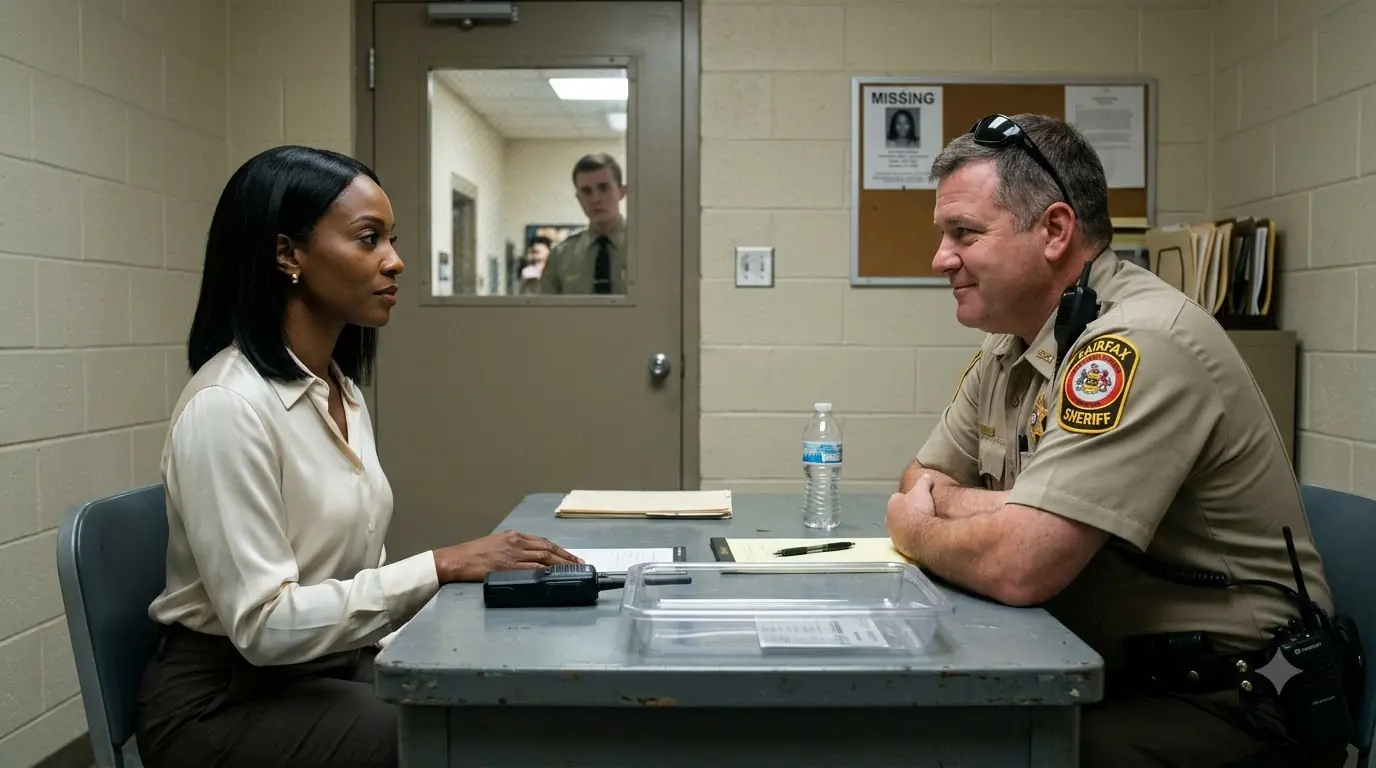
She had driven through enough places like Oak Haven to understand the pattern.
A long open highway.
A sudden speed reduction.
A faded billboard positioned conveniently beside a gravel turnout.
And, almost always, a patrol vehicle waiting somewhere nearby.
Sarah had no reason to hurry.
Her flight from Richmond was not scheduled until early evening, and she had deliberately given herself several extra hours.
After twenty-seven years of government service, she had learned that travel problems rarely arrived alone.
A delayed meeting became a delayed car.
A delayed car became a missed flight.
A missed flight became twelve people rearranging schedules.
So Sarah planned around chaos.
She always had.
That habit was one of the reasons she had reached forty-five years old without ever receiving a speeding ticket.
The other reason was simple.
Her father had taught her to drive.
James Hayes had spent thirty-six years as a postal carrier in Maryland and believed driving was a moral responsibility.
At seventeen, Sarah had complained that he checked his mirrors too often.
Her father had answered, “The person who thinks awareness is excessive is usually the person somebody else has to save.”
She still heard that sentence whenever she drove.
So when the speed limit dropped, Sarah slowed.
When the road narrowed, she centered the car.
When a school-zone warning appeared even though classes were not in session, she checked the time anyway.
And when she passed the weathered billboard at the edge of town, she saw the sheriff’s cruiser tucked behind it before the man inside had even lowered his radar gun.
Sheriff Boyd Cleary watched the silver Malibu pass.
The digital number on his radar display read forty-four.
Perfectly legal.
He looked at the Washington, D.C., rental registration displayed temporarily near the rear plate.
Then he looked at the driver.
Black woman.
Alone.
No passenger.
No local plates.
Boyd leaned back in his seat.
Beside him, Deputy Toby Miller was entering notes into a tablet.
“What?” Toby asked.
Boyd started the cruiser.
“Nothing.”
He pulled onto the road.
Toby looked up.
“What did she do?”
Boyd accelerated.
“She crossed the line.”
Toby looked through the windshield.
“What line?”
“The center.”
“I didn’t see that.”
“That’s why I’m sheriff.”
Toby said nothing.
He was twenty-six years old, three years into the department, and still learning that silence around Boyd Cleary was often less exhausting than disagreement.
Sarah noticed the cruiser two seconds after it appeared behind her.
She checked the speedometer.
Forty-four.
Rearview mirror.
Seat belt.
Road position.
All fine.
The cruiser remained behind her for almost half a mile.
Then the emergency lights came on.
Sarah exhaled once.
She activated her turn signal.
Checked the shoulder.
Moved completely off the travel lane.
Shifted into park.
Turned off the engine.
Lowered the driver-side window.
Then placed both hands on top of the steering wheel where they could be seen immediately.
Her breathing remained slow.
That part mattered.
Her father had taught her that too.
“Being calm won’t guarantee somebody else is reasonable,” he once told her. “But panic rarely improves your options.”
Sarah had spent most of her adult life inside rooms where panic created consequences measured in lives.
A roadside stop was small by comparison.
But the principle remained.
Boyd parked behind her.
Toby stepped out from the passenger side.
Boyd was already halfway to Sarah’s window before his deputy closed his door.
He wore mirrored sunglasses, a tan uniform stretched slightly tight across his stomach, and the slow swagger of a man who had learned that people moved differently when they saw his badge.
Sarah watched him approach through the side mirror.
He stopped beside the driver’s window.
“License and registration.”
No greeting.
No reason for the stop.
Sarah kept both hands visible.
“My license is inside my purse on the passenger seat. The rental agreement is in the glove compartment. May I retrieve them?”
Boyd studied her.
“Slow.”
“Of course.”
Sarah reached for the purse first.
She removed her wallet with two fingers.
Then, after receiving a nod, she opened the glove compartment and took out the rental paperwork.
Boyd accepted both.