The first thing Daniel Foster noticed when he stepped through his own front door was the smell of garlic bread.
The second was laughter.
That should have comforted him.
He had been gone for six days, three days longer than originally planned, because a contract negotiation in Chicago had collapsed twice before finally coming together that afternoon. He had spent the flight home imagining this exact moment: dropping his suitcase in the entryway, hearing his children somewhere inside the house, and surprising them two nights before they expected him.
Instead, Daniel stood quietly beneath the foyer light and listened.
His mother was laughing.
His sister Rebecca was laughing.
Rebecca’s husband Greg was saying something Daniel could not quite hear.
His fifteen-year-old son Noah sat somewhere beyond the wall because Daniel recognized the low murmur of his voice.
Then came the scrape of dinner plates against the dining table.
Daniel smiled.
He loosened his tie.
Six days away from home had been too long.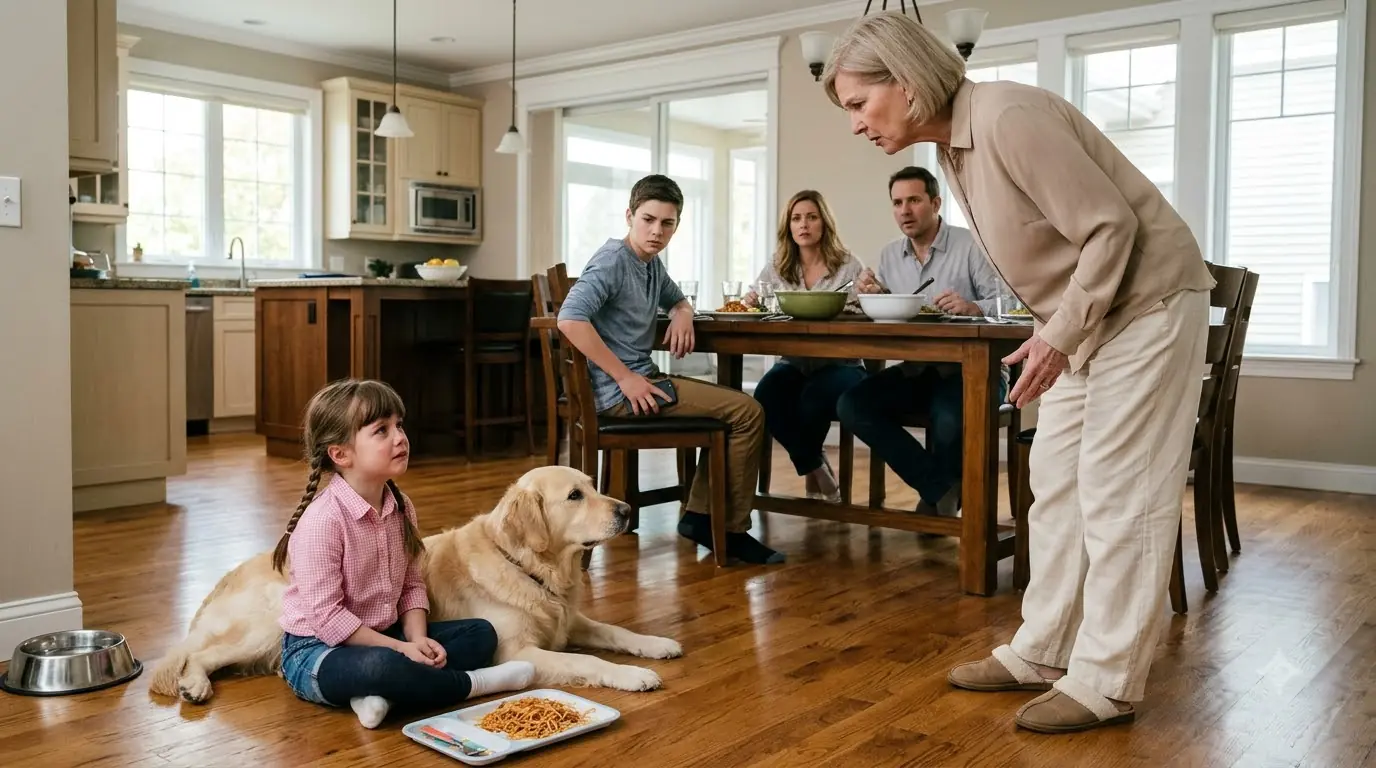
It always was.
The previous year had forced him into more travel than he wanted. His manufacturing company had grown from a regional operation into a national supplier almost faster than Daniel could restructure it. New customers meant new plants. New plants meant negotiations. Negotiations meant airports.
He hated airports.
His mother, Margaret, had repeatedly assured him that the children were fine.
“Stop worrying,” she would say. “I raised you and Rebecca. I’m perfectly capable of supervising two children.”
Daniel had believed her.
He had needed to.
Three years earlier, his wife Laura had died after an eighteen-month fight with ovarian cancer, leaving Daniel with a thirteen-year-old son and a three-year-old daughter.
Technically, Amelia was not Daniel’s biological daughter.
That fact mattered to precisely two kinds of people.
Lawyers handling the adoption.
And Margaret Foster.
Daniel had met Amelia when she was fourteen months old.
She had been living with a foster family after being removed from a home so unstable that nobody in Daniel’s family ever discussed the details around her.
Laura met her first.
Laura volunteered with a nonprofit that supported foster families. She came home one evening with tears in her eyes and said:
“There is a little girl who screams every time someone closes a door because she thinks they’re leaving.”
Daniel remembered answering:
“We cannot fix every terrible thing.”
Laura looked at him.
“No.”
Then she whispered:
“But maybe we can fix one.”
They became Amelia’s foster placement six months later.
Daniel resisted calling himself her father for nearly a year because he was terrified the court would move her again.
Amelia solved the question for him.
She was two and a half.
Daniel had come home from work covered in machine oil.
She ran across the kitchen, lifted both hands, and shouted:
“Daddy!”
That was it.
There was no legal argument after that.
Daniel and Laura formally adopted her eight months later.
Noah was eleven by then.
He had asked whether adoption meant Amelia was “really staying forever.”
Laura said yes.
Noah looked at his little sister, who was eating apple slices off his plate without permission, and replied:
“Okay. Then she needs to stop stealing my snacks.”
Family.
Simple.
At least Daniel had thought so.
Margaret attended the adoption hearing.
She smiled for photographs.
She brought Amelia a stuffed rabbit.
She never openly objected.
But Daniel remembered one conversation afterward.
Only one.
Margaret stood beside his car outside the courthouse and said:
“You know this changes Noah’s inheritance.”
Daniel stared at her.
“What?”
“She becomes legally equal.”
“Yes.”
“You’ve already transferred part of the company into the family trust.”
Daniel’s jaw tightened.
“She is my daughter.”
“I understand that emotionally.”
“No.”
He took a step closer.
“You either understand it or you don’t.”
Margaret had lifted both hands.
“I’m only thinking long-term.”
“So am I.”
Daniel never heard the argument again.
Laura was alive then.
Laura had a way of turning Margaret’s sharpness back on itself without raising her voice.
After Laura died, Margaret softened.
Or seemed to.
She cooked.
Helped with laundry.
Stayed overnight when Daniel traveled.
Sat beside Amelia during nightmares.
Attended Noah’s soccer games.
When Daniel’s company expansion required more travel, Margaret offered to move into the guest suite during the week.
Daniel hesitated.
She seemed offended.
“You would rather pay strangers?”
“I already have a nanny.”
“Your nanny leaves at six.”
“She stays late when needed.”
“Daniel, they need family.”
He had almost laughed at the word.
Instead, he let her help.
Two years later, standing in the foyer with his suitcase beside him, Daniel believed that decision had saved him.
For approximately forty-five more seconds.
He walked toward the dining room.
His mother’s voice carried around the corner.
“Noah, elbows.”
A pause.
“Sorry.”
Rebecca said:
“Mom, leave him alone.”
“He’s fifteen, not feral.”
Greg laughed.
A child laughed too.