By four-thirty on Christmas Eve, Owen Harper had exactly seventy-three dollars left in his checking account, a nine-year-old daughter waiting for him at the garage, and a foreclosure crew scheduled to take possession of everything he owned at eight o’clock the following morning.
He still stopped when he saw the stranded car.
That was the part his daughter would later insist mattered most.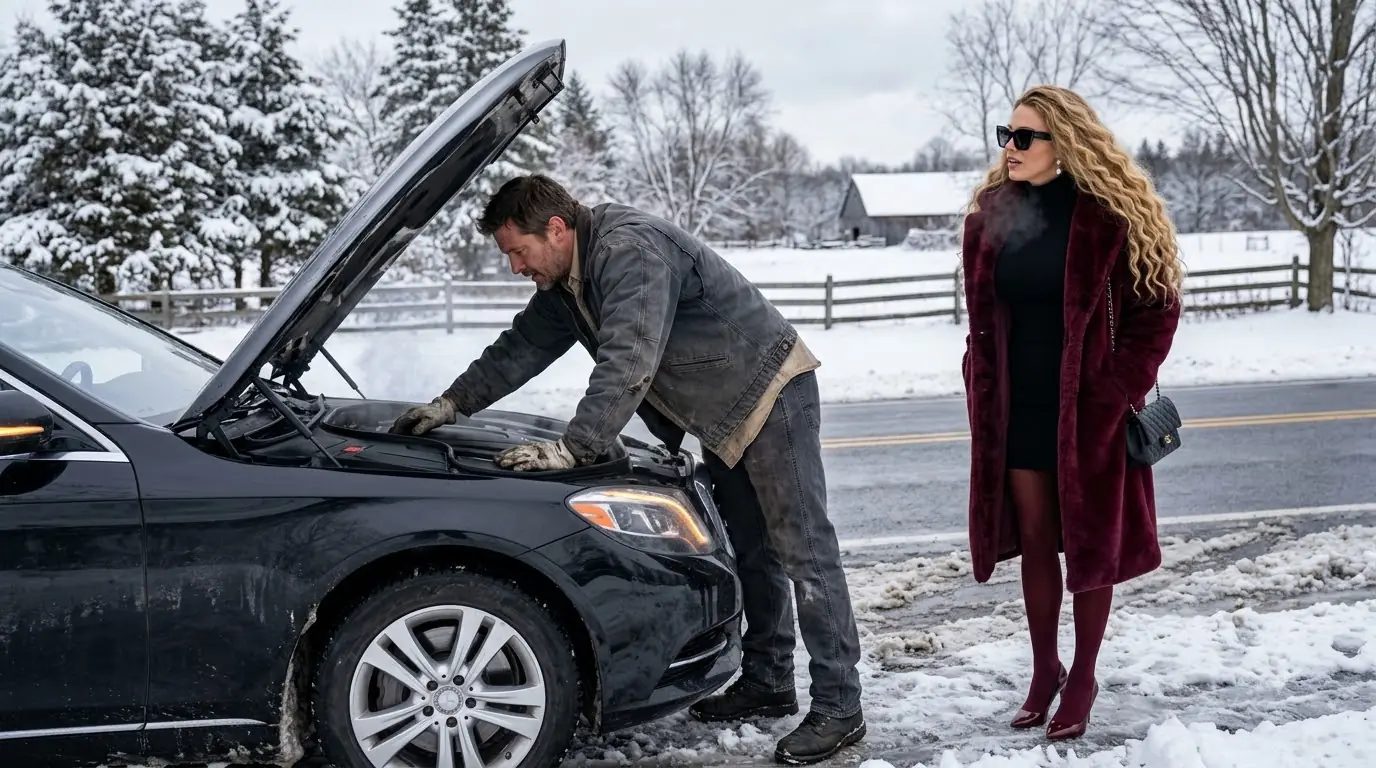
Not the woman standing beside it.
Not her money.
Not the company whose name appeared on the foreclosure notice folded inside Owen’s toolbox.
Just the fact that his truck was moving through blowing snow on an empty Ohio county road, he saw hazard lights blinking through the white, and he pulled over.
Owen did not know that the woman beneath the roadside trees was Celeste Vale.
He had heard the name.
Everybody in Ohio who owned a small business had heard it lately.
Vale North Capital had spent the last two years buying distressed commercial loans from regional banks, equipment lenders, and private finance companies. Its advertisements spoke about “preserving local enterprise through disciplined restructuring.”
Owen had different words for it.
Most of them were not suitable for Christmas Eve.
He climbed out of his nineteen-year-old pickup and pulled the collar of his faded charcoal work jacket against the wind.
The black luxury sedan ahead of him looked almost absurd against the snow-covered road.
Its hood remained closed.
Its headlights were on.
Steam did not rise from the front.
A woman stood beside the driver’s door.
Even from twenty feet away, Owen could tell she belonged somewhere that did not involve freezing beside Route 17.
She had long honey-blonde hair spilling from beneath the collar of a deep-burgundy fur coat. Under it, he could see the high neck of a fitted black dress. Burgundy tights disappeared into pointed heels that were useless on ice. Large black sunglasses covered half her face despite the gray sky.
A small quilted handbag hung from one gloved hand.
She watched him approach with a calm expression that suggested she was accustomed to strangers arriving because she had requested them.
Owen stopped several feet away.
“You all right?”
The woman looked toward his pickup.
Then toward him.
“I’m beginning to think that depends on whether you know anything about engines.”
Owen glanced at the sedan.
“Enough to make bad life decisions.”
For the first time, her mouth moved toward a smile.
“The car simply lost power.”
“When?”
“Five minutes ago.”
“Anything happen first?”
“A warning light.”
“Which?”
She hesitated.
“Red.”
“That narrows it to every expensive problem.”
The smile became real.
Owen nodded toward the hood.
“Pop it.”
She reached inside.
The hood released.
Owen lifted it.
He immediately recognized the engine family.
High-output six-cylinder.
Complex electrical management.
Far more sensors than any machine needed to move four wheels down a road.
He put his toolbox on the wet shoulder.
The woman came closer.
Snow collected across the shoulders of her coat.
“You’re a mechanic?”
“Sometimes.”
“That sounds evasive.”
“Depends what day you ask.”
She opened a large black umbrella.
Owen looked up.
“You know snow comes sideways.”
“I noticed.”
She angled it over him anyway.
He leaned into the engine compartment.
“Try starting it.”
The engine turned.
Caught.
Shuddered.
Died.
Owen listened.
Again.
Same.
“Stop.”
She returned.
“Fuel?”
“Maybe.”
He checked a connector.
“Electrical’s more likely.”
“How long?”
“If you need me to lie, fifteen minutes.”
“And if I don’t?”
“No idea.”
She folded one arm.
“I appreciate accuracy.”
“That makes one of us.”
Owen reached deeper into the engine bay.
Cold metal burned through his gloves.
His fingers found a loose connection beneath the alternator harness.
There.
Not broken.
Not exactly.
The locking tab had not seated properly after service, allowing vibration to work the connector loose.
He looked at the woman.
“When was this serviced?”
“Yesterday.”
“Dealer?”
“Company garage.”
“Whoever did it didn’t seat this.”
Her expression changed slightly.