Graham Calder had learned over the years that bad news usually approached quietly.
A horse going lame did not announce itself with a broken leg. First came a shortened stride. A ranch hand planning to leave did not usually quit during an argument. He started looking toward the road whenever the mail wagon passed. A winter that killed cattle rarely began with the worst storm of the season. It began with grass curing badly in September and an early frost settling where it should not.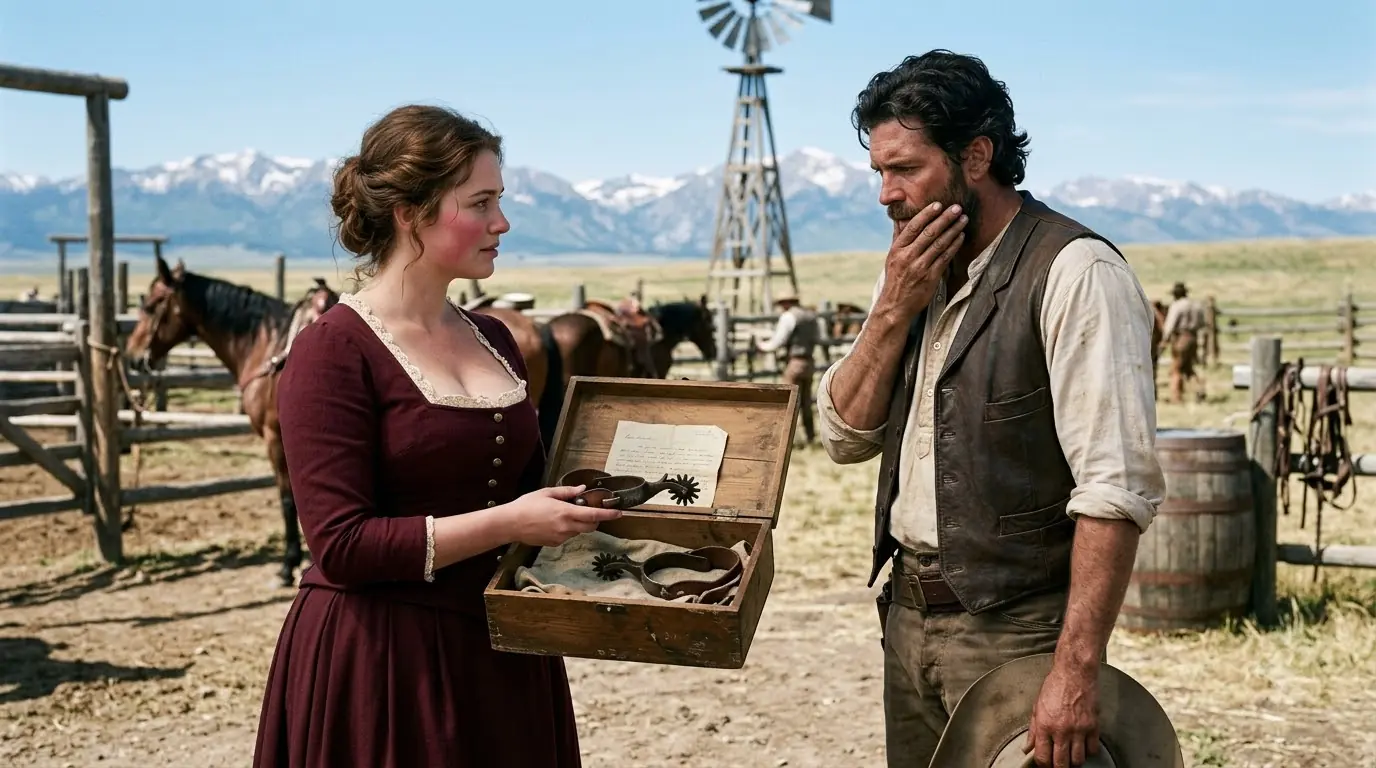
So when the young woman in the burgundy traveling dress walked across the Morrow Creek Corral yard carrying a cloth-wrapped parcel against her chest, Graham knew before she spoke that something had already happened.
He had a young bay colt's foreleg braced between his knees, checking a shoe that had loosened that morning. He set the hoof down carefully and straightened.
She stopped several feet away.
Dust dulled the lower hem of her dress, and the road had loosened strands of chestnut hair from the knot at the back of her head. She was younger than he first expected, perhaps twenty-eight, with a composed face that looked as though composure had required effort for most of the journey.
Her eyes searched his.
“You're Graham Calder.”
Not a question.
“I am.”
He wiped his hands on his trousers.
“Something I can do for you, miss?”
The woman tightened her hands around the parcel.
“My name is Lila Bennett.”
Graham waited.
She drew one breath.
“Your mother asked me to find you.”
Nothing visible changed in Graham.
Inside, everything did.
The corral yard continued around them. A wagon rolled through the gate. A hand shouted something about a hinge. One of the horses in the east pen struck a rail with its hoof.
Graham heard every sound with terrible clarity.
“My mother.”
Lila nodded.
“She wasn't well when she asked.”
The past tense reached him before the rest.
Graham's hands went still.
Lila saw.
Her voice softened.
“She died three weeks ago.”
Graham looked at her.
No grief came at first.
No tears.
Not even disbelief.
Only irritation so sudden and sharp it almost felt like heat.
“Three weeks.”
“Yes.”
“And you rode all the way up here.”
“Most of it.”
“Why?”
She looked down at the parcel.
“Because I promised.”
Graham laughed once without humor.
“Of course you did.”
Lila did not defend herself.
That annoyed him more.
She unwrapped the cloth.
Inside lay a folded letter and a pair of riding spurs.
Graham stared.
The metal had been cared for. Old, but not rusted. Leather straps stiffened with age but still usable.
He knew immediately they had never been his.
“These weren't mine.”
“They were bought for you.”
His eyes lifted.
“When?”
“I don't know everything yet.”
“What does that mean?”
“It means exactly what I said.”
There was something in her tone now. Not fear. Not apology.
Boundaries.
Graham disliked those too, mostly because they resembled his own.
She held out the letter.
“This part is yours.”
He took it.
The handwriting stopped him.
He had not seen it in six years.
His mother's writing had always leaned slightly forward, as if even words on a page ought to get where they were going without wasting time.
He turned the envelope over.
No seal.
Already opened.
His jaw tightened.
Lila saw.
“She asked me to read it before I left.”
“Why?”
“To make certain there was nothing in it she expected me to explain.”
“Was there?”
“No.”
“Convenient.”
Her expression sharpened.
“I rode across two territories carrying news I knew you might hate me for delivering. If you're looking for somebody convenient to blame, Mr. Calder, I recommend choosing someone who isn't standing here because she kept her word.”
Graham looked at her.
For the first time, something almost like respect entered the anger.
Then Silas Boone appeared from the tack shed.
He was sixty-two, gray-bearded, lean, and one of the few men alive Graham trusted enough to leave his back exposed around.
Silas looked from Graham to Lila.
Then to the letter.
His expression changed.
He knew.
Graham understood that immediately.
“You know something.”
Silas stopped.
“I know her handwriting.”
“That isn't what I asked.”
Silas's eyes met his.
“No.”
Graham waited.
Silas continued.
“I know enough to stay out of the first ten minutes.”
That answer was so completely Silas that Graham almost smiled.
Almost.
He turned toward the tack room.
“I need somewhere quiet.”
Silas nodded.
Graham entered alone.
He sat on an overturned bucket.
For several seconds he held the letter without opening it.
Then he unfolded the page.
Graham,