The first person to tell the Black teenager that she did not belong in first class was not an airline employee.
That almost made it worse.
He was simply a stranger.
A stranger who had looked at her for perhaps four seconds before deciding he understood enough about her to tell her where she belonged.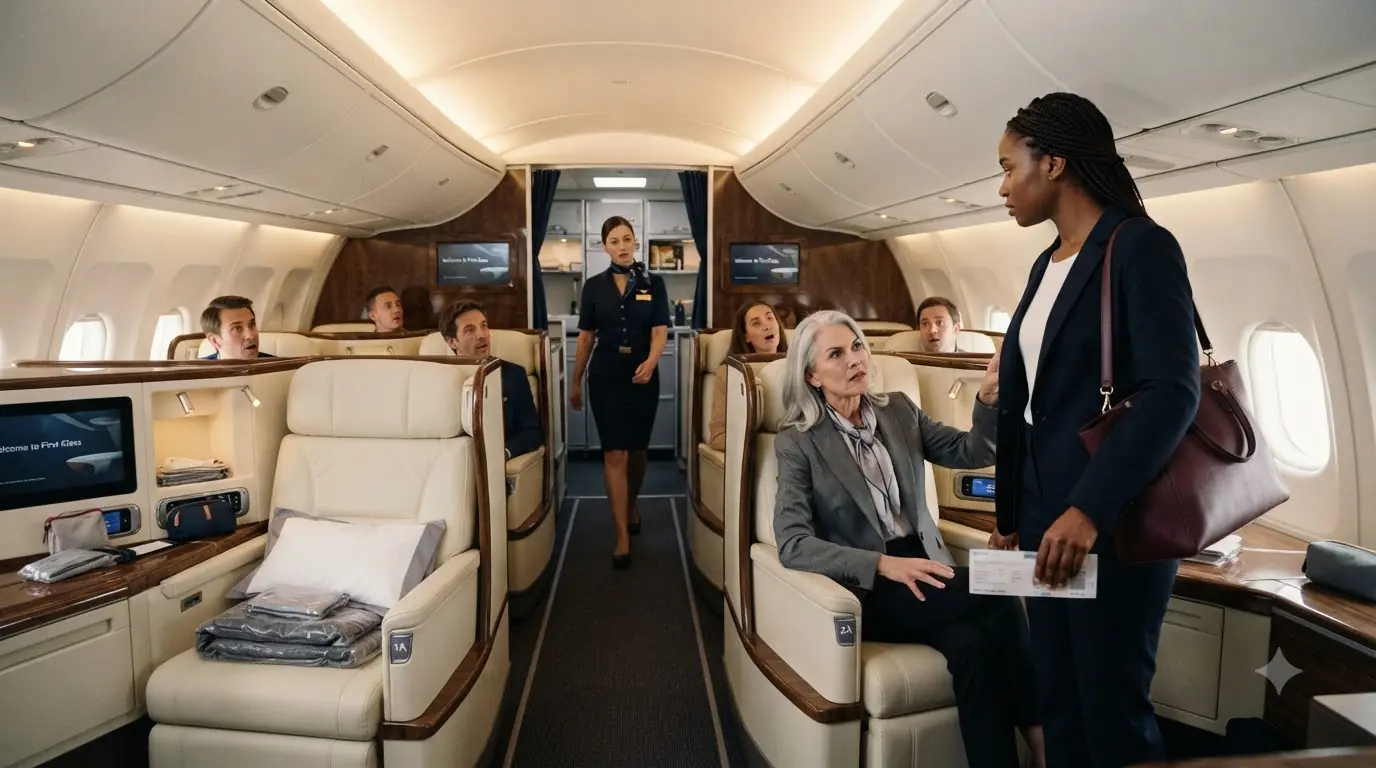
Flight 212 was still boarding at John F. Kennedy International Airport when the fourteen-year-old stepped into the aircraft.
She carried one burgundy travel bag.
A charcoal backpack rested over one shoulder.
Her passport sat inside a slim document wallet beneath her sweater.
And in her right hand was the boarding pass she had checked at least six times since entering the airport.
Seat 2A.
First class.
Window.
Her father had booked it himself.
She had originally complained about that.
“I don’t need first class.”
Her father had barely looked up from the tablet on his desk.
“You’re flying overnight by yourself.”
“I flew alone last summer.”
“Domestic.”
“It still had wings.”
That had made him smile.
“This is international.”
“So?”
“So I want you somewhere the cabin crew can keep an eye on you.”
“I’m fourteen, not four.”
“I noticed.”
She had folded her arms.
He had finally set the tablet aside.
“Listen.”
The change in his tone had stopped the argument.
Not because it became stern.
Because it became serious.
“You’re capable.”
“I know.”
“You’re smart.”
“I know.”
“You’re also still my daughter.”
She had tried not to smile.
“That sounds like your problem.”
“It is an expensive problem.”
She had laughed.
He had not changed the ticket.
So now she was boarding Flight 212 wearing a charcoal sweater, tailored trousers, and black sneakers while adults in polished shoes and business suits moved around her.
The first-class cabin was quiet compared with the main cabin behind it.
Cream leather seats.
Walnut trim.
Wide armrests.
Personal lamps.
Passengers speaking softly into phones before departure.
The Black teenager stopped beside row two.
Her boarding pass said 2A.
The small illuminated number beside the window said the same.
Someone was already sitting there.
A white executive in his late fifties occupied the seat as if he had been there for hours.
Silver hair.
Custom pinstripe suit.
Expensive watch.
Polished leather shoes.
A briefcase rested across his knees.
His suit jacket had been folded carefully beside him.
A financial newspaper waited on the console.
He did not appear lost.
That was the teenager’s first observation.
Her second was that seat 2B, immediately beside him, was empty.
She stood in the aisle.
“Excuse me.”
The executive looked up.
His eyes moved first to her face.
Then her clothes.
Then the burgundy bag.
Then behind her.
As if searching for the adult who must have accompanied her.
No adult appeared.
The teenager lifted her boarding pass.
“I think you’re in my seat.”
The executive barely glanced at the paper.
“No.”
She waited.
That was all he said.
“No.”
She checked the number again.
“Mine says 2A.”
The executive looked toward the rear of the aircraft.
“Economy is farther back.”
The teenager said nothing for a second.
At first, she wondered whether she had misunderstood.
Maybe he thought she had asked where economy was.
Maybe he had not heard.
Then he looked directly at her.
“You don’t belong in first class.”