The apple pie was still warm when Clara Whitmore crossed Willow Creek.
She carried it inside the old blue-and-white dish Samuel had bought her during their first winter in Wyoming, wrapped beneath a square of clean linen to keep the October wind from stealing the heat. Cinnamon and brown sugar escaped through the cloth with every step, making the walk feel warmer than it was.
The bridge complained beneath Clara’s boots.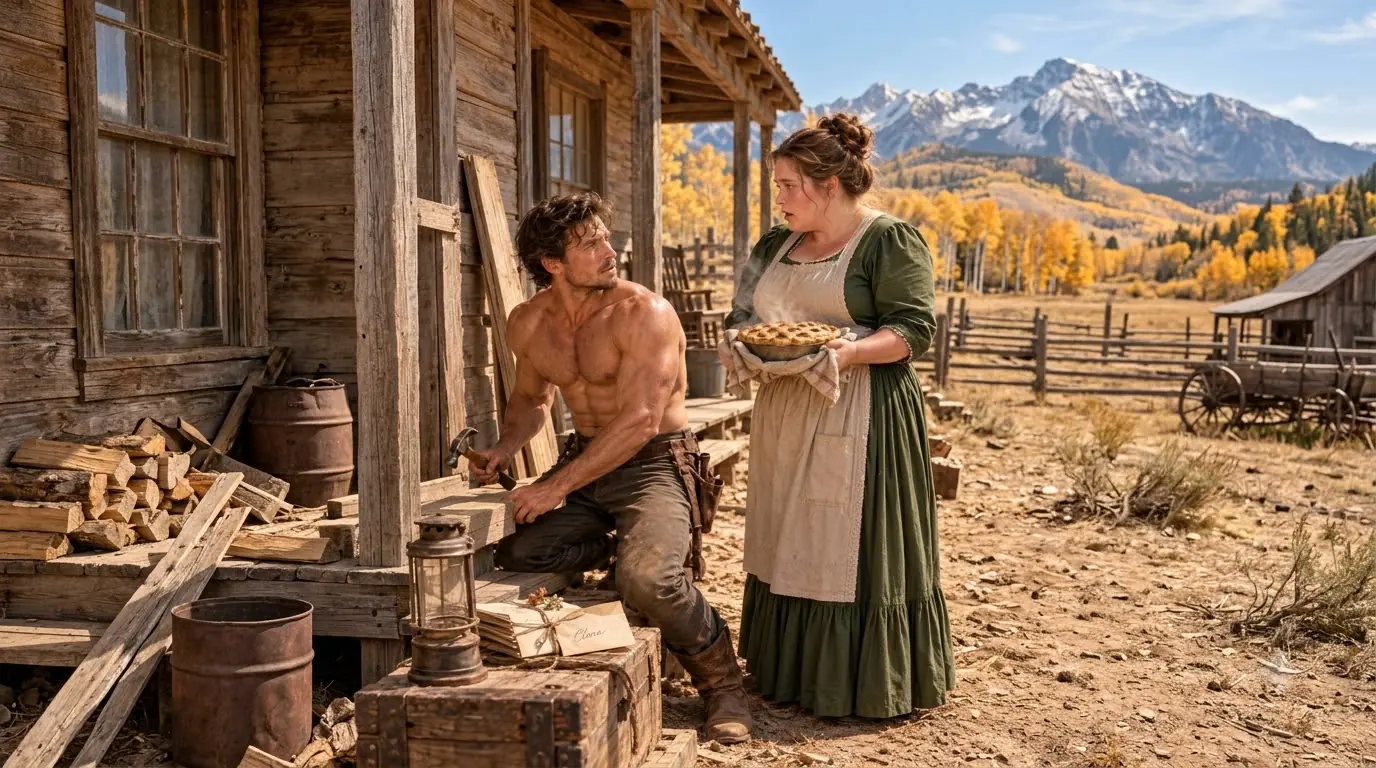
It was a narrow wooden thing, built before the flood of 1881 and repaired so many times that no two planks were the same age. Beneath it, Willow Creek moved dark and cold between yellow cottonwoods, carrying fallen leaves toward the distant Platte.
Clara stopped halfway across.
On the opposite bank stood the abandoned Rourke ranch.
For nearly four years, nobody had lived there.
The house was long and low, built from sun-darkened pine, with a porch leaning slightly toward the south and a barn whose doors never seemed entirely closed. Samuel used to say the place looked as though it were waiting for somebody stubborn enough to forgive it.
Three mornings earlier, smoke had risen from the chimney.
Then Clara had seen a horse.
A magnificent chestnut gelding.
Yesterday, hammering had echoed across the creek until sunset.
Somebody had finally bought the place.
Clara knew what it felt like to arrive somewhere without anyone waiting.
So she had made a pie.
That was all.
At least that was what she told herself.
She adjusted the dish against her hip and continued across.
At thirty-one, Clara had become accustomed to doing most things alone.
Two years earlier, fever had taken Samuel in less than nine days. One morning he had been complaining that the north fence needed replacing. A week later Clara had been sitting beside their bed listening to his breathing become slower.
People told her time would soften grief.
They were wrong.
Time simply changed its shape.
In the beginning, grief had been enormous and impossible to ignore. It filled every room, sat beside her at supper, followed her into sleep.
Later it became smaller but cleverer.
It hid in ordinary things.
Samuel’s coffee cup.
A loose hinge he would have repaired.
The empty place beside her at church.
The first snow.
A joke she would turn to tell him before remembering there was nobody there.
Clara had learned to live around those moments.
She chopped wood.
Mended fences.
Kept chickens.
Managed the Whitmore property.
Paid taxes.
Baked bread.
Fought loneliness with work until exhaustion carried her into sleep.
Then, almost a year ago, Mrs. Delaney at the general store had handed her an unusual newspaper.
On the back page was a small notice.
CORRESPONDENCE FOR WESTERN SETTLERS.
Respectable men and women wishing for friendship and thoughtful conversation may write through the Western Hearth Exchange. Addresses withheld for privacy.
Clara had laughed.
Then taken the paper home.
Three evenings later, she wrote.
She expected nothing.
Two weeks afterward, a letter arrived.
The handwriting was strong and slightly slanted.
The man signed only:
Thomas.
His first letter contained no foolish promises.
No questions about Clara’s land.
No attempt to flirt.
He wrote about snow.
About a stubborn horse named Bishop.
About missing good coffee on long cattle drives.
Then he asked:
What is something you miss that you do not tell people you miss?
Clara stared at that question for nearly an hour.
Finally she answered:
Noise.
I miss being annoyed that another person is making too much of it.
Thomas wrote back:
Then I hope someday somebody makes enough noise in your house to irritate you properly.
She smiled when she read it.
The letters continued.
Every week.
Sometimes twice.
Thomas knew Clara was widowed.
He never treated Samuel as competition with a dead man.
He asked about him.
What made Samuel laugh?
What did he cook badly?
What did Clara miss most?
No one else asked questions like that.
Most people seemed uncomfortable hearing a widow say she had once been happy.
Thomas listened through ink.
Clara listened too.
She learned he worked horses.
That he had spent years moving cattle between Wyoming and Montana.
That his mother died when he was nineteen.
That he could repair almost anything made of wood but consistently burned biscuits.
That thunderstorms made him restless.
That he had once broken three ribs after being thrown from a horse and finished the day because he was too proud to admit he could barely breathe.
He never told her exactly where he lived.
She never told him precisely where Willow Creek was.
Privacy had been part of the correspondence exchange.
That made the letters safer.