The people of Oak Haven laughed before Mayor Horus Abernathy finished his sentence.
That was what Meadow Green remembered most clearly years later.
Not the dust blowing across the Founders Day square. Not the faded bunting tied between the mercantile and the blacksmith shop. Not even the enormous injured stranger lying strapped to the flat wagon near the courthouse steps.
She remembered the laughter.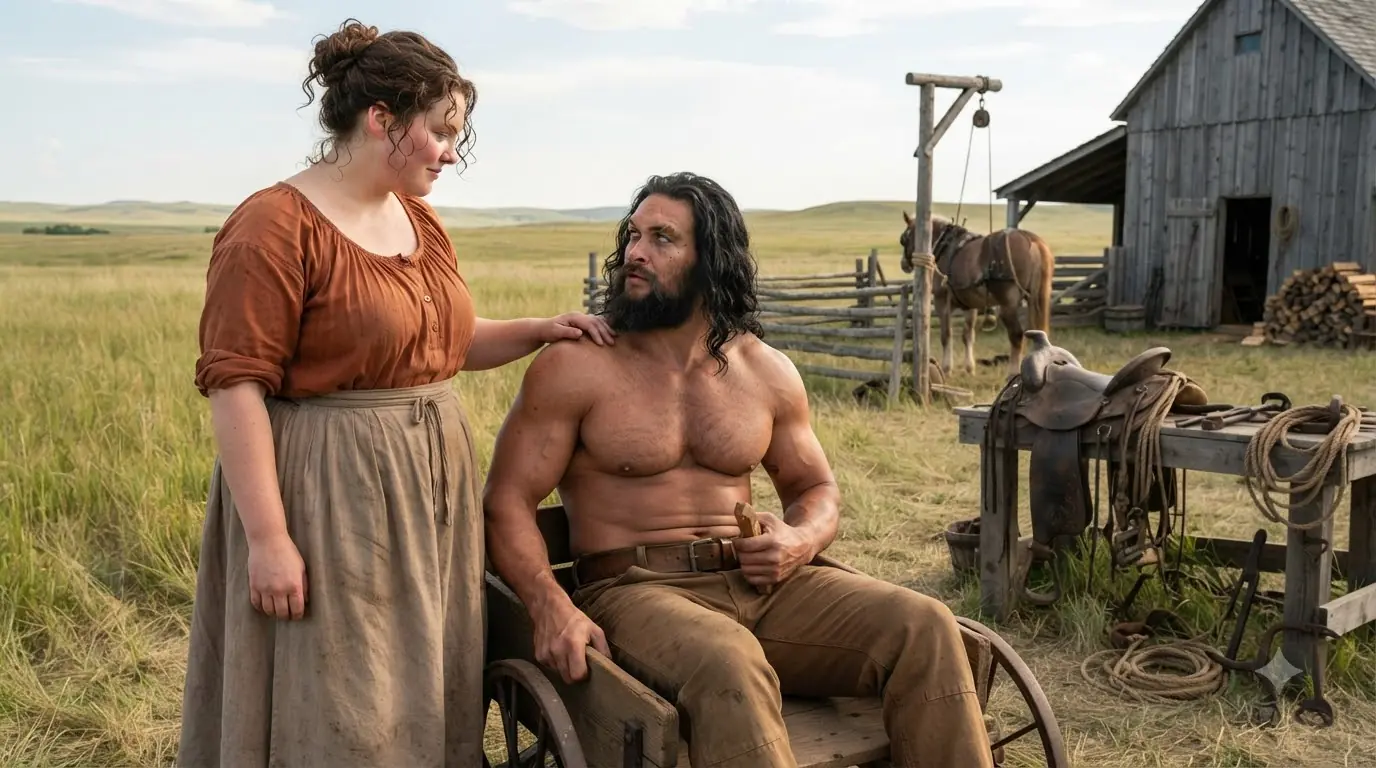
It rolled across the square in waves, starting with a few men near the saloon and spreading outward until women hid smiles behind gloved hands and children laughed because their parents were laughing.
Meadow stood near the back of the crowd holding a sack of flour against one hip.
She knew that laughter.
She had heard versions of it her whole life.
At fourteen, when a dressmaker complained she needed twice the fabric of other girls.
At seventeen, when boys whispered that anyone courting Meadow would need a wagon reinforced.
At twenty-three, when Samuel Green married her and several women openly wondered what he saw in a woman “built like a harvest barrel.”
Then again after Samuel died.
The laughter became quieter after widowhood.
Pity replaced some of it.
Cruelty remained.
Now Mayor Abernathy stood on the courthouse steps with his thumbs tucked beneath his suspenders and a grin stretched across his face.
Beside him rested the wagon.
On it lay the largest man Meadow had ever seen.
Even injured, even flat on his back beneath a wool blanket, he looked built from something harder than ordinary flesh.
Broad shoulders.
Massive arms.
Dark hair hanging almost to his shoulders.
A thick beard.
His face was pale beneath sun-browned skin, and pain had carved deep lines around his mouth.
Leather straps held his lower body steady.
His boots rested uselessly against the wagon boards.
He did not look at the crowd.
He stared at the sky.
The mayor turned toward Meadow.
“Well, Widow Green,” he called, “Oak Haven might finally have found you a husband who can't run away.”
The laughter exploded.
Meadow felt heat move from her throat to her cheeks.
Her grip tightened around the flour sack.
The stranger's eyes closed.
That was all.
No anger.
No protest.
Just one slow closing of the eyes.
Somehow that hurt Meadow worse than the joke.
Mayor Abernathy continued.
“Jedediah Boone here used to be a mountain man. Trapper. Timber cutter. Supposedly strong enough to carry half a mule when the other half got stubborn.”
More laughter.
“Then a pine tree decided it was stronger.”
A few men whistled.
The mayor slapped the wagon rail.
“Can't feel his legs now. Can't work. Can't ride. Can't do much except eat, from what we've discovered.”
Jedediah's eyes opened.
This time he looked directly at the mayor.
The expression chilled Meadow.
Pride.
Not wounded pride.
Something sharper.
The look of a man memorizing an insult because he had no way to answer it yet.
Mayor Abernathy turned back toward the crowd.
“Town's been feeding him three weeks. Doctor says he won't walk again. Nobody wants him.”
His gaze found Meadow.
“And since Widow Green's got more land than livestock these days…”
The laughter started again before the sentence ended.
Meadow put the flour sack down.
People noticed.
The laughter softened.
She walked forward.
Someone whispered her name.
She ignored it.
When she reached the wagon, she looked down at Jedediah.
Up close, he seemed even larger.
His left cheek was healing from an old bruise.
A scar ran from his shoulder toward his chest.
His pale blue eyes studied her without expectation.
He spoke first.
His voice was deep but rough.
“You don't have to.”
That surprised her.
She looked toward the mayor.
Abernathy grinned.
Meadow looked back at Jedediah.
“What happens if nobody takes you?”
His jaw moved once.
“Poorhouse, maybe.”
“And after that?”
He gave the slightest shrug.
“Ground eventually.”
Nobody laughed.
Meadow asked, “Can you use your hands?”
The mayor snorted.
“Widow, unless you're planning to have him knit—”
Meadow turned her head.
“Mayor.”
Something in her tone stopped him.
She looked back at Jedediah.
“Can you?”
He raised one enormous hand.
Opened and closed it slowly.
“Yes.”
“Arms?”
“Yes.”
“Mind?”
A faint expression almost became a smile.
“Depends who asks.”
Meadow nodded.
“I'll take him.”
The square went silent.
Even Mayor Abernathy blinked.
Then laughter returned uncertainly.
He stepped down.
“You serious?”