Everyone inside the stagecoach was praying for the baby to stop crying.
Caleb Warren was terrified of what would happen if he did.
Three-week-old Samuel had not truly eaten since the previous morning. The child had taken two weak swallows from a bottle at sunrise, turned his tiny face away, and spent the next several hours screaming until each cry became thinner than the one before it.
By the third day of the journey toward Fort Collins, Caleb had begun measuring hope in seconds.
Two seconds with the nipple between Samuel’s lips.
One swallow.
A shallow breath.
Then nothing.
“Please, son,” Caleb whispered.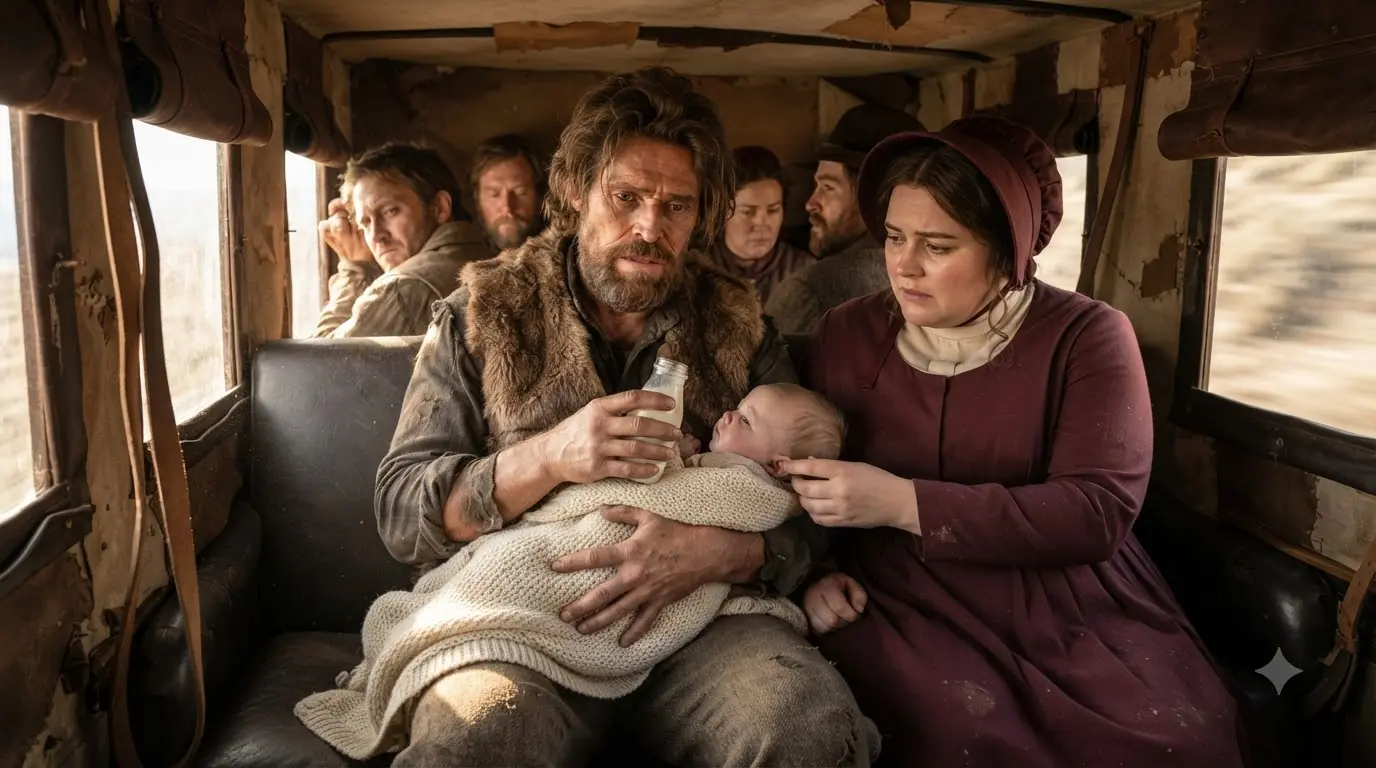
He had unfastened the front of his rough fur vest because Samuel sometimes settled when placed directly against his chest. The tiny boy now rested against the warmth of his skin, bundled in a cream wool blanket despite the heat trapped inside the coach.
Caleb’s enormous hand covered almost the entire back of the infant’s body.
“Just drink.”
The stagecoach struck a rut.
Wood groaned.
Leather straps swung overhead.
Dust streamed through narrow cracks around the doors while six passengers rocked violently from side to side.
Samuel began crying again.
A traveling salesman named Pritchard pressed both hands against his temples.
On the first day, the man had offered advice.
On the second, sympathy.
By the third, neither remained.
“Surely there's something else you can do.”
Caleb slowly lifted his eyes.
The salesman immediately looked toward the window.
Caleb was accustomed to that reaction.
At thirty-three, he was large even by frontier standards. Years of moving timber, livestock, and stone had broadened his shoulders and thickened his arms. A dark beard covered most of his face, and several days without proper sleep had made his gray eyes look almost savage.
Men often interpreted his silence as anger.
Today, Caleb had no strength left for either.
“If you know something I haven't tried,” he said quietly, “tell me.”
Pritchard swallowed.
“I only meant—”
“I know what you meant.”
Samuel’s cry broke into a cough.
Caleb looked down immediately.
The anger disappeared.
“Easy.”
Across from him sat Mrs. Henderson, the wife of a Methodist minister. Her lips moved silently as she prayed.
Beside her sat the only passenger who had said almost nothing in three days.
Eliza Moore.
Caleb knew her name only because the driver had shouted it when she boarded in Julesburg.
She looked around thirty.
Her dark-brown hair was hidden beneath a deep-red bonnet, though several loose strands had escaped beside her cheeks. A plain burgundy traveling dress covered her from throat to ankle. She was a large woman, perhaps near three hundred pounds, soft and broad through her shoulders and hips, yet she had spent the entire journey trying to occupy less space than her body naturally required.
Whenever Pritchard looked irritated by Samuel’s crying, Eliza lowered her head.
Whenever Samuel screamed, something happened to her face.
Caleb had noticed it on the first day.
Pain.
Not annoyance.
Pain so immediate that she seemed to stop breathing.
Then she always buried it.
Samuel began crying harder.
Eliza’s hands tightened in her lap.
Caleb dipped the bottle nipple into the milk again.
Fresh cow’s milk had been purchased at the previous relay station. He had diluted it the way an old woman there recommended.
Samuel pushed it away.
“Come on.”
Nothing.
Caleb rubbed the nipple against the baby's lower lip.
Samuel whimpered.
His tiny head turned weakly toward Caleb’s chest.
Mrs. Henderson finally stopped praying.
“How long since he truly fed?”
Caleb rubbed his face.
“I don't know anymore.”
“Yesterday?”
“A little yesterday morning.”
Mrs. Henderson’s expression changed.
Pritchard muttered something.
Caleb heard only one word.
Dangerous.
As though he did not know.
As though every mile of the road had not been carrying that word beside him.
He closed his eyes.
Margaret would have known what to do.
That thought came constantly.
Margaret would know.
His wife had known how to hold Samuel without waking him. How to support his neck while feeding. How to recognize the difference between hunger and discomfort from a single sound.
Caleb had watched her for five days.
Only five.
He had believed there would be years to learn.
Then fever came.
By the second night, Margaret could barely lift her head.
By the third morning she was gone.
Caleb had buried his wife behind their cabin beneath a cottonwood tree while Samuel slept in a wooden cradle inside.
Since then, Caleb had been trying to become two parents without understanding how to be one.
He turned toward the stagecoach window.
The plains outside blurred beneath merciless sunlight.
Four more hours, according to the driver.
Maybe five if a wheel broke.
Samuel did not have five hours.
Caleb knew that now.
He lowered his forehead until it touched the baby’s.
“I'm sorry.”
The words came before he could stop them.
He did not know whether he was apologizing to Samuel or Margaret.
Perhaps both.
Then Eliza moved.
It was a tiny sound.
Fabric shifting.
Caleb looked across.
She had unclasped her hands.
Her fingers trembled violently.
She leaned forward.
“How long?”
Caleb stared.