The first thing people noticed about the old John Deere 648 was not the rust.
It was the smoke.
A thin blue-gray ribbon leaked from somewhere beneath the yellow engine housing every time the auction crew managed to wake the machine, drifted across the muddy Wisconsin equipment yard, and disappeared into a cold February sky that looked as tired as the skidder itself.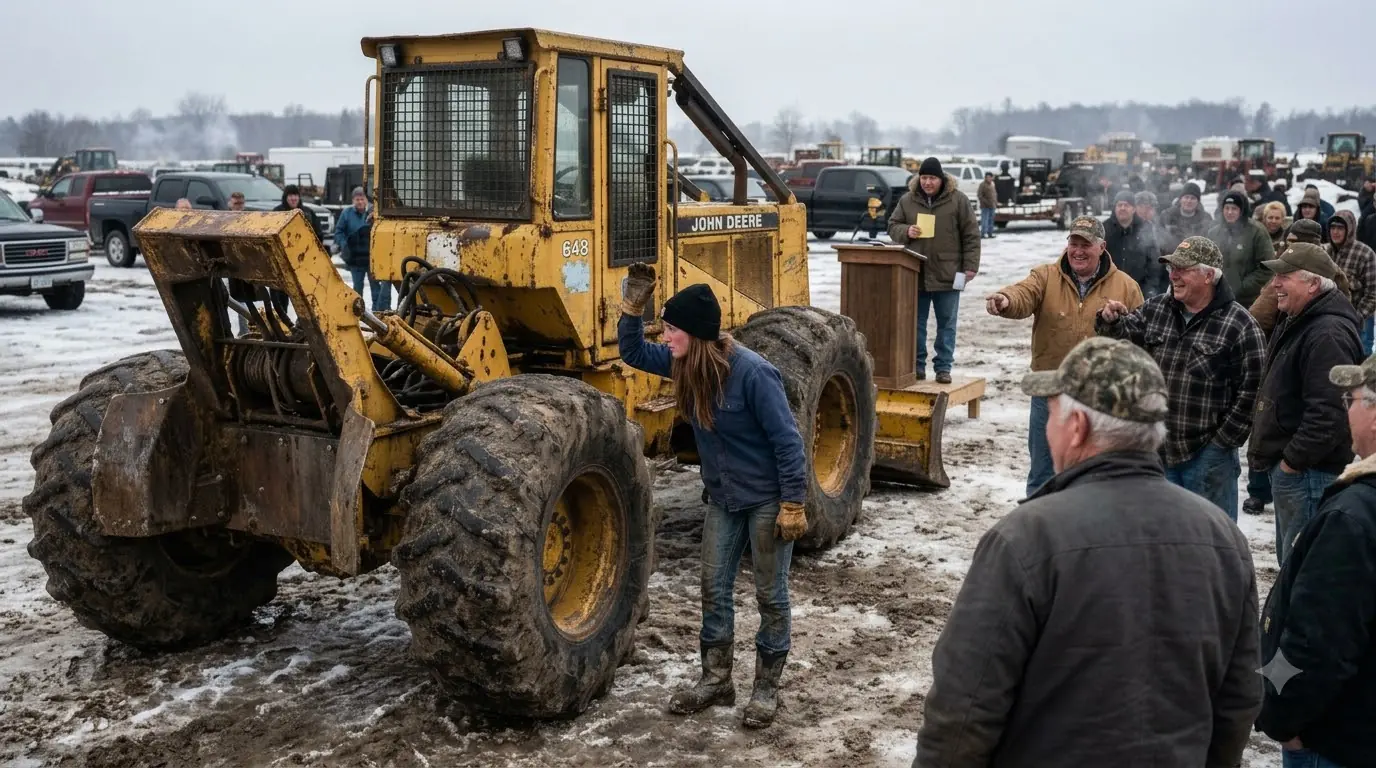
The second thing people noticed was the noise.
The diesel engine did not idle so much as argue with every piece of metal attached to it. The cab rattled. One fender vibrated. A loose steel step buzzed against its bracket. Somewhere beneath the rear housing, something clanked every few seconds with a rhythm that made experienced loggers instinctively look away.
The machine was more than thirty years old.
Its yellow paint had faded toward brown around the lower panels. The rear tires carried scars deep enough to make them look carved from old charcoal. Several hydraulic hoses were wrapped in protective sleeves darkened by oil and mud. The cab door had been repaired twice. The seat had a split wide enough to expose yellow foam.
Across the side panel, however, two things remained clear.
JOHN DEERE.
That was enough to gather a crowd.
Not because anyone wanted it.
Because everyone wanted to watch somebody else buy it.
Among the men standing around the auction ring were logging contractors who had spent their careers around equipment like this. Some had owned 648s when they were nearly new. Others had moved on to articulated skidders equipped with enclosed climate-controlled cabs, electronic monitoring systems, grapple packages, improved hydraulics, and price tags that could reach well into six figures.
The old Deere represented another era.
An era of cold seats.
Steel cable.
Manual grease guns.
Mechanical controls.
And repairs performed in mud with whatever tools happened to be in the truck.
At the edge of the crowd stood twenty-three-year-old farm girl Hannah Mercer.
She wore a faded blue farmer work shirt beneath a brown canvas vest, heavy work jeans, steel-toe boots, and thick leather gloves. Her long brown hair was pulled through the back of a black knit cap. Wind had reddened her cheeks, and the mud around her boots reached halfway up the rubber soles.
She looked too young to own the bidding number in her hand.
That was what several men had already decided.
Hannah knew because people rarely whispered as quietly as they imagined.
“Mercer girl.”
“Tom’s daughter?”
“Yeah.”
“She logging now?”
“Apparently.”
“With what?”
The answer sat twenty yards away smoking.
Someone laughed.
Hannah ignored them.
She was not looking at the smoke.
She was staring through the open engine panel toward the transmission housing.
More specifically, she was looking at a small rectangular aluminum service tag bolted near the access plate.
Fresh aluminum.
Bright enough to look wrong on an otherwise weathered machine.
She had noticed it forty minutes earlier during preview.
Most people inspected tires.
Hydraulic cylinders.
Cable.
Pins.
Cab.
Engine smoke.
Hannah had inspected those too.
But then she crawled underneath.
That had gotten more laughter.
One contractor asked whether she had lost an earring.
Hannah said nothing.
She lay on a flattened cardboard box in frozen mud and looked upward with a flashlight clenched between her teeth.
That was when she found the tag.
REMANUFACTURED TRANSMISSION.
Installation date: fourteen months earlier.
Meter at installation: 6,812 hours.
Current meter: 6,873.
Sixty-one hours.
She checked the serial number stamped on the housing.
It matched.
Someone had installed a rebuilt transmission and then run the skidder sixty-one hours before it ended up at auction.
That did not make the machine good.
It made the machine interesting.
Hannah crawled back out.
An older contractor named Dale Bishop stood above her laughing.
He wore a green jacket, insulated work gloves, and the expression of a man who had spent forty-five years being right often enough to forget the times he had not been.
“Find gold under there?”
Hannah stood and wiped mud from the front of her blue work shirt.
“Maybe.”
Dale laughed.
“That machine’s been dead twice already.”
“You know it?”
“I know machines.”
“That wasn’t my question.”
Dale looked toward the Deere.
“Former owner ran timber north of Eau Claire. Heard he parked it after buying a grapple skidder.”
“Why rebuild the transmission first?”
Dale shrugged.
“Because people make bad decisions.”
Hannah looked at him.
“Sometimes.”
Dale pointed toward the smoking engine.
“That thing’ll cost more to haul home than it’s worth.”
“Maybe.”
“You buying?”
“Maybe.”
He smiled.
“You got cash?”
Hannah held up the bidder card.
Dale laughed again.
By the time the auctioneer reached the skidder, the crowd had grown.
Not because interest had increased.
Entertainment had.
A crewman climbed into the cab and turned the key.
The engine cranked.