Twenty-three-year-old Clara Hayes returns to her family’s aging Georgia pecan farm after her father dies, inheriting eighty acres of trees that have been declining for reasons nobody can fully explain
For years, the Hayes orchard has produced less while costing more. Leaves yellow too early. Certain sections show weak spring growth. Nuts remain undersized. Entire clusters of trees appear stressed even during seasons when neighboring orchards perform normally.
The explanation accepted around town is simple: the Hayes soil is exhausted.
That is what local agricultural chemical dealer Wade Mercer has been telling Clara’s father for nearly a decade.
Every season, Wade recommends another treatment.
Another soil amendment.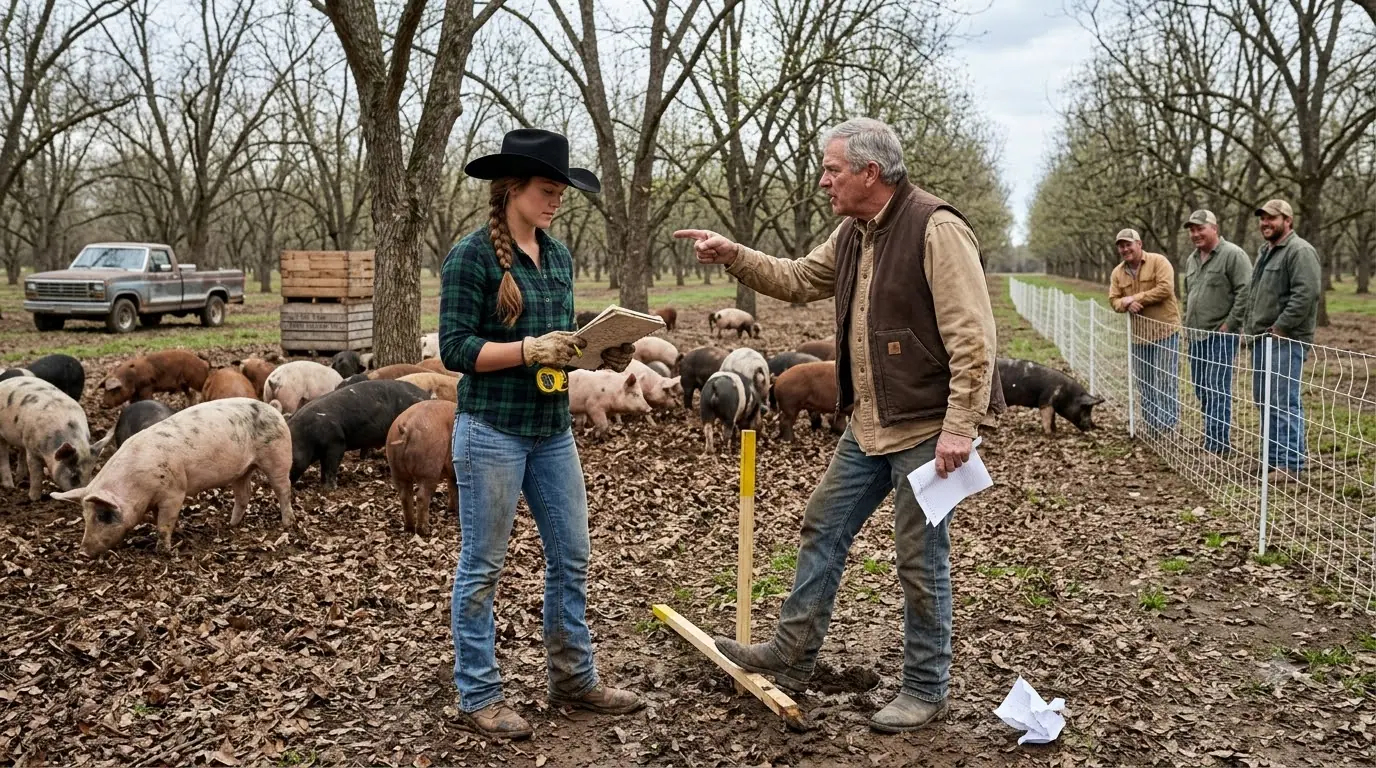
Another expensive spray program.
Another product supposedly designed to correct whatever deficiency appeared in the latest test.
Clara’s father trusted him because nearly every established farmer in the county did.
Clara does not.
After inheriting the farm, she studies years of records and notices something strange. The most damaged portions of the orchard do not follow soil type, elevation, drainage, or tree age.
Instead, they form irregular patches concentrated around areas that had once been accessible by old service roads.
Clara cannot explain it.
But she decides that repeatedly purchasing more chemical treatments without understanding the problem is financially impossible.
She tries something older farmers consider ridiculous.
Instead of intensively clearing the orchard floor and treating every weed as an enemy, Clara builds temporary fencing and rotates pigs beneath sections of mature pecan trees.
The animals eat fallen nuts, disturb shallow compacted ground, consume vegetation, and incorporate organic material into the upper soil.
An older neighboring farmer, Ray Dalton, openly mocks her.
He kicks over her measuring stakes, crumples her field notes, and tells her that her late father grew pecans while she is turning his orchard into a hog lot.
Clara refuses to argue.
She keeps measuring.
By the following spring, several pig-managed sections show noticeably better soil structure and stronger ground cover.
Then, while rooting through one of the orchard’s weakest areas, the pigs strike buried metal.
Clara immediately pulls the animals away and calls county agricultural agent Thomas Reed rather than opening anything herself.
Authorities uncover several old sealed agricultural drums beneath the soil.
The surviving labels carry serial numbers from a distributor once operated by Wade Mercer’s company.
That alone proves nothing.
Then historical records reveal something far more troubling.
The drums were sold during a period when disposal rules had become more expensive, and Wade’s former employee eventually admits that unwanted containers were sometimes taken to customer properties rather than handled through proper channels.
One of those properties was the Hayes orchard.
The same dealer who spent years selling the family increasingly expensive treatments for sick trees may have helped create the soil problem they were paying him to “correct.”
The discovery triggers an environmental investigation, soil remediation, lawsuits, and a complete reexamination of the orchard’s history.
But Clara’s greatest victory is not exposing Wade.
It comes years later when the damaged areas begin recovering.
Her pigs were never a miracle cure.
They merely caused enough disturbance in exactly the right place to reveal something hidden beneath the surface.
The orchard teaches Clara a lesson she carries for the rest of her life:
Sometimes the thing everyone calls failure is only a symptom.
And sometimes solving a problem begins by refusing to keep buying the explanation that created it.
The first pig escaped at 6:12 on a Tuesday morning.
Clara Hayes knew the exact time because she had been holding coffee in one hand and writing the temperature in her field notebook with the other when a hundred-and-eighty-pound Berkshire sow pushed beneath the temporary fence and ran directly toward the equipment shed.
Clara dropped both.
“Hazel!”
The pig accelerated.
Clara ran.
Mud sucked at her boots as she crossed the orchard.
Behind her, twenty-three other pigs began shouting as if their friend had discovered freedom and they were being personally oppressed by not joining her.
“Stop!”
Hazel did not.
Clara grabbed a yellow fence post from the ground.
Bad idea.
Hazel changed direction.
Now toward the farmhouse.
“Absolutely not.”
Clara cut across.
The pig saw her.
They stared at each other.
Hazel considered options.
So did Clara.
The farmhouse porch sat twenty yards behind her.
The kitchen door was open.
Her mother was inside.
If Hazel reached the kitchen, Clara would never hear the end of it.
“Don’t.”
Hazel ran.
Clara lunged.
Missed.
Her boot slid.
She hit the ground on both knees.
Mud splashed her face.
Hazel continued.
Then stopped abruptly beside a pile of fallen pecans.
The pig lowered her head and began eating.
Clara remained on the ground.
Breathing hard.
“You could’ve done that five minutes ago.”
Hazel ignored her.
A pickup truck slowed along the road.
Clara closed her eyes.
Of course.
Ray Dalton leaned out the driver’s window.
He was sixty-eight, weathered, broad through the shoulders, and constitutionally incapable of witnessing another farmer struggle without providing commentary.
“Everything under control?”
Clara looked down at herself.
Plaid shirt muddy.
Jeans muddy.
Gloves muddy.
Coffee somewhere behind her.
Pig eating thirty feet outside its paddock.
“Yes.”
Ray grinned.
“Looks professional.”
“Keep driving.”
He parked.
Of course he parked.
Ray climbed down wearing a tan work shirt, faded vest, jeans, and boots that had probably been the same shade since 1995.
He walked toward Hazel.
The pig looked up.
Ray pointed.
“That one knows more about farming than you.”
Clara stood.
“She also eats dirt.”
“Still undecided.”
Clara stared.