For nineteen years, Clara Bennett had learned how to disappear without ever leaving the room.
It was a skill no one had taught her directly. No nurse had written it into a rehabilitation plan. No therapist had suggested it as a coping strategy. Her foster grandmother certainly had never encouraged it. Yet by the time Clara turned twenty, she knew exactly where to position her wheelchair at weddings, school dances, birthday parties, church socials, graduations, and every other gathering where people eventually stood up and began moving to music.
Always near a wall.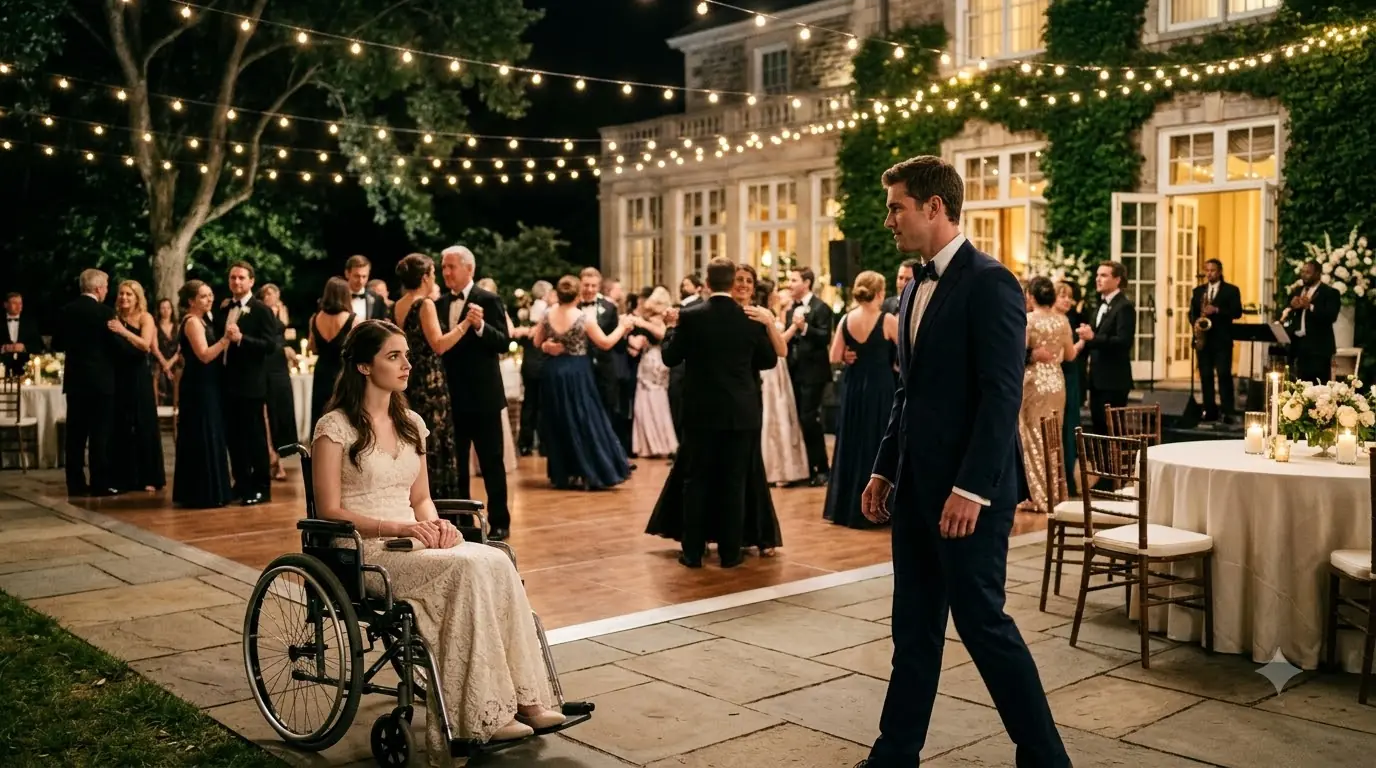
Never beside the dance floor.
Close enough that nobody could accuse her of hiding, but far enough that no cheerful stranger would feel compelled to ask whether she wanted help.
That distinction mattered.
Clara did not hate dancing.
She hated being asked whether she wished she could.
She hated strangers lowering their voices when they spoke to her, as though sitting in a wheelchair had somehow damaged her hearing. She hated compliments that sounded like condolences.
“You’re so brave.”
“You have such a beautiful attitude.”
“I don’t know how you do it.”
Most of all, she hated the sentence people thought was comforting.
“You don’t even seem disabled.”
Clara always wanted to ask what disability was supposed to look like.
Instead, she usually smiled.
Smiling made people comfortable.
She had become excellent at that too.
On the evening of the Hawthorne Children’s Foundation Gala, Clara positioned herself beside a climbing rose trellis at the edge of the garden and prepared to spend another night watching other people live loudly.
The Hawthorne estate sat outside Nashville, Tennessee, on forty acres of old trees, stone terraces, gardens, and lawns so carefully maintained they seemed painted rather than grown. Strings of warm lights stretched between enormous oak trees. A quartet played beneath a white pavilion. Servers moved through the crowd carrying champagne, sparkling water, and trays of food small enough to require explanations.
Clara had nearly refused the invitation.
Her grandmother had not allowed it.
“You are twenty years old,” Evelyn Bennett had said that afternoon while fastening the tiny pearl buttons down the back of Clara’s ivory lace dress. “You cannot spend your whole life acting as if fun requires written permission.”
“I have fun.”
“You read historical biographies for fun.”
“They’re interesting.”
“You alphabetized my spice cabinet last Saturday.”
“You had three containers of cinnamon.”
“That is not the point.”
Clara had smiled despite herself.
At seventy-one, Evelyn was small, silver-haired, stubborn, and almost impossible to defeat in an argument because she was perfectly willing to abandon logic once logic stopped helping her.
She had raised Clara since infancy.
Not legally at first.
That came later.
For the first fourteen months of Clara’s life, Evelyn had been listed merely as temporary foster placement number three.
The first two placements had lasted less than a month each.
Clara had been born with severe congenital abnormalities affecting both legs. Her right leg had limited muscular development below the hip. Her left leg had structural differences through the knee and ankle that made independent walking impossible.
Doctors had performed surgeries when she was a toddler.
More followed when she was six.
Then eleven.
None were intended to make her “normal,” a word Evelyn refused to use anyway. They were intended to reduce pain, preserve joint function, and help Clara maintain as much independence as possible.
She learned to transfer from wheelchair to bed before she learned long division.
She could drive with modified controls.
She could lift her own chair into the back of a compact SUV.
She had completed her first semester at Vanderbilt with grades high enough to make Evelyn brag to complete strangers.
Her legs were not the tragedy in Clara’s life.
The unanswered question of why her mother had left was.
According to the file Evelyn received years ago, Clara’s biological mother surrendered her at the hospital shortly after birth.
No visit afterward.
No letters.
No birthday cards.
No attempt at contact.
Clara had asked to see the paperwork when she turned sixteen.
Evelyn hesitated.
Clara insisted.
The file was thin.
INFANT FEMALE.
Birth date.
Hospital.
Congenital limb abnormality noted.
Mother: unavailable for placement.
Father: unidentified.
Emergency foster referral.
Then one sentence that Clara read until the words lost shape.
Biological mother declined continued custody following medical consultation.
Clara had stared at that sentence for almost an hour.
Following medical consultation.
As if someone had explained what was wrong with her body and her mother had simply changed her mind.
She never told Evelyn how deeply those five words entered her.
She did not need to.
Evelyn knew.
“Her decision says something about her,” Evelyn said that night.
“Not about you.”
Clara wanted to believe that.
Most days, she did.
Some nights, she was still a sixteen-year-old girl sitting on her bedroom floor wondering what a doctor could possibly have said that made her own mother decide she was too much.
The silver bracelet was the only object that came with her.
Tiny enough to fit an infant.
It now hung from a delicate chain around Clara’s wrist because it no longer closed naturally around her.
No name.
No initials.
Only a small engraved crescent moon on one side and a nearly invisible number on the inside.
417.
Evelyn had asked social services about it.
No one knew.
Clara eventually stopped asking.
Tonight the bracelet caught the warm garden lights whenever she moved her hand.
She was watching it when laughter rose from the dance floor.
Clara looked up.
Couples were beginning to gather as the quartet transitioned into something slower. Guests in evening gowns and dark suits stepped beneath the lights. An elderly couple moved first, drawing applause when the man spun his wife with the confidence of someone who had been doing it for fifty years.
Clara smiled.
That was real.
Not the dancing itself.