An adult bald eagle found grounded in Clallam County, Washington, is recovering at a licensed wildlife rehabilitation center after arriving with abrasions on the legs and feet, several small facial wounds, and extensive bruising hidden beneath the dense feathers covering its body.
The bird was discovered unable to take normal flight near the Dungeness River corridor, an area where bald eagles regularly move between shoreline habitat, open water, agricultural fields, and forested perches along the northern Olympic Peninsula.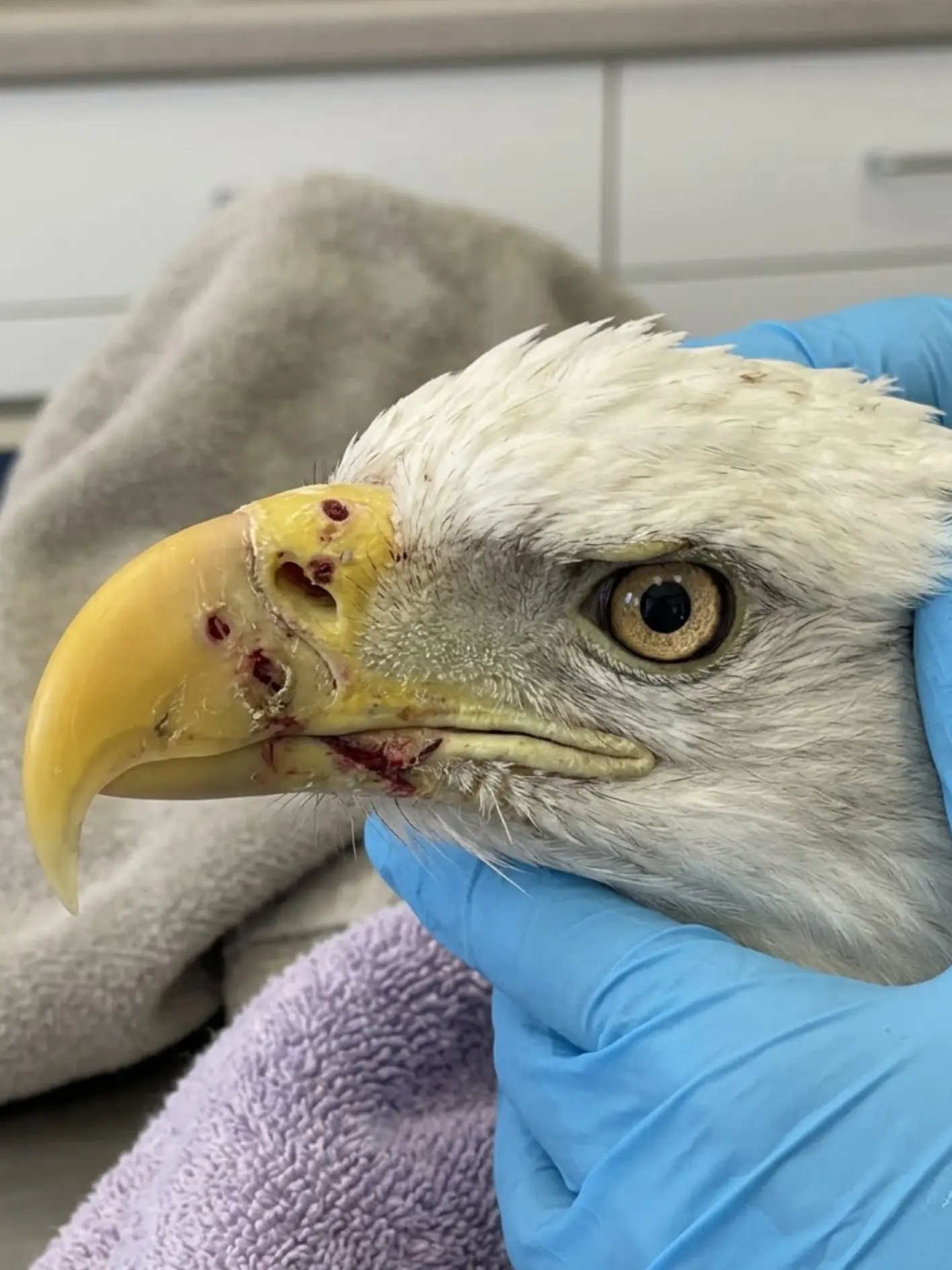
A wildlife officer responded after the eagle remained on the ground and failed to leave when approached.
Although the bird was conscious and responsive, its behavior was not consistent with a healthy adult capable of normal flight. The eagle was carefully restrained, its talons controlled, and its wings secured close to the body before being placed inside a ventilated transport carrier.
At first glance, the injuries did not appear catastrophic.
There was no obviously dangling wing.
No major open fracture could be seen.
The eagle had abrasions on the legs and feet, and several small wounds were visible around the beak and cere. Dried blood was present around portions of the face.
But once veterinary staff began a full examination and carefully separated the feathers over the chest and body, they found something more extensive.
Large areas of soft-tissue bruising were present beneath the plumage.
The pectoral muscles — the powerful muscles responsible for much of an eagle’s wingbeat — appeared to have sustained significant blunt trauma.
Radiographs later provided an important piece of good news: no major displaced fracture was identified.
But the absence of broken bones did not mean the eagle was ready to fly.
“The abrasions were easy to see,” a veterinarian involved in the bird’s care said. “Once we began working through the feathers, we found much more extensive bruising than was visible from the outside. Fortunately, the radiographs did not show a major fracture, so our focus now is on soft-tissue healing and determining whether normal flight returns.”
For the rehabilitation team, that distinction is critical.
A bald eagle does not need a broken wing to lose the ability to fly.
Severe bruising, inflammation, muscle pain, and soft-tissue injury can be enough to keep even a structurally intact adult bird on the ground.
The Eagle Was Found in a Region Where Bald Eagles Are Common
Clallam County provides extensive bald eagle habitat.
The Strait of Juan de Fuca, Dungeness River, coastal wetlands, forested shoreline, and nearby agricultural areas offer feeding opportunities and mature trees suitable for perching.
Bald eagles in the region may feed on fish, waterfowl, carrion, and other available prey.
Seeing an eagle perched near the water is routine.
Seeing one remain grounded is not.
Healthy adult bald eagles are powerful flyers and are generally capable of creating distance from humans when necessary.
A bird that stays down may be injured, neurologically impaired, intoxicated, exhausted, or systemically ill.
When this eagle failed to take normal flight, the responding officer treated the situation as a medical emergency.
Approaching a bald eagle safely requires training.
Even a weak bird can strike rapidly with its feet.
The talons are designed to penetrate and hold.
For that reason, the responder controlled the legs first, then secured the wings and supported the body before placing the eagle in a carrier.
The goal during field rescue is not to perform a diagnosis on site.
It is to prevent additional injury and move the bird into a controlled environment where proper examination can occur.
The Facial Wounds Were the First Visible Clue
During the initial assessment, staff noted several small wounds around the beak and cere.
The image taken during examination shows the adult eagle alert while a gloved hand gently stabilizes the head.
There are several small areas of superficial tissue damage around the upper beak and nostril region, along with dried blood near the edge of the mouth.
Those wounds were real.
Their cause was not immediately clear.
A facial abrasion could result from impact with a hard surface.
It could occur if the bird struck vegetation or fencing.
It could also be produced during a confrontation with another eagle or while struggling on the ground.
The appearance alone could not establish what happened.
That uncertainty shaped the rest of the evaluation.
Wildlife veterinarians often have to avoid one of the easiest diagnostic mistakes: assuming that the most visible injury is the entire problem.
In this eagle, it was not.
The Legs and Feet Also Showed Abrasions
The lower legs and feet had superficial abrasions consistent with recent physical trauma.
Some areas showed mild swelling.
There was damaged skin but no obvious catastrophic injury to the feet.
The talons remained intact enough for the team to assess grip and toe movement.
Leg abrasions can occur when a bird crash-lands or struggles repeatedly on rough ground.
They may also appear after contact with a road surface, fencing, gravel, branches, or other hard material.
Again, the injuries did not identify the cause by themselves.
The veterinary team documented them carefully because their location and pattern could help reconstruct the event when considered alongside the rest of the examination.
The Bruising Beneath the Feathers Was More Concerning
The major finding came when staff began separating feathers over the chest and body.
Bald eagles have dense plumage that can conceal significant trauma.
From the outside, the bird may appear relatively intact.
Underneath, soft tissues can show substantial bruising.
In this case, the pectoral region contained extensive areas of discoloration and tenderness consistent with blunt-force trauma.
The pectoral muscles are particularly important.
These muscles generate much of the power required for the downstroke during flight.
An eagle weighing several kilograms must produce tremendous force during takeoff.
The bird cannot simply open its wings and glide away.
It has to generate enough lift to move a large body into the air.
If the pectoral muscles are bruised, swollen, painful, or partially damaged, a bird may be physically unable to produce that force even when every wing bone remains intact.
“A bald eagle does not need a broken bone to lose the ability to fly,” the veterinarian said. “Significant bruising of the flight muscles can be painful enough to keep a bird grounded until those tissues recover.”
What Caused the Trauma Remains Uncertain
The injury pattern supported several possibilities.
A collision was one.
The eagle could have struck a vehicle, window, fence, tree limb, or another structure.
A territorial conflict was another.
Adult bald eagles sometimes engage in aggressive encounters over feeding areas, nesting territory, or other resources.
Talons can produce punctures and secondary trauma.
A third possibility is that the bird became weak for another reason and then suffered trauma while falling or attempting to land.
That possibility is especially important because the sequence of events cannot be assumed.
A bird may be injured first and become weak afterward.
Or a bird may become weak first and then become injured.
Without a witness, both scenarios remain possible.
The rehabilitation team therefore treated the physical injuries while continuing to investigate whether another underlying medical problem had contributed to the eagle becoming grounded.
A Complete Physical Examination Was Necessary
The bird was examined systematically from head to tail.
The eyes were assessed.
The beak was checked for cracks and abnormal alignment.
The oral cavity was inspected.
The skull and neck were evaluated.
Both shoulders were palpated.
The major bones of the wings were examined manually.
The chest was assessed for swelling and asymmetry.
The legs and feet were checked for fractures, joint instability, and grip strength.
Neurological responses were observed throughout.
This kind of examination is time-consuming.
But that is necessary with raptors because dense feathers hide injuries that are not visible in a quick inspection.
The team was looking for one central answer:
Was there structural damage severe enough to explain the inability to fly?
Radiographs Provided Reassuring Information
Because the bird had been found grounded, X-rays were obtained.
The veterinary team examined the wings, shoulder girdle, chest, and other relevant structures.
No major displaced fracture was identified.
That was one of the strongest positive findings of the case.
A fracture of the humerus, radius, ulna, or shoulder girdle can significantly reduce the likelihood of a successful return to the wild, depending on severity and alignment.
This bird appeared to have avoided that type of skeletal injury.
But normal radiographs do not mean normal flight.
X-rays primarily show bone.
They do not fully reveal bruised muscle, inflamed connective tissue, small tears, or many other forms of soft-tissue trauma.
The eagle still had a significant medical problem.
It was simply a different kind of problem than the team initially feared.
Soft-Tissue Injury Can Be Functionally Severe
Flight is a coordinated mechanical process.
Bones provide structure.
Muscles provide power.
Tendons and ligaments stabilize and transfer force.
The nervous system coordinates movement.
The cardiovascular system supplies oxygen.
The eyes guide the entire process.
If one component is compromised, flight can deteriorate.
In this eagle, the pectoral bruising became the leading physical explanation for the reduced flight ability.
Pain can cause a bird to limit the downstroke.
Swelling can reduce muscle efficiency.
Inflammation can make full extension uncomfortable.
A bird may instinctively protect an injured side even when the bones are normal.
That means the correct treatment is often rest first, not immediate exercise.
The Wounds Were Cleaned and Treated
The visible abrasions and facial wounds were cleaned carefully.
Dried blood and superficial debris were removed.
The veterinary team evaluated each wound for depth and signs of contamination.
Where appropriate, feathers were separated to improve access.
The goal was to protect healthy tissue while preventing infection.
The wounds around the face required particular care because the beak, nostrils, and eyes are nearby.
Aggressive manipulation can create additional damage.
The team therefore used conservative wound management rather than unnecessary intervention.
Pain-control and anti-inflammatory medication were also used when clinically appropriate.
Reducing inflammation can improve comfort and allow the bird to hold the wings in a more natural position during recovery.
Rest Became Part of the Treatment
The eagle was placed in a quiet medical enclosure.
Activity was restricted.
At this stage, there was no benefit in forcing a flight test.
A bruised pectoral muscle subjected to powerful repeated wingbeats could become more painful and potentially sustain additional injury.
The bird needed time for swelling and inflammation to decrease.
Housing was arranged to reduce unnecessary movement while still allowing the eagle to stand and reposition comfortably.
Depending on strength, low perches or floor-level support can be used early in rehabilitation.
The objective is to prevent a weak bird from attempting to climb or fly before it is ready.
Bloodwork Was Used to Look Beyond the Trauma
The physical injuries were convincing, but the rehabilitation team still needed to rule out systemic problems.
Blood was collected for routine evaluation.
A complete blood count can provide information about:
- red blood cell status,
- inflammation,
- possible infection,
- and overall physiological condition.
Basic chemistry testing can offer clues about organ function, hydration, and metabolic stress.
The team also considered lead screening.
That decision was not based on evidence that lead had caused the facial wounds or bruising.
It was based on the fact that unexplained weakness in a bald eagle can sometimes have more than one cause.
Lead Exposure Was Considered as a Possible Contributing Factor
Bald eagles are opportunistic scavengers.
They may consume animal remains containing small lead fragments associated with ammunition.
Lead exposure can contribute to neurological abnormalities, weakness, gastrointestinal dysfunction, and changes in blood parameters.
A bird weakened by lead may be more vulnerable to collision or other trauma.
But that possibility cannot be assumed.
In this case, lead screening was used to answer a question rather than support a predetermined diagnosis.
Was there evidence of a second problem that could explain why the eagle became vulnerable in the first place?
Until results support that conclusion, the trauma remains the primary confirmed finding.
Neurological Status Was Monitored Carefully
The head and facial injuries also made neurological monitoring important.
A collision can produce a concussion or other head trauma even when the skull is not visibly fractured.
Staff therefore watched for:
- abnormal pupil responses,
- head tilt,
- poor balance,
- visual tracking problems,
- tremors,
- weakness,
- abnormal foot placement,
- and changes in alertness.
So far, the eagle did not show a steadily progressive neurological syndrome during observation.
That was encouraging.
A bird whose coordination deteriorates over time would raise concern for a more serious neurological process.
The absence of progressive deficits allowed the team to remain focused primarily on soft-tissue recovery.
Vision Remained an Important Release Question
The small wounds around the head required continued eye assessment.
A bald eagle depends on exceptional vision.
Even a bird that regains full flight cannot return safely to the wild if visual function is significantly compromised.
The eagle must be able to:
- detect food,
- judge distances,
- avoid obstacles,
- navigate at speed,
- and land accurately.
The initial eye response appeared encouraging.
But functional vision would continue to be evaluated throughout rehabilitation.
Appetite Became an Early Sign of Progress
The rehabilitation team also watched food intake closely.
A severely stressed or painful raptor may refuse food after admission.
That can quickly become a secondary medical problem.
This eagle initially required close monitoring of appetite, but as the acute stress of rescue and examination began to decrease, the bird started showing greater interest in food.
That was important.
A returning appetite provides calories and protein needed for tissue repair.
It also suggests that the bird is becoming more stable.
A bird that voluntarily eats while remaining alert is generally in a better position to rebuild strength than one requiring prolonged nutritional support.
Body Weight Alone Was Not Enough
Staff monitored body condition, not simply scale weight.
A bird can maintain weight while losing useful muscle.
For flight, pectoral condition is especially important.
The team therefore assessed the muscle mass along the keel and looked for signs that prolonged inactivity was causing deconditioning.
This creates a rehabilitation challenge.
The bird needs rest long enough for bruised tissues to heal.
But excessive inactivity can reduce muscle strength.
The transition from rest to exercise has to be timed carefully.
Too early risks reinjury.
Too late risks avoidable deconditioning.
The Facial Wounds Began to Heal
As the eagle remained in care, staff continued evaluating the superficial wounds around the beak and cere.
The important questions were:
Was swelling decreasing?
Was there discharge?
Was there evidence of infection?
Was the surrounding tissue healthy?
Were the nostrils remaining clear?
Were the eyes unaffected?
If the wounds dry, remain clean, and gradually close, they become less important to the long-term prognosis.
The more difficult question remains the deeper soft-tissue injury.
Bruising Can Take Time to Resolve
Muscle bruising does not disappear immediately.
Damaged tissue may remain painful even after the external appearance improves.
For that reason, the team monitored how the eagle held its body and wings.
Persistent asymmetry could indicate ongoing discomfort.
Natural stretching behavior would be a good sign.
A bird that begins extending both wings normally, preening, and adjusting posture without hesitation may be showing that the injured tissues are becoming less painful.
That type of behavior often provides useful information before formal exercise begins.
Wing Extension Became the Next Functional Milestone
Once the bruising began to improve, staff watched for symmetrical wing movement.
Could the eagle extend both wings fully?
Did one wing lag?
Was there persistent drooping?
Did the bird show a pain response during natural movement?
The absence of a fracture gave the team reason for optimism.
If both wings could eventually move through a normal range and the pectoral muscles regained strength, the bird could have a realistic path toward release.
But that could only be proven in flight.
Perching Had to Remain Normal
Before flight testing, the eagle also needed to demonstrate normal balance and foot function.
The abrasions on the legs and feet had to heal.
Grip strength had to remain symmetrical.
The bird needed to sit securely on a perch without repeatedly slipping or shifting weight abnormally.
Perching tests multiple systems at once:
- vision,
- coordination,
- foot strength,
- balance,
- and endurance.
A bird that cannot perch normally is not ready for a flight enclosure.
Flight Rehabilitation Would Come Later
Only after the wounds were healing, bruising had substantially improved, bloodwork was reassuring, and the eagle was eating normally would the team consider transferring it into a larger flight enclosure.
This is where the true release assessment begins.
The enclosure must be large enough to evaluate more than one short hop.
Staff need to watch:
- takeoff,
- altitude gain,
- wingbeat symmetry,
- sustained flight,
- turns,
- braking,
- landing,
- and recovery after exercise.
A bird may look completely normal in a medical enclosure and still reveal weakness once required to fly.
Takeoff Will Be Especially Important
The pectoral muscles generate tremendous force during takeoff.
That makes the first several wingbeats an excellent functional test for this case.
If the bruising has healed adequately, the eagle should be able to launch strongly and gain altitude without hesitation.
If the bird remains low, uses unusually rapid wingbeats, or repeatedly aborts takeoff, the muscles may not yet be ready.
Staff would then continue conditioning rather than rushing release.
One Flight Will Not Be Enough
A bald eagle must be able to perform repeatedly.
Wild survival requires endurance.
The bird may need to cross water.
Respond to other eagles.
Travel between feeding and roosting sites.
Gain altitude in wind.
Escape disturbances.
One successful pass across an enclosure does not demonstrate that level of performance.
The rehabilitation team will look for consistency over multiple sessions.
A strong takeoff followed by immediate fatigue would not meet release standards.
Turning Can Reveal Hidden Weakness
Straight flight can sometimes mask subtle problems.
Turning requires asymmetrical control of the wings and tail.
If one side remains painful or weak, the eagle may have difficulty making controlled turns in both directions.
It may lose altitude.
It may compensate by altering the wingbeat.
Those details help rehabilitators distinguish a bird that is simply rebuilding endurance from one with a persistent functional deficit.
Landing Is Another Critical Test
The final stage of every flight is just as important as takeoff.
A bald eagle must approach a perch at the correct speed, spread and adjust the wings, extend both feet, grip securely, and balance immediately.
Poor landing can indicate:
- visual impairment,
- weakness,
- pain,
- poor coordination,
- or incomplete conditioning.
For this eagle, accurate landings would provide strong evidence that the chest bruising and facial trauma have not left an important functional deficit.
If Flight Strength Returns, the Prognosis Improves Considerably
The absence of major fractures is the strongest reason the rehabilitation team can remain cautiously optimistic.
Soft-tissue injuries can heal well.
Bruising can resolve.
Muscle strength can return.
If infection is avoided and there is no hidden neurological or systemic disease, many of the current limitations may be temporary.
That is why the prognosis for eventual release can be considered cautiously favorable.
The caution remains important because the bird was grounded for a reason.
The team still needs proof of full function.
If Flight Remains Weak, More Investigation May Be Needed
Not every soft-tissue injury resolves quickly.
If the eagle continues showing reduced flight strength after bruising should have improved, the medical team may need to reconsider the diagnosis.
Possible next steps could include:
- repeat radiographs,
- closer shoulder evaluation,
- additional bloodwork,
- reassessment for subtle soft-tissue injury,
- or extended conditioning.
A hidden tendon or ligament injury may become more obvious during exercise than during initial examination.
The rehabilitation process itself can therefore become diagnostic.
The Cause May Never Be Determined With Certainty
Even if the eagle eventually recovers fully, veterinarians may never know exactly how it was injured.
There was no confirmed collision.
No witnessed fight.
No known fall.
The pattern of abrasions, facial wounds, and bruising proves that trauma occurred.
It does not identify the precise event.
That uncertainty is acceptable.
The medical goal is not to create a perfectly complete narrative.
It is to restore the bird to function.
The Case Is a Reminder That Feathers Can Hide Significant Trauma
A bald eagle can look remarkably intact from only a few feet away.
Dense plumage covers much of the body.
That makes injuries difficult to see.
This case demonstrates why a careful physical examination matters even when radiographs ultimately show no fractures.
The leg abrasions were obvious.
The facial wounds were obvious.
The extensive bruising was not.
Without separating the feathers and palpating the underlying tissues, the scale of the soft-tissue injury could easily have been underestimated.
The Eagle Does Not Need Perfect-Looking Feathers to Be Released
Some feathers may remain stained or slightly damaged for a time after the wounds heal.
That is not necessarily release-limiting.
Wildlife rehabilitation focuses on function.
If the feathers provide appropriate protection, the skin is healthy, and flight performance is normal, minor cosmetic damage may not matter.
The bird does not need to look pristine.
It needs to survive independently.
Wild Behavior Must Also Return
As the eagle becomes stronger, staff expect it to become more resistant to human presence.
That is healthy.
The goal is not to create a cooperative patient.
A rehabilitated eagle should remain wary of people.
Human contact will be minimized as soon as medical procedures are no longer necessary.
A bird that moves away when staff enter, selects distant perches, and avoids unnecessary interaction is demonstrating behavior more appropriate for eventual release.
The Release Decision Will Require Multiple Systems to Be Normal
Before the eagle leaves rehabilitation, staff will need to see:
- healed leg and facial wounds,
- resolved or substantially improved bruising,
- normal body condition,
- reassuring bloodwork,
- no neurological abnormalities,
- normal visual function,
- strong symmetrical grip,
- normal wing extension,
- sustained powerful flight,
- controlled turns,
- accurate landings,
- and appropriate wild behavior.
Passing one test is not enough.
Release depends on the entire animal.
Returning to Clallam County Would Be the Preferred Outcome
If the eagle completes rehabilitation successfully, wildlife staff would generally aim to return it to suitable habitat in the same broad area where it was originally found.
For an adult bird, that can be important.
The eagle may already know:
- feeding areas,
- roosting sites,
- local waterways,
- and established territory.
The final release site would be selected based on safety and habitat conditions, not simply convenience.
The Final Answer Will Come From the Flight Enclosure
The X-rays have already answered one important question.
There is no major displaced fracture.
The physical examination answered another.
There is substantial soft-tissue trauma beneath the feathers.
Now the remaining question is functional.
Can the eagle recover enough strength to fly normally?
No laboratory value can answer that completely.
No photograph can answer it.
The bird will have to demonstrate it.
The Visible Abrasions Were Only the Beginning
When the eagle first arrived, the leg wounds and blood around the face were the injuries everyone could see.
They appeared to provide a straightforward explanation for why the bird had been rescued.
The deeper examination showed that the trauma extended farther.
Under the plumage, large areas of bruising affected muscles central to flight.
That finding explained how an eagle could have intact bones and still remain grounded.
It also changed the rehabilitation plan from a simple wound-care case into a period of controlled recovery followed by functional testing.
For Now, the Bird Needs Time
Time for inflammation to decrease.
Time for bruised muscle fibers to repair.
Time for superficial wounds to close.
Time for appetite and normal behavior to return.
Then time to rebuild strength.
Wildlife rehabilitation often involves less dramatic work than emergency medicine.
The emergency identifies the problem.
Rehabilitation waits for biology to do what medicine cannot do instantly.
The Prognosis Remains Cautiously Favorable
There is currently no major skeletal injury preventing the eagle from recovering.
That matters.
The eyes remain a focus of observation, but no catastrophic visual injury has been established.
The feet are functional.
The bird remains responsive.
If the soft-tissue injuries continue healing without complications and flight strength returns, release remains a realistic goal.
The team is not promising that outcome.
It is preserving the possibility.
The Final Test Will Be Whether the Eagle Can Fly Like a Wild Eagle Again
That standard is demanding.
A bird that flies a few yards is not necessarily recovered.
A bald eagle must launch powerfully, gain altitude, remain airborne, maneuver, land accurately, and repeat the entire process without abnormal fatigue or pain.
Those are the abilities that kept this bird alive before the injury.
They are the abilities it must regain before human care can end.
The abrasions around the eagle’s legs and face were the injuries rescuers could see when the bird was first found.
The extensive bruising hidden beneath its feathers told a more complete story once veterinarians began the examination.
With no major fracture identified, the eagle’s recovery will now depend primarily on whether those damaged soft tissues heal well enough for the powerful muscles of the chest and wings to function normally again.
If they do, the next major stage will take place not on an examination table, but inside a flight enclosure.
And if the eagle can launch strongly, climb, turn, land, and repeat those movements without hesitation, the injuries that once kept it on the ground may ultimately become only temporary evidence of a traumatic event it survived.
Until then, the rehabilitation team will continue doing what the bird cannot yet do for itself: protect the healing tissues, monitor for hidden complications, and wait for the day when the eagle’s own flight provides the final answer.