An adult Bald Eagle was admitted to the fictional Great Lakes Wildlife Conservation Center after being found injured and unable to fly normally in Dane County, Wisconsin, with extensive wounds around the head, face, and upper beak.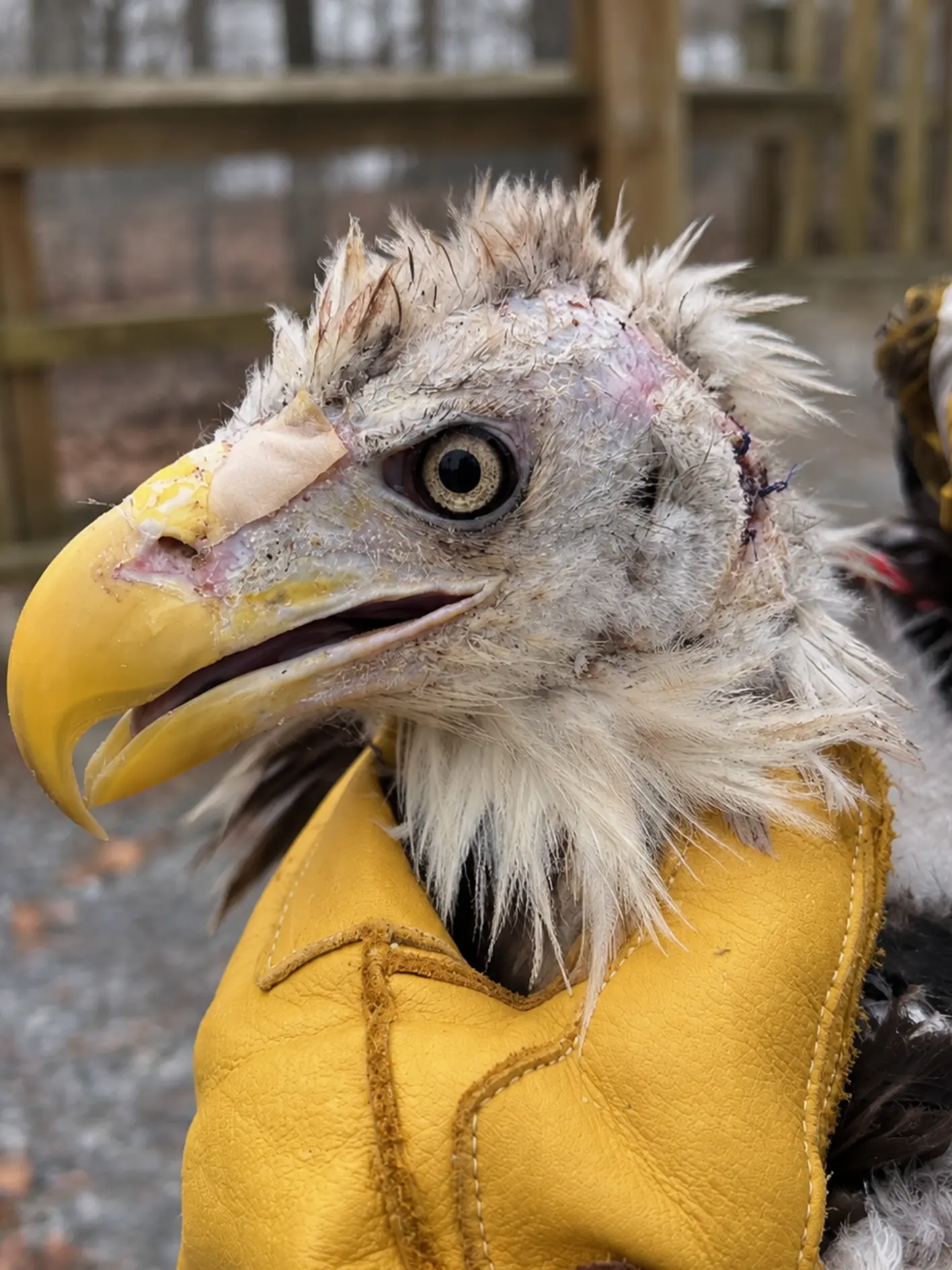
The bird, temporarily identified by rehabilitation staff as Valor, had multiple puncture-type wounds and lacerations across the scalp and facial region. Several areas of feathers around the head had been torn away, and damaged tissue was visible near the cere and upper beak.
The injuries were serious enough to require immediate veterinary treatment.
Wildlife staff believe the pattern of trauma could be consistent with an encounter with another Bald Eagle, possibly during a territorial dispute or competition over food. However, no one witnessed the original event, and veterinarians emphasized that the exact cause remains unconfirmed.
The bird was first reported by residents who noticed an eagle remaining on the ground near the edge of a wooded property.
The East Wisconsin Wildlife Rescue Team responded to the call, safely captured the injured eagle, and transported it directly to the conservation center for emergency evaluation.
When Valor arrived, the eagle was still alert.
Its eyes remained open.
Its feet and talons were functional.
But it was weak, dehydrated, and carrying injuries that extended across some of the most anatomically important structures of the head.
The veterinary team’s first goal was not to determine whether Valor could fly again.
It was to answer more immediate questions.
Could the eagle see?
Could it breathe normally?
Was the skull fractured?
Was the beak still structurally functional?
And had the wounds penetrated deeply enough to damage nerves, blood vessels, or other critical tissues?
The Eagle Was Found Grounded Near a Wooded Area
The rescue began when a Dane County resident noticed the Bald Eagle sitting unusually low near the edge of a wooded property.
At first, the bird did not appear to be in immediate distress.
Bald Eagles sometimes spend time on the ground while feeding, resting, or scavenging.
But the resident continued watching.
The eagle did not leave.
Several minutes passed.
Then the bird attempted to move.
Instead of launching into normal flight, it walked a short distance and opened its wings without gaining meaningful altitude.
That behavior raised concern.
The resident moved farther away and contacted wildlife professionals rather than attempting to approach the eagle directly.
From a distance, blood could be seen around the bird’s head.
The feathers over the crown and face appeared disorganized.
One side of the head seemed more severely affected than the other.
By the time the East Wisconsin Wildlife Rescue Team arrived, Valor remained alert enough to react to people approaching.
But the bird could not sustain normal flight.
That combination — a large raptor that was still defensive but unable to leave — required careful handling.
Even an Injured Bald Eagle Can Be Dangerous to Handle
Bald Eagles are powerful birds.
Their most dangerous defensive structures are not their beaks but their feet.
The talons are capable of inflicting serious injuries even when a bird is weak.
For that reason, the rescue team did not attempt an improvised capture.
Responders used appropriate protective equipment and focused on controlling the eagle’s feet while keeping the wings supported close to the body.
The goal was to minimize additional trauma.
Because the injuries involved the head and face, rescuers also avoided unnecessary manipulation at the scene.
There was no attempt to clean the wounds extensively in the field.
No one tried to determine the full depth of the injuries there.
The priority was stabilization and rapid transport.
“Once we saw how extensive the facial wounds were, the safest option was to get the bird contained and moving toward veterinary care,” a fictional member of the rescue team later said. “That was not an injury we wanted to spend a long time handling outdoors.”
Valor was placed into a dark, ventilated transport carrier and taken directly to the Great Lakes Wildlife Conservation Center.
The Head Trauma Was More Extensive Than It First Appeared
Once the eagle arrived, the veterinary team was able to examine the injuries under controlled conditions.
The damage was concentrated around the scalp, face, and upper beak.
There were several areas consistent with puncture wounds.
Other injuries were more irregular and appeared to involve tearing of the skin and superficial tissues.
One area near the top of the head required surgical repair.
Another wound extended close to the cere, the fleshy area at the base of the upper beak.
There was also evidence of bruising beneath some of the feathers.
The pattern suggested that Valor had experienced significant force.
What remained unclear was exactly how that force had been delivered.
Dr. Melissa Grant, a fictional wildlife veterinarian at the center, said the injury pattern was compatible with an encounter involving another large raptor.
But she cautioned against treating that as a confirmed explanation.
“The wounds made us consider an interaction with another eagle because of their distribution and puncture-like appearance,” Grant said. “But we did not witness the event, so we cannot say with certainty that another eagle caused them.”
That distinction remained important throughout the case.
Why Another Bald Eagle Was Considered a Possibility
Bald Eagles can be intensely territorial.
Adults may defend nesting territories, feeding locations, or access to resources.
Conflicts can occur in the air or on the ground.
During close encounters, the birds may use their talons to strike, grab, or grapple.
Their body weight can also produce significant impact injuries.
These conflicts do not always result in severe trauma.
But when they do, injuries can involve the head, wings, eyes, feet, or chest.
A puncture from a talon may create a relatively small opening at the skin while extending deeper into the underlying tissues.
If a struggling eagle falls from the air or strikes the ground afterward, secondary injuries can occur as well.
That made several scenarios possible in Valor’s case.
The visible wounds may have resulted from a conflict.
The eagle may then have fallen.
Or the bird could have been injured by an entirely different mechanism.
Without a witness, the veterinary team could only describe what the injuries looked like, not reconstruct the event with certainty.
The Most Important Question Was What Had Been Damaged Beneath the Skin
The external wounds were dramatic.
But wildlife veterinarians were more concerned about what could not be seen immediately.
Head trauma can affect multiple critical structures.
The skull may be fractured.
The eye may be injured.
Nerves controlling vision or movement can be damaged.
The upper beak can become unstable.
The nasal passages can become obstructed.
Swelling can increase pressure around delicate tissues.
A wound that appears superficial may also become contaminated and infected.
The veterinary team therefore began with a full trauma assessment rather than focusing only on the visible lacerations.
Valor’s hydration status was evaluated.
The bird’s body condition was assessed.
The pupils were compared.
Both eyes were examined for obvious rupture or internal damage.
The beak was checked for alignment.
The mouth and oral cavity were inspected.
The cervical region was palpated cautiously.
Neurologic responses were monitored.
The eagle remained subdued but responsive.
That was encouraging.
Diagnostic Imaging Brought the First Significant Piece of Good News
Radiographs were obtained to evaluate the skull, beak, neck, and other areas of concern.
The team wanted to know whether the visible trauma had caused major fractures.
The images did not reveal a large displaced skull fracture.
The beak remained generally aligned.
There was no catastrophic skeletal injury that immediately eliminated the possibility of recovery.
That did not make the case minor.
The soft-tissue trauma remained substantial.
The wounds still required treatment.
But the absence of a major displaced fracture improved the outlook.
“The wounds looked severe from the outside,” Grant said. “The imaging helped us understand that some of the deepest concerns — particularly catastrophic skull or beak damage — were not present.”
That allowed the team to move forward with wound repair.
Both Eyes Required Careful Evaluation
Because the trauma extended across the head, both eyes were examined closely.
An eagle’s vision is essential to survival.
Even relatively subtle visual deficits can affect flight, landing, hunting, and obstacle avoidance.
The eyes remained structurally intact.
Pupil responses were present.
Valor continued visually tracking movement during the examination.
There was no immediate evidence that either globe had been ruptured.
That was another encouraging finding.
However, the team continued monitoring vision throughout hospitalization.
Head trauma can produce delayed changes.
Swelling may increase.
Neurologic deficits may become more obvious after the initial stress response subsides.
For that reason, one normal examination was not enough.
The Beak Was Also Functional
The trauma near the cere raised concern that the upper beak might be unstable.
A Bald Eagle depends on the beak to tear food, manipulate prey, preen feathers, and defend itself.
If the beak had been severely fractured or displaced, the long-term prognosis could have changed dramatically.
Fortunately, the upper and lower beak remained generally aligned.
Valor could open and close the mouth.
No catastrophic beak fracture was identified.
Still, the team watched feeding function closely over the following days.
Anatomical alignment is important.
Functional use is even more important.
The Wounds Were Cleaned Under Controlled Conditions
Once Valor was stable enough, the veterinary team proceeded with wound treatment.
The dense head feathers made direct visualization difficult in several areas.
Feathers around the wounds were trimmed where necessary to allow access.
The affected areas were carefully irrigated.
Debris and dried blood were removed.
The depth of each wound was evaluated.
Tissue viability was assessed.
Where tissue had been significantly damaged, conservative debridement was performed.
The goal was to preserve healthy structures while removing material that could interfere with healing.
Several lacerations required closure.
Sutures were placed in areas where the wound margins could be brought together without excessive tension.
A protective dressing was used around part of the injured beak region.
A photograph taken during treatment shows Valor being supported by a trained handler wearing heavy protective gloves.
The feathers around the head have been partially removed or displaced around the treatment area.
Sutures are visible near the scalp.
A protected region extends toward the upper beak.
The image documents the treatment stage of the case.
It does not establish the original cause.
Infection Was a Major Concern From the Beginning
Puncture wounds can be deceptive.
The surface opening may be small.
Bacteria can still be carried deeply into tissue.
If the wounds truly resulted from another raptor’s talons, contamination would remain a concern.
But infection risk would also exist with many other traumatic mechanisms.
The veterinary team therefore watched for:
increasing swelling;
heat;
discharge;
tissue breakdown;
foul odor;
fever or systemic illness;
and delayed wound closure.
Antimicrobial therapy was used when clinically indicated.
Pain management was also important.
A wild eagle may hide discomfort until pain becomes severe.
Reducing unnecessary pain supports feeding, rest, and overall recovery.
The First 24 Hours Were About Stability
Valor spent the first night in a quiet enclosure with padded flooring.
No high perch was provided.
The bird had sustained head trauma and was still weak.
A fall inside the enclosure could have caused another injury.
Human contact was minimized.
Staff entered only when necessary.
The eagle remained alert enough to follow movement but spent much of the time resting.
Fluids were provided to address dehydration.
The wounds were reassessed for bleeding.
Respiratory effort remained stable.
The bird’s head position was monitored.
No severe neurologic deterioration occurred during the first night.
That was important.
But the prognosis remained guarded.
The Team Was Not Yet Thinking About Release
At this stage, asking whether Valor would fly again was premature.
The immediate goals were more basic.
The eagle needed to remain neurologically stable.
The eyes had to continue functioning.
The beak had to remain usable.
The wounds had to stay clean.
The bird had to begin eating.
“The first goal was not flight,” Grant said. “It was making sure the trauma had not compromised the functions the bird needed simply to recover.”
Only after those questions were answered could rehabilitation move toward release assessment.
Appetite Became One of the First Encouraging Signs
Food was offered once Valor was stable enough.
Initially, the eagle showed limited interest.
That was not surprising.
Wildlife patients often eat poorly after capture, transport, anesthesia, and emergency treatment.
The next day, however, staff noticed increased attention toward food.
Valor began feeding independently.
The eagle used its feet to hold the food.
It closed the beak normally.
It tore pieces without obvious instability.
That was an important functional milestone.
It suggested that the beak injury had not prevented basic feeding.
It also showed that the bird’s overall strength was beginning to return.
The Eagle Became More Difficult to Handle
Over the next several days, Valor’s behavior changed.
The bird became more alert.
It spent more time upright.
Its responses to people became stronger.
During necessary examinations, Valor resisted handling more forcefully.
For wildlife rehabilitators, this was good news.
A healthy Bald Eagle should not become comfortable with routine human contact.
As the bird recovered, the return of defensive behavior suggested improving energy and appropriate wild instincts.
Staff began spending even less time near the enclosure.
The goal was to allow recovery without encouraging habituation.
The Head Wounds Began Closing
The repaired scalp wounds remained intact.
Swelling gradually decreased.
The tissues around the cere and upper beak looked healthier.
No rapidly spreading infection developed.
The sutured areas began sealing.
Some wounds were allowed to heal through healthy granulation rather than being closed completely.
That decision depended on tissue condition and contamination risk.
The veterinary team continued documenting the wounds at each examination.
Photographs helped compare healing from one treatment session to the next.
Valor’s appearance remained rough.
The feathers around the head were disorganized.
Some had been lost.
Others were stained.
But the underlying tissues were improving.
In wildlife rehabilitation, cosmetic appearance is not the priority.
Function is.
Neurologic Monitoring Continued Even After the Bird Looked Better
Because Valor had sustained significant head trauma, the veterinary team continued neurologic assessments after the external wounds began healing.
They watched for abnormal head position.
Loss of balance.
Unequal pupil responses.
Poor coordination.
Unusual eye movements.
Changes in awareness.
Difficulty gripping a perch.
These signs can indicate deeper injury even when the skin appears improved.
Valor continued showing appropriate responses.
No major persistent neurologic deficit became apparent.
That allowed the team to begin considering the next stage of rehabilitation.
A Low Perch Was Introduced
Once the eagle could stand reliably, staff added a low perch.
This allowed them to evaluate balance and grip while minimizing the consequences of a fall.
Valor stepped onto the perch.
Both feet gripped normally.
The bird remained stable.
The head stayed level.
The eyes tracked movement.
These details mattered.
A Bald Eagle returning to the wild needs precise coordination between vision, balance, and foot placement.
The successful use of the low perch was a small but important step.
Later, the perch height could be increased.
The Team Also Reassessed the Wings
Valor had originally been found unable to fly normally.
That meant the wings had to be evaluated even though the most obvious wounds were on the head.
Both shoulders were examined.
The long bones of the wings showed no major fracture on imaging.
Range of motion appeared acceptable.
The eagle began performing voluntary wing stretches.
There was no persistent droop.
That suggested the original inability to fly may have been related to weakness, pain, disorientation, or the immediate effects of trauma rather than a severe orthopedic injury.
Only flight testing could confirm that.
Why Suspected Territorial Conflicts Can Be So Serious
Bald Eagles are powerful animals.
When disputes escalate, the forces involved can be substantial.
Two large birds may lock talons.
They may strike with the feet.
They may grapple in the air.
They can lose altitude while focused on each other.
A bird may sustain injury directly from another eagle and then suffer additional trauma when it strikes the ground, vegetation, or a structure.
If that is what happened to Valor, the visible head wounds may represent only one part of the original event.
But again, the team could not confirm that scenario.
The injuries were compatible with it.
They were not proof of it.
That distinction remained part of the official clinical description.
The Eagle Eventually Moved Into a Larger Enclosure
Once the head wounds were stable and the veterinary team was satisfied with Valor’s vision and neurologic status, the eagle was transferred to a larger rehabilitation space.
At first, the bird stayed on lower perches.
Then it began moving between them.
Short flights followed.
The first attempts were cautious.
Valor did not immediately demonstrate the power expected from a fully conditioned adult eagle.
That was normal after hospitalization.
Muscle condition declines during periods of inactivity.
A bird that has spent days resting cannot be expected to perform at full strength immediately.
The team allowed gradual conditioning.
Flight Became the Next Major Test
Valor began flying longer distances inside the enclosure.
Staff watched from outside.
They looked for:
symmetrical wingbeats;
normal altitude gain;
accurate turns;
appropriate obstacle avoidance;
controlled landings;
and the ability to repeat flights without abnormal fatigue.
The head trauma made obstacle avoidance particularly important.
A bird can appear visually responsive while sitting still and reveal subtle visual or neurologic problems only during movement.
So far, Valor’s flight performance was encouraging.
The eagle began landing more accurately.
It gained elevation.
It used both wings evenly.
No persistent imbalance was observed.
The Wounds Were Healing Faster Than the Feathers Could Replace Themselves
Although the skin continued healing, the head did not immediately regain its normal appearance.
Feathers lost during trauma and treatment would take time to replace.
Some might not return fully until molt.
That did not necessarily affect release.
A Bald Eagle does not have to look cosmetically perfect to return to the wild.
It must function normally.
As long as the remaining feather coverage was adequate and no exposed wound remained, cosmetic irregularity alone would not prevent release.
The medical team therefore focused on deeper criteria.
Release Would Require More Than One Good Flight
Valor still needed to demonstrate consistency.
A single strong flight would not be enough.
The eagle needed to show:
normal vision;
stable neurologic function;
healed wounds;
absence of infection;
appropriate body condition;
strong, symmetrical flight;
controlled landing;
normal grip strength;
and appropriate avoidance of people.
Repeated performance matters because wildlife presents unpredictable demands.
A bird may need to fly repeatedly in wind.
Avoid other eagles.
Move between feeding areas.
Land on narrow branches.
Respond to vehicles.
A patient that tires after one flight is not ready.
Body Condition Improved During Rehabilitation
Valor’s appetite remained strong.
The eagle regained weight lost during the acute phase.
Breast muscle condition improved.
Hydration normalized.
The bird spent increasing amounts of time on higher perches.
Its posture looked more like that of a healthy adult raptor.
Staff interaction decreased as direct medical treatment became less frequent.
At this stage, the best sign of progress was that the bird needed people less.
The Cause of the Injury May Never Be Proven
Even as Valor improved, the original event remained unresolved.
There was no witness.
No video.
No carcass or other evidence indicating a specific conflict.
The pattern of injuries still made an eagle-on-eagle encounter plausible.
But other mechanisms remained possible.
The rehabilitation center continued using cautious language in the medical record.
Trauma of uncertain origin, with injuries considered consistent with a possible encounter with another large raptor.
That description preserves the evidence without overstating what is known.
In wildlife medicine, uncertainty is common.
An injured bird often arrives carrying the result of an event but none of the history.
Public Response Made the Rescue Possible
Valor’s case also illustrates why public observation matters.
The resident who found the eagle did not know whether another eagle had attacked it.
They did not know whether the skull was fractured.
They did not know whether surgery would be needed.
They only recognized that the bird was behaving abnormally.
It remained grounded.
It had visible blood.
It could not leave normally.
That was enough reason to call for professional help.
Members of the public do not need to diagnose wildlife injuries.
They need to recognize when professional evaluation is warranted.
What to Do if You Find an Injured Bald Eagle
Anyone who encounters a Bald Eagle with visible trauma should keep a safe distance.
Do not attempt to pick the bird up with bare hands.
Do not throw a blanket over it unless specifically instructed by trained responders.
Do not force it to fly.
Do not offer medication.
Do not pour water into the beak.
Keep pets and other people away.
Record the location.
Then contact wildlife authorities, animal control, conservation officers, or a licensed wildlife rehabilitator.
Even a seriously injured eagle can use its talons defensively.
Professional capture protects both the animal and the rescuer.
The Injuries May Have Happened in Seconds
One of the striking aspects of the case is the contrast between how quickly the trauma may have occurred and how long recovery requires.
If Valor was injured during a territorial encounter, the actual conflict may have lasted only moments.
The wounds took weeks to manage.
The skin had to close.
Swelling had to resolve.
Neurologic stability had to be demonstrated.
Vision had to be confirmed.
Strength had to return.
Flight had to be rebuilt.
That is common in wildlife trauma.
The event is brief.
The consequences are not.
The Veterinary Team Remained Cautiously Optimistic
By the later stages of rehabilitation, Grant described Valor’s progress as encouraging.
The eyes remained responsive.
The beak continued functioning.
The head wounds were closing.
No major infection developed.
Neurologic behavior appeared normal.
Flight strength was improving.
Those findings moved the prognosis away from the uncertainty of the first night.
Still, the team avoided promising a release until all functional testing was complete.
“The early findings gave us reason for cautious optimism,” Grant said. “But release is something the bird has to earn functionally. We need to see normal flight, coordination, endurance, and behavior before we make that decision.”
The Final Flight Assessment Would Matter Most
When the wounds were fully stable and the eagle had regained sufficient condition, staff planned a final series of flight assessments.
The bird would need to cross the rehabilitation enclosure repeatedly.
It would need to gain elevation without hesitation.
Turn both directions.
Avoid obstacles.
Land precisely.
Maintain normal wing position afterward.
Show no neurologic abnormalities.
And continue behaving like a wild eagle rather than a bird accustomed to people.
If Valor met those standards, release could become realistic.
If subtle visual or neurologic problems appeared under more demanding flight conditions, the prognosis would have to be reconsidered.
The Final Perspective
Valor arrived at Great Lakes Wildlife Conservation Center with extensive head and facial trauma after being found grounded in Dane County.
East Wisconsin Wildlife Rescue safely captured the adult Bald Eagle and transported it for emergency care.
The wounds included puncture-like injuries, lacerations, damaged tissue around the scalp, and trauma near the upper beak.
The distribution of injuries raised suspicion that the eagle may have been involved in a territorial encounter with another Bald Eagle.
But no one witnessed the event.
The precise cause remains unknown.
At the hospital, the veterinary team focused first on what could be confirmed.
The skull was evaluated.
The beak was examined.
Both eyes were assessed.
Neurologic function was monitored.
Radiographs did not reveal a catastrophic displaced skull fracture.
The eyes remained structurally intact and visually responsive.
The beak remained functional.
Those findings gave the team room to treat the wounds aggressively while maintaining hope for recovery.
The damaged tissues were cleaned.
Some wounds were surgically repaired.
Sutures were placed.
The injured areas were protected.
Pain and dehydration were treated.
Infection was monitored closely.
During the first night, Valor remained weak.
Then the bird began eating.
It stood more consistently.
Its responses to staff became stronger.
The head wounds began closing.
Swelling decreased.
No major neurologic deficit emerged.
The eagle moved to a low perch.
Then a larger enclosure.
Short flights became longer ones.
Landings improved.
Both wings worked normally.
The wounds may have been created in a matter of seconds.
Recovery required weeks.
That difference is what the public rarely sees.
The rescue itself is only the beginning.
The difficult work happens afterward — in the repeated examinations, wound care, imaging, medication, feeding assessments, neurologic checks, and gradual conditioning required before a wild animal can be considered ready to leave.
Valor is not being judged by how much better the injuries look.
The decision will come down to function.
Can the eagle see normally?
Can it fly strongly?
Can it land precisely?
Can it avoid obstacles?
Can it maintain endurance?
Can it behave like a wild Bald Eagle without depending on people?
Only when those questions have been answered will the veterinary team know whether Valor can safely return to the wild.
For now, the early signs remain encouraging.
The eagle is alert.
The wounds are healing.
The eyes remain responsive.
The beak works.
Flight strength is returning.
And the bird that arrived after a suspected violent encounter is beginning to look less like a trauma patient and more like the animal it was before the injury.
The final step, however, cannot be decided by an X-ray or a healed suture line.
It will be decided in the air.