An adult bald eagle transferred from Tillamook County to a licensed wildlife rehabilitation clinic on the Oregon Coast arrived with one of the most immediately noticeable abnormalities staff had seen in a recent raptor admission: the normally clean white feathers covering much of the bird’s head and upper neck were rough, uneven, discolored, and visibly damaged.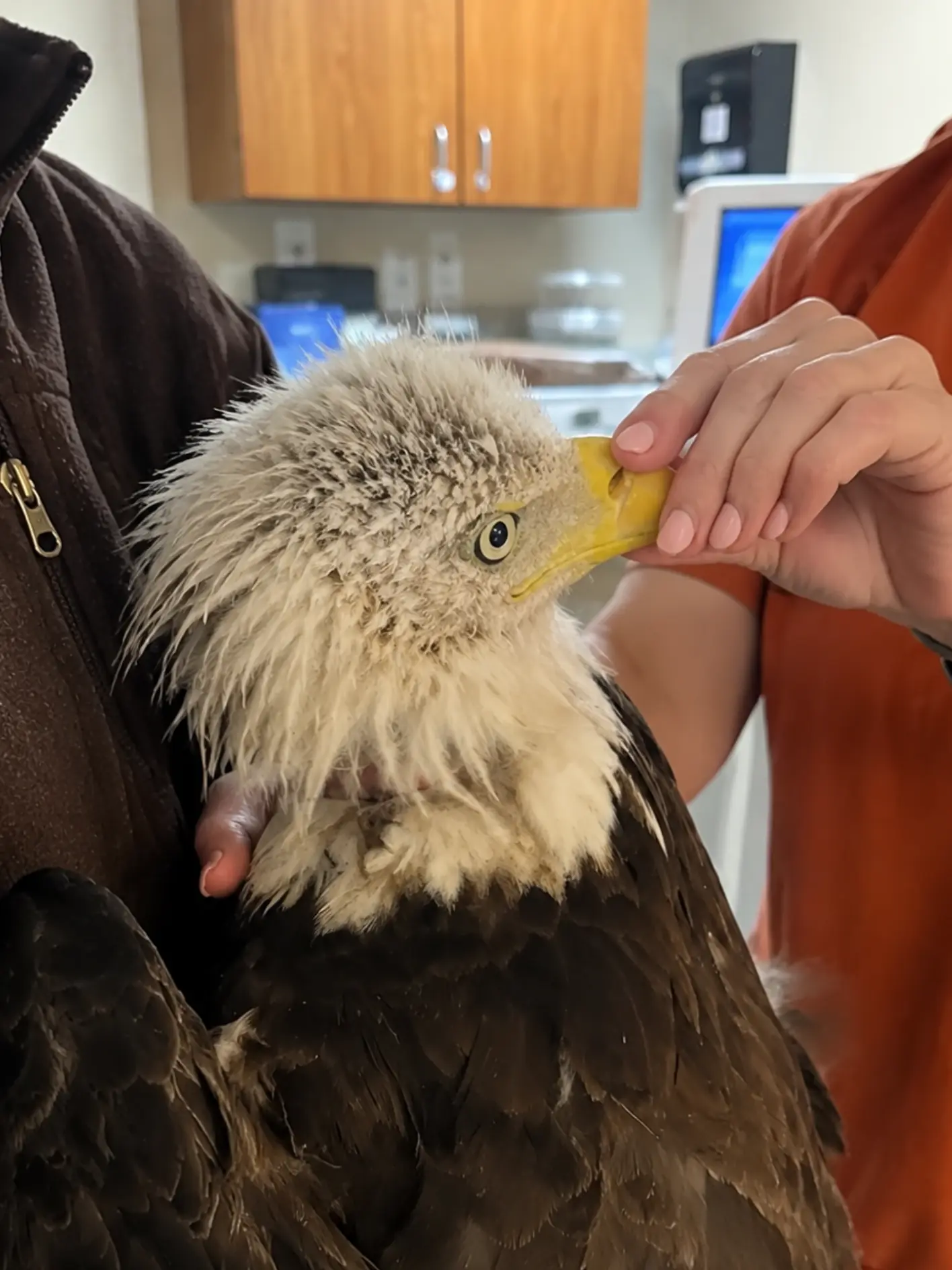
The eagle had been found grounded near the wetlands surrounding Tillamook Bay after a member of the public noticed that the bird had remained in the same general area for an unusually long period and did not immediately fly away when approached from a distance.
That behavior alone was enough to raise concern.
A healthy adult bald eagle will generally move away from close human activity when it has the strength and space to do so. A bird that remains grounded may be injured, debilitated, neurologically impaired, contaminated, or otherwise unable to fly normally.
When wildlife responders arrived, they secured the eagle and transported it for professional evaluation.
At the clinic, the unusual condition of the head plumage immediately drew attention.
The bright white crown feathers that normally give an adult bald eagle such a distinctive appearance were disordered and matted in several areas. Some feathers appeared stained or darkened. Others were bent, frayed, or shortened. The feathering around the crown and upper neck lacked the smooth, layered appearance staff would expect from a healthy adult bird maintaining its plumage normally.
But the rehabilitation team was careful not to make assumptions based solely on appearance.
Damaged feathers can result from many different events.
Mud, food residue, oil-like substances, repeated rubbing against a structure, entanglement, poor preening during illness, and some forms of external trauma can all change the way plumage looks.
The first question was therefore not simply, “What happened to the feathers?”
It was:
What happened to the eagle that caused it to become grounded in the first place?
“The feathers were the first thing everyone noticed, but they were not necessarily the most important medical question,” one of the veterinarians involved in the examination said. “Our job was to determine whether this was simply external plumage damage or whether something more serious had caused the eagle to become weak enough to remain on the ground.”
Found Near the Tillamook Bay Wetlands
Tillamook County contains extensive estuarine, river, agricultural, and forest habitat that can support bald eagles throughout much of the year.
The broad waters and tidal areas surrounding Tillamook Bay provide fish, waterfowl, carrion, and other feeding opportunities for large raptors.
Seeing an adult bald eagle in the region is therefore not unusual.
Seeing one remain grounded is different.
The eagle was not reported to have a clearly dangling wing or an obviously broken leg.
There was no immediate indication of a catastrophic injury visible from a distance.
Instead, the concern came from its behavior.
The bird appeared reluctant or unable to leave.
That is often enough to justify professional assessment in a species capable of strong flight under normal circumstances.
Wildlife responders approached cautiously and contained the eagle using appropriate equipment.
Even a weakened bald eagle can retain substantial power in the feet and talons, so minimizing stress and preventing injury to both the bird and rescuers is essential.
The eagle was transported to the coastal rehabilitation clinic for a complete examination.
The Head Feathers Were the First Obvious Abnormality
Once the eagle was under controlled restraint, veterinary staff could examine the head more carefully.
The feathers were clearly not in normal condition.
The white plumage was uneven.
Some sections appeared clumped.
Individual feather tips were visibly frayed.
There were areas of discoloration that contrasted with the otherwise pale head and neck.
The feathers did not lie smoothly over one another.
In the image recorded during the examination, the adult eagle remains alert while veterinary staff gently stabilize the head and beak.
The eye is open and attentive.
The bird does not appear unconscious.
But the crown and upper neck feathers are visibly roughened and disordered.
That appearance provided an important clue.
It did not provide a diagnosis.
“The abnormal appearance was obvious,” the veterinarian said. “But you cannot look at a photograph like that and determine whether you are dealing with contamination, abrasion, illness-related poor preening, or another process. You have to examine the bird.”
Not All Feather Damage Means the Same Thing
Feathers can look damaged for very different reasons.
A bird that has recently been in mud or dirty water may have feathers that appear clumped until they dry and are properly preened.
A sticky substance can cause feather barbs to adhere to one another, interfering with normal structure.
Repeated contact with wire, fencing, a narrow enclosure, or another rough surface can physically abrade feathers.
Illness can also affect plumage indirectly.
A sick eagle may stop preening normally.
As dirt and natural oils become unevenly distributed, the feathers can begin to look rough and poorly maintained even without direct mechanical damage.
There are also more serious possibilities.
Some environmental contaminants can affect feather structure or irritate the underlying skin.
Exposure to excessive heat or caustic material can damage feathers as well.
But without supporting evidence, the team could not responsibly label the case a chemical exposure or burn.
The clinical approach remained deliberately broad.
The Skin Beneath the Plumage Had to Be Examined
Staff carefully separated sections of the crown and neck feathers to evaluate the skin underneath.
They looked for:
- redness,
- abrasions,
- swelling,
- crusting,
- open wounds,
- parasites,
- abnormal discharge,
- and areas of tissue damage.
Several small regions appeared mildly irritated, but no extensive deep wound or large area of tissue necrosis was immediately identified.
That was reassuring.
If a corrosive substance had caused severe skin injury, the prognosis and treatment plan could have been very different.
The absence of extensive skin destruction made superficial contamination, repeated rubbing, mechanical feather damage, or poor preening more plausible possibilities.
But the cause still remained uncertain.
The Eyes and Beak Were Checked Carefully
Because the damage was concentrated around the head, veterinarians paid particular attention to the eyes, eyelids, beak, nostrils, and oral cavity.
Vision is essential for a bald eagle.
An injury that looks minor around the head can become release-limiting if it affects one or both eyes.
The team evaluated pupil responses and visual tracking.
They checked for swelling around the orbit.
The beak was assessed for cracks, abnormal alignment, or evidence of impact.
The nares were examined for obstruction.
No major beak fracture was identified.
The initial visual responses were encouraging.
There was no obvious catastrophic ocular injury.
Those findings allowed the team to focus more closely on the question of why the bird had been grounded.
Could the Eagle Have Suffered Head Trauma?
Damaged crown feathers can also occur when a bird strikes something.
A collision with a structure, vehicle, branch, or another object could abrade feathers and create neurological problems at the same time.
The veterinary team therefore evaluated the eagle for signs of head trauma.
They watched head position.
Balance.
Pupil symmetry.
Response to handling.
Coordination.
Mental alertness.
No major neurological deficit was immediately evident during the first controlled examination.
The bird remained responsive and aware of its surroundings.
That was a positive finding.
But wildlife clinicians know that subtle neurological abnormalities can become more obvious over time.
Observation continued.
The Rest of the Body Could Not Be Ignored
The unusual head plumage was visually dramatic, but staff examined the eagle from beak to tail.
Both wings were extended carefully.
The shoulders were compared.
The major wing bones were palpated.
The legs and feet were examined for wounds, swelling, abnormal movement, or weakness.
The chest and keel were assessed for body condition.
Hydration was considered.
Breathing was monitored.
There was no immediately obvious major long-bone fracture.
No grossly unstable joint was detected during the initial hands-on evaluation.
The eagle’s body condition was somewhat below ideal but not profoundly emaciated.
It appeared tired and reduced in overall performance rather than catastrophically collapsed.
That combination made diagnostic imaging important.
Radiographs Were Used to Search for Hidden Trauma
A wild eagle can sustain fractures that are difficult to detect through feathers and muscle.
Radiographs were therefore obtained to evaluate the major skeletal structures.
Veterinary staff examined the wings, shoulder girdle, chest, and other relevant areas for fractures, dislocations, or abnormalities that could explain the grounded behavior.
The initial images did not reveal a major skeletal injury.
That was one of the most encouraging findings in the case.
There was no obvious fracture that would require prolonged immobilization or immediate orthopedic surgery.
But normal bones did not answer the entire question.
The eagle still had not behaved like a normal, fully functional adult bird at the rescue site.
No Fracture Does Not Mean No Medical Problem
Flight depends on far more than an intact skeleton.
Muscles.
Tendons.
Ligaments.
Vision.
Neurological function.
Cardiovascular capacity.
Blood chemistry.
Nutrition.
All contribute.
An eagle can have normal radiographs and still be too weak, painful, ill, or deconditioned to fly safely.
That meant the rehabilitation team needed to investigate systemic causes as well.
The condition of the feathers reinforced that concern.
Poor plumage may sometimes be the result of environmental exposure.
It can also be a secondary sign that a bird has been ill long enough to stop maintaining itself normally.
The team wanted to know whether the damaged head feathers were the primary problem or simply evidence of something else.
Bloodwork Became an Important Part of the Investigation
Blood samples were collected for a broader medical assessment.
A complete blood count could help identify anemia, inflammation, or changes associated with infection.
Basic chemistry testing could provide information about organ function, hydration, and metabolic status.
Because bald eagles can encounter lead through scavenging, lead screening could also be considered when clinically appropriate.
The team did not assume lead exposure was present.
The point of testing was to avoid overlooking a hidden problem simply because the feathers were the most visible abnormality.
A bird can look alert and still have significant blood abnormalities.
Likewise, a bird can have dramatic-looking feather damage while its internal medical condition is relatively stable.
Only testing could help separate those possibilities.
The Entire Plumage Was Examined
The rehabilitation team also needed to know whether the abnormal feathers were limited to the head.
The neck, shoulder coverts, chest, wings, primary flight feathers, and tail were inspected carefully.
The most pronounced damage appeared to be concentrated around the head and upper neck.
The primary flight feathers were substantially better preserved.
That mattered.
Head feathers play an important role in insulation and protection, but they do not generate the lift and thrust required for flight.
If the wing and tail feathers had shown equally severe structural damage, the rehabilitation timeline might have been much longer.
The relative preservation of the major flight feathers left open the possibility that the eagle could return to normal aerial function once the underlying medical issue was resolved.
Staff Looked for Residue or Contamination
Any unusual material on the feathers was evaluated cautiously.
If a feather felt greasy, sticky, powdery, or otherwise abnormal, that could provide a clue.
Small samples can sometimes be retained for further evaluation when an environmental contaminant is suspected.
But visual discoloration alone is not enough to identify a chemical substance.
Wildlife rehabilitation teams have to avoid a common mistake: assuming that unusual-looking plumage automatically means oil, chemical exposure, or deliberate contamination.
In this case, no single external material immediately explained the entire pattern.
That uncertainty remained part of the medical record.
Cleaning Had to Be Done Conservatively
If superficial residue was present, staff could clean selected areas using a wildlife-appropriate protocol.
That process has to be done carefully.
Feathers are complex structures.
Overwashing can damage the natural surface qualities of plumage.
Aggressive scrubbing can physically break feather barbs or irritate already sensitive skin.
The goal is not to make the eagle look cosmetically perfect.
It is to restore function while causing as little additional damage as possible.
Areas that appeared contaminated were therefore addressed conservatively, with attention to the bird’s body temperature and stress level.
A large raptor cannot simply be washed repeatedly without considering the physiological consequences.
A Feather That Is Broken Cannot Truly Heal
This is one of the most important differences between feather injuries and skin injuries.
Once a feather has completed its growth, it is no longer living tissue in the way skin or bone is.
If a feather is only dirty or its barbs are separated, normal preening may help restore much of its structure.
If the shaft or vane is physically broken, however, the body cannot repair it.
The feather remains damaged until it is replaced.
That usually occurs through molt.
“Feathers that are only matted can sometimes be restored through cleaning and preening,” the veterinarian explained. “Once a feather is structurally broken, however, the bird generally has to replace it through molt.”
That meant some of the eagle’s damaged head feathers might continue looking abnormal even if every underlying medical problem resolved.
Cosmetic Appearance Is Not the Same as Functional Health
A bald eagle with imperfect head feathers can still potentially be released if the remaining plumage provides adequate protection and insulation and the bird otherwise meets all functional standards.
Wildlife rehabilitation is not a beauty contest.
The white crown does not need to look photographically perfect.
The bird needs to function.
Can it maintain body temperature?
Is the skin healthy?
Does it preen?
Are the flight feathers functional?
Can it fly strongly?
Can it hunt or scavenge?
Can it live independently?
Those questions matter more than whether every head feather lies smoothly.
Preening Became a Useful Behavioral Sign
As the eagle settled into care, staff watched for normal grooming behavior.
Preening is more than cosmetic maintenance.
Birds use the beak to realign feather barbs, remove debris, distribute natural oils, and maintain feather condition.
A bird that begins preening actively after a period of weakness may be showing improved comfort and normal behavior.
If the damaged head feathers were primarily matted rather than structurally destroyed, preening could improve their appearance significantly over time.
The team therefore considered renewed grooming a positive milestone.
It could indicate that the eagle was feeling well enough to invest energy in routine self-maintenance again.
Appetite Was Another Important Indicator
The eagle’s willingness to eat also became part of the assessment.
A wild raptor that begins feeding independently usually has a better rehabilitation outlook than one that remains anorexic or requires prolonged nutritional support.
Food intake provides energy for muscle recovery.
It supports immune function.
It helps rebuild body condition.
It also offers a behavioral clue.
A bright, responsive eagle that eats readily and maintains appropriate weight is moving in a very different direction from a bird that remains weak and uninterested in food.
The rehabilitation team monitored the eagle’s appetite and body weight while waiting for bloodwork and observing the plumage.
Why the Bird May Have Stopped Preening Before Rescue
If the eagle had been ill or exhausted for several days, reduced preening could explain some of the poor feather condition.
Preening requires coordination, flexibility, and energy.
A bird that is weak may simply stop maintaining its feathers as regularly.
Environmental debris then accumulates.
Feather barbs remain separated.
Sections become clumped.
That can create a dramatic appearance even without a major external contaminant.
This was one of several possibilities the team considered.
It would also fit the question that remained unresolved:
Was the damaged plumage the cause of the problem, or the consequence of an eagle that had already become unwell?