An adult Bald Eagle was rushed to a wildlife conservation center in northeastern North Carolina after being found badly injured near a wetland outside Elizabeth City, with multiple wounds suggesting that the bird may have survived a violent encounter with another large raptor.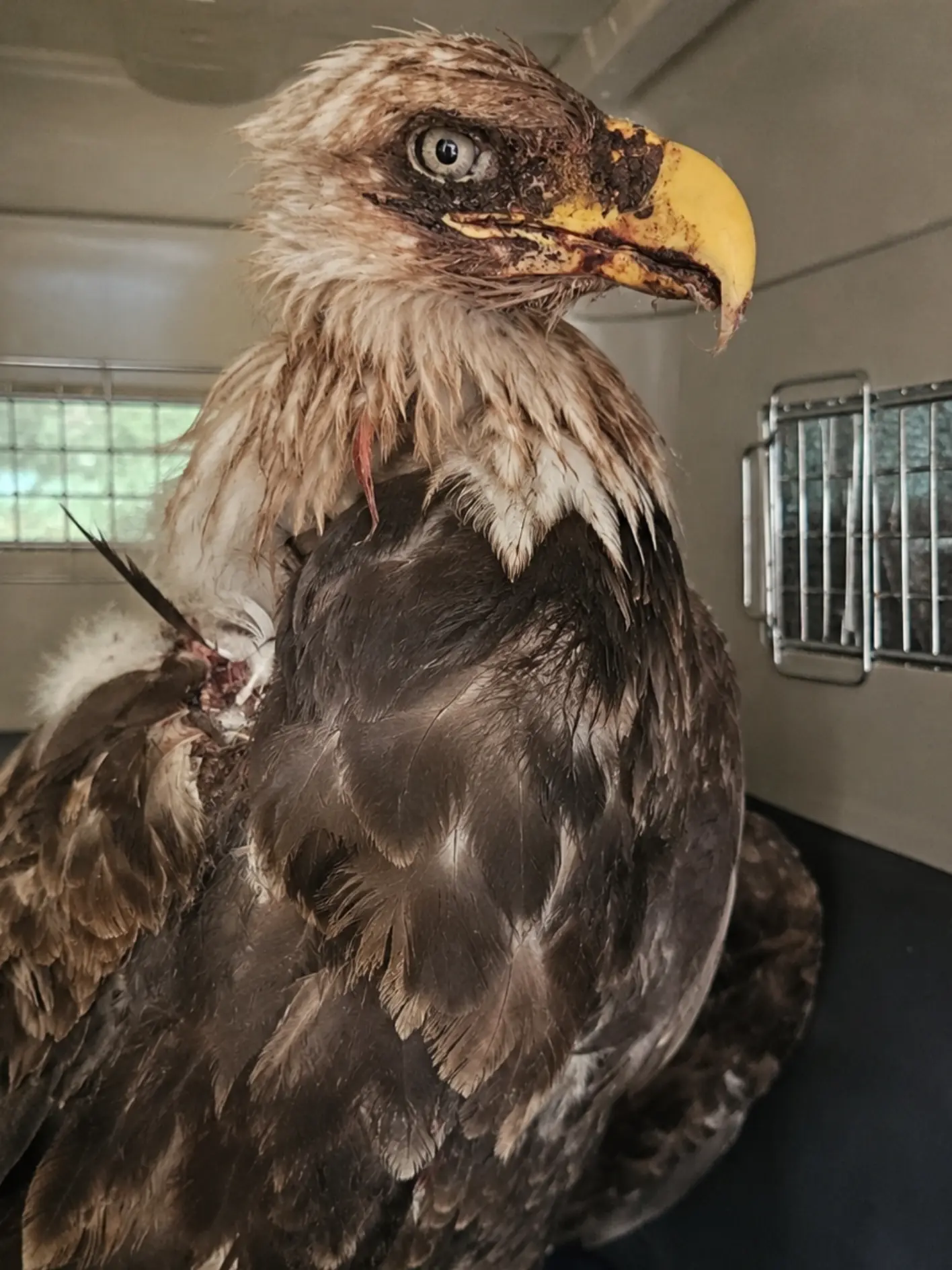
The Eastern Carolina Wildlife Rescue Team responded to the location after receiving a report that the eagle was on the ground, visibly injured and unable to leave the area normally. Despite the amount of blood on its head and feathers, the bird was still conscious and watching the people around it.
Rescuers approached cautiously.
Even a severely injured Bald Eagle can retain enough strength in its feet to cause serious injury. The bird’s talons were controlled first, the wings were supported against the body, and the eagle was placed into a secure transport carrier before being taken directly to the wildlife center for emergency evaluation.
When the bird arrived, veterinary staff described it as unusually quiet but still alert.
That distinction immediately raised concern.
A healthy adult Bald Eagle normally resists handling aggressively. This eagle watched the medical team and reacted to movement, but it did not struggle with the intensity expected from an otherwise healthy wild bird.
Its head, face and upper neck were heavily stained with blood.
Several feathers were matted together.
There were visible wounds around the face and neck, and additional trauma was apparent along the upper body.
Once the feathers were carefully separated and the dried blood began to be cleaned away, the veterinary team realized the injuries were substantially deeper than they had first appeared.
Multiple narrow puncture wounds extended through the skin of the head and neck.
Several were deep enough to require immediate stabilization.
“Some of the wounds were so severe that we had to close the worst ones before we could even proceed with the definitive surgical workup,” the attending wildlife veterinarian said. “Our first priority was controlling the active tissue damage, protecting the deeper structures and getting the bird stable enough for anesthesia.”
The pattern of injuries raised an obvious possibility.
The eagle may have been involved in a territorial confrontation with another Bald Eagle.
But no one witnessed the event, and the medical team emphasized that the cause cannot be confirmed from the wounds alone.
“The injuries are very compatible with talon punctures from another large raptor,” the veterinarian said. “A fight with another Bald Eagle is one of the possibilities we are considering, but without a witness, we have to be careful not to present that as a certainty.”
For now, the center is treating what it can prove:
The eagle suffered significant penetrating trauma to the head and neck.
And the next several days will determine whether the damage remains limited to the soft tissues or whether deeper complications emerge.
The Rescue Began With a Grounded Eagle
The first report came from a member of the public who noticed the Bald Eagle remaining low to the ground near a wetland edge.
The bird was not behaving normally.
Rather than moving away or attempting to fly when people were nearby, it remained in place.
Its posture was upright enough to suggest it was conscious, but it was clearly compromised.
Blood was visible around the head.
One side of the feathers appeared heavily disturbed.
The Eastern Carolina Wildlife Rescue Team was contacted and dispatched to the location.
Because of the bird’s size and the potential danger from the talons, rescuers did not attempt a casual capture.
A large eagle can produce tremendous force with its feet even when weak.
The responders used protective equipment and approached in a coordinated way, covering the bird and securing the legs before allowing the wings to move freely.
That sequence matters.
Controlling the wings without first controlling the feet can place both the bird and the handler at risk.
Once contained, the eagle was transported with its body supported and visual stimulation minimized.
The goal was to prevent additional bleeding or injury during the trip to the wildlife hospital.
Quiet but Alert Can Be a Warning Sign
When the eagle reached the center, staff immediately noted that it was not unconscious.
Its eyes were open.
It followed movement.
It responded when touched.
But it was far too subdued for a healthy Bald Eagle.
That kind of presentation can occur after:
- severe pain,
- blood loss,
- exhaustion,
- prolonged stress,
- or traumatic injury.
Wild raptors frequently conceal weakness as long as they can.
By the time a Bald Eagle becomes easy to approach or unusually tolerant of restraint, it may already be significantly compromised.
The team therefore treated the quiet behavior as a clinical sign rather than as evidence that the bird was comfortable.
The Head and Neck Wounds Were More Serious Than They Looked
Raptor puncture wounds can be deceptive.
A talon can leave only a relatively small opening in the skin while penetrating much farther beneath the surface.
The external wound may measure only a few millimeters.
The internal tract can extend through muscle, fascia and other soft tissues.
That is why each puncture had to be examined individually.
As staff cleaned the blood and separated the feathers around the eagle’s face and neck, they identified multiple wounds of varying depth.
Some were superficial.
Others were not.
Several required immediate closure or stabilization before the team could safely proceed with a more extensive examination.
The deeper wounds were of particular concern because the head and neck contain structures essential to nearly every part of an eagle’s daily function.
Vision.
Swallowing.
Breathing.
Head movement.
Balance.
Feeding.
A wound that appears small externally can become far more consequential if it reaches the eye, oral cavity, airway, deeper musculature or cervical structures.
The Worst Wounds Had to Be Stabilized First
Before a full surgical exploration could begin, the veterinary team had to control the most urgent problems.
The bird received supportive care while the most unstable wounds were managed.
Fluids were administered according to the eagle’s clinical needs.
Pain medication was started.
Because penetrating wounds are highly vulnerable to contamination, antimicrobial therapy was considered part of the treatment plan.
The eagle was also kept warm and quiet.
The medical team wanted the bird’s circulation, breathing and general condition as stable as possible before placing it under anesthesia.
Wildlife anesthesia carries additional risk in a patient that may already be dehydrated, exhausted or dealing with blood loss.
The most visible injury is not always the most urgent problem.
Stabilizing the entire patient comes first.
The Eagle’s Eyes Were Examined Carefully
Any significant trauma around the head raises immediate concern for vision.
The eyes were therefore assessed for:
- corneal injury,
- abnormal pupil response,
- eyelid damage,
- bleeding,
- and evidence of deeper penetration.
Visual function will remain an important part of the bird’s prognosis.
A Bald Eagle that survives severe soft-tissue wounds but loses functional vision may still be unable to return to the wild.
The species depends heavily on precise visual processing for hunting, navigation, territorial behavior and landing.
Initial examination did not identify an obvious catastrophic injury to both eyes, which was encouraging.
But the team will continue monitoring visual responses as swelling changes and the bird recovers from anesthesia and medication.
Imaging Was Needed to Look Beneath the Wounds
The veterinary team also obtained diagnostic imaging to evaluate structures that could not be assessed from the surface alone.
Radiographs were used to look for:
- skull fractures,
- cervical injury,
- shoulder or wing trauma,
- retained foreign material,
- and other evidence of deeper impact.
The medical staff did not identify an obvious major wing fracture during the initial orthopedic examination.
That was important because the bird had been found on the ground and might have suffered additional trauma during whatever event preceded the rescue.
The absence of a major wing fracture would improve the bird’s chances of eventual release, provided the head and neck injuries heal without serious complications.
But the radiographs were only one part of the assessment.
Soft-tissue punctures do not always appear dramatically on X-rays.
The surgical examination remained essential.
Bloodwork Helped Assess the Bird Beyond the Visible Injuries
Samples were collected to evaluate the eagle’s systemic condition.
The veterinary team may monitor parameters such as:
- packed cell volume,
- hydration,
- inflammatory changes,
- and organ function.
The amount of visible blood on the bird does not necessarily reveal how much blood has actually been lost.
Packed cell volume can help clinicians understand whether anemia or acute blood loss is becoming clinically important.
Bloodwork can also reveal whether the bird is significantly dehydrated or showing evidence of systemic stress.
Because grounded Bald Eagles may occasionally have more than one problem at the same time, additional screening can be considered when clinically appropriate.
A traumatic injury does not automatically rule out toxin exposure or underlying illness.
Surgery Allowed the Team to Follow the Wound Tracts
Once the eagle was sufficiently stable for anesthesia, the veterinary team could examine the punctures more thoroughly.
Feathers around the wounds were carefully managed to improve visibility.
The affected areas were flushed.
Contaminated material was removed.
Nonviable tissue was debrided as needed.
Each deeper wound tract was evaluated to determine how far it extended and what structures it might involve.
This is one of the most important differences between treating a superficial cut and treating a puncture wound.
A puncture can seal quickly at the skin while bacteria and damaged tissue remain trapped underneath.
Closing every opening immediately is not always desirable if contamination remains inside.
Veterinarians therefore have to decide which wounds should be closed, which need drainage, and which are safer to leave partially open during the early healing period.
Infection Is One of the Biggest Concerns
Wild raptor talons are not sterile.
Even if another bird caused the injuries during a completely natural territorial confrontation, those punctures can introduce bacteria deep into tissue.
The eagle was also injured outdoors, where feathers, soil and environmental debris can enter open wounds.
The medical team will be watching for:
- increasing swelling,
- heat,
- discharge,
- tissue discoloration,
- worsening pain,
- abnormal odor,
- or systemic decline.
A wound that appears stable on the first day can develop infection later.
That is why the eagle will need repeated examinations even if its overall behavior improves quickly.
The Neck Wounds Require Particular Caution
Several of the injuries involved the head and neck region.
The neck of a bird is highly mobile and contains vital structures in a relatively narrow space.
Veterinarians must consider possible injury to:
- cervical muscles,
- the esophagus,
- trachea,
- blood vessels,
- and deeper connective tissues.
No immediate evidence of catastrophic airway disruption was identified during the first stabilization period.
That is encouraging.
But subtle damage may become clearer as swelling changes.
The eagle’s ability to breathe normally, swallow, rotate its head and preen will all be monitored.
Normal neck movement is essential to eventual release.
A Territorial Fight Is Plausible — but Still Only a Hypothesis
The distribution of the wounds is one reason staff are considering a confrontation with another raptor.
Bald Eagles use their feet and talons during aggressive interactions.
Territorial disputes may occur over:
- nesting areas,
- food,
- mates,
- or preferred perches.
The birds may chase one another through the air, strike with their feet or briefly lock talons.
When that happens, the head, neck, chest and shoulders can become vulnerable.
Most territorial encounters do not result in injuries this severe.
Often one bird retreats.
But occasionally the interaction can become violent enough to cause penetrating trauma or a fall.
The pattern in this eagle is consistent with such an event.
That does not mean another eagle has been proven responsible.
No one observed the incident.
The center is therefore describing the territorial-fight scenario as suspected rather than confirmed.
The Possibility of Another Cause Has Not Been Completely Excluded
A large raptor encounter is one explanation.
Other possibilities remain.
The eagle may have struck a sharp object during flight.
It may have been injured during a collision.
Some wounds could theoretically have occurred after the bird reached the ground.
The medical team’s role is not to construct a dramatic story around incomplete evidence.
It is to document the injuries accurately and treat the patient according to what those injuries require.
If additional evidence emerges, the interpretation can change.
The First Night Was About Preventing Deterioration
After surgery and wound management, the eagle was moved into a quiet recovery environment.
A padded floor was used rather than a high perch.
That reduced the risk of falling while the bird was recovering from anesthesia, pain medication and exhaustion.
Human contact was minimized.
Staff continued monitoring:
- respiration,
- posture,
- alertness,
- bleeding,
- temperature,
- and neurological responses.
The prognosis remained guarded.
Not because the team had given up, but because serious head and neck trauma can change rapidly during the first 24 to 48 hours.
The First Encouraging Changes Were Small
By the following period of observation, the team began looking for subtle improvements.