An adult female bald eagle rescued after a suspected vehicle strike in Cumberland County, Maine, is undergoing intensive rehabilitation after veterinarians discovered that the bird was dealing with far more than a traumatic wing injury.
The eagle was initially found injured near Brunswick and was picked up by a state wildlife officer after it became clear that she could not fly safely. She was first taken to a veterinary clinic in Brunswick, where clinicians stabilized her condition and placed a supportive bandage around the injured left wing.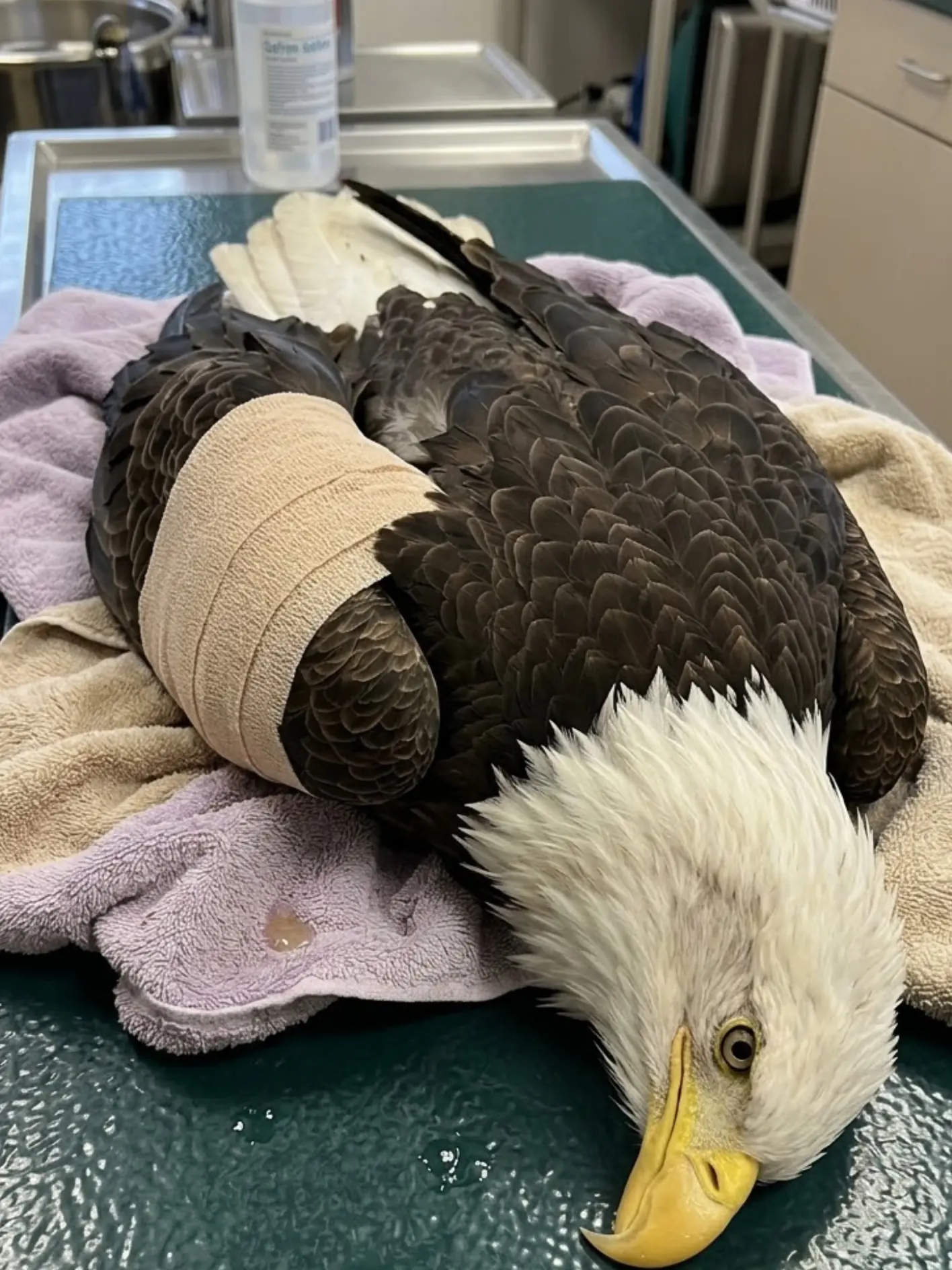
Once she was considered stable enough for transport, a wildlife volunteer drove the eagle to a licensed rehabilitation center in southern Maine for a more complete examination.
At first, some of the findings were encouraging.
The adult female was in fairly good body condition. She was alert, responsive, and more active than staff might have expected from a bird that had apparently been struck by a vehicle. Her overall demeanor suggested that she had retained considerable strength despite the trauma.
But the examination soon revealed multiple concerns.
Several of the eagle’s primary flight feathers and tail feathers were dirty and frayed. Feather lice were observed among the body plumage. Both feet had minor abrasions, several talons were mildly blunted, and one toe on the right foot could not flex and extend normally.
The left wing, however, was the most obvious acute problem.
The first veterinary clinic had already immobilized it after finding evidence of significant orthopedic injury. Additional radiographs taken at the wildlife center confirmed two fractures involving the left ulna, one of the major bones of the forearm portion of a bird’s wing.
Then the X-rays revealed something no one had expected.
Inside the eagle’s gastrointestinal tract was a large fishing hook associated with metallic lead, along with several partially digested bone fragments.
Suddenly, what had begun as a vehicle-trauma case had become a much more complicated combination of orthopedic injury, a gastrointestinal foreign body, possible lead exposure, and several additional findings that would need to be followed over time.
The wing fracture was the injury everyone expected.
The fishing tackle was not.
A Rescue After a Suspected Vehicle Strike
The adult bald eagle was found injured in Cumberland County, in the Brunswick area of southern Maine.
Bald eagles are regularly seen across the state, particularly around rivers, lakes, coastal waters, marshes, and areas where fish and carrion are available. An eagle standing on the ground is not automatically an emergency.
An eagle that cannot leave when approached is different.
The bird’s condition was concerning enough that a state wildlife officer responded and determined that professional veterinary care was necessary.
Based on the circumstances in which she was discovered and the nature of the injuries later found, a vehicle strike was considered the suspected cause of the acute trauma.
The collision itself, however, was not witnessed.
That distinction matters.
Wildlife veterinarians frequently receive patients after the event that injured them. The body may provide strong clues, but unless someone saw the incident happen, the precise mechanism cannot always be established.
In this case, the evidence supported trauma consistent with a vehicle collision, but clinicians still had to focus on what they could confirm.
The eagle was injured.
The left wing was abnormal.
She could not safely return to the wild.
The First Clinic Stabilized the Wing
The wildlife officer transported the eagle to a veterinary clinic in Brunswick for the first stage of care.
The immediate goal was not to determine every injury.
It was to stabilize the patient.
A bald eagle with an injured wing may continue trying to escape if given too much room. Those attempts can worsen a fracture or damage surrounding soft tissues before a complete diagnosis has been made.
The clinic therefore limited unnecessary movement and placed the left wing in a supportive bandage.
That stabilization was important because the ulna was later found to be fractured in two places.
A bandage does not repair the bone by itself.
It protects the injured wing from excessive movement while the bird is being evaluated and transported.
After the eagle was stable enough to travel, a volunteer transporter took her to a licensed wildlife rehabilitation center in southern Maine, where staff could perform a more detailed orthopedic and medical workup.
The transfer represented another step in a chain of coordinated care:
wildlife officer,
local veterinary clinic,
volunteer transporter,
rehabilitation team.
Each part mattered.
The Eagle Was Surprisingly Alert
At the rehabilitation center, the eagle’s general condition initially provided some reassurance.
She was not profoundly emaciated.
She was responsive to people around her.
Her body condition was considered reasonably good.
That matters because a wildlife patient with significant nutritional depletion has less reserve for healing.
This eagle appeared to have entered care with enough body mass and muscle condition to support treatment.
But good body condition does not erase serious trauma.
The team still needed to examine the bird systematically.
Both wings.
Both feet.
The eyes.
The beak.
The chest.
Neurological responses.
Feather condition.
The gastrointestinal tract.
And, because a wild raptor can arrive with more than one unrelated problem, clinicians could not assume that everything they found would trace back to the suspected collision.
That point would become especially important once the radiographs were reviewed.
The Plumage Was Not in Ideal Condition
Several primary flight feathers and tail feathers were dirty, frayed, or damaged.
Those feathers are not merely cosmetic.
Primary feathers contribute to propulsion and control during flight.
Tail feathers assist with braking, steering, and balance.
A few damaged feathers may not prevent release, especially if enough healthy feathers remain and flight performance is normal.
More extensive damage can matter.
For a large bird such as a bald eagle, feather integrity contributes directly to aerodynamic efficiency.
The rehabilitation team therefore documented the condition of the plumage so it could be considered later during flight assessment.
At this early stage, the damaged feathers were not necessarily the most important medical problem.
The fractures were.
But they were another part of the overall rehabilitation picture.
Feather Lice Were Also Present
During the physical examination, staff observed feather lice among the eagle’s body plumage.
Ectoparasites can occur naturally on wild birds.
Their presence does not automatically mean the eagle was severely ill before the accident.
The significance depends on the burden and the condition of the host.
A relatively healthy wild bird may tolerate some external parasites without obvious clinical consequences.
A heavily compromised patient may be affected more.
In this eagle, the lice were documented and could be treated appropriately if needed, but they were not considered the primary reason she had entered care.
This distinction is important in wildlife medicine.
Not every abnormal finding is the cause of the emergency.
Some are secondary.
Some may be incidental.
Some become important only when combined with other stressors.
Both Feet Had Minor Injuries
The eagle’s feet also showed evidence of trauma.
There were mild abrasions on both feet.
Several talons appeared slightly blunted.
Those findings were not as dramatic as the wing injury, but they still required attention.
Bald eagles depend heavily on their feet.
They use them to perch.
They grip food.
They stabilize themselves during landing.
They capture and restrain prey.
A foot injury that looks minor during intake can become relevant later if it interferes with grip strength or weight-bearing.
The veterinary team therefore documented the abrasions and talon condition while looking for deeper damage.
One finding was more concerning.
A toe on the right foot did not flex and extend normally.
One Right Toe Could Not Move Normally
The abnormal right toe created another question.
Was the problem caused by swelling?
Tendon injury?
Nerve impairment?
Previous trauma?
Pain?
At intake, the team could not determine the answer immediately.
The inability to flex or extend a toe normally matters because a bald eagle needs coordinated movement of all the digits for secure gripping.
A single impaired toe does not automatically prevent release.
But the function of the foot must be adequate.
That means this issue will need to be reassessed after the acute trauma has stabilized.
If movement returns as swelling and pain decrease, the problem may prove temporary.
If the deficit persists, additional neurological or musculoskeletal evaluation may be necessary.
For now, the right toe remains one more item on a growing list of findings that must be monitored.
The Left Wing Was Clearly the Major Orthopedic Injury
The left wing had already been bandaged by the first veterinary clinic.
Once the rehabilitation team reviewed the bird and obtained additional radiographs, the reason became clear.
There were two fractures involving the left ulna.
The ulna is one of the two primary bones of the forearm portion of a bird’s wing, running alongside the radius.
For a flying bird, the alignment and function of this region are critical.
The wing has to extend normally.
It has to fold normally.
Muscles and connective tissues need to move over the skeletal framework without abnormal restriction.
A fracture can disrupt those relationships.
Two fractures make the problem even more important.
Why Ulna Fractures Matter for Flight
A bald eagle’s wing is a highly integrated mechanical system.
Bone position affects feather position.
Joint movement affects wing shape.
Muscle force has to travel through the limb in a precise, coordinated way.
If the ulna heals in poor alignment, the wing may no longer extend or fold normally.
Abnormal callus formation could affect nearby tissues.
Pain or stiffness could reduce the amplitude of the wingbeat.
The eagle might technically become airborne while still lacking the efficiency and endurance required for wild survival.
That is why the standard for success is not simply “the bone healed.”
The question is whether the wing heals in a way that restores function.
The Fractures Need Protection
During the early healing phase, the left wing must be protected from strenuous use.
The supportive bandage helps limit movement.
The eagle will be housed in an environment designed for medical recovery rather than exercise.
This is one of the paradoxes of raptor rehabilitation.
The eventual goal is powerful flight.
The immediate goal may be preventing flight entirely.
A strong attempt to launch can transmit substantial force through the injured forearm.
If the fractures are not stable, that movement can interfere with healing or worsen displacement.
The bird therefore needs time before controlled rehabilitation can begin.
Another Finding Appeared Near the Left Wrist
The radiographs also showed an unusual appearance in the region of the left carpus, or wrist.
At first glance, that could suggest an additional injury.
But the team could not confidently make that diagnosis from the current images.
The reason was positioning.
Because the ulna was fractured, the wing could not be placed in the ideal position for radiographic imaging without risking additional pain or damage.
That limitation can change the way bones overlap on an X-ray.
A structure may appear abnormal simply because the limb is rotated or held at an unusual angle.
For that reason, veterinarians are treating the carpal finding cautiously.
The left wrist region looked abnormal.
It is not yet possible to say with certainty that there is a separate acute lesion there.
Repeat imaging later should provide a better answer.
Follow-Up X-Rays Will Be Important
As the ulna begins to heal, the eagle may tolerate more precise positioning for radiographs.
Those future films can answer several questions.
Are the two fractures remaining properly aligned?
Is callus formation developing?
Is healing progressing at the expected rate?
Does the carpal region still appear abnormal when positioned more accurately?
The answers may influence both treatment and prognosis.
Radiographs are not simply used once to make a diagnosis.
In orthopedic wildlife cases, they often become part of a timeline.
The first films show where the case began.
Later films show whether the body is moving toward functional recovery.
Pelvic Asymmetry Added Another Question
The radiographs also suggested asymmetry around the pubic or pelvic region.
Unlike the fractured ulna, however, there was no clear evidence of an acute pelvic injury.
The asymmetry may represent a previous trauma that had already healed.
Wild birds often survive injuries that are never observed or treated.
A bald eagle may collide with something, fight with another eagle, or experience another accident and continue living if the damage is not severe enough to eliminate function.
A healed old injury can sometimes appear unexpectedly on imaging obtained years later for a completely different problem.
That may be what the team is seeing here.
But once again, the clinicians are not treating speculation as diagnosis.
The pelvis appears asymmetric.
No definite acute lesion has been identified.
Repeat imaging and future functional assessment may help determine whether the finding has any practical significance.
Then the Radiographs Revealed Something Entirely Different
The orthopedic findings were already enough to make this a complicated case.
Then the veterinary team examined the abdominal portion of the radiographs.
Inside the gastrointestinal tract was a large fishing hook.
Associated with it was metallic lead.
Several partially digested bone fragments were also visible.
The discovery immediately expanded the scope of the case.
The eagle was no longer being treated only for traumatic orthopedic injuries.
Now the team had to consider a potentially dangerous gastrointestinal foreign body and possible lead exposure.
Neither problem had been obvious from the outside.
A Fishing Hook Can Become a Serious Internal Hazard
Fishing hooks present several risks when swallowed by wildlife.
A hook may lodge in the esophagus or stomach.
It may penetrate the wall of the gastrointestinal tract.
It can migrate.
It may cause bleeding.
It can create inflammation or infection.
If attached to fishing line, additional complications can develop elsewhere in the digestive system.
Not every swallowed hook produces immediate clinical signs.
A bird may remain alert and continue eating while the foreign object is still present.
That does not make the hook harmless.
The exact location and orientation of the hook matter enormously.
The rehabilitation team now has to determine whether the object can be removed safely and what method offers the lowest risk.
The Hook May Not Be Related to the Vehicle Strike
The fishing hook could have been swallowed before the suspected collision.
It may represent an entirely separate hazard.
Bald eagles frequently consume fish and carrion.
A fish containing discarded tackle or a food item associated with fishing debris can expose an eagle to hooks, sinkers, or line.
The bird may also scavenge something already containing the equipment.
No one knows when this eagle swallowed the hook.
There is no evidence that the foreign body caused the vehicle incident.
The two problems may be completely unrelated.
That is one of the difficult realities of wildlife medicine.
A patient can arrive because of one acute event and reveal an older, hidden threat during the workup.
The Metallic Lead Raises a Toxicology Concern
The presence of metallic lead associated with the fishing tackle creates another layer of concern.
Lead is toxic to bald eagles.
If absorbed in sufficient amounts, it can affect neurological function, gastrointestinal function, and other physiological systems.
But an X-ray showing metallic lead inside the digestive tract is not the same as a confirmed diagnosis of lead toxicosis.
That distinction is essential.
Imaging tells clinicians that lead-containing material is present.
Blood testing is needed to determine whether enough lead has entered the eagle’s bloodstream to create clinically significant exposure.
For that reason, blood lead testing becomes an appropriate next step.
Blood Testing Can Determine Whether Absorption Has Occurred
If the eagle’s blood lead concentration is elevated, treatment may need to include chelation therapy in addition to management of the foreign body.
Chelating medications bind lead and help the body eliminate it.
The decision to use them depends on the blood value, clinical signs, and the bird’s overall condition.
If the blood lead level is low, the focus may remain on removing or managing the physical source before substantial absorption occurs.
Either way, the discovery matters.
The eagle is carrying lead inside the digestive tract.
The medical team now has to determine whether that exposure is still only a potential threat or has already become a systemic toxicological problem.
The Bone Fragments Were Less Concerning
Several partially digested bone fragments were also visible on the radiographs.
Unlike the fishing hook, these findings may simply reflect recent feeding.
Bald eagles regularly consume animal material containing bone.
Small bone fragments can pass through the digestive tract as part of normal feeding.
Their presence therefore does not automatically indicate disease.
The contrast is useful.
Not everything visible on an X-ray is abnormal.
The fragments can be consistent with what the bird had eaten.
The hook and metallic lead are foreign material and require a different level of attention.