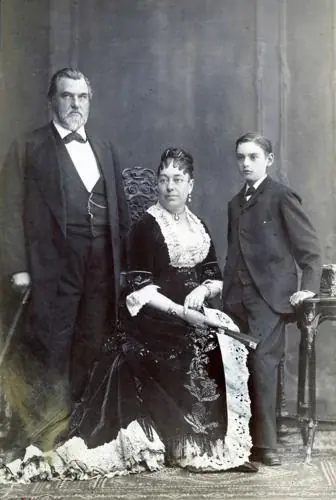
San Francisco.
January 14, 1905.
Jane Stanford was seventy-six years old and one of the most powerful women in California.
Her husband, railroad magnate and former California governor Leland Stanford, had been dead for more than a decade.
Their only child, Leland Stanford Jr., had died from typhoid fever at fifteen.
Out of that grief, Jane and her husband had created a university in their son's name.
By 1905, both men were gone.
Jane remained.
And Stanford University depended heavily on her.
She was not merely an elderly widow whose name appeared on buildings.
She was president of the university's board of trustees.
She controlled money.
She involved herself directly in appointments.
She had strong opinions about professors, administrators and the university's direction.
And she had repeatedly clashed with Stanford's founding president, David Starr Jordan. Stanford's own historical materials describe a relationship marked by significant tensions over how the institution should be run.
On the evening of January 14, Jane was at her Nob Hill mansion in San Francisco.
As usual, a bottle of Poland Spring mineral water had been placed near her bed.
She drank from it.
Almost immediately, something seemed wrong.
The water was intensely bitter.
Jane reacted quickly.
She forced herself to vomit and called for help.
Her maid, Elizabeth Richmond, came to the room.
Jane's longtime secretary, Bertha Berner, was also summoned.
Both women tasted the water and agreed something was wrong with it.
The bottle was sent for chemical analysis.
At first, nobody knew whether the strange taste came from spoiled water, contamination or something more sinister.
Then the test results came back.
Strychnine.
The water contained enough poison to potentially be fatal.
This was not simply an upset stomach.
Someone appeared to have tampered with a bottle that had been sitting beside one of the wealthiest women in California while she slept.
Jane had survived largely because she tasted the bitterness and reacted before enough poison remained in her system.
Now came the obvious question.
Who had put it there?
The possibilities immediately became uncomfortable.
The bottle was not sitting in a public restaurant.
It was inside Jane Stanford's private home.
Someone with access to the household appeared to have reached it.
Suspicion initially fell on members of the domestic staff.
Elizabeth Richmond, the maid who had responded when Jane became ill, was investigated.
A private detective agency was brought in.
Detectives monitored Richmond and searched pharmacies for suspicious purchases of strychnine.
Yet the investigation failed to establish that Richmond had poisoned Jane.
She was dismissed, but the central mystery remained.
Someone had apparently attempted to kill Jane Stanford.
Nobody could say who.
And Jane knew it.
For a woman accustomed to controlling nearly every element of her life, that uncertainty was terrifying.
She could dismiss a servant.
She could change a university policy.
She could sell property.
She could alter her travel schedule.
But she could not protect herself from an attacker whose identity she did not know.
The poisoning also arrived during a period when Jane was reconsidering the leadership of Stanford University.
Her relationship with David Starr Jordan had become strained.
According to later historical research, Jane had begun discussing whether Jordan should remain president.
One Stanford Magazine account says she was increasingly doubtful that he was the right person to lead the university. Later research by historian Richard White goes further, arguing that she intended to remove him.
That would become important after her death.
At the time, however, Jane's immediate problem was simpler.
She no longer felt safe in San Francisco.
The first poisoning had failed.
But the person responsible was still free.
Jane had also been suffering from a respiratory illness and disliked the cold, damp San Francisco winter.
She decided to leave.
Hawaii offered warm weather.
From there, she planned to continue toward Japan.
It was partly a vacation.
Partly recovery.
And, after the poisoned water, partly escape.
On February 15, 1905, Jane Stanford and her traveling party sailed away from San Francisco.
The distance from California to Hawaii is measured in thousands of miles of Pacific Ocean.
Jane may have believed that distance could separate her from whoever had reached the water beside her bed.
For nearly two weeks, it seemed to work.
She arrived in Honolulu.
She stayed at the Moana Hotel in Waikiki.
She went sightseeing.
She took an excursion across Oahu.
She appeared to be recovering from the anxiety that had followed the San Francisco incident.
On February 28, she went on a picnic with members of her party.
She ate sandwiches and gingerbread.
She returned to the hotel describing the outing as enjoyable.
That evening, she prepared for bed.
And shortly before retiring, Jane asked Bertha Berner for something she had taken many times before.
Bicarbonate of soda.
A common digestive remedy.
Berner went to the luggage and retrieved the bottle.
A spoonful was prepared.
Nothing about the white powder looked unusual.
Jane had escaped a poisoned bottle of water in California.
Now, nearly two thousand miles away, she raised another ordinary household remedy to her mouth.
This time, there was no bitter warning strong enough to save her.