When this adult Bald Eagle arrived at our wildlife hospital, there was no catastrophic fracture, no visibly shattered wing, and no external wound large enough to explain how rapidly the bird was deteriorating. From a distance, someone might have assumed that it had suffered a collision or simply become too weak to fly, but the most alarming signs were coming from inside the body.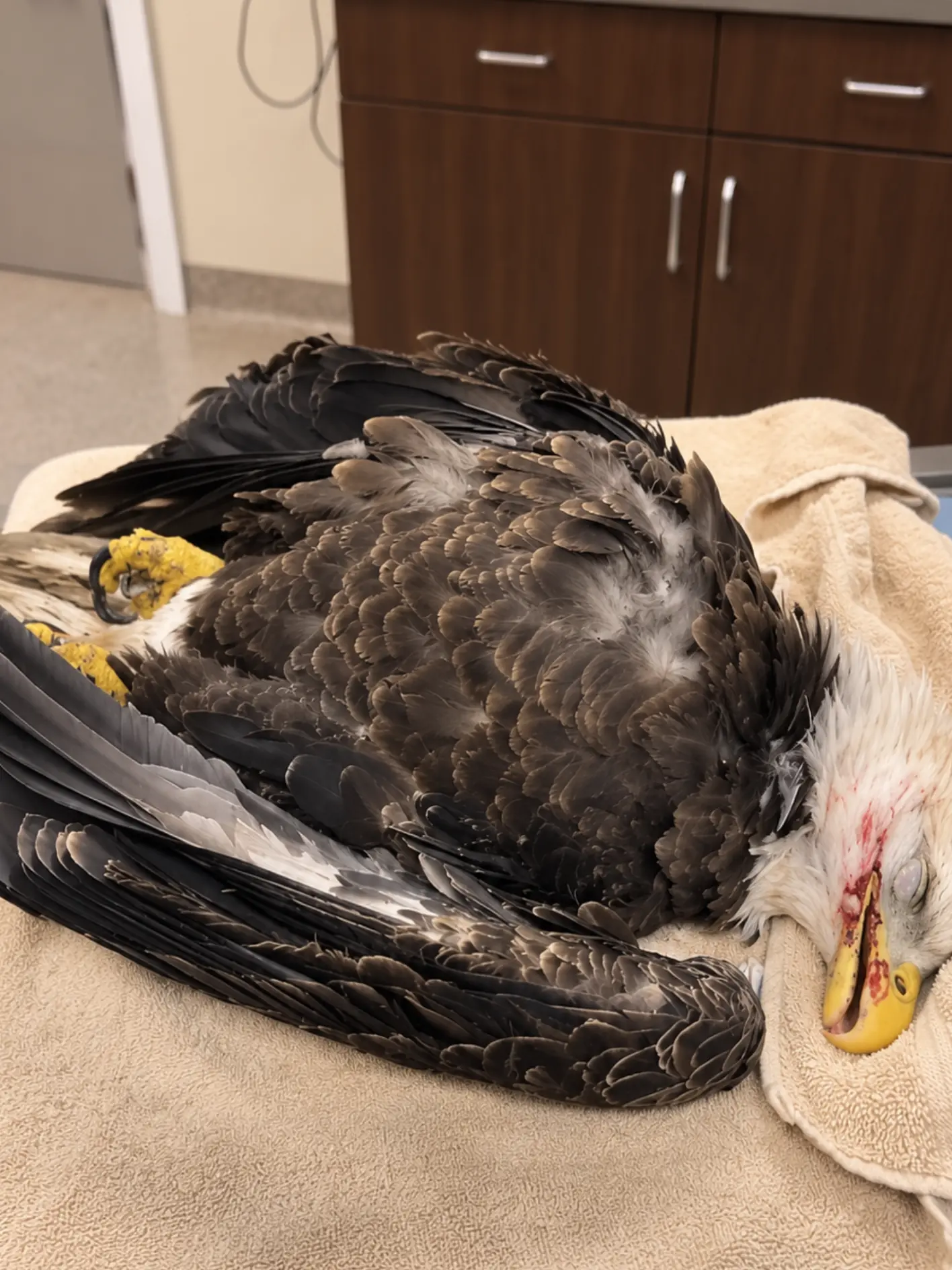
The eagle was profoundly weak and unable to remain upright for more than a short period. Blood was visible around the mouth, and the bird had passed dark, nearly black droppings that immediately raised concern for gastrointestinal bleeding. Several small areas of spontaneous hemorrhage were also visible beneath the skin and around superficial tissues, even though there was no corresponding major traumatic injury.
The clinical picture suggested that this was not simply a bird that had been injured and lost blood from a visible wound. Something appeared to be interfering with the eagle’s ability to stop bleeding normally.
Blood testing revealed another serious problem. The eagle also had an elevated blood lead concentration.
For the medical team, that meant the bird may have been dealing with two different toxic burdens at the same time. One was suspected to be an anticoagulant rodenticide exposure that had compromised normal clotting. The second was lead exposure, which could further weaken an already unstable patient and contribute additional systemic stress.
By the time the eagle reached professional care, the consequences of those exposures were no longer theoretical. The bird was actively losing blood, becoming progressively weaker, and showing signs that the body’s ability to compensate was beginning to fail.
This is one of the reasons we are sharing this case.
Wildlife toxins do not always produce dramatic external injuries. A bird can appear nearly intact on the outside while bleeding internally. A scavenger does not need to consume poison directly to become poisoned, and it does not need to be shot with lead ammunition to absorb lead. Sometimes it only needs to eat another animal that has already been exposed.
The Eagle Was Found Weak, but There Was No Obvious Major Injury
The Bald Eagle was discovered on the ground in a rural area after a resident noticed that it had remained in essentially the same location for an unusually long period. The bird was awake but subdued. It did not attempt a strong escape when approached from a safe distance, and it appeared incapable of sustained flight.
At first, trauma seemed like an obvious possibility. Vehicle collisions, territorial fights, power-line injuries, and other forms of blunt trauma are common reasons adult eagles become grounded. However, the person who found this bird could not see a broken wing or a major wound.
The eagle’s posture was simply wrong.
Its body remained low. The head drooped intermittently. The bird appeared exhausted, and when it attempted to reposition itself, the movements were slow and poorly sustained.
Wildlife responders were contacted, and trained personnel approached the eagle using protective equipment. Even a profoundly weak Bald Eagle can still defend itself with its talons, so the feet were controlled first while the wings and body were supported.
The rescuers quickly noticed something else.
There was blood around the mouth.
At first, it was not clear whether the blood originated from a small oral injury, the respiratory system, or deeper within the gastrointestinal tract. The bird did not have an obvious external wound that could account for the amount of weakness being observed.
Then the eagle passed an extremely dark dropping.
That changed the medical concern considerably.
The Black Droppings Raised Concern for Digested Blood
Dark, tarry fecal material can be associated with melena, a term used when blood has been digested somewhere within the upper gastrointestinal tract before being passed through the digestive system.
Melena does not identify the exact source of bleeding by itself. Blood may originate from different parts of the gastrointestinal system, and several medical conditions can produce similar findings. However, in an eagle that was already weak and bleeding from the mouth without major external trauma, the appearance of black fecal material was highly concerning.
The veterinary team needed to know whether the bird was bleeding internally and, if so, why.
A normal animal has multiple mechanisms that limit blood loss when a vessel is damaged. Platelets and clotting proteins work together to stabilize bleeding sites and allow tissue repair to begin.
When that system is severely impaired, even small vessel injuries can continue to bleed.
An animal may then develop hemorrhage in places where there is no obvious traumatic wound.
That was beginning to look increasingly plausible in this case.
The Pattern of Bleeding Suggested a Coagulation Problem
As the eagle was examined more closely, veterinary staff found areas of bruising and superficial hemorrhage that seemed disproportionate to the visible injuries.
This type of pattern can raise concern for a coagulopathy, meaning the body is having difficulty forming or maintaining normal blood clots.
There are several possible causes of abnormal coagulation in wildlife, so the veterinary team did not immediately declare that rodenticide poisoning had been confirmed. Severe liver disease, certain toxins, profound systemic illness, and other medical problems may also interfere with normal clotting.
However, the combination of spontaneous hemorrhage, suspected gastrointestinal bleeding, profound weakness, and the absence of a major traumatic explanation made anticoagulant exposure an important possibility.
The bird was treated as an emergency.
Anticoagulant Rodenticides Can Cause Bleeding Far From the Original Exposure
Some rodenticides are designed to interfere with the biochemical processes required for normal clotting.
These compounds can impair the body’s ability to maintain adequate activity of vitamin-K-dependent clotting factors. When those factors become sufficiently depleted, normal vessel damage that would ordinarily seal itself may continue bleeding.
This bleeding does not need to occur at the mouth.
It may happen internally.
Blood can accumulate in body cavities, tissues, the gastrointestinal tract, or other organs.
An affected animal may become progressively weak as circulating red blood cells and blood volume decline.
Eventually, the patient may reach a point where oxygen delivery to tissues becomes inadequate.
From the outside, the animal may simply look tired.
Inside, the situation can be life-threatening.
A Bald Eagle Does Not Need to Eat Rodenticide Bait Directly
One of the most important conservation lessons from suspected rodenticide cases is that predators and scavengers may be exposed indirectly.
Imagine a rodent entering a building or feeding area where anticoagulant bait has been placed. The animal consumes the bait but does not die instantly. Depending on the product, dose, and exposure pattern, it may remain alive long enough to move outside.
As its condition worsens, the rodent may become slower and less responsive.
That makes it easier prey.
An owl may catch it.
A hawk may take it.
A fox may find it.
A scavenging eagle may consume it after it dies.
The predator never approached a bait station.
It never intentionally contacted the rodenticide.
It simply ate prey.
That is known as secondary exposure.
The predator does not need to eat the poison itself. It only needs to eat an animal that did.
The Blood Lead Result Added a Second Problem
While the veterinary team investigated the abnormal bleeding, routine toxicologic screening identified elevated lead in the eagle’s blood.
This did not automatically mean lead was responsible for every clinical sign.
The hemorrhagic pattern remained more suspicious for a severe coagulation problem, and further testing would be needed to evaluate suspected anticoagulant rodenticide exposure.
However, the lead result was still significant.
The eagle was not entering treatment with one isolated medical problem.
It was entering treatment with severe blood loss while carrying an additional toxic heavy-metal burden.
That matters because lead can affect several physiologic systems. Depending on the magnitude and duration of exposure, it can contribute to neurologic weakness, gastrointestinal abnormalities, altered blood production, renal stress, reduced coordination, and generalized debilitation.
A bird already losing blood has very little reserve for another systemic toxin.
Lead Exposure Is a Familiar Problem in Scavenging Raptors
Bald Eagles are powerful hunters, but they are also opportunistic scavengers.
They consume fish, waterfowl, mammals, carrion, and animal remains encountered across the landscape.
That feeding strategy is one reason they are vulnerable to lead exposure.
When an animal is shot with lead-based ammunition, the projectile may not always remain as one intact piece. Lead can fragment when it strikes tissue, and some fragments may disperse into surrounding meat.
The largest fragments may be visible.
Many smaller pieces may not be obvious to someone looking at the carcass.
If portions of the animal remain in the field, scavengers can later consume those tissues.
A Bald Eagle has no ability to identify microscopic or small metallic fragments hidden in meat.
It sees food.
It eats.
That is enough for exposure to occur.
The Bird Does Not Need to Be the Intended Target
This point is often misunderstood.
Lead poisoning in eagles is usually not about someone deliberately shooting an eagle.
The bird may never come near a firearm.
The exposure may begin with another animal entirely.
A deer, game animal, pest species, or other animal is shot.
Part of the carcass remains accessible.
An eagle feeds on that material.
The lead enters the eagle’s digestive tract and may subsequently enter the bloodstream.
The toxic effect occurs in an animal that was never the intended target of the ammunition.