A state wildlife officer patrolling a rural dirt road in Pueblo County, Colorado, recently came across an adult Bald Eagle sitting unusually close to the roadside and showing almost no attempt to move away.
At first, the circumstances suggested a familiar emergency.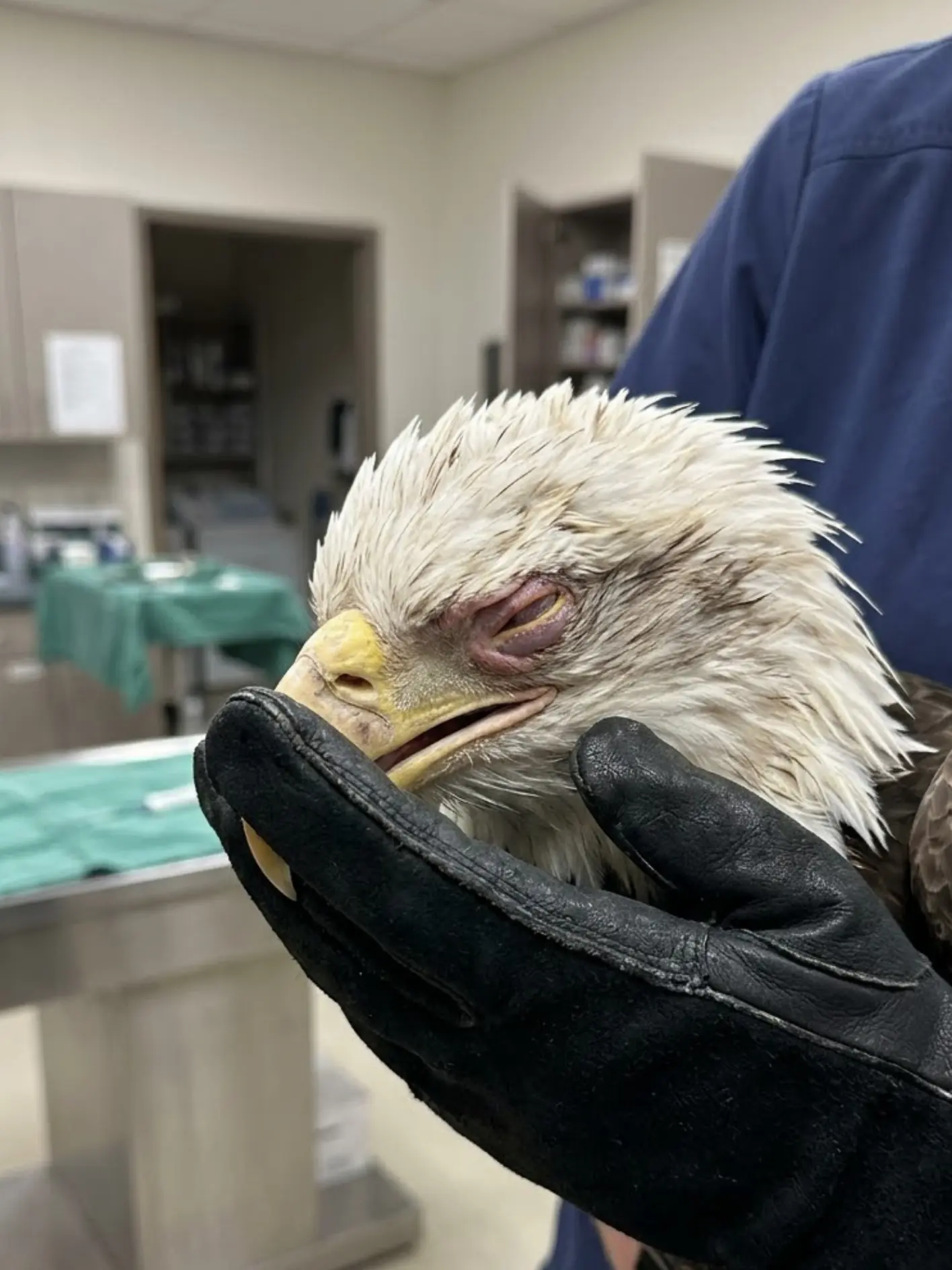
A large raptor found grounded beside a road often raises immediate concern for a vehicle collision. Bald Eagles regularly feed on carrion, cross roads at low altitude, and sometimes fail to gain enough height before an approaching vehicle reaches them.
But when the wildlife officer approached this eagle, something about the scene did not fit.
There was no obviously broken wing.
No major external bleeding.
No visibly displaced leg.
The bird simply looked profoundly ill.
“At first, we thought it had been struck by a vehicle,” the officer recalled. “But when I got close, I couldn’t see an obvious traumatic injury. It just looked terrible. It was weak, barely trying to move, and clearly needed help.”
The officer safely contained the eagle and transported it to a regional wildlife intake facility in southern Colorado. After initial stabilization, the bird was transferred to a licensed raptor rehabilitation organization for more extensive diagnostic testing and long-term care.
What followed was not the straightforward trauma case everyone had initially expected.
Radiographs failed to reveal a major fracture.
Instead, veterinarians found evidence of dehydration, poor body condition, significant inflammation around one eye, and generalized weakness that appeared to involve the entire body rather than one injured limb.
The absence of a major skeletal injury shifted the medical investigation in a different direction.
If the eagle had not been seriously injured by a vehicle, what had made a powerful adult bird so weak that it remained nearly motionless beside a rural road?
Blood testing eventually provided an important clue.
The eagle had an elevated blood lead concentration, along with laboratory findings consistent with systemic stress and dehydration.
For the rehabilitation team, the case had changed from a suspected collision into a much more complicated internal-medicine problem.
And over the following weeks, the transformation would be remarkable.
A Healthy Bald Eagle Usually Does Not Allow a Person to Walk Up to It
Bald Eagles are familiar throughout much of Colorado, particularly near reservoirs, rivers and areas where food is abundant.
An eagle sitting on the ground is not automatically injured.
It may be feeding.
It may have recently consumed a large meal.
It may simply be resting.
But a healthy wild eagle generally maintains distance from people.
If someone approaches too closely, the bird normally walks, hops or flies away.
This eagle did almost none of those things.
The officer could approach far closer than would normally be possible with a healthy adult.
The bird remained conscious, but its reactions were subdued.
Its posture was low.
Its feathers appeared poorly maintained.
It showed little of the defensive behavior expected from a powerful wild raptor.
That lack of response was one of the clearest signs that something was seriously wrong.
The First Assumption Was Trauma
Roadside location naturally raised concern for a vehicle strike.
Veterinary teams regularly receive raptors with injuries caused by cars and trucks.
Common findings can include:
- wing fractures,
- leg fractures,
- pelvic trauma,
- head injuries,
- internal bleeding,
- bruising,
- and concussion.
The eagle was therefore handled as a trauma patient until examination could show otherwise.
Its wings were supported.
The feet and talons were safely controlled.
Unnecessary movement was minimized.
At the rehabilitation facility, veterinarians began with a systematic physical examination.
Both wings were palpated.
The shoulders were compared.
The legs and pelvis were examined.
The skull, neck and spine were checked for signs of blunt-force trauma.
No obvious skeletal catastrophe was found.
That was encouraging.
But the bird still looked extremely sick.
Radiographs Changed the Direction of the Case
Radiographs were obtained to look for hidden fractures or dislocations beneath the dense feathers.
No major skeletal fracture was identified.
There was no obvious wing injury severe enough to explain why the eagle had remained grounded.
No large displaced leg fracture was seen.
Nothing in the images provided a simple orthopedic explanation for the severity of the bird’s weakness.
“The absence of fractures was good news,” one veterinarian said. “But it also told us that we needed to look beyond trauma. This was beginning to look like a whole-body medical problem rather than simply a broken wing or leg.”
That distinction became central to the rest of the case.
One Eye Was Also Significantly Inflamed
During the intake examination, staff documented another concerning abnormality.
One eye was surrounded by marked swelling and irritation.
The eyelids were inflamed.
The bird did not appear to be using the affected eye as normally as expected.
For a Bald Eagle, any significant eye problem immediately raises concern.
Vision is critical for:
- navigating at speed,
- locating food,
- judging distance,
- landing,
- avoiding hazards,
- and responding to other birds.
Even if the rest of the body recovered completely, permanent visual impairment could potentially prevent release.
The eye was therefore evaluated separately from the eagle’s general weakness.
Veterinary staff examined the eyelids, cornea, pupil response and visual reactions as carefully as the bird’s condition allowed.
At that point, they could not determine whether the eye inflammation was caused by trauma, infection, systemic illness or some combination of factors.
The uncertainty reinforced the need for laboratory testing.
The Eagle Was Also Dehydrated and Underconditioned
Body condition provided another clue that the illness might have begun before the eagle reached the roadside.
The bird had reduced pectoral musculature compared with what would normally be expected in a healthy adult.
Those large breast muscles power flight.
A noticeable reduction suggests the eagle may have been eating poorly or physically declining for some time.
The plumage was also less well maintained than expected.
Healthy Bald Eagles spend considerable time preening.
When a bird becomes chronically ill or weak, feather maintenance often declines.
Dehydration was also present.
Taken together, those findings suggested that whatever was affecting the eagle may not have started on the morning it was discovered.
The roadside might simply have been where the illness finally became impossible to hide.
Bloodwork Became the Next Major Step
Veterinary staff collected blood for a broader medical workup.
Testing included evaluation of:
- red blood cell parameters,
- hydration,
- organ function,
- evidence of inflammation,
- and toxic exposure.
Lead screening was particularly important.
Bald Eagles are opportunistic scavengers.
They may feed on deer, waterfowl or other animals that have been shot.
When lead ammunition fragments inside tissue, small pieces can remain in animal remains available to scavengers.
An eagle does not have to swallow an entire bullet to become exposed.
Tiny fragments can be enough.
Once swallowed, lead may be absorbed into the bloodstream and affect multiple organ systems.
Lead Became an Important Part of the Clinical Picture
The eagle’s bloodwork showed an elevated lead concentration.
The result was significant enough to be considered clinically relevant in the context of the bird’s weakness.
Lead toxicosis can affect the nervous system, gastrointestinal tract, blood production and general muscle function.
Affected raptors may show:
- profound weakness,
- poor coordination,
- loss of appetite,
- inability to fly,
- inability to perch,
- abnormal posture,
- and neurological changes.
The result helped explain why a bird with no major fracture could still be so debilitated.
But the rehabilitation team remained careful.
A laboratory result does not automatically prove that lead caused every abnormality in a patient.
The eagle also had an inflamed eye, dehydration, weight loss and possible additional health issues.
The case was treated as a complex systemic illness rather than reduced to one number.
The Source of Lead Could Not Be Proven
No one knew exactly where the eagle had encountered lead.
That is common in wildlife medicine.
Bald Eagles can travel many miles in a short period.
They may feed in one location and show severe clinical signs somewhere entirely different.
A possible source is scavenged animal remains containing ammunition fragments.
But without direct evidence, the rehabilitation team could not identify a specific carcass or event.
The medically responsible wording remained simple:
The bird had clinically important lead exposure.
The precise source was unknown.
Treatment Began With Stabilization
Before anything else, the eagle needed basic physiological support.
Fluid therapy was started to correct dehydration and support circulation.
The bird was placed in a quiet, low-stimulation enclosure.
Handling was minimized.
Body weight and food intake were closely monitored.
Pain management was provided when clinically appropriate.
The inflamed eye received targeted care.
And because the lead concentration was considered significant, treatment to support elimination of lead from the body was initiated according to the veterinary team’s assessment.
No single intervention was expected to produce an immediate recovery.
The eagle had several problems at once.
Each had to be addressed while the team waited to see which functions would return.
Treatment for Lead Is Not Instantaneous
Chelation therapy can be used in clinically significant lead toxicosis.
These medications bind lead and help the body eliminate it.
But lowering blood lead concentration is only one part of recovery.
Neurological and muscular function may take longer to improve.
A bird can remain weak after laboratory values begin moving in the right direction.
Severe exposure may also produce lasting damage.
That is why repeated clinical examination matters just as much as repeat blood testing.
The team watched both.
The First Several Days Were Quiet
Initially, the eagle remained weak.
It spent much of its time resting.
Its posture remained low.
The bird was not particularly interested in interacting with its environment.
From a human perspective, a calm eagle may appear comfortable.
In wildlife rehabilitation, excessive calm can mean something very different.
Healthy wild Bald Eagles generally do not want people near them.
A bird that barely reacts may simply lack enough strength to defend itself.
For that reason, staff were waiting for the eagle to become more difficult.
More alert.
More defensive.
More wild.
Those would all be positive changes.
The Eye Was Monitored Every Day
The inflamed eye remained a major concern.
Staff tracked whether swelling decreased.
They monitored the eyelids.
They watched for changes in the cornea.
They evaluated pupil response and whether the bird appeared able to follow movement.
Gradually, the tissue around the eye began looking less inflamed.
The bird opened the eye more consistently.
Its visual attention became more obvious.
That was one of the first encouraging developments.
The improvement did not yet prove that vision was completely normal.
But it suggested that the eye problem might not be permanently disabling.
Appetite Was Another Early Turning Point
The eagle initially showed limited interest in food.
That was expected in a bird experiencing severe systemic stress.
As hydration improved and treatment continued, the appetite gradually returned.
The bird began taking food more consistently.
Then it started eating voluntarily.
That change mattered for several reasons.
A bird that eats independently requires less handling.
Less handling means less stress.
Better nutrition supports tissue repair and muscle recovery.
And voluntary feeding usually indicates that the animal is feeling stronger and more aware of its surroundings.
For staff, seeing the eagle begin eating on its own was one of the clearest signs that treatment was beginning to make a difference.
Body Weight Became an Important Measure
The rehabilitation team monitored the eagle’s weight closely.
Rapid weight gain was not the goal.
Stable, progressive improvement was.
The bird needed to rebuild the muscle it had lost.
The pectoral muscles were especially important.
Those muscles provide the power for flight.
An eagle may become medically stable while still being far too deconditioned to survive in the wild.
That means rehabilitation must continue well beyond the point when the bird simply looks healthier.