At first, Eric Lawson thought the adult Bald Eagle was doing exactly what Bald Eagles often do around landfills: searching for an easy meal.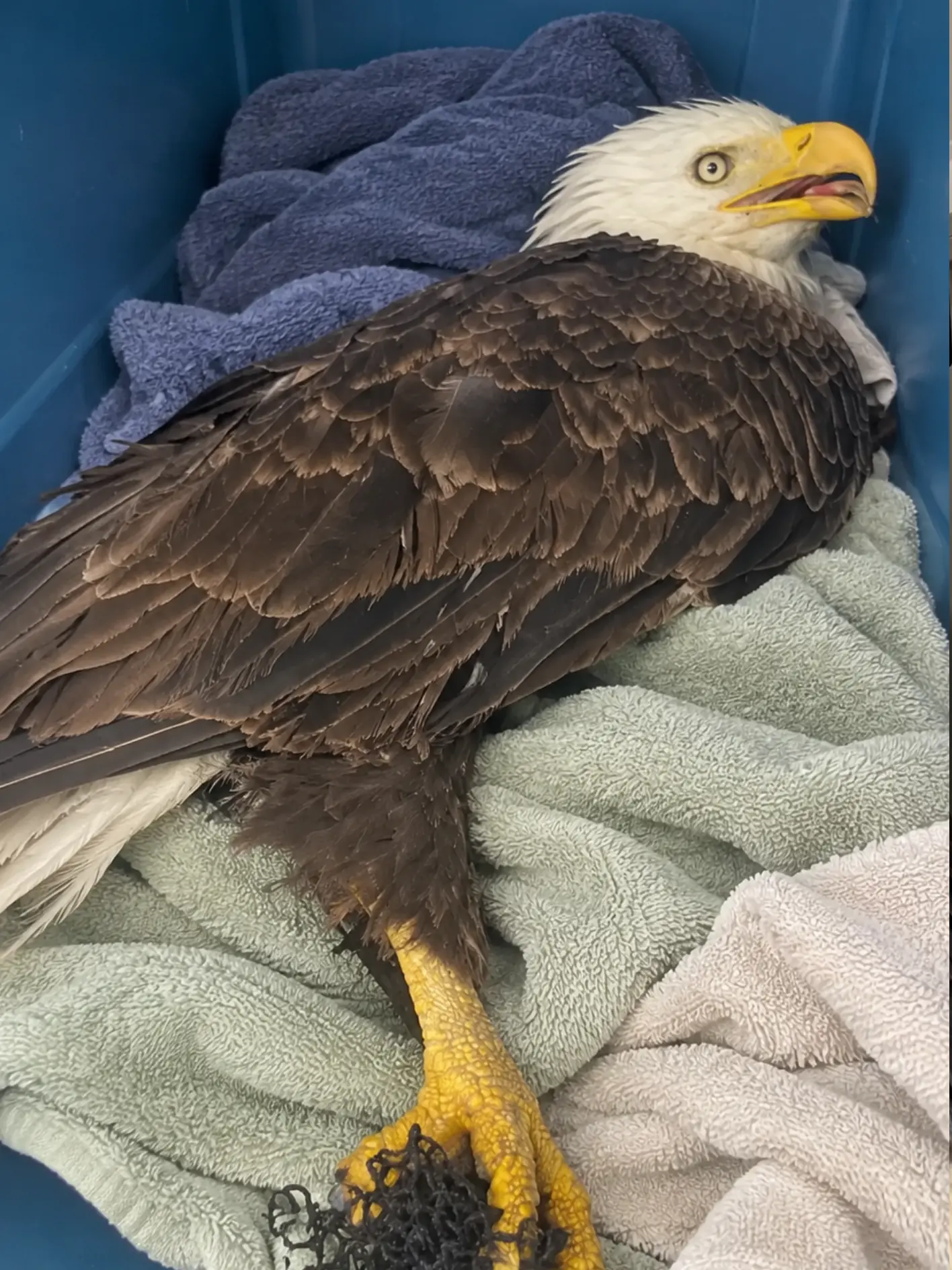
The bird had landed near the outer edge of the fictional Pine Ridge County Landfill in Minnesota, where food scraps and animal remains sometimes attract scavenging wildlife.
But after watching for several seconds, Lawson noticed something unusual.
The eagle was not moving normally.
It took a few awkward steps, lifted one foot, dropped it again, and opened its wings as if preparing to fly.
Instead of taking off, the bird stumbled forward.
Then Lawson saw the reason.
A tangled mass of black synthetic mesh was wrapped around one of the eagle’s feet and several talons.
Part of the material dragged behind the bird.
Every time the eagle tried to pull away, the mesh tightened.
The bird opened its wings again.
It hopped.
Twisted.
Pulled backward.
Then tried to bite at the material around its foot.
None of it worked.
The eagle’s normal instinct was to struggle until it escaped.
But in this case, that instinct was making the problem worse.
“The harder it pulled, the tighter everything seemed to get,” Lawson later recalled. “That was when I realized this wasn’t something I should try to fix myself.”
He stopped nearby activity and contacted animal-control authorities.
Within a short time, fictional Animal Control Officer Maria Chen and Conservation Officer Daniel Reeves were on their way.
The immediate problem appeared simple: remove the netting.
The medical problem was not.
By the time the eagle reached the fictional North Star Raptor Rehabilitation Center, veterinarians were asking a much more serious question:
Had the material been tight around the foot long enough to permanently damage blood flow, nerves, tendons, or the toes themselves?
For a Bald Eagle, that question could determine whether the bird would ever be released.
A Landfill Can Offer Food and Hidden Hazards at the Same Time
Bald Eagles are capable hunters, but they are also opportunistic scavengers.
That behavior allows them to take advantage of many different food sources.
Fish remain an important part of the diet in many areas, but eagles may also feed on carrion, discarded animal remains, and other accessible food.
That adaptability can bring them into human-modified environments.
Landfills are one example.
A landfill may offer easily accessible food.
But the same location can also contain materials that wildlife cannot recognize as dangerous.
Plastic mesh.
Packaging straps.
Twine.
String.
Discarded fishing line.
Thin synthetic netting.
Loops of plastic.
To a person, many of these materials look lightweight and harmless.
To a large bird with powerful curved talons, they can become traps.
The shape of an eagle’s foot makes entanglement particularly difficult.
The toes are designed to close powerfully around prey and perches.
The talons curve inward.
A loose loop that catches around one claw can easily slide deeper as the bird grips, twists, or tries to pull away.
What begins as one strand around one talon can quickly involve an entire foot.
That appeared to be what had happened to the eagle Lawson found.
The Eagle Could Still Move — But Not Normally
When Lawson first noticed the bird, it was still conscious and alert.
That made the situation deceptively easy to underestimate.
The eagle was not lying motionless.
It could stand.
It could open its wings.
It could respond to movement.
But one foot was compromised.
The bird repeatedly lifted the affected leg.
Then placed it back down.
The mesh dragged beneath it.
At one point, the eagle tried to launch.
Its wings opened fully.
The body leaned forward.
But the entangled foot prevented a clean push-off, and the trailing material interfered with movement.
The eagle came back down.
For a scavenging bird near heavy equipment and vehicle activity, remaining grounded created another layer of danger.
Lawson knew the bird needed help.
He also understood that approaching a stressed adult Bald Eagle carried serious risk.
So instead of trying to grab it, he focused on controlling the surrounding environment.
Nearby machinery was paused.
Other workers were asked to stay back.
The eagle was given as much quiet space as possible while responders traveled to the site.
That decision mattered.
Every additional chase or failed capture attempt could have caused the eagle to struggle harder against the mesh.
The Entanglement Was Becoming Tighter
When Chen and Reeves arrived, the black material was clearly wrapped around the foot and talons.
Some loops were loose.
Others had tightened much closer to the skin.
The eagle continued trying to free itself.
It pulled with the affected leg.
Gripped the mesh with the opposite foot.
Opened its wings.
Twisted its body.
Then stopped and rested.
The sequence repeated.
The problem was no longer simply that the eagle was entangled.
The problem was that each escape attempt could increase pressure on the foot.
Synthetic mesh does not respond like vegetation.
A bird pulling against grass may eventually break it.
Plastic may tighten instead.
If enough pressure develops, the material can constrict soft tissue.
Circulation can be reduced.
Swelling may increase.
As swelling develops, the loops become even tighter.
That can create a dangerous cycle:
entanglement causes pressure;
pressure causes swelling;
swelling makes the entanglement tighter;
and the tighter material causes even more tissue damage.
Chen and Reeves therefore did not rush to pull the entire mass away.
They first needed to control the eagle.
The Feet Were Both the Injury Site and the Handling Hazard
Adult Bald Eagles are powerful animals.
During restraint, the feet and talons represent a major handling danger.
In this case, the problem was unusually complicated.
One foot was partially trapped.
The other remained completely functional and available for defense.
The eagle could strike with the healthy foot while simultaneously worsening the entanglement on the injured side.
Chen approached carefully with appropriate protective equipment.
Reeves helped control the body and wings.
The goal was to minimize flapping and twisting while securing the legs.
Once the bird was under control, responders could finally examine the mesh more closely.
The tightest loops were woven among the toes and around the curved talons.
Some sections could be safely cut at the landfill.
Others could not.
Trying to pull the entire bundle free at the scene risked dragging constricting material across already swollen tissue.
Their objective was therefore limited.
Reduce tension.
Remove long trailing sections.
Stop further tightening.
Then transport the eagle to a controlled veterinary setting.
“The goal there wasn’t to make the foot look normal,” Reeves said. “It was to stop the situation from becoming worse before the bird reached medical care.”
Some of the Netting Was Left in Place
That decision may seem counterintuitive.
If an animal is tangled, why not remove everything immediately?
Because the tightest material may be the most dangerous to manipulate without proper restraint, lighting, instruments, and medical support.
A loop can disappear between toes.
A strand may be buried beneath swollen skin.
Plastic can catch behind a talon and tear tissue when pulled.
In severe cases, an animal may need sedation or anesthesia before the material can be removed safely.
Chen and Reeves cut away the loose sections that were dragging behind the bird.
They reduced the weight and tension.
But they left the most tightly wrapped portion around the foot for the veterinary team.
The eagle was placed in a padded transport container.
A photograph taken shortly after rescue shows the bird resting low on towels inside a blue container, with a mass of black synthetic material still visibly caught around the affected foot and talons.
The eagle’s eyes remain open.
Its beak is slightly parted.
The affected leg is extended.
The image captures the entanglement clearly.
But it cannot show the most important problem:
what was happening inside the foot.
The First Concern at the Rehabilitation Center Was Blood Flow
At North Star Raptor Rehabilitation Center, fictional veterinarian Dr. Allison Grant began by evaluating circulation.
The staff already knew the material was tight.
What they did not know was how long it had been tight.
That distinction is critical.
A recently trapped foot may recover quickly once pressure is removed.
A limb constricted for a prolonged period can sustain much more serious injury.
Reduced circulation can deprive tissue of oxygen.
Nerves can become damaged.
Tendons may be affected.
Skin can break down.
In extreme cases, tissue may die.
Grant looked at the color of the toes.
Temperature.
Swelling.
Response to touch.
Movement.
Grip.
The team also assessed whether any portion of the mesh had cut into the skin.
The affected foot was swollen.
Some of the loops had left clear pressure impressions.
One or more toes moved less freely than the others.
But there was still a crucial positive sign.
Blood flow was present.
The toes were not cold and lifeless.
The tissue still appeared viable.
That meant the foot had a chance.
The Netting Had to Be Removed One Loop at a Time
The veterinary team began controlled removal.
This was not simply a matter of cutting one strand.
The mesh had become woven around multiple talons.
Some loops crossed over others.
The eagle’s curved claws acted almost like hooks holding the material in place.
The bird had to remain safely restrained while the team worked.
Depending on the exact position and degree of entanglement, sedation can be considered when it improves safety and reduces additional tissue trauma.
Grant’s team carefully separated the material and cut individual loops rather than pulling the mass as a single piece.
The closer they came to the skin, the slower they worked.
A strand under tension can snap back.
A loop can drag across damaged tissue.
The team needed to see exactly what each piece was doing before removing it.
Gradually, the foot emerged.
Then the last tight section was cut away.
The entanglement was over.
The injury was not.
Removing the Mesh Did Not Immediately Restore a Normal Foot
Once the material was gone, the extent of the constriction injury became easier to evaluate.
The foot was swollen.
Several areas of skin were irritated.
There were superficial abrasions where plastic had rubbed during the bird’s attempts to escape.
The toes did not all flex normally at first.
One appeared particularly stiff.
That was concerning, but not surprising.
A constricted limb can remain abnormal even after the pressure is removed.
Swelling may temporarily increase when normal circulation returns.
Nerves that have been compressed can take time to regain function.
Soft tissues may remain painful.
The team therefore resisted drawing conclusions too quickly.
“The removal ended the entanglement,” Grant said. “It did not immediately tell us what the final function of the foot would be.”
That would require time.
X-Rays Looked for Damage Beneath the Swelling
Radiographs were obtained to evaluate the bones of the affected foot and toes.
The team wanted to rule out fractures caused by pulling, twisting, or repeated falls during the struggle.
They also looked for dislocation or other structural injury.
The images brought encouraging news.
No major fracture was identified.
There was no obvious dislocation.
The primary problem remained soft-tissue swelling and constriction injury.
That was a better outcome than a broken toe or damaged leg bone.
But a normal X-ray did not guarantee normal function.
Bones could be intact while nerves, tendons, circulation, or soft tissues remained compromised.
For a Bald Eagle, those structures are essential.
A Functional Foot Is as Important as a Functional Wing
People often think of flight as the defining requirement for release of a raptor.
It is only part of the equation.
An eagle also needs functioning feet.
The feet are used for perching.
Landing.
Capturing prey.
Holding food.
Manipulating carcasses.
Defending territory.
Maintaining balance.
A Bald Eagle with perfect wings but a foot that cannot grip properly may still be incapable of surviving independently.
That made Harbor’s case — the temporary rehabilitation name given to the eagle — fundamentally different from a simple entanglement rescue.
Freedom was not achieved when the mesh came off.
Freedom would require the foot to work again.
The First Stage of Treatment Was Quiet
Harbor was placed in a padded recovery enclosure.
No high perch was provided initially.
The team did not want the eagle attempting to land on an injured foot before swelling and circulation had stabilized.
The affected limb was monitored frequently.
Staff looked for changes in color.
Temperature.
Swelling.
Movement.
Skin condition.
Pain response.
Wounds were cleaned.
Analgesia and anti-inflammatory treatment could be used as clinically appropriate.
Hydration was supported.
The eagle was allowed to rest.
During the first several hours, Harbor frequently kept weight off the injured foot.
That was expected.
The bird remained alert, but the stress of entanglement, capture, transport, and medical restraint had taken a toll.
Appetite was initially reduced.
The next twenty-four hours were especially important.
Constriction Injuries Can Look Worse After the Material Comes Off
One of the difficult aspects of these cases is that the full extent of damage may not be immediately apparent.
When tight material is removed, circulation changes.
Swelling can become more noticeable.
Areas of skin previously compressed may become inflamed.
Nerve function can remain delayed.
Veterinarians therefore cannot assume that a successful disentanglement means the crisis has ended.
Harbor’s foot was checked repeatedly.
The team was particularly concerned about any sign that a toe was losing blood supply.
A toe that becomes cold, dark, progressively swollen, or unresponsive would change the prognosis.
Fortunately, the overall tissue color remained acceptable.
Warmth remained present.
The foot was injured.
But it was still alive.