When the Bald Eagle was first discovered near a municipal landfill in the Upper Midwest, it was lying face-down and completely motionless.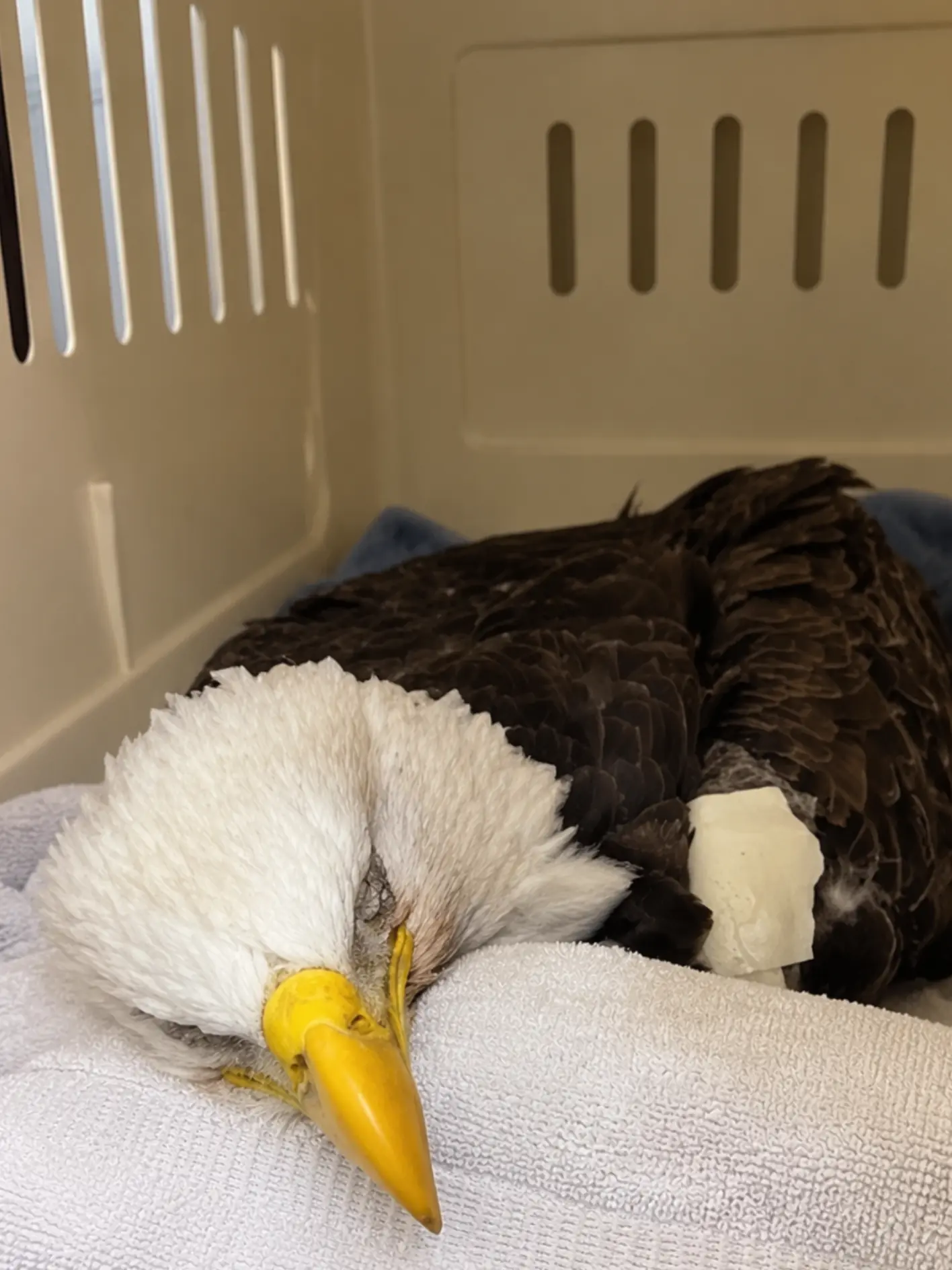
For several moments, the people who found it could not tell whether the bird was alive.
Its wings rested loosely against the ground. Its head was pressed into the vegetation, and there was no immediate attempt to lift itself, spread its wings, or defend against the people standing nearby.
A healthy adult Bald Eagle would normally react strongly to a close human approach.
This one did nothing.
Only after someone watched carefully for several seconds did they notice a faint movement in the bird’s chest.
It was still breathing.
Wildlife authorities were contacted immediately, and the eagle was transported for emergency veterinary care.
At first, no one knew what had happened.
There was no obvious broken wing.
No major external bleeding.
No large wound.
No visible evidence of a vehicle collision or electrocution.
Yet the eagle was profoundly depressed neurologically, unable to stand, barely responsive to handling, and too weak to maintain its head in a normal position.
Veterinary staff initially considered several possibilities: head trauma, severe systemic disease, lead poisoning, infectious disease, and other forms of toxic exposure.
But subsequent toxicology testing identified something very different.
Pentobarbital — a barbiturate commonly used in veterinary euthanasia — was detected in the eagle.
The finding immediately changed the nature of the case.
What had begun as an unexplained wildlife emergency became a potential secondary-poisoning incident.
Investigators later confirmed that an animal euthanized with pentobarbital had been disposed of at the landfill on the second day of the month.
The timing, location, and toxicology findings were considered strongly consistent with the eagle having scavenged tissue from that carcass.
State wildlife officers have since opened an investigation into how the euthanized animal was handled and how its remains became accessible to scavenging wildlife.
For the eagle, however, the investigation came second.
The immediate priority was keeping it alive.
The Bird Looked Dead From a Distance
The person who first spotted the eagle initially thought they were looking at a carcass.
The adult bird was lying low, its body still and its head down.
There was none of the movement normally associated with a large raptor.
No defensive posture.
No attempt to stand.
No effort to escape.
When the observer moved closer, the eagle still did not react.
That was unusual enough to prompt a call for help.
Wildlife responders later said that this lack of response was one of the most alarming aspects of the scene.
A sick or injured Bald Eagle may be grounded, but many still defend themselves aggressively. Their talons remain powerful, and even a compromised bird may strike when approached.
This eagle appeared almost completely sedated.
The responders approached carefully anyway.
Even a severely debilitated raptor must be handled as if it can defend itself.
The feet were controlled first, and the bird was placed in a padded carrier with its head positioned to keep the airway clear.
Because the eagle’s level of consciousness was so poor, rescuers did not attempt to give food or water at the scene.
That could have caused aspiration if the bird was unable to swallow normally.
Instead, it was transported directly for medical evaluation.
Veterinary Staff Could Not Find an Injury Severe Enough to Explain the Collapse
At the wildlife hospital, the initial examination focused on trauma.
Both wings were palpated.
The shoulders were assessed.
The legs and feet were examined.
The pelvis and spine were checked.
The head and eyes were evaluated for evidence of collision.
The bird was weak enough that even routine handling required caution.
But despite the severity of the eagle’s condition, veterinarians did not find a catastrophic injury.
There was no major wing fracture.
No obvious spinal trauma.
No substantial external wound.
No orthopedic finding that explained why a powerful adult eagle was lying nearly unconscious.
That discrepancy became important.
The bird’s problem did not appear to be primarily mechanical.
It looked systemic.
More specifically, it looked as if something was suppressing the eagle’s central nervous system.
The Neurological Depression Was Profound
The eagle showed markedly reduced responsiveness.
Its muscle tone was poor.
Grip strength was weak.
The bird could not remain upright.
Its head repeatedly dropped toward the bedding.
The eyes stayed closed for long periods.
When handled, the eagle showed only limited reaction.
That presentation pushed toxic exposure higher on the list of possible causes.
Lead poisoning is an important concern in Bald Eagles, particularly because they frequently scavenge carcasses.
But lead is not the only toxin capable of producing severe neurological signs.
Veterinary staff collected blood and other diagnostic samples for laboratory testing.
The team also began supportive care immediately.
They could not wait for the final toxicology results.
The Photograph From Intake Shows Just How Depressed the Eagle Was
Photographs from the first hours of hospitalization show the adult eagle lying on folded towels inside a treatment carrier.
Its head rests heavily against the bedding.
The eyes are closed.
The bird is not standing or perching.
A padded area around the body provides support while staff minimize unnecessary movement.
The image cannot reveal the cause of the illness.
But it does reflect the seriousness of the bird’s condition.
A healthy Bald Eagle does not normally remain in that posture while people are nearby.
At that moment, the eagle was not simply tired.
It was critically compromised.
Toxicology Identified Pentobarbital
When laboratory testing returned, the case took a dramatic turn.
Pentobarbital was detected in the bird.
Pentobarbital is a barbiturate that can be used by veterinarians as part of euthanasia procedures.
When administered appropriately, it produces rapid depression of the central nervous system, leading to unconsciousness and death.
The concern for wildlife arises after the euthanized animal has died.
Pentobarbital does not necessarily disappear immediately from the tissues of the carcass.
If another animal later consumes enough contaminated tissue, the scavenger can also be exposed.
That secondary exposure can cause profound sedation, loss of coordination, respiratory depression, coma, and, in severe cases, death.
For a Bald Eagle that naturally feeds on carrion, an improperly disposed carcass can therefore become a hidden source of poison.
The Toxicology Result Changed the Investigation
Once pentobarbital was identified, veterinary staff notified wildlife authorities.
Investigators began looking at the eagle’s discovery location and the recent disposal history of animal remains at the landfill.
The question became straightforward:
Had an animal recently euthanized with pentobarbital been placed somewhere scavengers could reach it?
Landfill and disposal records were reviewed.
Information was gathered from the parties responsible for transporting or handling recent animal remains.
Investigators eventually confirmed that an animal euthanized with pentobarbital had been disposed of at the site on the second day of the month.
That finding closely matched the eagle’s location and toxicology results.
Although no one had witnessed the eagle taking its first bite from the carcass, the evidence created a strong circumstantial link.
The bird had been found near the landfill.
Pentobarbital was present in its system.
And a pentobarbital-euthanized animal had recently been placed there.
Wildlife officers opened a formal investigation into whether the carcass had been handled and disposed of in accordance with applicable requirements.
Why One Euthanized Carcass Can Become a Wildlife Hazard
The risk does not end with one eagle.
A carcass accessible to scavengers can attract multiple animals.
Bald Eagles.
Golden Eagles.
Vultures.
Ravens.
Coyotes.
Foxes.
Other carnivores and omnivores.
All may feed from the same remains.
If pentobarbital is present in sufficient concentration, more than one scavenger can potentially be affected.
That is why proper disposal of animals euthanized with barbiturates is considered so important.
The animal may be dead.
The drug can still remain biologically active in its tissues.
A disposal mistake therefore has the potential to turn one intentional euthanasia into a second, completely unintended poisoning.
The Eagle Required Intensive Supportive Care
There is no simple button veterinarians can press to immediately remove pentobarbital from a poisoned wild bird.
Treatment is largely supportive while the drug is metabolized and eliminated.
For this eagle, that meant careful monitoring of the most basic functions.
Breathing.
Body temperature.
Hydration.
Circulation.
Neurological responsiveness.
Positioning.
Because the bird could not reliably hold itself upright, staff placed it on padded bedding and repositioned it as needed to reduce pressure and maintain a clear airway.
Fluids were administered based on the eagle’s condition.
Supplemental oxygen was available if respiratory effort declined.
The treatment area was kept quiet and dim to minimize stress.
Food was not offered aggressively while the eagle remained neurologically depressed.
A bird with an impaired swallowing reflex can inhale food or liquid into the respiratory system.
The team therefore waited until the eagle was alert enough to swallow safely before advancing nutritional support.
The First Night Was Uncertain
During the first several hours, little changed.
The eagle remained recumbent.
Its eyes opened only briefly.
Grip strength was weak.
The head remained low.
Staff monitored the bird closely, watching for any decline in respiratory effort or circulation.
The initial prognosis was guarded.
A severely intoxicated raptor can improve as the drug clears.
But the amount consumed is rarely known.
Neither is the length of time between ingestion and rescue.
A bird found quickly may have a very different outcome from one that has remained unconscious outdoors for many hours.
There are also secondary dangers.
A sedated eagle cannot escape predators.
It cannot regulate its behavior normally.
It may become hypothermic or overheated.
It may aspirate.
It may sustain injuries while unable to coordinate movement.
The rehabilitation team therefore treated the bird’s condition as potentially life-threatening even though no fracture or large wound had been found.
The First Improvement Was Almost Imperceptible
The first positive sign was a stronger response around the eyes.
The eagle began blinking more consistently.
Then it opened one eye for longer periods.
Later, the head lifted briefly from the towels before dropping again.
These were tiny changes.
To the rehabilitation team, they were meaningful.
A central nervous system that had been profoundly suppressed appeared to be reawakening.
Over the next several hours, the bird became increasingly aware of its surroundings.
The toes began flexing.
The feet produced a little more grip.
The head remained upright for longer intervals.
Then the eagle began reacting when staff entered the room.
Each of these changes suggested that the sedative effect was gradually diminishing.
Standing Again Was a Major Milestone
The first attempt to stand was unsteady.
The eagle positioned its feet beneath the body but could not maintain balance for long.
Staff did not force the bird to remain upright.
It was allowed to rest and try again later.
Eventually, the eagle was able to sit more normally.
Then it stood for a short period.
By the following stages of recovery, the bird was holding itself upright with much greater consistency.
“The first time it really tried to stand, that was when we felt we might have a very different bird the next day,” one rehabilitator said.
The change was significant because normal posture requires coordinated neurological and muscular function.
The eagle was not simply waking up.
It was regaining control of its body.
Grip Strength Returned
For a Bald Eagle, the feet provide an especially useful neurological measure.
Healthy eagles grip with considerable force.
When this bird arrived, its feet were weak.
As the intoxication resolved, the toes began closing more strongly.
The eagle started gripping bedding and nearby surfaces.
Eventually, handlers needed to exercise the same degree of caution they would with any alert adult raptor.
That was welcomed.
The easiest version of this eagle to handle had been the sickest one.
The difficult bird was the healthier bird.
Feeding Was Delayed Until Swallowing Was Safe
Once alertness improved, staff evaluated swallowing function.
Only then did feeding begin.
Small portions were offered first.
The eagle showed increasing interest.
It began taking food voluntarily.
That reduced the need for direct nutritional support and provided another important sign that neurological function was returning.
A recovering bird must do more than remain conscious.
It must eat.
Maintain weight.
Digest normally.
Use its feet and beak.
And ultimately regain the full suite of behaviors required in the wild.
The return of appetite was therefore a major step.
The Eagle Was Not Released Simply Because It Woke Up
Pentobarbital poisoning can resolve dramatically once the drug clears.
A bird that looked nearly dead one day may appear surprisingly normal later.
Wildlife professionals still cannot release it immediately.
The rehabilitation team needed to confirm that the eagle’s neurological recovery was complete.
Balance had to be normal.
Grip had to be strong.
Vision and reaction time had to be appropriate.
The bird needed to perch safely.
It needed to feed independently.
And eventually, flight had to be evaluated.
A subtle neurological deficit that is barely visible on the ground can become dangerous in the air.
A Low Perch Came First
As the eagle regained strength, a low perch was introduced.
This tested several systems simultaneously.
Foot grip.
Balance.
Postural control.
Endurance.
The bird initially spent only limited time perched.
Later it remained there confidently.
Both feet engaged normally.
The eagle no longer leaned or collapsed toward the floor.
That allowed the rehabilitation team to move gradually toward the next phase.
Flight Testing Was Essential
Once the medical team believed the acute intoxication had resolved, the eagle was transferred into an appropriate rehabilitation space where flight could be observed safely.
The first questions were basic.
Could it launch?
Could it maintain altitude?
Were both wings symmetrical?
Could it turn?
Could it land?
Pentobarbital had not injured the wings directly, but severe sedation can leave a bird temporarily weak and deconditioned.
More importantly, clinicians had to be certain that no residual neurological impairment remained.
The eagle’s first controlled flights were encouraging.
It gained lift normally.
Turns were coordinated.
Landings became increasingly precise.
No persistent imbalance was identified.
The Investigation Continued While the Eagle Recovered
The medical story and the investigative story moved forward at the same time.
Wildlife officers continued reviewing how the euthanized carcass reached the landfill and whether the required precautions had been taken.
Investigators were also concerned about whether other scavengers might have had access to the same remains.
A single sick eagle can sometimes serve as the first visible warning of a larger exposure.
That possibility makes rapid reporting especially important.
If one scavenger is found neurologically depressed near an accessible carcass, authorities may need to secure the source before additional animals feed.
Proper Disposal Is the Central Prevention Lesson
This case is not an argument against veterinary euthanasia.
Pentobarbital is an important veterinary drug and, when used appropriately, allows animals to be euthanized humanely.
The hazard arises when the body of an animal euthanized with the drug is disposed of in a way that allows scavengers access to contaminated tissues.
Prevention therefore happens after euthanasia.
Veterinary facilities, animal owners, shelters, livestock operators, disposal facilities, and others responsible for a euthanized carcass need to follow applicable state and local requirements and ensure that remains cannot be scavenged.
Depending on local law and circumstances, appropriate options may include secure containment, approved burial, cremation, rendering, or other permitted disposal methods.
The precise method varies.
The principle does not:
wildlife should not be able to reach the carcass.
The Drug Does Not Become Harmless Simply Because the Animal Has Died
That may be the most important point for the public.
A euthanized carcass can look like any other source of carrion.
To an eagle, there is no visible warning.
The bird cannot smell a veterinary drug and understand that the tissue is dangerous.
It simply sees food.
A Bald Eagle may consume carrion because scavenging is part of its normal biology.
The responsibility therefore lies with people to prevent contaminated carcasses from entering that food chain.
The eagle did nothing unusual.
It behaved like an eagle.
The unusual and preventable part was the availability of the toxic food source.
A Motionless Eagle Is Not Necessarily Dead
There is another lesson from the rescue itself.
The bird was so still when discovered that people initially could not determine whether it was alive.
Had the observer assumed the eagle was dead and walked away, the outcome could have been very different.
Watching for breathing mattered.
Calling wildlife professionals mattered.
Not force-feeding the bird mattered.
Transporting it quickly mattered.
Anyone who finds an apparently dead or profoundly sedated eagle should avoid handling it directly and contact wildlife authorities or a licensed rehabilitator.
A large raptor may regain consciousness unpredictably.
Even a severely poisoned eagle can suddenly become capable of defending itself with its feet.
Professional handling protects both the bird and the rescuer.
Do Not Give an Unresponsive Eagle Food or Water
This deserves particular emphasis.
People often want to offer water to a weak wild animal.
In a neurologically depressed bird, that can be dangerous.
If the swallowing reflex is impaired, liquid can enter the airway.
Food can also be aspirated.
The safest action is to keep the scene quiet, prevent additional disturbance, and contact trained responders.
Treatment should begin only after professionals have evaluated the bird’s level of consciousness and airway protection.
The Case Shows Why Toxicology Matters
Without laboratory testing, this eagle might have remained an unexplained poisoning case.
Its symptoms were not unique to pentobarbital.
Severe lead intoxication can produce weakness and neurological impairment.
Head trauma can create profound depression.
Infectious diseases can affect coordination and consciousness.
Other toxins can mimic many of the same signs.
Toxicology provided the critical evidence linking the clinical presentation to a specific substance.
The later landfill investigation then provided the environmental context.
Medicine identified the toxin.
Investigation identified the likely route.
Together, they revealed a preventable chain of events.
The Recovery Was Encouraging
As the drug cleared, the bird continued returning toward normal behavior.
It stood.
Perched.
Ate independently.
Gripped strongly.
Became defensive.
Flew.
Each step reduced concern that permanent neurological injury had occurred.
The final release decision would depend on consistent performance rather than a single good day.
But the direction of recovery was increasingly favorable.
The eagle that had arrived lying almost motionless on towels was becoming an active wild raptor again.
Wildlife Rehabilitation Treats the Consequence — Disposal Practices Prevent the Cause
The veterinarians could provide fluids.
They could monitor respiration.
They could support nutrition.
They could protect the eagle until the drug left its body.
What they could not do was prevent the original exposure after it had already happened.
That is where prevention becomes more important than treatment.
If euthanized animals are managed correctly, secondary pentobarbital poisoning should be avoidable.
A properly secured carcass does not become food for an eagle.
A properly managed disposal site does not expose scavengers.
A veterinarian or owner who communicates clearly about euthanasia drugs can help ensure that people handling the remains understand the risk.
These are practical interventions.
They do not require changing wildlife behavior.
They change the human behavior that created the hazard.
Officials Are Looking at What Went Wrong
The investigation remains focused on how an animal euthanized with pentobarbital came to be accessible at the landfill.
Authorities may review:
who transported the remains,
how the carcass was documented,
where it was placed,
what disposal instructions were provided,
whether wildlife barriers or burial requirements were followed,
and whether additional contaminated remains may be present.
The purpose of such an investigation is not simply to assign blame.
It is also to prevent recurrence.
If there was a breakdown in procedure, identifying that breakdown can protect future wildlife.
One Incident Can Become a System-Wide Lesson
Wildlife poisoning events often reveal vulnerabilities that were invisible before an animal became sick.
A landfill procedure that seemed adequate may not actually prevent scavenging.
A transport protocol may lack clear labeling.
Someone handling an animal carcass may not have been told that pentobarbital remained in the tissues.
A single communication failure can create a hazard far beyond the original veterinary procedure.
That makes cases like this valuable from a prevention standpoint.
The goal should not be merely to save one eagle.
It should be to make the same event less likely to happen again.
The Bald Eagle’s Near-Death Appearance Was Caused by a Drug Designed to Produce Unconsciousness
There is an unsettling biological logic to the case.
Pentobarbital is used because it depresses the central nervous system rapidly and effectively.
When the eagle ate contaminated tissue, the drug did exactly what pharmacology would predict.
It suppressed awareness.
Coordination faded.
Muscle tone declined.
The bird became increasingly sedated.
Eventually it was found face-down, almost indistinguishable from a dead eagle.
The drug had never been intended for that bird.
But once it entered the eagle’s body, intent no longer mattered.
Chemistry did.
The Final Message Is Preventive
The most important lesson from this case can be stated simply:
An animal euthanized with pentobarbital must be disposed of in a way that prevents wildlife from eating it.
That responsibility continues after the euthanasia procedure is finished.
The patient may be gone.
The medication remains.
When proper disposal fails, scavengers can become unintended victims.
Bald Eagles are particularly vulnerable because carrion is a normal part of their diet.
They cannot recognize the difference between a safe carcass and one containing a lethal veterinary drug.
People have to make that distinction for them.
From Face-Down and Motionless to a Real Chance at Release
When this eagle was first found, there was no dramatic rescue scene.
There was simply a motionless bird.
A faint breath.
A phone call.
Then a sequence of decisions that gave it a chance.
The eagle was transported without being force-fed.
Veterinarians recognized that the profound neurological depression did not match the absence of major trauma.
Toxicology was pursued.
Pentobarbital was identified.
Investigators traced a plausible source to an animal euthanized with the drug and discarded at the landfill on the second day of the month.
Wildlife officials opened an investigation.
And while that investigation continues, the eagle has been doing something equally important:
waking up.
Standing.
Gripping.
Eating.
Perching.
Flying.
The outcome could have been very different.
The bird could have been mistaken for dead.
It could have remained undiscovered.
It could have aspirated if someone had tried to give it water.
It could have died before anyone knew why.
Instead, it reached professional care.
That does not make the poisoning acceptable.
It makes the prevention lesson clearer.
A euthanized animal is not automatically a harmless carcass.
If pentobarbital remains in the tissues, improper disposal can put every scavenger that finds those remains at risk.
This Bald Eagle survived long enough for people to discover that lesson.
The next eagle should not have to.