The first time Michael Turner saw the adult Bald Eagle at the edge of a field in rural Pennsylvania, he assumed there was nothing wrong with it. He had been driving slowly along a narrow county road bordered by pasture, second-growth woods, and scattered farmhouses when he noticed a large dark bird standing in the grass about thirty yards from the pavement. Bald Eagles were not an everyday sight in the area, but they were no longer extraordinary either.
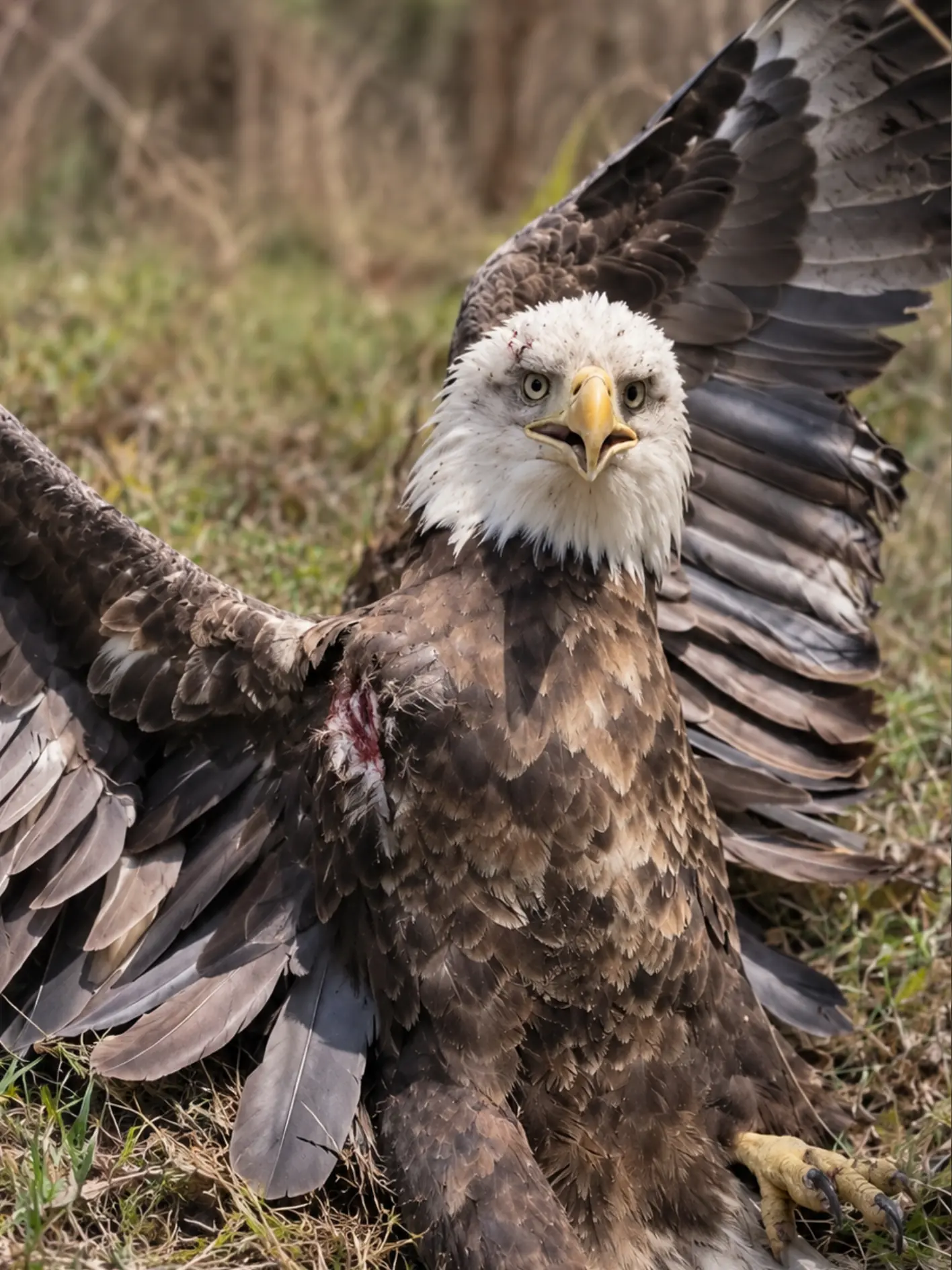
Turner had seen them following the nearby river and occasionally feeding on carrion in open fields, so he initially thought the bird had simply landed to eat something he could not see from the road. He pulled into a gravel turnout, stayed inside his truck, and watched for a moment. The eagle’s white head was unmistakable. Its yellow beak caught the light each time it turned toward the road, and both feet appeared planted firmly beneath its body. Nothing about the scene immediately looked like an emergency.
Then the eagle tried to leave.
It lowered its body, opened both wings, and began running across the grass. The first few wingbeats were powerful enough to disturb the dry weeds around it. For a moment, Turner expected the bird to rise cleanly over the field. Instead, the left wing drove downward with normal force while the right side opened less completely and seemed to lag behind. The eagle lifted only slightly, traveled perhaps several yards, and dropped back onto the ground.
Turner remained in the truck.
The bird stood still for almost a minute, breathing heavily. Then it tried again.
This time the eagle ran farther. Both wings opened. The tail spread. Its feet left the ground for a fraction of a second before the right side lost power and the body tilted. The eagle landed awkwardly, stumbled, and folded its wings.
That was when Turner stopped thinking he was watching a bird that had merely chosen to rest.
The eagle clearly wanted to fly.
It simply could not.
He took out his phone and recorded a short video from the vehicle, not for social media but because he knew wildlife responders might need to see the behavior. In the recording, the bird looked strong enough to stand and alert enough to track traffic, yet every attempt to take off ended the same way. One wing generated lift. The other did not.
Turner drove a little farther down the road, turned around, and came back slowly so he could observe from another angle. He did not get out. From the opposite side of the field, the problem became more obvious. Several feathers around the eagle’s right shoulder were displaced, and a dark red stain showed through the brown plumage near the upper wing. The bird’s tail feathers were dirty, likely from spending time on the ground, and the right wing rested slightly lower when folded.
Turner called the county wildlife office.
The person who answered asked him to stay at a distance and describe what he was seeing. Was the eagle standing? Yes. Was it conscious? Definitely. Was there active heavy bleeding? Not that he could see. Had the bird been struck by a vehicle? Turner had not witnessed any collision. Was there fishing line, fencing, or another obvious hazard nearby? No. Had it attempted to fly? Several times, unsuccessfully.
The call was referred to the fictional Allegheny Raptor Rehabilitation Center, which handled injured birds of prey throughout the region. A coordinator there asked Turner to send the short video.
Within minutes, the center called back.
A response team was being dispatched.
Turner was told not to walk into the field, not to offer food or water, and most importantly, not to force the eagle into another flight attempt. If the wing injury involved muscle or other soft tissue near the shoulder, each powerful downstroke could worsen the damage. The bird was also still an adult Bald Eagle with fully functional feet. Even a grounded eagle can cause serious injuries if someone tries to handle it without training.
Turner agreed to wait near the turnout and keep watch.
Over the next half hour, the eagle moved gradually toward the tree line. It walked rather than flew. Twice it opened its wings when vehicles passed, and once it crouched as though preparing to launch, but it did not complete the movement. The earlier attempts had apparently taken a great deal out of it.
A nearby homeowner, Rachel Monroe, noticed Turner’s truck and walked toward the road to ask whether he needed help. When he pointed out the eagle, Monroe immediately called her two dogs inside. She had lived on the property for seventeen years and said she had occasionally seen Bald Eagles crossing the valley but had never seen one remain on the ground for so long.
The two watched from a distance.
The eagle stood in the same area for nearly twenty minutes.
Monroe later said the most unsettling part was how alert it looked.
“It was watching everything,” she recalled. “If you only looked at the head, you would have thought this was a perfectly strong eagle. Then it would open the wings and you could see something was very wrong.”
When the rescue team arrived, the bird had been observed for more than an hour.
Field responders Dana Willis and Chris Parker first spoke with Turner and Monroe before approaching. Turner showed them the video of the failed takeoffs. Parker watched it twice.
The footage confirmed what the responders needed to know.
The bird was not simply reluctant to fly.
It was physically unable to generate normal lift.
Willis and Parker brought a ventilated transport crate, heavy protective gloves, towels, a soft capture net, and basic field supplies. They also planned their approach around the landscape. The field was mostly open, but a thick band of brush and young trees began approximately forty yards behind the eagle. If the bird ran into that cover, capture could become much harder and more stressful. The road on the opposite side created another hazard.
The responders positioned themselves so that the eagle would be encouraged to move parallel to the tree line rather than into traffic or dense brush.
Willis began approaching slowly from the side.
The eagle immediately noticed her.
Its head came up. The body straightened. The beak opened slightly.
Willis stopped.
The bird raised one foot, then set it down again.
She moved closer.
The eagle began walking away.
Within seconds, the walk became a run.
Despite the wing injury, its legs were strong. The bird moved much faster across the uneven ground than Turner expected, using both wings partly for balance. Parker shifted position to prevent it from reaching the road.
That movement triggered another takeoff attempt.
The eagle lowered its body and drove forward.
The first wingbeat lifted it several inches.
The second produced an obvious asymmetry.
The bird rose briefly, rolled slightly toward the injured side, and came down hard in the grass.
The responders stopped advancing immediately.
Nobody wanted another attempt.
“The problem at that point was not whether we could eventually catch the bird,” Willis later said. “The problem was preventing the bird from repeatedly injuring itself while trying to get away from us.”
They waited until the eagle’s breathing slowed.
Parker moved toward a shallow depression in the field where the vegetation was lower. Willis angled from the opposite side, carrying the towel and net. The eagle watched them both but had less room to build speed.
When Willis closed the final distance, the bird opened its wings and raised its feet defensively.
She used the towel to cover the upper body while Parker immediately controlled the legs above the feet.
The eagle reacted with far more strength than its failed flights had suggested.
Its talons drove against the gloves. The beak opened. The healthy wing pushed hard beneath the towel. The injured side also moved, but Parker supported it against the body to prevent twisting.
The struggle lasted only a few seconds.
Once the feet were safely controlled and the wings supported, the responders lifted the eagle and placed it into the padded crate.
Only then did they get a close look at the injury.
Several feathers near the right shoulder were broken or missing. Beneath them was a deeper wound surrounded by bruised tissue and dried blood. A second, smaller abrasion was visible lower on the wing. The chest feathers were dirty from the ground, and the tail showed signs of repeated contact with grass and soil. There was no bone protruding through the skin and no uncontrolled bleeding.
The eagle remained intensely alert.
Its eyes followed every movement.
From several yards away, it had looked like an eagle that simply could not fly. In the responders’ hands, the reason became clearer. Beneath the feathers was a painful injury in exactly the part of the body responsible for generating and controlling the downstroke.
The bird was transported to the fictional Allegheny Raptor Rehabilitation Center, where Dr. Megan Holloway, the attending wildlife veterinarian, prepared for a full examination.
The center treated the case as trauma of unknown origin.
No one had seen a vehicle strike.
No witness had reported an eagle fight.
There was no visible wire, fence, or other object attached to the bird.
A responsible medical history could describe what had been found, not invent what had happened before.
Holloway began with the basics: respiratory effort, circulation, eye response, neurologic status, spine, legs, and major bleeding.
The eagle’s heart rate and breathing were elevated from stress and exertion. It was moderately dehydrated, which suggested it had likely been grounded for longer than the period Turner had observed. Body condition was not severely poor, so the injury probably had not prevented normal feeding for a long period, but the bird was clearly tired.
Both eyes were responsive.
The feet were strong.
The spine did not show obvious instability.
The most significant pain response came when Holloway carefully examined the right shoulder and upper wing.
The superficial appearance had underestimated the amount of soft-tissue damage.
One wound extended through the skin into underlying tissue. The surrounding muscles were swollen, and there was significant bruising. Several feather shafts had been damaged near the site. The eagle resisted any attempt to extend the wing fully.
Holloway ordered radiographs.
The team wanted to rule out fractures of the humerus, radius, ulna, and major components of the shoulder girdle before making assumptions based on external appearance.
The images provided the first major piece of good news.
The humerus was intact.
The radius and ulna were intact.
The shoulder joint remained aligned.
There was no obvious spinal injury.
No major skeletal injury explained the failed takeoffs.
For a few moments, that sounded almost contradictory.
A Bald Eagle that could not fly had no broken wing bone.
Holloway explained why that was not unusual.
“A bird does not need a broken bone to lose flight,” she said. “The shoulder has to generate and control enormous force. If muscle is bruised, torn, painful, or inflamed, the wing may be structurally intact but functionally useless.”