A report came in early in the day about an adult Bald Eagle sitting on the ground near Lake Coeur d’Alene in northern Idaho and apparently unable to fly.
At first, the situation sounded serious.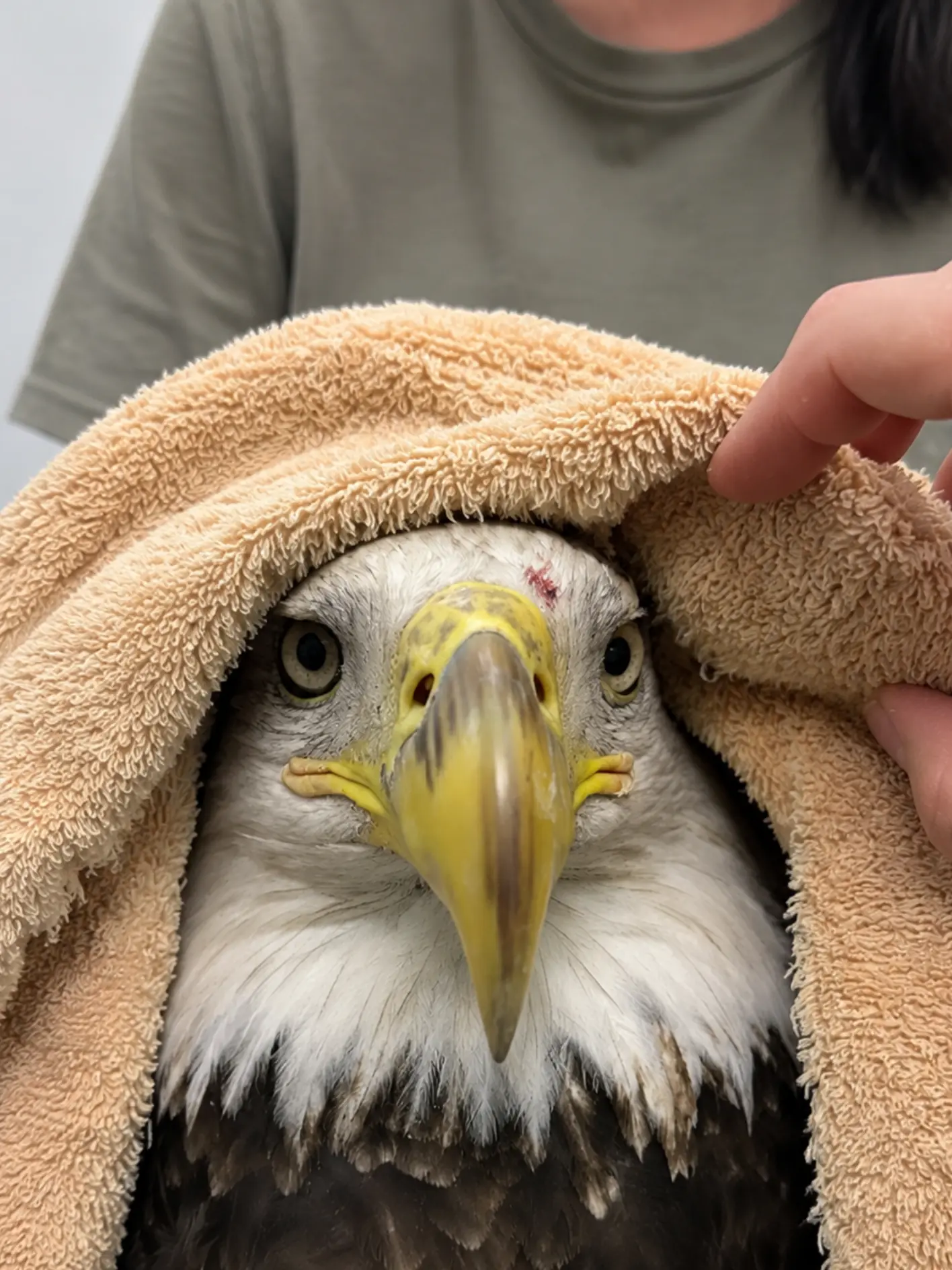
The bird had remained in the same area for an unusually long period of time. Witnesses said it was alert and watching its surroundings, but whenever it appeared ready to leave, it failed to get airborne. Instead of moving into a nearby tree or launching away from people, it stayed close to the ground.
Fortunately, a longtime Bald Eagle monitor who regularly follows eagles in the Coeur d’Alene area was nearby and was able to reach the site quickly.
“I’ve watched Bald Eagles here for years, and this one wasn’t behaving normally,” the monitor said. “It was awake, it knew we were there, but it wasn’t leaving. That alone was enough to make us concerned.”
The rescue team initially prepared for the possibility of a major wing injury.
A grounded adult eagle can have a fractured humerus, a dislocated shoulder, spinal trauma, severe internal injuries, neurological disease, toxin exposure, or a head injury. Any one of those problems could leave a bird unable to fly.
But once the eagle was safely contained and examined, the case became less straightforward.
There was a small superficial wound near the front of the head and evidence that the bird may have experienced a hard impact. Yet radiographs did not show a major fracture or dislocation. The wings remained structurally intact, the legs were functional, and there was no obvious skeletal injury severe enough to explain why a powerful adult eagle had suddenly been unable to leave the ground.
That shifted the focus toward another possibility.
The bird may have been temporarily stunned or disoriented after a collision.
One theory considered by rescuers was that the eagle had been involved in an aerial territorial dispute with another Bald Eagle or an Osprey, lost altitude, and struck the ground hard enough to leave it briefly unable to coordinate normal flight.
No one witnessed the event.
The exact cause may never be known.
But after several hours of quiet supportive care and repeated neurological evaluation, the bird began to change.
Its balance improved.
Its grip strengthened.
Its posture became more normal.
And eventually, when the eagle was given a controlled opportunity to fly, it answered the question everyone had been waiting to ask.
It opened both wings and lifted cleanly into the air.
The First Sign of Trouble Was That the Eagle Stayed on the Ground
Bald Eagles are common around Lake Coeur d’Alene and the surrounding waterways.
They can be seen perched in tall trees, soaring over open water, feeding along shorelines, or competing with other birds for fish.
An eagle on the ground is not automatically injured.
Bald Eagles may descend to feed, rest, or investigate carrion.
But healthy adult eagles usually maintain the ability to create distance from people.
That is what made this bird different.
Witnesses said the eagle remained grounded even after people were visible nearby.
It did not climb to a higher position.
It did not launch into a nearby tree.
It watched.
It shifted its body.
But it did not leave.
The local eagle monitor noticed the same thing.
The bird was mentally present enough to follow movement, but physically something was wrong.
That combination can be particularly concerning.
A profoundly unconscious bird clearly needs help.
An alert eagle that cannot perform normal escape behavior can be easier to underestimate.
The Local Eagle Monitor Helped Confirm That the Behavior Was Abnormal
People who spend years observing wildlife often notice subtle changes that casual observers may miss.
The eagle monitor knew what normal Bald Eagle behavior looked like in that area.
He had watched birds:
- defend fishing locations,
- chase Ospreys,
- interact with other eagles,
- move between shoreline perches,
- and take flight when disturbed.
This bird did none of that.
Instead, it remained low and reluctant to move.
“I didn’t need to know exactly what had happened,” the monitor said. “The important thing was that a wild adult eagle was letting us stay relatively close, and it wasn’t taking off. That’s not normal.”
The decision was made to bring in trained wildlife personnel.
No One Tried to Force the Eagle to Fly
This was an important part of the response.
It can be tempting to approach a grounded bird in the hope that it will simply “wake up” and fly away.
That can be dangerous.
If an eagle has a fractured wing, being chased into flight can worsen the injury.
If the bird has a concussion or other neurological trauma, forcing a takeoff may result in another collision.
If it is exhausted or internally injured, repeated escape attempts can consume limited energy.
The rescuers therefore did not test the bird by pushing it to fly at the scene.
They observed first.
Then they captured it carefully.
A Bald Eagle Can Still Be Dangerous When Injured
The bird’s inability to fly did not make it harmless.
Bald Eagle talons remain extremely powerful.
Even a debilitated eagle can strike with its feet during restraint.
The rescue team approached with appropriate protective equipment.
A towel or net was used to control the body.
The feet were secured first.
The wings were supported against the body to prevent vigorous flapping.
Once the eagle was contained, it was placed in a secure transport carrier and moved to a licensed raptor rehabilitation hospital in northern Idaho.
The entire process was designed to minimize additional stress and avoid turning a potentially temporary neurological problem into a more serious physical injury.
The Initial Examination Found Only a Small External Wound
At intake, the eagle was alert.
Its eyes were open.
It responded to movement.
Staff noted a small superficial wound near the forehead, just above the beak.
The area was cleaned and disinfected.
There was no large laceration.
No severe facial trauma.
No obvious open fracture.
The bird could move both legs.
The feet remained functional.
The wings could be positioned for examination.
Yet the history still demanded an explanation.
Why had an adult Bald Eagle been unable to fly?
The Wing Examination Was Reassuring
Veterinary staff carefully palpated both wings.
They examined:
- the shoulders,
- humeri,
- elbows,
- radii and ulnae,
- wrists,
- and major flight feathers.
There was no obvious gross deformity.
One wing was not hanging dramatically lower than the other.
No exposed bone was present.
Range of motion did not immediately suggest a catastrophic fracture.
That was encouraging.
But feathers can conceal orthopedic injuries, so imaging was still needed.
Radiographs Showed No Major Fracture
X-rays were obtained to look for skeletal damage.
The team paid particular attention to the wings and shoulder girdle.
A fracture of the humerus or forearm bones could easily explain an inability to fly.
A shoulder dislocation could produce similar signs.
Pelvic injury and other trauma also had to be considered.
The radiographs did not identify a major fracture or dislocation.
That was one of the most important findings of the case.
A bird that had appeared potentially seriously injured at the scene did not have the skeletal damage everyone had feared.
The absence of a fracture did not mean the eagle was normal.
It meant the investigation needed to move in another direction.
Neurological Function Became the Main Concern
The veterinary team began focusing more closely on neurological signs.
They evaluated:
- pupil responses,
- head position,
- balance,
- foot placement,
- grip strength,
- posture,
- coordination,
- and awareness.
The eagle was not comatose.
It remained responsive.
But during the early examination, the bird appeared somewhat disoriented and less coordinated than expected.
Those findings were compatible with a temporary neurological impairment following blunt-force trauma.
A concussion-like event became one possible explanation.
The team was careful with the language.
Standard radiographs cannot prove a concussion.
No one had witnessed a collision.
But the combination of mild head trauma, temporary inability to fly, abnormal coordination, and gradual improvement with rest was consistent with that possibility.
A Territorial Encounter Was Considered
Lake Coeur d’Alene supports both Bald Eagles and Ospreys.
Both species can be highly defensive around:
- feeding areas,
- preferred perches,
- nests,
- and fish.
Aerial conflicts between large raptors are not unusual.
Most end without serious injury.
One bird gives way.
Another keeps the fish.
Both continue flying.
But occasionally, a pursuit becomes more physical.
Birds can collide.
Talons can make contact.
A bird can lose altitude unexpectedly.
A distracted eagle may misjudge distance to the ground or a tree.
One theory considered by the rescue team was that this eagle may have been involved in a territorial encounter with another Bald Eagle or an Osprey and struck the ground during the conflict.
The small forehead wound could have been associated with a collision.
The temporary disorientation could fit blunt trauma.
But there was no witness.
There was no way to confirm the sequence.
“One possibility was an aerial territorial interaction,” the veterinarian explained. “But we can’t say that’s what happened. What we can say is that the bird had no major fracture and showed signs that could be consistent with temporary trauma-related disorientation.”
The Exact Cause May Never Be Known
This is common in wildlife medicine.
Animals rarely arrive with complete histories.
There is no patient interview.
No one can ask an eagle where it hurts or what happened before it was found.
Veterinarians work from:
- physical evidence,
- imaging,
- bloodwork,
- witness reports,
- and changes over time.
In this case, several scenarios remained possible.
The eagle may have:
- collided with another bird,
- struck the ground after an aerial dispute,
- hit a branch or structure,
- misjudged a landing,
- or experienced another brief traumatic event.
The medical team did not need to solve the entire mystery before treating the patient.
They needed to determine whether the bird was stable and whether normal function would return.
Quiet Supportive Care Became the Treatment
Because no major fracture was found, there was no orthopedic procedure to perform.
No surgery was immediately indicated.
The most appropriate treatment was supportive.
The eagle was placed in a quiet, low-stimulation enclosure.
Activity was restricted.
There was no high perch initially.
No immediate flight testing.
The bird was allowed to rest.
Hydration was assessed and supported as necessary.
Pain medication could be provided if clinically indicated.
The small superficial wound near the head was monitored.
The main goal was to give the nervous system time to recover while staff watched for signs that the bird was either improving or deteriorating.
Rest Is Especially Important After Possible Head Trauma
A bird that has suffered blunt trauma can appear relatively stable at first and still develop worsening neurological signs later.
Inflammation and swelling can evolve after the initial impact.
That means forcing activity too soon is unwise.
The rehabilitation team continued repeated neurological checks while minimizing unnecessary handling.
They watched the bird’s eyes.
Head control.
Foot position.
Balance.
Response to movement.
And grip.
Over the next several hours, the trend became increasingly encouraging.
The Eagle Began Holding Itself More Normally
One of the first noticeable improvements was posture.
The eagle became more upright.
Its head was held in a more normal position.
The body looked less unstable.
The bird responded more quickly when staff entered the room.
Those changes were subtle, but they mattered.
In wildlife rehabilitation, neurological improvement often appears first in posture and coordination long before an animal is ready for a demanding functional test.
The team continued to wait.
Grip Strength Improved
The feet provided another important clue.
Bald Eagles depend heavily on strong, coordinated grip.
A bird must be able to:
- hold a perch,
- land safely,
- manipulate food,
- and stabilize itself in wind.
During repeated assessments, the eagle’s grip became firmer.
Toe placement appeared more deliberate.
Both feet functioned symmetrically.
That suggested the problem was not progressing.
More importantly, it appeared to be improving.
A Low Perch Became the Next Test
Before attempting flight, staff wanted to know whether the eagle could perch normally.
A low perch was introduced.
The height was deliberately limited.
If the bird lost balance, a fall from a high perch could create exactly the kind of injury everyone was trying to avoid.
The eagle stepped onto the perch.
It gripped.
It remained upright.
It adjusted its position.
There was no repeated slipping.
That was a major milestone.
A bird that can stand on a flat surface may still have neurological weakness.
Perching requires much more precise control.
The toes have to remain engaged.
The legs make constant adjustments.
The head and visual system contribute to balance.
The eagle performed those tasks increasingly well.
The Eye Examination Was Also Important
Because a head impact was possible, the veterinary team evaluated vision closely.
Both eyes were examined.
Pupil responses were compared.
The eagle tracked movement.