The sound was what made Robert Miller stop.
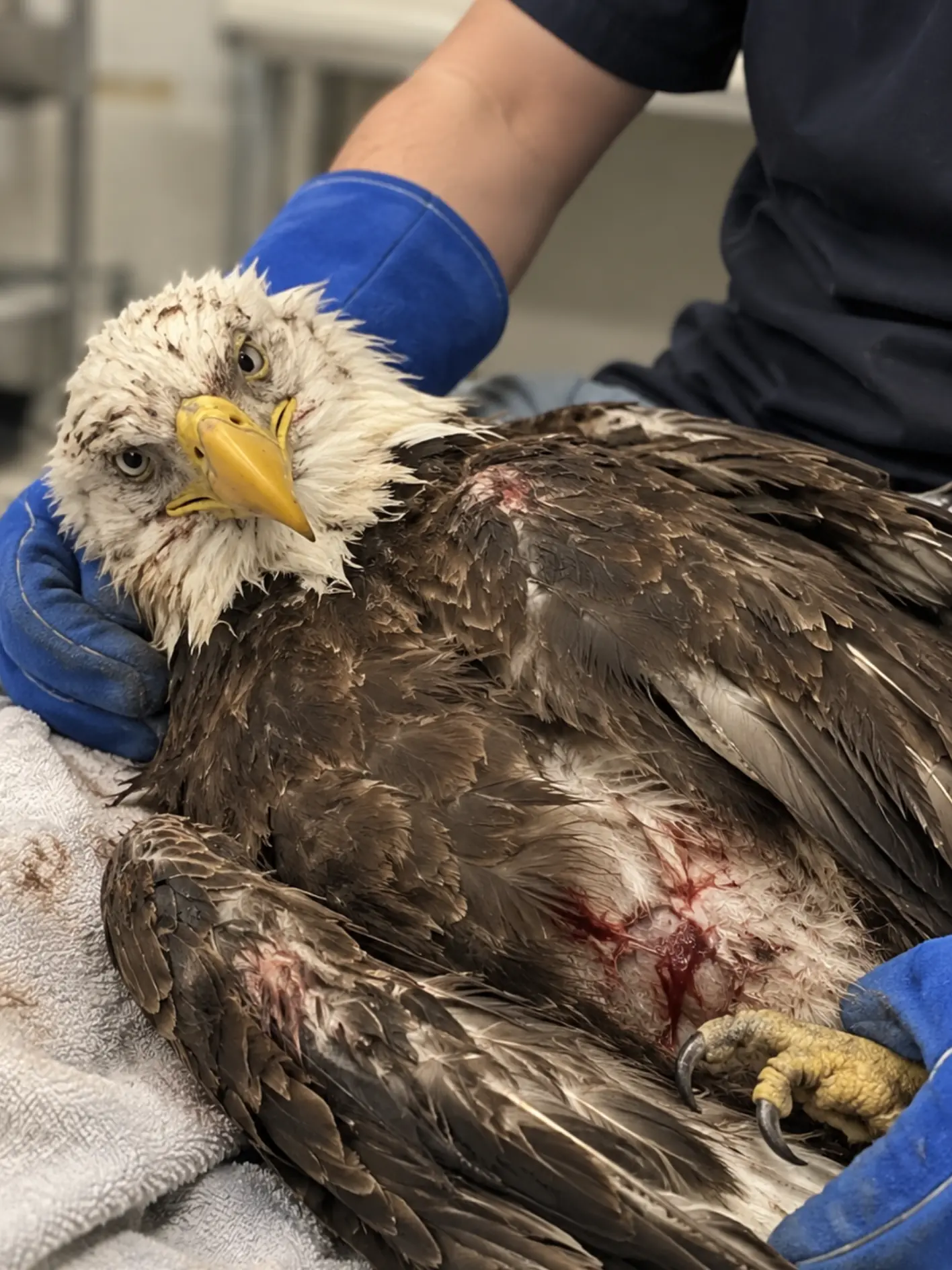
He had been walking along the edge of his wooded property in northern Minnesota shortly after sunrise when he heard a sudden burst of wingbeats somewhere beyond a stand of alder and spruce. At first, he thought a grouse had flushed from the brush or a deer had moved through the low ground near the creek. Then the noise came again, heavier this time, followed by a harsh call that did not sound like any bird he normally heard close to the ground.
Miller stood still and listened.
The woods went quiet for several seconds.
Then came another violent rustling sound.
Something large was struggling.
He followed the sound carefully along an old path that curved toward a narrow creek running through the back portion of the property. The ground there was uneven, covered with dead leaves, small branches, and patches of frozen mud left from the night before. When he reached a break in the brush, he saw a flash of white.
At first, he thought the bird might be standing over a carcass.
Then he saw the chain.
An adult Bald Eagle was on the ground, one foot held in a steel trap.
The bird was crouched low with both wings partly open. Its white head feathers were dirty, and several brown feathers along the shoulder and side of the body were damaged. Every time the eagle tried to pull away, the trapped foot remained fixed while the rest of the body twisted around it.
Miller stopped immediately.
The eagle saw him.
Its head came up.
The eyes locked onto him.
The bird opened its beak and tried to move backward, but the trap held.
One wing struck the ground.
The other spread for balance.
For several seconds, the eagle pulled with all its strength.
Then it stopped.
Miller backed away.
He had hunted deer in the region for most of his life and had seen trapping equipment before, but he had never handled an adult eagle. He understood enough to know that trying to free the bird bare-handed would be dangerous for both of them.
The free foot still carried a full set of powerful talons.
The trapped leg was being held at an awkward angle.
The chain was anchored somewhere beneath leaves and brush.
Any sudden pull could worsen whatever injury had already occurred.
Miller took out his phone and called the Minnesota conservation office.
He described the location, the bird, and the trap as clearly as he could.
The dispatcher asked him several questions.
Was the eagle conscious?
Yes.
Was there heavy active bleeding?
Not that he could see.
Was the trapped foot still warm and normally colored?
Miller was too far away to tell.
Could the eagle fly?
No. It could barely move without pulling against the trap.
The dispatcher told him not to touch the bird, not to attempt to open the trap, and not to allow anyone else near the area.
A conservation officer and a licensed wildlife-response team were being sent.
Miller stayed nearby but kept enough distance that the eagle settled again.
From where he stood, he could see that the bird had probably been struggling for some time.
Leaves around the trap had been scraped away.
The ground was disturbed in a wide circle.
Several feathers lay scattered near the creek bank.
The eagle’s wings were not simply dirty. One shoulder had a blood-stained area where feathers were missing or bent.
The bird had apparently spent hours trying to escape.
The trap itself held one foot.
Much of the rest of the visible damage had likely come from everything that happened afterward.
Every attempt to fly had driven the wings and body into the ground.
Every twist had pulled against the trapped limb.
Every burst of panic had consumed energy the eagle could not replace.
When conservation officer Emily Hart arrived, she first met Miller at the edge of the property rather than walking directly toward the bird.
He showed her the path.
Then he stopped.
Hart went ahead alone far enough to observe through binoculars.
The eagle remained on the ground.
One foot was caught.
The other was free and still strong enough to strike.
The trap appeared to be attached to a short chain anchored beneath vegetation.
Hart radioed the wildlife-response team, already only a few minutes away, and advised them to bring equipment suitable for a large raptor and a trapped limb.
She also photographed the area before anything was disturbed.
That documentation mattered.
At that point, no one knew who had set the trap, what species it had been intended for, whether it was legally placed, or whether any trapping regulation had been violated.
The priority was the eagle.
The investigation would come later.
When rescuers Daniel Price and Melissa Grant arrived from the fictional North Star Raptor Rehabilitation Center, they spent several minutes studying the scene.
The eagle watched them constantly.
Price noted that the bird’s head remained upright and both eyes were open.
That was encouraging.
The posture of the body was not.
The eagle was sitting low.
Its feathers were dirty.
The trapped leg looked swollen.
The shoulder area on one side was scraped and bruised.
The bird had likely exhausted itself through repeated escape attempts.
The team developed a plan before entering the immediate area.
Grant would approach from the eagle’s front at an angle with a large towel.
Price would stay to the side, focused on controlling the free foot as soon as the bird was covered.
Hart would manage the trap and chain once the bird’s body was secured.
They wanted to prevent the eagle from making one final violent attempt to fly.
The responders moved slowly.
The eagle reacted almost immediately.
Its wings opened.
The trapped foot pulled against the steel jaws.
The free foot came forward.
The bird tried to hop backward.
The chain snapped tight.
Everyone stopped.
The eagle settled again, breathing quickly.
Grant waited.
Then she moved closer.
When she was within reach, she placed the towel over the eagle’s head and upper body in one controlled motion.
Price immediately secured the free leg above the foot.
The talons closed hard against his glove.
The trapped foot remained fixed.
With the bird’s body supported and vision reduced, Hart began working on the trap.
The eagle struggled once beneath the towel.
Price supported the wings against the body.
Grant kept the chest free enough for normal breathing.
Hart examined exactly where the trap was holding.
Fortunately, the jaws were around the lower portion of the foot rather than high on the leg.
Unfortunately, swelling had already developed.
The skin beneath the jaws looked compressed and irritated.
The team did not pull.
Hart opened the trap gradually while Grant supported the leg so it would not drop or twist when released.
The foot came free.
For several seconds, no one moved.
Price checked the toes.
They were swollen but not cold.
There was still some movement.
That mattered.
The eagle was lifted carefully and placed on a clean towel.
The trapped foot was examined quickly.
There were pressure injuries and soft-tissue swelling, but no obvious catastrophic amputation or open long-bone fracture.
Several toes moved slightly when stimulated.
Circulation appeared reduced but still present.
The rescuers were cautiously encouraged.