Bald Eagle Found Tangled in Netting and Drifting Downriver — A Rescue That Lasted Minutes Became a Rehabilitation That Took Weeks
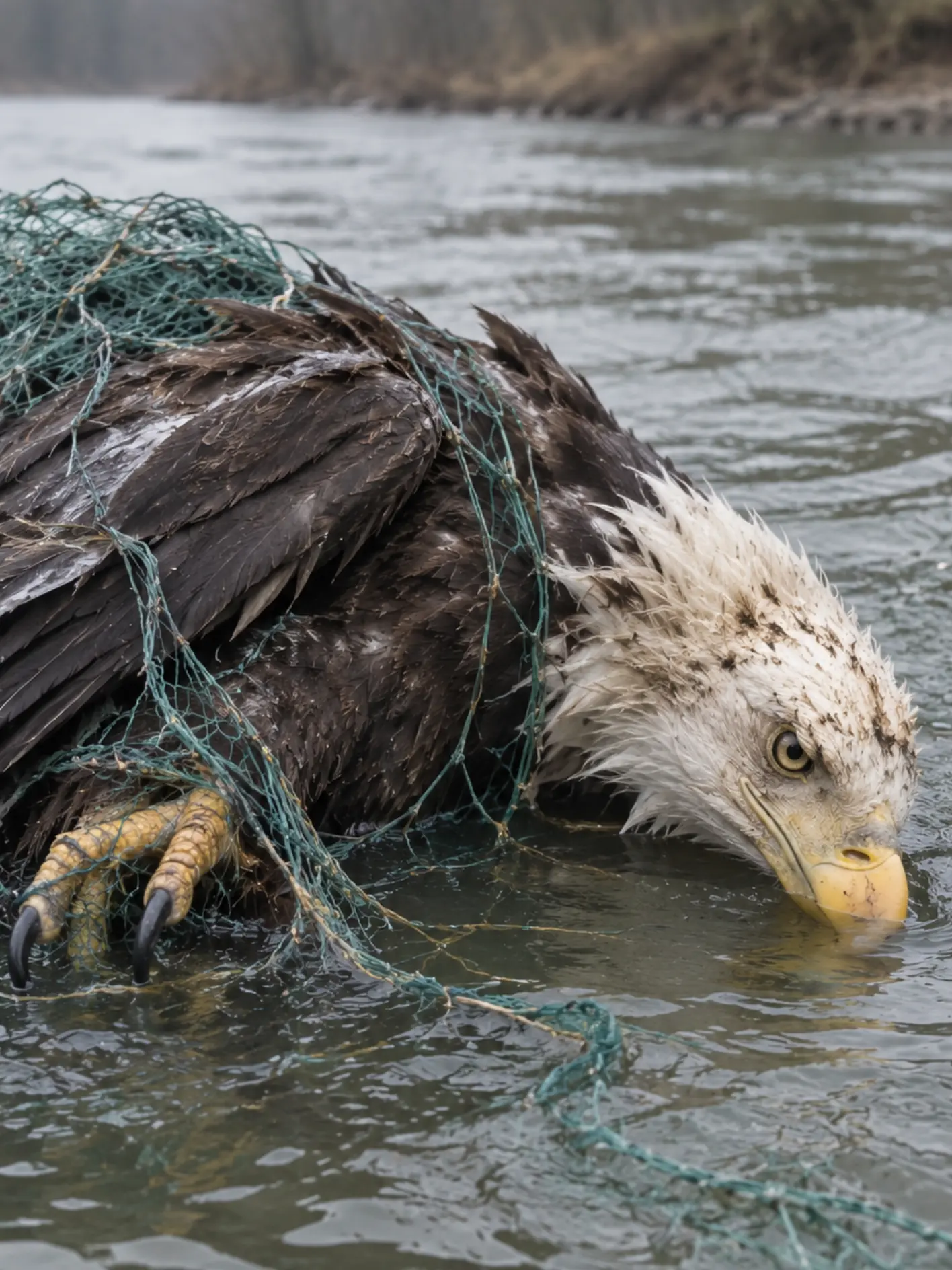
The Bald Eagle was still alive when rescuers reached it, but the margin between rescue and drowning had become dangerously small.
Most of the adult eagle’s body was already in the water. Its brown wings were soaked and pressed heavily against its sides, while several lengths of green synthetic netting crossed the back, wrapped around one foot, and disappeared beneath the surface of the river. Only the bird’s white head and part of its upper back remained consistently above the water.
The eagle was conscious, but its movements had become weak.
Every few moments, it attempted to lift a wing or pull one foot forward. Each effort moved the netting slightly, but instead of releasing the bird, the struggling appeared to tighten other strands around the body. The current continued carrying the eagle downstream, pulling the loose portions of netting behind it and adding resistance to every movement.
For an unknown period of time, the bird had been fighting two things at once: the net around its body and the river carrying it away.
By the time the fictional Northwoods Wildlife Response Team arrived on the Chippewa River in Wisconsin, the eagle had almost stopped fighting.
That was not a sign that it had calmed down.
For a wild Bald Eagle, the absence of a strong defensive response was one of the clearest indications that something was seriously wrong.
The bird was exhausted, soaked, and becoming dangerously cold.
Responders moved quickly but deliberately. They used a small boat to match the movement of the current rather than forcing the eagle into another burst of struggling. One rescuer controlled the bird’s feet while another supported the body and wings. Several loose portions of netting were cut immediately, while strands buried tightly beneath feathers or wrapped around the leg were left in place until the eagle could be examined under more controlled conditions.
Within minutes, the bird was out of the river.
The rescue itself was over.
The medical consequences of the entanglement were only beginning.
At the fictional Great Lakes Wildlife Rehabilitation Center, veterinarians would spend the next several days watching for hypothermia, circulation damage, muscle injury, respiratory complications, wounds hidden beneath the feathers, and the possibility that the net had damaged the eagle’s flight feathers badly enough to prevent release.
What looked from the riverbank like a simple problem with a simple solution — cut away the net — would become a much more complicated rehabilitation case.
The eagle would have to recover not only from the material wrapped around its body, but also from everything that had happened while it was trapped.
The Eagle Was Almost Mistaken for Debris
The rescue began on an overcast morning along a relatively quiet stretch of river bordered by leafless trees and low vegetation.
The water was carrying branches, leaves, and other debris downstream.
A person walking near the riverbank noticed a dark object moving with the current.
At first, there was no reason to think it was an animal.
The shape remained low in the water and drifted in the same general direction as everything else moving downstream.
Then the observer saw something white.
The object turned slightly, and a white head emerged above the darker mass.
A large yellow beak became visible.
The person realized that a Bald Eagle was in the water.
Seeing an eagle swimming does not automatically mean the bird needs rescue. Bald Eagles occasionally enter the water while pursuing fish, and they can sometimes use powerful wing movements to propel themselves toward shore.
This bird, however, was not swimming normally.
One wing moved only slightly.
The other barely moved at all.
The eagle appeared to make repeated attempts to lift itself, but the body remained low in the river.
The observer then saw the green netting.
Part of it lay across the eagle’s back. Other sections disappeared beneath the bird and emerged again near one leg.
The person moved closer to the shoreline but did not enter the water.
That decision would later be considered important.
A Bald Eagle is capable of causing serious injury with its talons even when exhausted. Entering moving water to handle a large raptor without proper equipment could have created a second emergency.
Instead, the observer contacted wildlife professionals and continued tracking the bird from shore.
The caller provided updates as the current moved the eagle farther downstream.
Those updates gave the response team something valuable: a moving location.
Without them, rescuers might have arrived at the original site only to find that the eagle had already drifted far away.
The River Was Working Against the Bird
Entanglement in water creates a different problem from entanglement on land.
A bird caught in netting on shore may still be able to rest between attempts to escape.
A bird caught in moving water rarely has that opportunity.
The river continually pulls against the body and against whatever material is attached to it.
In this case, several lengths of netting trailed behind the eagle.
The current pulled those loose sections downstream, creating additional tension across the strands that remained wrapped around the bird.
Each attempt to move a wing changed the tension somewhere else.
When the eagle pulled with one foot, the net tightened across part of the body.
When it tried to extend a wing, another strand appeared to catch.
The bird was caught in a system that responded to movement by becoming more restrictive.
The water created another problem.
The eagle’s feathers became increasingly saturated.
A healthy Bald Eagle normally relies on the structure and arrangement of its feathers to maintain insulation and repel much of the water encountered during ordinary conditions.
A bird trapped in water cannot maintain its plumage normally.
It cannot preen.
It cannot shake effectively.
It cannot reposition itself to keep important areas dry.
As the feathers became soaked, they lost some of their insulating ability and became heavier.
The eagle therefore had to expend more energy to move a body that was becoming colder and more difficult to control.
The longer the entanglement continued, the less likely the eagle was to free itself.
Bald Eagles Can Swim, but Entanglement Changes Everything
Wildlife professionals are careful not to assume that every eagle seen in water is drowning.
Bald Eagles can swim when necessary.
They may use their wings in a motion sometimes compared with a butterfly stroke, pushing water behind them as they move toward shore.
A bird that has taken a heavy fish may even remain in the water temporarily before reaching land.
The eagle on the Chippewa River was in a fundamentally different situation.
Neither wing had full freedom of movement.
One foot was tangled.
The body was partially restrained.
The feathers were saturated.
The current was moving the bird away from the nearest easy landing point.
There was no coordinated swimming motion.