What began as a nighttime wildlife emergency near Lake Lanier, Georgia, ended with one of the more unusual explanations conservation officers could have hoped for.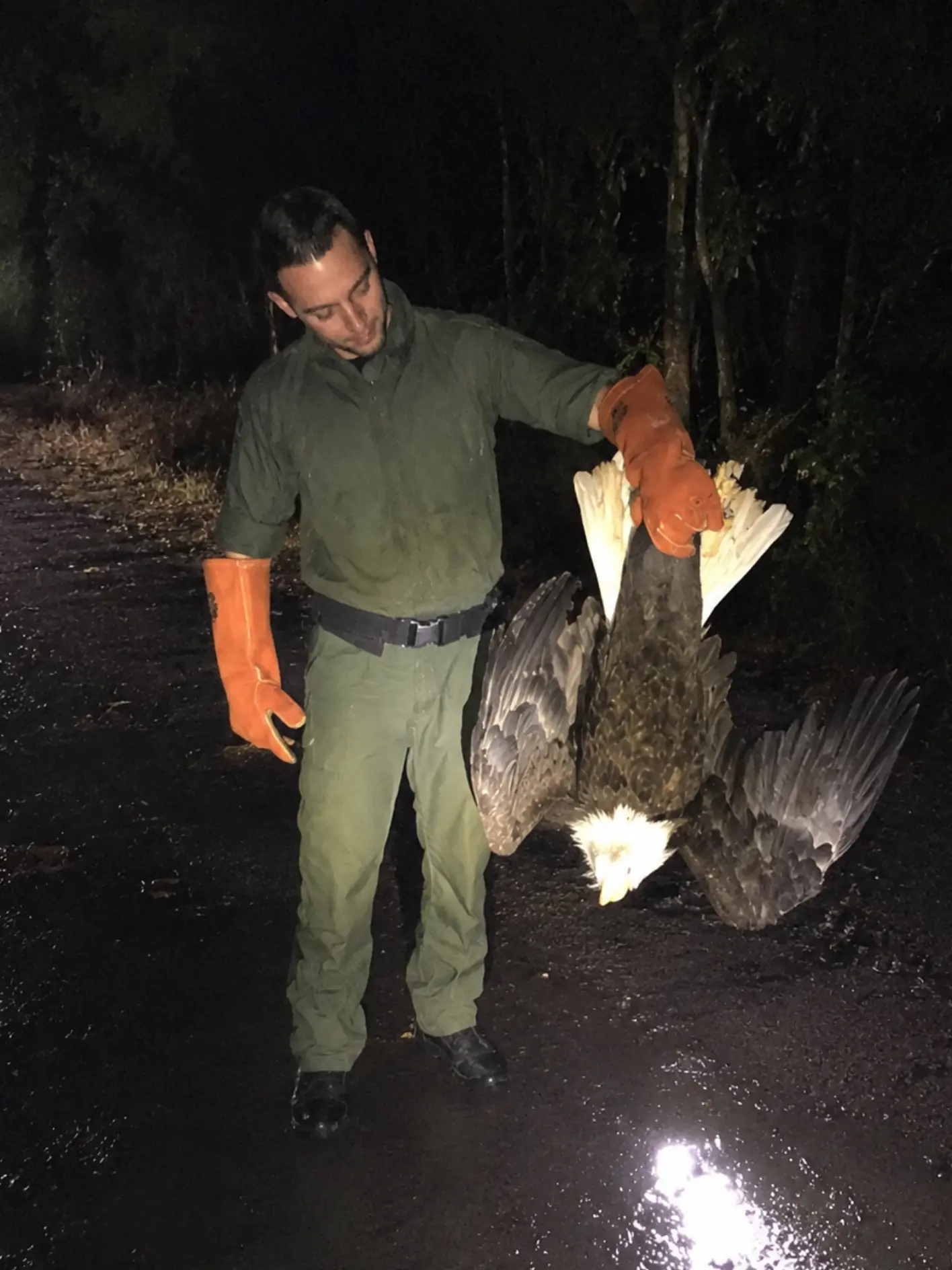
An adult Bald Eagle had been found on the ground in a wooded area near the lake, apparently unable to fly.
The person who reported the bird initially feared it had suffered a serious injury. Bald Eagles rarely allow people to approach closely when they are healthy, and this bird remained on the ground despite repeated opportunities to leave.
There was no obvious blood.
No wing appeared to be hanging at an abnormal angle.
The eagle was conscious and responsive.
Yet it simply would not take off.
Two wildlife officers were dispatched to investigate. After watching the bird for a period of time and conducting a careful physical assessment, they found no obvious evidence of a fracture, major soft-tissue injury or neurological impairment.
Both wings appeared structurally normal.
The eagle could move its legs.
Its grip remained strong.
Its eyes were alert.
Then the officers noticed another clue.
The bird appeared exceptionally full.
Their working conclusion was far less dramatic than the injuries they had initially feared: the eagle had apparently taken advantage of an unusually large meal and temporarily loaded itself with more weight than it could easily lift from the flat, confined ground where it had been found.
“The officers determined that the bird had recently eaten a very substantial meal,” the wildlife agency said in its account of the incident. “There was no obvious traumatic injury. It simply appeared to be temporarily too heavily loaded to generate an efficient takeoff from where it was sitting.”
For a large raptor, that situation is unusual enough to surprise the public but biologically plausible.
Bald Eagles are opportunistic feeders.
When food is available, particularly carrion or a concentrated source of fish, they may consume a substantial amount in a relatively short period.
For this eagle, the result was apparently a temporary case of having eaten more than it could comfortably carry into the air.
The Report Initially Sounded Much More Serious
The call came after dark from a wooded area not far from the lake.
A Bald Eagle had been seen on the ground.
It was not flying.
It was remaining in place.
Those three observations were enough for wildlife officers to take the situation seriously.
Grounded Bald Eagles can be suffering from a wide range of medical problems.
They may have been struck by vehicles.
They may have collided with trees, buildings or power infrastructure.
They may have fractures that are difficult to see beneath thick feathers.
Toxin exposure, including lead poisoning, can produce weakness and neurological impairment.
Infectious diseases can also leave a bird unable to fly.
A Bald Eagle that appears relatively normal while sitting still can therefore be much sicker than it looks.
That is why the officers did not assume the bird was merely resting.
A Grounded Eagle Is Not Automatically an Injured Eagle
At the same time, being on the ground is not itself abnormal for a Bald Eagle.
Eagles descend to feed.
They may remain beside carcasses for extended periods.
They may stand along shorelines after catching fish.
They can rest on low ground when circumstances allow.
The problem is distinguishing normal behavior from a medical emergency.
One of the strongest clues is how the bird responds when people are nearby.
A healthy wild Bald Eagle typically maintains distance.
It watches carefully.
If a person gets too close, it usually moves or flies.
This eagle remained grounded.
That behavior justified a closer professional assessment.
The Officers Watched Before They Intervened
Rather than immediately chasing the bird in an attempt to “make it fly,” the responding officers observed it first.
That distinction is important.
Forcing a potentially injured raptor into flight can worsen an existing fracture or cause the bird to collide with surrounding objects.
If neurological impairment is present, an eagle may attempt to fly but lack the coordination to do so safely.
The officers instead watched posture, alertness and movement.
The eagle appeared aware of its surroundings.
It followed activity around it.
There was no obvious head tilt or severe disorientation.
Its wings appeared symmetrical while folded.
Nothing immediately suggested a catastrophic injury.
But because it still would not leave, the officers decided that a hands-on examination was justified.
Even a Healthy Bald Eagle Can Be Dangerous to Handle
The bird’s apparent inability to fly did not make capture risk-free.
The feet remained the primary concern.
A Bald Eagle’s talons can produce serious injuries even when the bird is exhausted or medically compromised.
The officers used protective gloves and controlled the eagle’s feet before fully restraining it.
The wings were supported carefully.
The bird was handled for the shortest time necessary to evaluate its condition.
Images taken during the response show an officer holding the adult eagle securely under wet nighttime conditions while assessing it.
The photograph looks dramatic.
But the bird’s actual problem turned out to be far less severe than the scene initially suggested.
No Obvious Fracture Was Found
During the examination, the officers looked for the findings that would have suggested a true traumatic emergency.
They checked whether one wing was hanging lower than the other.
They looked for swelling.
They inspected the feet and legs.
They evaluated grip.
They checked for bleeding or obvious open wounds.
They observed whether the bird could move both wings normally.
Nothing stood out.
There was no visible open fracture.
No obvious dislocation.
No severe laceration.
No major neurological abnormality was apparent during the field assessment.
The bird was alert enough that a profound systemic illness also seemed less likely based on its immediate presentation.
That did not completely exclude medical disease.
But it made the officers begin considering a much simpler explanation.
The Eagle Had Apparently Eaten an Enormous Meal
The bird’s body condition and unusually distended digestive system suggested recent heavy feeding.
Large raptors are capable of consuming significant quantities of food when the opportunity arises.
That makes evolutionary sense.
A wild eagle cannot assume that another meal will be available a few hours later.
When food is plentiful, eating heavily can be advantageous.
The problem comes immediately afterward.
Flight is expensive.
Launching a large bird from the ground requires considerable force.
Add a large amount of food to the bird’s body mass, remove the advantages of height or a favorable headwind, and takeoff can become substantially more difficult.
The officers concluded that this eagle had most likely encountered exactly that situation.
It was not structurally incapable of flight.
It was temporarily too heavily loaded to launch efficiently from where it was standing.
Bald Eagles Are Built to Take Advantage of Large Meals
Bald Eagles are often associated with fishing, but their diet is much broader.
They are opportunistic predators and scavengers.
They may consume:
fish,
waterfowl,
small mammals,
road-killed animals,
animal carcasses,
and food taken from other birds.
If a large carcass becomes available, an eagle may remain at the site and eat repeatedly.
Unlike humans, wild predators do not generally structure meals around regular daily schedules.
Food availability can be unpredictable.
When calories are accessible, the incentive is often to eat while the opportunity exists.
That strategy works extremely well most of the time.
Occasionally, however, it leaves a bird very full.
Taking Off From the Ground Is Different From Leaving a Perch
This detail helps explain why an eagle may appear “unable to fly” despite having healthy wings.
An eagle launching from a tree branch already has elevation.
It can drop into the air, extend the wings and convert that downward movement into forward speed and lift.
A bird on flat ground has to create that lift from almost nothing.
It must push away with the legs and immediately generate enough airflow across the wings to get the body airborne.
A headwind can help.
A slope can help.
Open space can help.
Dense woodland, flat ground, wet surfaces and an unusually heavy digestive load can make the process much more difficult.
The bird may still be physically capable of sustained flight once airborne while temporarily struggling with the launch itself.
Large Meals Can Temporarily Change Flight Performance
The idea that a large meal can affect flight should not be interpreted as meaning Bald Eagles regularly become helpless every time they eat.
Most feeding does not produce that outcome.
But birds live under strict aerodynamic constraints.
Additional mass has consequences.
A heavily fed raptor has to generate more lift.
That means more force from the wings and greater energy expenditure during takeoff.
If the bird has eaten near the upper end of what it can comfortably carry, a difficult launch site can become the final limiting factor.
This eagle appeared to have combined both disadvantages:
a very large meal and an unfavorable place from which to take off.
Why Officers Still Had to Treat It Like a Possible Emergency
The humorous nature of the final explanation should not obscure why the response was appropriate.
A Bald Eagle with lead poisoning can also remain grounded while looking externally normal.
So can an eagle with head trauma.
A bird with a small but significant wing fracture may hold the wing almost normally while resting.
An eagle affected by disease can initially appear alert.
That is why members of the public should not diagnose a grounded bird simply by looking at it.
“Too full to fly” is something professionals may conclude after excluding more serious possibilities.
It should not become a reason to ignore an eagle that cannot leave the ground.
The Bird Needed Time More Than Medicine
Once the officers were satisfied that no obvious emergency injury was present, the situation changed from rescue medicine to observation.
The eagle did not need a splint.
It did not need surgery.
There was no obvious wound requiring treatment.
The most useful intervention was time.
As digestion progressed, the mass of food within the gastrointestinal tract would gradually decrease.
The bird would also become more comfortable and more capable of producing the force needed for takeoff.
The goal was therefore to ensure it could rest somewhere safe without traffic, pets or repeated human disturbance.
Sometimes the Best Wildlife Treatment Is Minimal Intervention
Wildlife rehabilitation is often associated with dramatic medicine.
Fracture repair.
Surgery.
Oxygen therapy.
Intravenous fluids.