For a scavenging Bald Eagle, the danger from a lead bullet may begin long after the shot has been fired.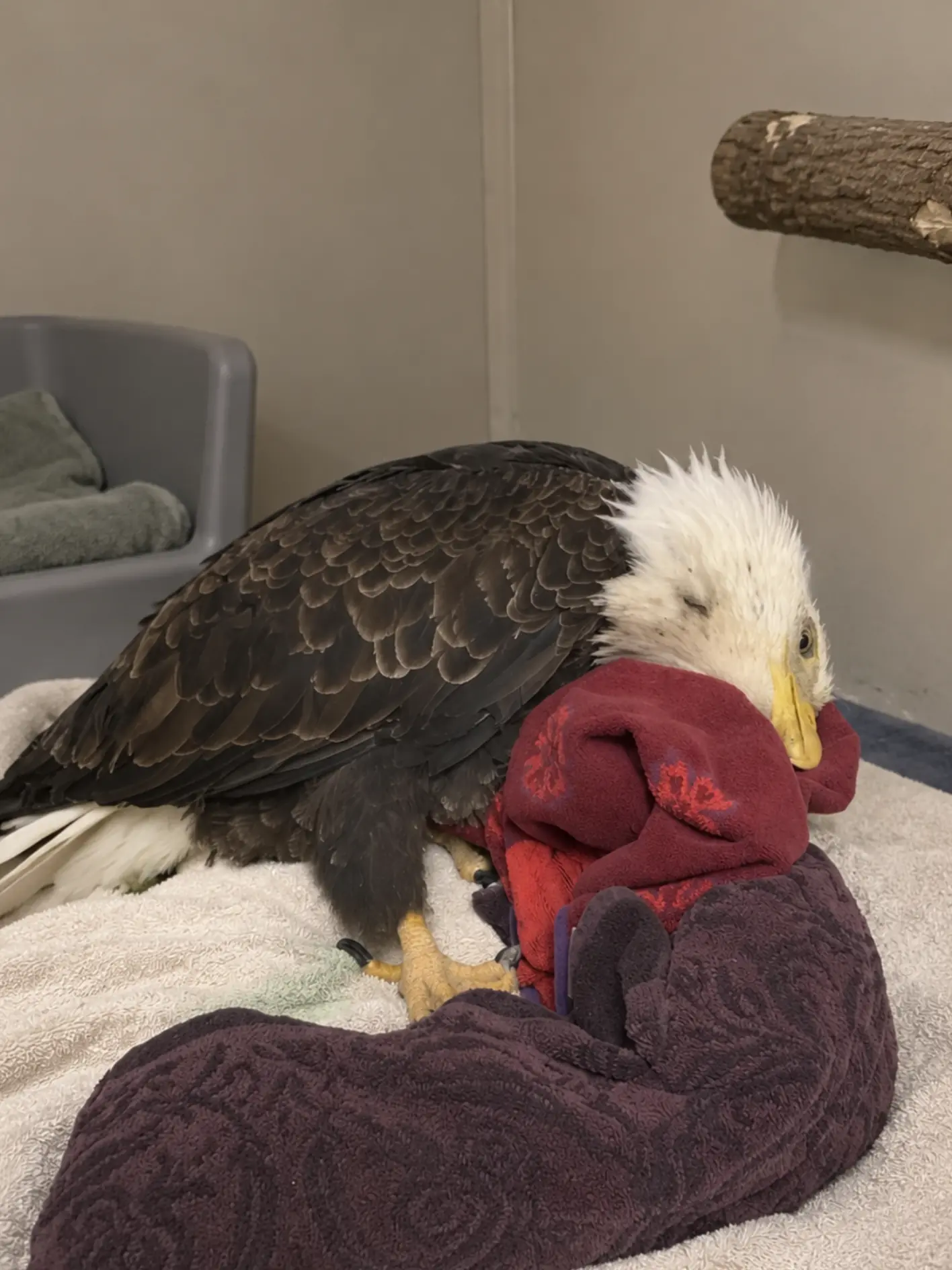
The eagle does not have to be shot itself.
It only has to eat from the wrong carcass.
That appears to be what happened to an adult Bald Eagle found grounded in rural northern Wisconsin after residents noticed that the bird had remained in the same area for hours and was not behaving normally.
At first, there was no obvious explanation.
The eagle was not bleeding. Neither wing appeared visibly broken. There was no major external wound suggesting a collision or gunshot injury. Yet the bird was weak, unusually subdued, and reluctant to move. When people approached from a distance, it did not immediately fly away.
Eventually, the eagle lowered its head and remained almost motionless.
Wildlife authorities were contacted, and the bird was transported to a licensed wildlife rehabilitation hospital for evaluation.
There, veterinarians discovered that the problem was not something they could see from the outside.
Blood testing revealed a clinically significant concentration of lead.
“There was no bullet wound to find,” one member of the rehabilitation team said. “The evidence was circulating in the eagle’s blood.”
The diagnosis highlighted a long-recognized hazard for scavenging wildlife: microscopic fragments of lead ammunition left behind in the remains of animals that have been shot.
For Bald Eagles, which routinely feed on carrion, those fragments can turn an otherwise normal meal into a toxic exposure.
And the consequences may extend well beyond the initial poisoning.
Lead can impair coordination, vision, strength, appetite, and neurological function. In sufficiently affected birds, those deficits may leave an eagle more vulnerable to collisions with vehicles, buildings, utility structures, or other hazards it might ordinarily avoid.
In other words, lead poisoning may not always be the final injury.
Sometimes it creates the conditions for the next one.
A Grounded Eagle With No Obvious Trauma
The eagle was first reported after a landowner noticed the bird sitting near the edge of an open field.
Bald Eagles frequently spend time on the ground while feeding, so the sight itself was not immediately alarming.
What drew attention was the bird’s lack of movement.
It stayed in roughly the same area.
It did not fly when activity increased nearby.
Its head remained low for long periods.
At one point, the eagle attempted to walk several steps before stopping again.
The observer contacted wildlife professionals rather than approaching the bird.
When a trained responder arrived, the eagle remained alert enough to watch the person closely but did not display the powerful defensive behavior expected from a healthy adult raptor.
Its grip was weak.
Its posture was subdued.
There was no obvious fracture.
The wings could be folded against the body.
But something was clearly wrong.
The bird was carefully restrained, the talons controlled, and the eagle was placed in a padded transport carrier.
No one attempted to force it to fly.
That decision was important.
A bird with neurological impairment may be physically capable of flapping but unable to control direction, altitude, or landing. Forcing a debilitated eagle into the air can turn an undiagnosed medical problem into traumatic injury.
The eagle was transported directly to veterinary care.
The Examination Raised Suspicion of a Systemic Problem
At the hospital, the team began with a full physical examination.
The bird’s eyes were evaluated.
The wings and shoulders were palpated.
The spine, pelvis, legs, and feet were examined.
Staff checked for wounds hidden beneath the feathers.
No major orthopedic injury was found that could fully explain the degree of weakness.
The eagle was mildly dehydrated and below ideal body condition.
Grip strength remained reduced.
Its responses seemed slower than expected.
The bird also showed little interest in food.
Those findings pushed the veterinary team toward causes that could affect the entire body rather than one specific limb.
Among the possibilities were infection, head trauma, severe systemic disease, and toxic exposure.
Lead was high on that list.
Bald Eagles are frequently screened for lead when they arrive with unexplained weakness, inability to fly, abnormal neurological behavior, or a history that suggests scavenging exposure.
A blood sample was collected.
The result confirmed the concern.
The Wing Was Not Broken — The Nervous System Was Being Affected
The lead concentration was high enough to require treatment.
That helped explain why a bird with no major wing fracture still could not function normally.
Lead is toxic to multiple organ systems.
In birds, significant exposure can affect the nervous system, gastrointestinal tract, blood production, and overall metabolic function.
Clinical signs vary with the degree and duration of exposure.
Some eagles show relatively subtle changes.
Others arrive severely compromised.
Affected birds may develop:
- weakness and lethargy;
- loss of appetite;
- reduced grip strength;
- poor coordination;
- inability to stand or fly normally;
- altered mental status;
- partial paralysis or severe motor deficits;
- gastrointestinal dysfunction;
- tremors or other neurological abnormalities.
In advanced cases, visual function can also be affected.
Some severely poisoned birds may become functionally blind or respond abnormally to objects, movement, or approaching people.
Not every lead-positive eagle develops all of these signs.
But the range illustrates why the poisoning can be so dangerous.
A Bald Eagle depends on extremely precise coordination.
It needs strong feet to grasp prey and perches.
Accurate vision is required for hunting, navigation, and landing.
Rapid neurological responses allow the bird to avoid traffic, power infrastructure, buildings, and other obstacles.
When those systems begin to fail, the consequences can multiply.
The Eagle Was Never Shot
One of the most important aspects of this case was that the eagle did not need to be struck by a bullet to become poisoned by ammunition.
Bald Eagles are both predators and scavengers.
They may catch fish and other live prey, but they also readily consume animal remains.
That behavior is completely normal.
During hunting seasons, scavenging opportunities can include the remains of deer and other game animals.
Depending on local practices and species, eagles may encounter discarded internal organs, wounded animals that later die, or carcasses left in the landscape.
Other scavenging species can be exposed in the same way.
When lead ammunition strikes an animal, the projectile may not remain as one intact piece.
It can fragment.
Some pieces may remain near the wound channel.
Others can spread into surrounding tissue.
Fragments can also remain in discarded viscera.
Many of those pieces are extremely small.
An eagle cannot separate them from the meat.
The bird simply eats.
What Happens After Lead Is Swallowed
Once metallic lead fragments reach the digestive system, the hazard changes.
The acidic environment of the avian gastrointestinal tract can promote dissolution of metallic lead, allowing lead to become biologically available for absorption.
The metal can then enter the bloodstream.
From there, it can affect multiple tissues and organ systems.
The eagle does not experience the exposure as a foreign object lodged in its stomach.
It experiences the consequences as a toxin circulating through the body.
That is what makes secondary lead exposure so difficult to recognize in the field.
There may be no wound.
No embedded projectile visible externally.
No dramatic moment when the poisoning occurs.
The bird may simply begin becoming weaker.
Appetite falls.
Coordination deteriorates.
Reaction time slows.
Eventually, someone sees an eagle sitting on the ground and assumes it has a broken wing.
The actual problem may be microscopic.
Scavenging Is Not the Abnormal Behavior
Wildlife professionals emphasize an important point when explaining these cases:
The eagle is not making a mistake by scavenging.
Carrion is a normal component of Bald Eagle feeding ecology.
The problem is that an otherwise natural food source may contain a human-introduced toxic material.
“The bird is doing exactly what an eagle is supposed to do,” a rehabilitator explained. “It has no way to know that there are lead fragments in the tissue.”
That distinction matters for prevention.
Wildlife managers cannot realistically teach eagles to avoid carcasses.
The more practical solution is to reduce the amount of toxic lead entering those carcasses in the first place.
Why Lead Poisoning Can Become a Collision Case
One of the most concerning aspects of neurological lead exposure is that poisoning may increase an eagle’s vulnerability to additional trauma.
A healthy Bald Eagle approaching a road can react quickly to vehicles.
A healthy bird can judge distance, coordinate takeoff, gain altitude, and clear an obstacle.
A neurologically impaired eagle may not respond as effectively.
Weakness can reduce takeoff power.
Poor coordination can affect flight control.
Visual impairment may affect obstacle avoidance.
Slower neurological processing may delay escape.
The result can be a secondary collision.
A poisoned eagle may be struck by a vehicle.
It may collide with a building.
It may hit utility infrastructure.
It may simply fail to gain enough altitude to clear a fence or roadway.
Veterinarians are careful, however, not to reverse-engineer every accident.
Finding lead in a bird that has been hit by a vehicle does not prove that lead caused the collision.
Healthy eagles are also struck by cars.
An eagle may be lead-positive and still suffer an entirely unrelated trauma.
The scientifically appropriate conclusion is narrower:
clinically significant neurological impairment from lead can plausibly increase a bird’s vulnerability to accidents.
That is an important possibility, not a universal explanation.
Treatment Began Immediately
Because the eagle’s blood lead concentration was high enough to be clinically significant, the veterinary team began treatment.
The central therapy was chelation, a medical process in which specific medications bind lead and help the body eliminate it.
Chelation does not reverse every effect instantly.
The bird still needs supportive care while lead concentrations decline and affected systems recover.
The eagle was placed in a quiet enclosure with soft bedding.
Hydration was addressed.
Neurological function was monitored.
Body weight was recorded.
Grip strength and posture were checked repeatedly.
Food intake was watched closely.
Because the bird was weak and had shown poor appetite, nutrition had to be reintroduced carefully.
Small, manageable portions were offered rather than overwhelming the eagle with a large meal.
The objective was to support recovery without adding unnecessary stress.
Appetite Was One of the First Problems
Lead poisoning commonly affects feeding.
A bird that does not eat loses muscle rapidly.
That is especially dangerous for a flying predator.
A Bald Eagle may look large because of its feathers even while its actual muscle condition is deteriorating beneath them.
The rehabilitation team therefore assessed the pectoral muscles and tracked weight over time.
At first, the eagle showed limited interest in food.
Staff offered smaller portions and monitored whether the bird swallowed normally.
As treatment progressed, appetite gradually improved.
The eagle began taking food more consistently.
Then it started feeding independently.
That change mattered.
Nutrition was not merely replacing calories.
It was supporting detoxification, muscle recovery, immune function, and eventual rehabilitation.
The First Encouraging Sign Was Not Flight
The eagle remained on low footing during the early stage.
No high perch was provided.
A neurologically weak bird can fall and injure itself, even if the wings and legs are physically intact.
The team first looked for simpler improvements.
Could the bird hold its head upright?
Would it respond appropriately when someone entered?
Did both feet grip?
Could it stand without spreading its wings for balance?
Those signs slowly improved.
The eagle began spending more time upright.
Its eyes remained open longer.
Grip strength increased.
And, eventually, the bird became more defensive during examinations.
That was a welcome change.
“The day the eagle started making it very clear that it did not want us handling it was one of the first reassuring signs,” a staff member said.
Wildlife rehabilitators do not want a Bald Eagle to become comfortable with people.
Resistance is often evidence that normal strength and behavior are returning.
Repeat Blood Tests Matter
Improvement in appearance alone was not enough.
The team repeated blood lead testing during treatment.
The concentration declined.
That supported what they were seeing clinically.
But monitoring continued.
Lead exposure can be complex, and one improved measurement does not necessarily mean the problem is completely resolved.
Clinicians also wanted to know whether neurological signs returned after treatment stopped.
Was grip still normal?
Was appetite stable?
Did the bird maintain weight?
Was posture consistently normal?
Could it balance?
The eagle needed both biochemical and functional recovery.
A Perch Became a Neurological Examination
Once the bird could stand reliably, a low perch was introduced.
Perching is a deceptively demanding behavior.