An adult Bald Eagle is receiving intensive treatment at a wildlife conservation center after being admitted with a severe injury involving the base of its upper beak and a fractured jaw — trauma veterinarians say is strongly suspicious for a projectile injury.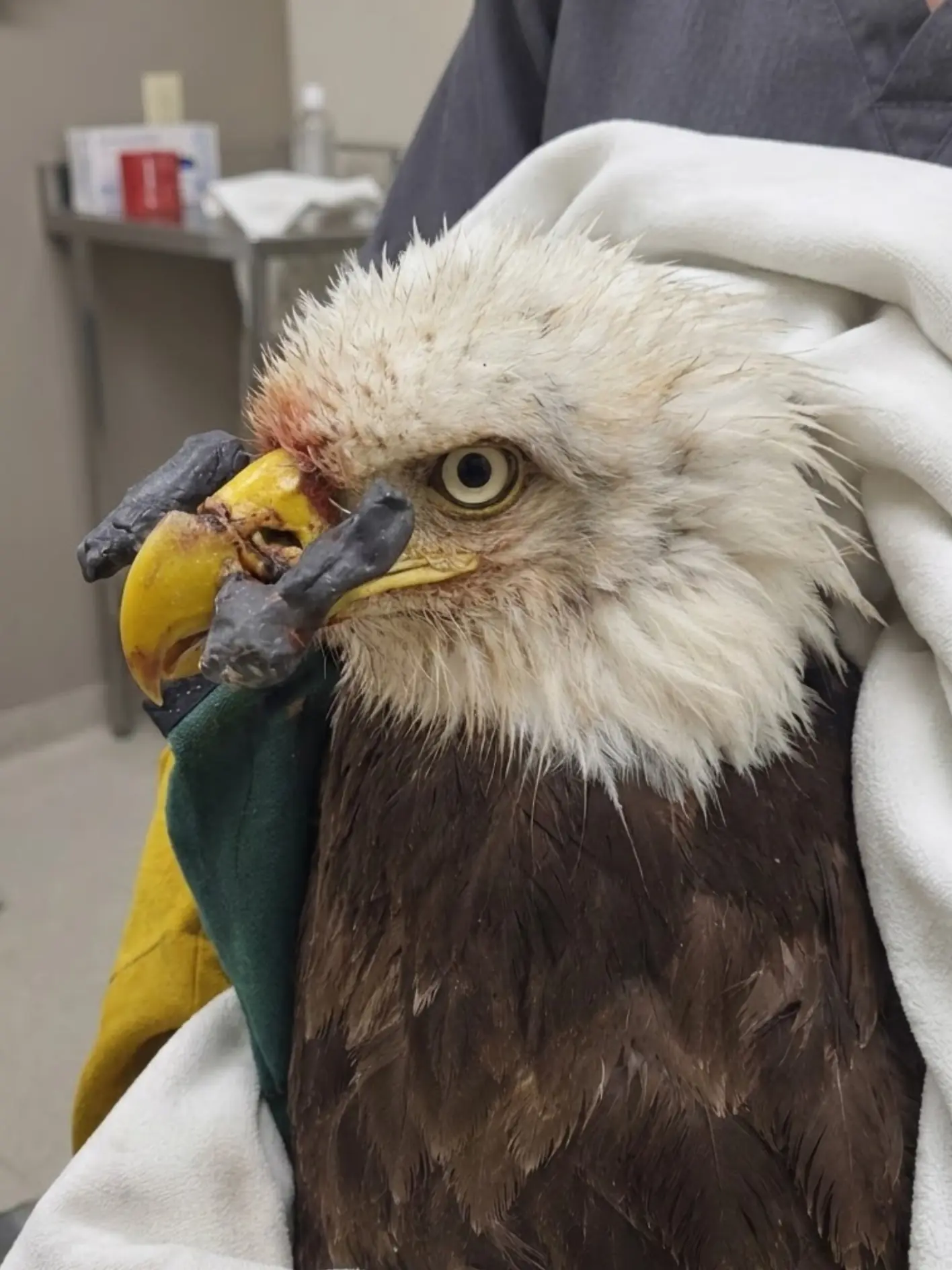
When the eagle first arrived, the damage was impossible to miss.
Blood stained the white feathers surrounding the face. The tissues at the base of the upper beak were swollen and disrupted, and a deep wound extended through the region around the cere, the soft tissue where the nostrils are located. The bird’s lower jaw also moved abnormally, raising immediate concern for a fracture.
Despite the severity of the injury, the eagle was still conscious and responsive.
Its eyes remained open.
It followed movement around the treatment room.
It could stand when supported.
And although the bird was clearly uncomfortable, its neurological responses gave the veterinary team an important reason to continue.
“It appears that something passed through the area near the base of the upper beak, and the jaw is fractured as well,” the attending wildlife veterinarian said. “The pattern is concerning for gunshot trauma, but imaging and the full medical examination are necessary before we can characterize the injury more precisely.”
For the team, simply keeping the eagle alive is only the first challenge.
The more difficult question is whether the damaged beak and jaw can recover enough function for the bird to feed itself again.
A Bald Eagle may have healthy wings, strong feet, and normal vision, but if it cannot grasp, manipulate, and tear food independently, it cannot survive in the wild.
That makes this one of the most complicated types of injuries a raptor rehabilitation team can face.
The Eagle Was Found With Obvious Facial Trauma
The bird was reported after being seen on the ground and behaving abnormally.
A healthy adult Bald Eagle would normally avoid prolonged close contact with people. This bird remained in place, allowing observers to notice dried blood around the face and an abnormal appearance to the beak.
Wildlife responders were contacted and approached the bird carefully.
Even an injured Bald Eagle can cause serious injury with its talons, so the feet were controlled first. The body was then wrapped securely in a towel, with special care taken not to place pressure on the damaged face.
The eagle was transported directly to a licensed wildlife rehabilitation facility, where veterinary staff were prepared to assess the injury.
Photographs from the initial examination show an eagle that was still remarkably alert considering the condition of its face.
The damage was concentrated around the upper beak and surrounding tissues.
Blood had dried along the base of the beak.
The skin near the cere was disrupted.
The lower jaw appeared unstable.
These findings immediately raised concern that the injury extended deeper than the surface.
The Beak Is More Complex Than It Appears
To many people, an eagle’s beak looks like a solid piece of horn.
It is not.
The outer surface is covered by keratin, the same general type of material found in claws and human fingernails.
Beneath that keratin, however, is living tissue.
There is bone.
There are blood vessels.
There are nerves.
And at the base of the beak are structures associated with the nasal passages and surrounding facial tissues.
A severe injury in this area can therefore affect far more than the visible outer shell.
If only superficial keratin is damaged, regrowth may be possible.
If the underlying bone or germinal tissue responsible for producing new keratin is destroyed, the long-term consequences can be much more serious.
“The visible part of the beak is only the outer layer,” the veterinarian said. “What matters to us is whether the living tissue and bone underneath remain viable enough to heal.”
The Jaw Injury Was an Immediate Concern
The lower jaw was also abnormal during the first examination.
The eagle could open and close its mouth, but movement was not symmetrical.
Palpation suggested instability consistent with a fracture.
That created an immediate functional problem.
An eagle uses the upper and lower portions of the beak together to manipulate food.
If the jaw cannot close properly, the bird may be unable to tear meat.
It may have difficulty swallowing.
Even small alignment problems can interfere with feeding.
For a wild raptor, long-term malocclusion — a mismatch between the upper and lower beak — can become a life-threatening disability.
The veterinary team therefore needed diagnostic imaging before deciding how to stabilize the injury.
X-Rays Helped Define the Damage
Once the eagle was medically stable enough, radiographs of the head and beak were obtained.
The images confirmed fractures involving the facial structures and jaw.
They also allowed veterinarians to evaluate the skull, surrounding bones, and deeper portions of the injury that could not be assessed from the outside.
The pattern of trauma raised serious concern for a projectile injury.
Small radiopaque fragments may sometimes be visible on imaging when metallic material is present, but clinicians interpret those findings carefully.
External wounds alone are not enough to prove exactly how an animal was injured.
In this case, the distribution of trauma was considered strongly suspicious for gunshot injury, and the case was documented accordingly.
Because Bald Eagles are federally protected, wildlife law-enforcement authorities may be notified when medical findings suggest that a bird has been intentionally shot.
Any material removed during treatment that could have evidentiary value can be preserved.
The rehabilitation center’s role, however, remains medical.
Its first responsibility is to the patient.
The Bird’s Eyes Were Carefully Evaluated
Any injury around the upper beak and face creates concern for the eyes.
The trauma was close enough to the orbit that the team needed to determine whether vision had been affected.
Both eyes were examined for:
pupil response,
corneal injury,
hemorrhage,
abnormal movement,
and evidence of deeper trauma.
The initial findings were encouraging.
The eagle appeared visually responsive.
It tracked movement.
There was no immediate indication that both eyes had suffered catastrophic damage.
That was important because visual function is one of the non-negotiable requirements for release.
A Bald Eagle must be able to judge distance accurately while flying, hunting, and landing.
The bird’s vision would continue to be monitored throughout rehabilitation.
Stabilizing the Wounds Came First
Before any complex reconstruction could be considered, the damaged tissues had to be cleaned and stabilized.
The eagle was sedated or anesthetized as needed so the medical team could work without causing unnecessary pain or additional injury.
The wounds were flushed thoroughly.
Dried blood and debris were removed.
The margins were examined for tissue viability.
Contaminated or clearly nonviable tissue was addressed conservatively.
The goal was to preserve as much healthy tissue as possible.
This is particularly important around the beak because tissue that appears badly damaged at first may still retain enough circulation to survive.
Removing too much too early could eliminate structures that might otherwise heal.
Infection Is a Major Risk in Facial Trauma
A projectile or other penetrating injury can carry bacteria deep into tissue.
The mouth itself also naturally contains bacteria.
That means wounds involving the jaw and beak are especially vulnerable to infection.
The veterinary team watched closely for:
increasing swelling,
discharge,
odor,
tissue discoloration,
fever or systemic decline,
and evidence that deeper structures were becoming infected.
Antibiotics were used when clinically indicated.
Pain medication was also essential.
An eagle with a fractured jaw cannot simply be expected to tolerate the injury while healing occurs.
Pain control supports both welfare and recovery.
A bird experiencing uncontrolled pain may refuse food, remain inactive, and struggle during handling.
The Jaw Had to Be Stabilized
The fractured jaw could not be allowed to move freely.
Each attempt to bite, tear, or struggle could worsen the fracture.
The team therefore applied temporary stabilization while specialists evaluated the best long-term approach.
Depending on the exact fracture pattern, avian veterinarians can use several methods to stabilize beak or jaw injuries.
These may include external support, dental acrylic or composite materials, or other specialized techniques designed to maintain alignment while bone heals.
The objective is not simply to make the beak look normal.
The upper and lower structures must meet correctly.
Functional alignment is more important than cosmetic appearance.
If the jaw heals in the wrong position, the eagle may survive hospitalization but remain unable to feed independently.
Feeding Became One of the Immediate Challenges
The bird could not be expected to tear normal pieces of food with a freshly fractured jaw.
That meant nutrition had to be managed carefully.
Food could be cut into small pieces that required minimal tearing.
Assisted feeding might be necessary if the eagle could not take enough calories on its own.
Fluids and nutritional support were provided according to the bird’s condition.
The team wanted to maintain body weight without placing unnecessary stress on the healing beak.
“Keeping the eagle alive medically is only one part of the challenge,” a rehabilitator said. “We also have to maintain nutrition while the structures it normally uses to feed are injured.”
Over time, the bird’s ability to accept and manipulate food would become one of the most important measures of recovery.
The First Several Days Remained Uncertain
The eagle was housed in a quiet intensive-care enclosure.
Handling was limited to medical procedures.
The bird was not placed in a large flight space simply because its wings appeared functional.
Flying was not the immediate problem.
The beak was.
During the first several days, staff watched closely for changes in:
facial swelling,
wound appearance,
jaw stability,
appetite,
body weight,
and overall responsiveness.
The tissue around the injury had to declare whether it would remain viable.
That process cannot be rushed.
Sometimes damaged tissue appears stable for the first day and then deteriorates as circulation fails.
Other times, an injury that initially looks severe begins showing healthy healing surprisingly quickly.
The First Encouraging Sign Was Tissue Stability
During follow-up examinations, the medical team began seeing areas of healthy tissue around the wound.
Swelling decreased gradually.
There was no rapid progression of tissue death.
The wound margins remained viable.
The eagle also became more active.
Its eyes stayed open longer.
It watched staff closely.
Its feet gripped more strongly.
Eventually, it began resisting restraint more aggressively.
For rehabilitation staff, that change was welcome.
A wild Bald Eagle should not be easy to handle.
Increasing resistance indicated improving strength and awareness.
The Bird Began Accepting Food More Reliably
As pain and swelling decreased, the eagle showed greater interest in food.
At first, the pieces offered were small enough that the bird did not need to tear them forcefully.
The eagle learned to take the food while protecting the injured jaw.
Over time, swallowing became more consistent.
That was encouraging, but staff were careful not to mistake assisted or modified feeding for normal function.
A releasable eagle must eventually be capable of handling natural food independently.
That means using the beak under normal mechanical stress.
The bird would need to prove that later.
Beak Healing Is Slow
Bone healing requires weeks.
Keratin regeneration can take considerably longer.
Even if the fracture stabilizes, the outer beak may not immediately return to normal.
The veterinary team therefore began monitoring the injured keratin closely.
The key question was whether new material would grow from surviving tissue.
If the keratin-producing region remains viable, gradual regrowth may occur.
If that tissue has been permanently destroyed, the bird could be left with a defect that requires ongoing management.
For a wild eagle, ongoing human maintenance is generally not compatible with release.
That is why the long-term prognosis remains guarded even when the eagle appears stronger.