An urgent call from Lake Gaston in northeastern North Carolina quickly turned into a coordinated wildlife rescue after an adult Bald Eagle was spotted on the ground with severe injuries clearly visible even from a distance.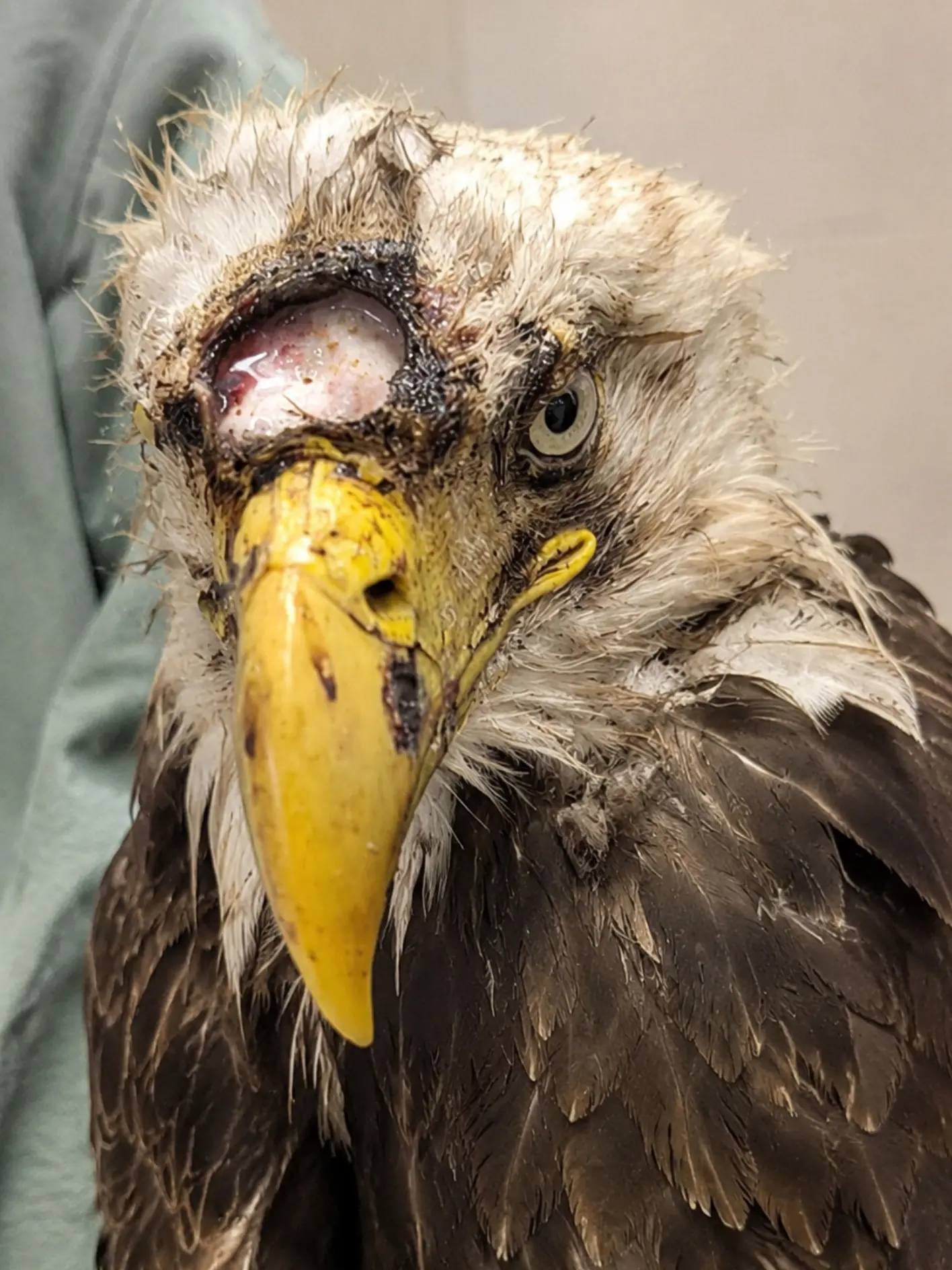
The caller reported that the eagle was alive but appeared unable to leave the area normally. Blood and debris covered portions of its head and face, and one side of the bird’s head looked especially concerning.
By the time our rescue team reached the lake, two state wildlife officers and a regional wildlife protection officer were already waiting nearby.
They had done exactly what we hoped they would do.
Rather than repeatedly approaching the eagle and forcing it to move, they had kept the surrounding area quiet, monitored the bird from a safe distance and waited for personnel equipped to safely capture a large injured raptor.
Once everyone was in position, the rescue became a team effort.
The officers helped block possible escape routes toward the water while the wildlife rescue team approached with protective equipment. The eagle was still conscious and alert enough to follow movement around it, and despite its condition, its talons remained a serious safety concern.
After a careful approach, the bird was covered, its feet were secured, its wings were supported against the body and it was transferred into a ventilated transport carrier.
Only then were we able to see just how extensive the injuries were.
The eagle had multiple puncture wounds around the head, face and neck. One eye was surrounded by severe swelling and damaged tissue. Blood had dried through feathers around the forehead and bill, and additional wounds were hidden beneath the thick neck plumage.
There was no time to determine exactly what had happened at the lake.
The immediate priority was getting the eagle to the Carolina Wildlife Care Center, where an emergency wildlife veterinarian was already waiting.
What followed was several hours of stabilization, diagnostic imaging and wound treatment.
And one of the first major questions was whether this had been a deliberate human-caused injury.
The X-rays provided an important answer.
No pellets were visible.
No bullet fragments were found.
No metallic foreign bodies consistent with gunfire could be identified.
Instead, the distribution and depth of the puncture wounds were far more consistent with another possibility: a violent confrontation with another large eagle.
No one witnessed the event, so the precise cause may never be known.
But for the first time that day, the team had a working explanation for why the bird had arrived in such devastating condition.
The Call Made It Clear This Was Not a Bird That Could Simply Be Watched
Bald Eagles frequently rest near lakes, rivers and shorelines.
Seeing one on the ground does not automatically mean something is wrong.
An eagle may descend to feed on fish or carrion. It may remain low for a period after consuming a large meal. It may simply be resting.
The situation at Lake Gaston was different.
Witnesses could see visible injury from a distance.
The bird was not leaving.
Its head and face appeared heavily soiled with blood.
And its behavior suggested that it either could not or would not attempt normal flight.
Those observations justified an immediate professional response.
A severely injured eagle should not be repeatedly chased in an effort to determine whether it “can still fly.”
Doing so can worsen fractures, reopen bleeding or push a compromised bird into water, traffic or inaccessible terrain.
The officers who arrived first therefore maintained distance and controlled the scene until the capture team was ready.
That decision likely prevented additional trauma.
Capturing an Injured Bald Eagle Is Still Dangerous
A Bald Eagle that appears exhausted can remain surprisingly powerful.
The feet are the primary danger.
Large talons capable of capturing fish and defending territory can also seriously injure an unprotected rescuer.
That is why the capture focused first on controlling the feet.
Once the bird was covered and its vision temporarily reduced, the talons were secured and the wings were supported.
The team avoided placing unnecessary pressure across the chest.
Birds do not breathe the same way mammals do, and excessive restraint around the body can interfere with normal respiratory movement.
Every step was intended to protect both the eagle and the people handling it.
The bird was then placed in a darkened carrier lined with padding.
The quieter environment reduced visual stimulation during transport while also keeping the injured animal from repeatedly trying to escape.
The Injuries Looked Worse Up Close
When the carrier was opened at the wildlife hospital, the eagle remained conscious.
That was encouraging.
But it was also far too quiet.
Healthy adult Bald Eagles generally make it very clear that they do not want human contact.
This bird watched the medical staff but showed relatively little resistance.
The feathers around its head were wet and matted.
Dried blood covered the face.
One eye was surrounded by severe traumatic swelling.
Several narrow openings could be seen around the head and neck.
Those small openings were particularly concerning.
Puncture wounds can be deceptive.
A narrow entry point may hide a deep tract beneath the surface.
The medical team therefore could not judge the severity of the case simply by counting the visible holes.
Each one had to be cleaned and examined individually.
Some of the Wounds Needed Immediate Stabilization
Before the team could proceed with a full surgical evaluation, the most serious wounds had to be addressed.
“Some of the punctures were deep enough that we had to stabilize and close the worst areas before we could even move forward with the definitive surgical workup,” the attending veterinarian said. “There was simply too much trauma to treat this like a routine wound-cleaning procedure.”
The bird was placed on supportive care while the team worked.
Pain medication was administered.
Fluid therapy was provided according to the eagle’s hydration and circulatory status.
The patient was kept warm and handled only as much as necessary.
Because deep puncture wounds are highly vulnerable to bacterial contamination, antimicrobial treatment was also incorporated into the plan as clinically appropriate.
Only after the eagle was considered sufficiently stable could the team safely proceed with anesthesia and more extensive examination.
The Injured Eye Was One of the Greatest Concerns
The appearance of one eye was alarming.
The surrounding tissues were swollen and traumatized, and the normal structures were difficult to evaluate beneath the inflammation and debris.
For a Bald Eagle, visual function is not a secondary concern.
It is essential to survival.
An eagle must judge distance while landing on narrow branches.
It must track moving prey.
It must navigate around trees, wires and other obstacles.
It must make rapid visual calculations during territorial interactions and flight.
A bird can have perfectly healthy wings and still be unreleasable if its vision is not adequate for those tasks.
The eye was therefore examined as carefully as the bird’s condition allowed.
Veterinary staff evaluated the cornea, eyelids, globe, pupil response and surrounding tissue.
The severe swelling meant that the long-term visual prognosis could not be determined immediately.
That uncertainty would remain one of the major questions during the first days of treatment.
The Team Needed to Know Whether the Eagle Had Been Shot
Because no one had witnessed the injury occur, the medical team had to consider several possibilities.
A vehicle collision could cause severe head trauma.
A sharp object could create penetrating wounds.
Gunshot trauma could produce multiple injuries and embedded metallic fragments.
A fight with another large raptor could also create exactly the type of punctures being seen.
Radiographs were therefore taken of the head, neck, chest and other areas as clinically appropriate.
Staff specifically looked for radiopaque material that might indicate pellets, bullet fragments or another metallic projectile.
They also evaluated the skeleton for fractures.
The results were significant.
No pellets were identified.
No bullet fragments were visible.
No metallic foreign bodies consistent with gunfire were found.
The radiographs did not support a gunshot injury.
That did not explain everything.
But it removed one of the most concerning possibilities from the top of the list.
The Wounds Looked Much More Like Talon Injuries
Once the imaging results were combined with the physical examination, another pattern became more convincing.
The injuries were narrow.
Many were deep.
Several were concentrated around the head and neck.
They resembled wounds that can occur when a large raptor strikes another bird with its feet.
“The pattern is highly compatible with talon trauma,” the veterinarian said. “When you consider the number of punctures, their distribution and the absence of ballistic material on the radiographs, a conflict with another eagle becomes a very reasonable explanation.”
Reasonable does not mean proven.
No one saw the fight.
There was no video.
There was no second injured eagle found beside this bird.
For that reason, the team continued describing the event as a suspected raptor-to-raptor confrontation.
Bald Eagle Fights Can Become Extremely Physical
Bald Eagles are powerful predators, but they are also territorial animals.
Conflicts can occur over several resources:
nesting territory,
mates,
food,
feeding locations,
or preferred perches.
Many disagreements are resolved through display and pursuit.
One bird leaves.
The interaction ends.
Occasionally, however, the encounter becomes physical.
The birds may strike with their feet.
They may briefly lock talons.
They can lose altitude.
They can collide with branches, the ground or each other.
During a close fight, the head and neck may become especially vulnerable.
A talon that produces only a small puncture on the surface can travel much deeper beneath the feathers.
That is why the injuries seen in this eagle were medically significant even where the skin openings looked relatively small.
Deep Punctures Carry a Serious Infection Risk
Another eagle’s talons are not sterile.
Neither is the environment where a fight occurs.
A puncture can carry bacteria, dirt, feathers and organic debris deep into tissue.
The skin may begin closing while contamination remains trapped underneath.
That creates a risk of:
abscess formation,
soft-tissue infection,
tissue necrosis,
and potentially systemic illness.
For that reason, wound treatment involved more than simply placing sutures over every opening.
Some wounds required extensive flushing.
Damaged or nonviable tissue had to be removed.
Certain areas could be closed after cleaning.
Others needed to remain partially open so fluid could drain rather than becoming trapped.
The goal was not to make the wounds look closed.
The goal was to make them heal safely.
The Neck Wounds Required Extra Caution
Several punctures were located around the neck.
That region contains vital structures packed into a relatively narrow space.
The medical team had to consider possible injury to:
the trachea,
the esophagus,
cervical muscles,
major vessels,
and other deeper tissues.
Fortunately, the initial evaluation did not reveal an obvious catastrophic penetration of the airway.
The eagle was able to breathe without signs immediately suggesting complete tracheal disruption.
That was an important positive finding.
Still, normal breathing was only one part of the assessment.
The team would also need to evaluate swallowing and neck movement as swelling changed over the following days.
Hours of Treatment Were Required
The initial wound care took hours.
The team worked through one area at a time.
Blood and debris were removed.
Feathers were carefully separated or managed where necessary to expose the wounds.
Deep puncture tracts were flushed.
Damaged tissue was assessed.
The injured eye was rechecked.
The bird’s temperature, breathing and cardiovascular stability were monitored throughout.
This type of case requires patience.
Rushing through the examination risks missing deeper injury.
But prolonged anesthesia and restraint also carry their own risks.
The veterinary team had to continually balance the need for a complete evaluation against the physiological stress of treatment.
The Eagle’s Quiet Behavior Made Close Monitoring Essential
After the procedures, the bird was placed in a quiet recovery enclosure with padded flooring.
No high perch was provided initially.
An eagle recovering from severe trauma, anesthesia and pain medication does not need the additional risk of falling.
The lights were reduced.
Human traffic was minimized.
The eagle remained under frequent observation.
Staff monitored:
breathing,
head position,
temperature,
eye appearance,
bleeding,
neurological responsiveness,
and ability to reposition itself.
The prognosis remained guarded.
That did not mean staff believed the bird would die.
It meant there were still too many unanswered questions to predict the final outcome responsibly.
The Eye Could Not Be Judged From Appearance Alone
The severely injured eye remained particularly difficult to interpret.
An eye can appear dramatic immediately after trauma because of swelling and hemorrhage.
Some of that appearance may improve as inflammation decreases.
In other cases, deeper damage becomes apparent only after the tissue can be examined more clearly.
The team would need time to determine whether:
the globe remained structurally viable,
the cornea could heal,
the pupil responded appropriately,
and functional vision was preserved.
There was no responsible way to promise that the eye could be saved on the first day.
There was also no reason yet to conclude that vision had been permanently lost.
The correct answer was simply that it was too early.
The First 24 Hours Would Tell the Team a Great Deal
Following severe penetrating trauma, clinicians watch carefully for deterioration.
Swelling can increase.
Hidden bleeding may become more obvious.
Infection may begin developing.
Tissue that initially appears healthy can sometimes lose viability.
Neurological abnormalities can emerge after the acute stress of rescue subsides.
That is why the first night was treated as a critical observation period.
The eagle needed rest.
But it also needed repeated reassessment.
Small Improvements Would Matter
Recovery from this type of injury is rarely defined by one dramatic moment.
The team would look first for small changes.
The eagle holding its head higher.
The unaffected eye remaining open longer.
A stronger grip.
A more active response when someone enters the room.
Normal swallowing.
Attempts to reposition itself.
Those behaviors can indicate that pain control, hydration and systemic stability are improving.
For a wildlife patient, becoming less tolerant of people is often a good sign.
A stronger Bald Eagle should want rescuers to keep their distance.
Food Would Be Introduced Carefully
Because the injuries involve the head and neck, feeding requires additional attention.
The medical team first needs confidence that swallowing is normal.
Once it is safe to offer food, smaller pieces can reduce the need for aggressive tearing or manipulation around the injured face.
Staff will observe whether the eagle can:
open the beak normally,
grasp food,
swallow,
and eat without new bleeding or obvious pain.
A return to voluntary feeding would be one of the most encouraging early milestones.
The Wounds May Need Another Sedated Examination
Severe puncture injuries rarely end with one treatment session.
A wound that looks stable after initial cleaning may behave differently several days later.
Some pockets can develop infection.
Some tissue may require additional debridement.
Sutures may need adjustment.
The eye may need to be reevaluated after swelling falls.
If necessary, the eagle may undergo another sedated examination.
That would not indicate treatment failure.
It would be part of normal management for complicated penetrating trauma.
The Bird’s Feathers Also Need Time to Recover
Blood, wound fluid and environmental debris had heavily soiled the feathers around the eagle’s head and upper body.
Plumage condition matters for more than appearance.
Feathers provide insulation and aerodynamic function.
For a bird that may eventually return to the wild, damaged or badly contaminated plumage can affect recovery.
The medical team will clean only what is necessary during the acute phase.
As the eagle feels better, natural preening should take over much of that work.
A bird that begins preening voluntarily is also signaling that it feels well enough to devote energy to normal maintenance behavior.
The Cause May Remain Unconfirmed Forever
The absence of gunshot evidence is useful.
The wound pattern strongly suggests talon trauma.
But wildlife medicine often ends without a complete reconstruction of the original event.
No one can ask the eagle what happened.
No witness saw the encounter.
The bird may have fought another Bald Eagle.
It may possibly have interacted with another large raptor.
It could also have sustained some wounds during a secondary collision.
The team is comfortable saying what the evidence supports.
It is not comfortable inventing certainty where none exists.
The current conclusion is therefore cautious:
The injuries are most consistent with a severe raptor-to-raptor confrontation, with another Bald Eagle considered a leading possibility.
If Another Eagle Was Involved, It Was Natural Behavior
A suspected territorial fight should not be interpreted as one bird behaving “cruelly.”
Wild animals do not engage in territorial behavior according to human moral categories.
Bald Eagles defend resources because doing so affects survival and reproduction.
Competition is part of their biology.
Most encounters end without catastrophic injury.
Occasionally they do not.
When a severely injured eagle is subsequently found unable to care for itself, professional rehabilitation can still be appropriate even if the original injury arose from entirely natural behavior.
The Wings Still Have to Be Evaluated Functionally
The most visible injuries are concentrated around the head and neck, but eventual release will depend on the entire bird.
Even if no major wing fracture is detected, the eagle still has to regain:
full body strength,
normal balance,
normal vision,
normal neck movement,
and adequate endurance.
Flight testing will not happen during the acute wound phase.
There is no reason to risk reopening wounds merely to prove that the wings move.
The medical problems come first.
Neck Mobility Will Be Especially Important
Bald Eagles need extraordinary neck flexibility.
They use it to:
preen,
tear food,
scan the environment,
track prey,
and maintain orientation during flight.
Deep wounds that heal with severe scar restriction could potentially interfere with normal function even if infection is controlled.
During rehabilitation, staff will repeatedly assess whether the eagle can turn its head fully and comfortably.
Pain-free range of motion will be one of the eventual release criteria.
Vision May Become the Deciding Factor
If the injured eye recovers, the prognosis could improve substantially.
If significant permanent visual impairment remains, the situation becomes more complicated.
Rehabilitation staff cannot decide whether an eagle is releasable based solely on whether an eye looks normal.
Functional testing matters.
Can the bird track?
Can it judge distance?
Can it navigate a flight enclosure?
Can it land accurately?
Those questions come much later.
For now, the eye needs a chance to heal.
Flight Rehabilitation Is Still Far Away
If wound healing proceeds well, the eagle may eventually move from intensive care into a larger enclosure.
The progression would likely begin with normal standing and low perching.
From there, staff would assess grip and balance.
Only after those functions are reliable would the bird move into a flight space.
At that stage, rehabilitation becomes a functional test.
Can it launch?
Can it maintain altitude?
Can it turn?
Can it land?
Can it repeat those actions without fatigue or abnormal coordination?
A Bald Eagle has to do far more than simply flap its wings to qualify for release.
For Now, the Prognosis Remains Guarded
There are encouraging findings.
No gunshot material was seen on the X-rays.
No obvious catastrophic airway injury was identified.
The bird remained conscious through the initial rescue.
The team was able to stabilize the worst wounds.
But there are also serious concerns.
The punctures are deep.
The risk of infection remains substantial.
One eye is significantly injured.
The head and neck have sustained considerable trauma.
That combination makes a guarded prognosis appropriate.
If infection can be controlled, the eye remains functional and normal neurologic and neck movement are preserved, the outlook may improve.
But the medical team is not willing to get ahead of the bird’s actual recovery.
Teamwork Gave the Eagle This Opportunity
One element of the case is already clear.
The rescue worked because several people handled their part correctly.
Someone recognized that the eagle needed help and reported it.
The two wildlife officers and conservation officer arrived and protected the scene rather than repeatedly disturbing the bird.
The specialized rescue team handled the capture.
The transport was completed quickly.
The veterinary staff was ready before the eagle arrived.
“This was truly a team effort,” the rehabilitation director said. “The caller, the officers, the rescuers and the medical staff all became part of the same chain. If one link had been missing, this bird might not have reached treatment when it did.”
Public Reporting Often Makes the Difference
People who encounter injured eagles sometimes hesitate because they are uncertain whether the bird actually needs help.
The safest approach is to observe behavior from a distance and contact professionals when there are clear warning signs.
Those include:
visible bleeding,
inability to fly,
prolonged time on the ground,
poor balance,
obvious trauma,
or allowing unusually close approach.
The public should not attempt to grab a Bald Eagle without proper training and equipment.
A severely injured bird can still strike.
Calling quickly is often the most useful thing a witness can do.
The Story Is Not Finished
After hours of treatment, the Bald Eagle is now resting in a controlled environment rather than trying to survive injured beside Lake Gaston.
Its wounds have been cleaned.
The most serious areas have been stabilized.
Pain is being managed.
The risk of infection is being addressed.
Veterinary staff are monitoring the eye, breathing, neurological function and neck mobility.
The X-rays also provided one meaningful piece of reassurance.
There was no evidence of pellets, bullet fragments or other metallic material indicating that the bird had been shot.
Instead, the injuries are most compatible with a violent encounter involving another large raptor, with a rival Bald Eagle considered one of the strongest possibilities.
We may never know exactly what happened before the rescue call was made.
What we do know is what happened after it.
Several people who had never planned to work together that day did exactly that.
They surrounded an injured wild eagle not to harm it, but to prevent it from suffering alone.
They captured it safely.
They got it into medical care.
And veterinary staff spent hours treating wounds that could not simply be ignored and hoped away.
For now, that is where the story stands.
The eagle is resting.
The medical team is watching.
The damaged eye still carries uncertainty.
The puncture wounds still carry risk.
But the bird is alive, protected and receiving treatment.
“We’re hoping for the best,” the rehabilitation director said. “There is still a long way to go, but this eagle has a chance now because so many people responded quickly and worked together. We are incredibly grateful to everyone who helped give it that chance.”