An adult Bald Eagle found critically injured near the shoreline of Lake Cumberland Reservoir in southern Kentucky was rushed into emergency wildlife care after rescuers discovered multiple penetrating wounds across its upper body.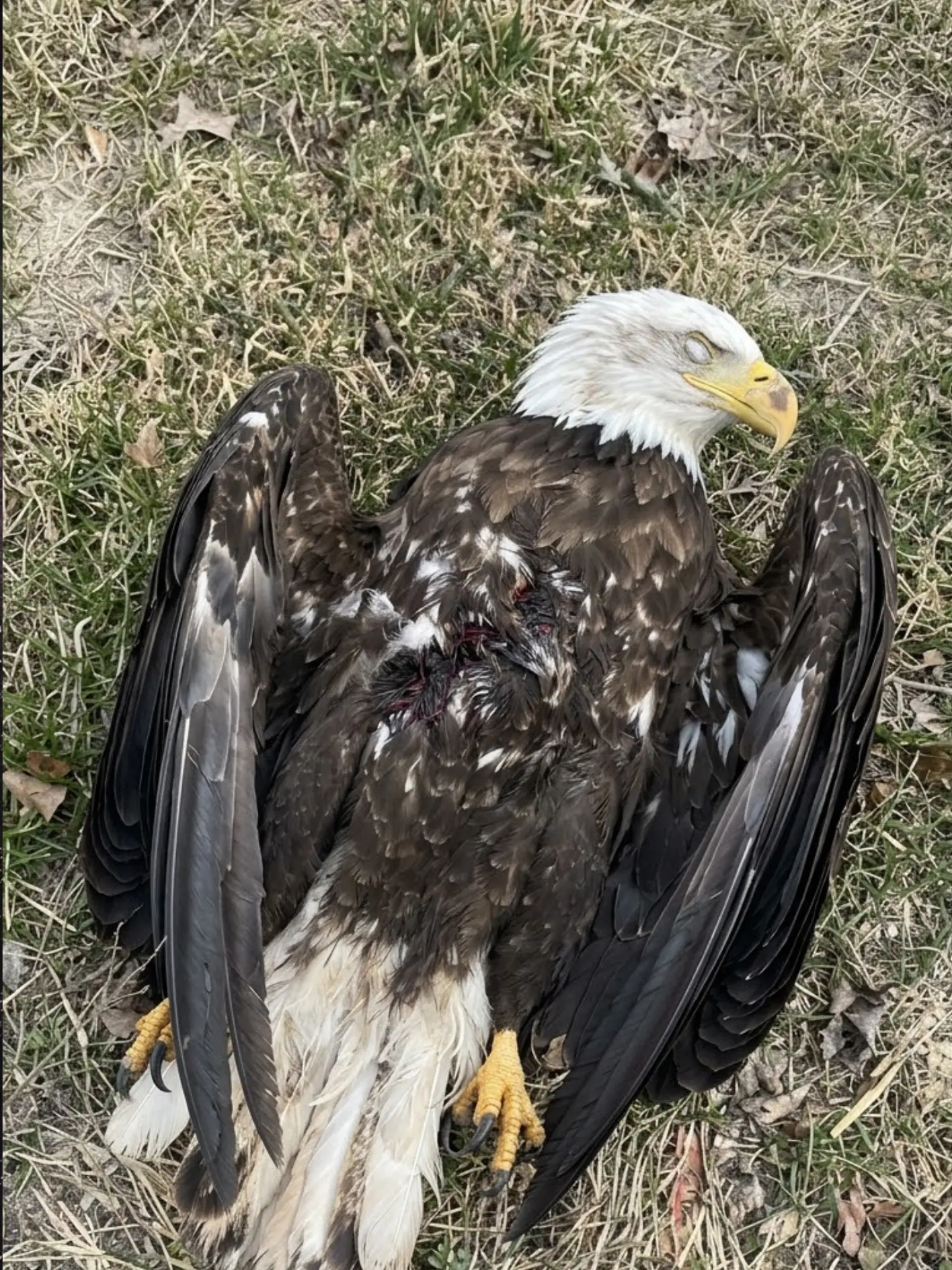
The eagle was first noticed lying in the grass near the reservoir, its wings partially extended and its body unusually still. From a distance, the bird appeared barely responsive. There was visible blood and disturbed plumage around the upper chest and shoulder region, but the exact cause of the injuries was not immediately clear.
A member of the public contacted wildlife authorities rather than attempting to approach the bird.
State wildlife conservation officers responded and quickly determined that the eagle required immediate medical attention.
The bird was alive, but profoundly debilitated.
It was unable to fly.
Its normal defensive response was markedly reduced.
And beneath the feathers, officers could see evidence of significant trauma.
The eagle was safely restrained, placed into a padded transport carrier, and taken directly to a regional wildlife rehabilitation center in southern Kentucky, where an emergency veterinary team was waiting.
At first, several possibilities remained open.
The eagle could have suffered a collision.
It could have been injured during a territorial confrontation with another large raptor.
It might have struck a vehicle or other object.
The wounds themselves were serious, but external appearance alone could not establish what had caused them.
That changed after diagnostic radiographs were taken.
The images revealed multiple small metallic fragments embedded within the injured region.
Combined with the pattern of penetrating trauma, the findings were considered consistent with a gunshot injury.
What had begun as an unexplained wildlife emergency had suddenly become something more troubling.
“We knew from the initial examination that this bird had experienced substantial trauma,” the attending wildlife veterinarian said. “But the radiographs changed the nature of the case. Once we identified multiple metallic fragments within the injured area, gunshot trauma became one of our primary concerns.”
The eagle remains under intensive veterinary care.
Its wounds have been cleaned and stabilized, pain is being managed, and staff are closely monitoring for infection, internal complications, and permanent damage to the structures required for flight.
For now, the prognosis remains guarded.
The immediate question is whether the bird can survive the trauma.
The longer-term question may prove even more difficult:
If it survives, can it ever fly normally again?
The Eagle Was Found Nearly Motionless Near the Reservoir
The initial report came from a person traveling through an area near Lake Cumberland Reservoir who noticed the Bald Eagle on the ground.
Bald Eagles sometimes spend time on the ground while feeding, particularly when scavenging carrion or consuming fish.
What made this situation different was the bird’s posture.
It was not standing over food.
It was not watching the surrounding area with the alertness expected from a healthy adult eagle.
Instead, it was lying low against the ground.
Its wings were partly displaced from the body.
The head remained down for extended periods.
There appeared to be blood among the feathers around the upper torso.
The observer did not attempt to pick the bird up.
That decision was important.
Even critically injured Bald Eagles can cause severe injuries with their talons, and improper handling can worsen fractures or internal trauma.
Wildlife authorities were contacted immediately.
Conservation Officers Found a Bird in Serious Distress
When officers reached the scene, they approached cautiously.
The eagle remained conscious enough to respond to movement, but its reactions were limited.
A healthy adult Bald Eagle ordinarily maintains substantial distance from people and will usually attempt to fly when approached.
This bird could not.
Closer inspection revealed obvious traumatic injury around the chest and shoulder region.
Blood had dried through portions of the plumage.
Several areas appeared consistent with penetrating wounds.
The wings were still attached and capable of some movement, but the eagle showed no ability to produce normal flight.
The officers prioritized getting the bird into professional care rather than attempting to determine the exact cause in the field.
Safe Capture Required Control of the Talons First
The eagle’s weakness did not eliminate the danger to rescuers.
Bald Eagles capture prey primarily with their feet, and even a compromised bird may retain substantial grip strength.
Protective gloves and established raptor-handling techniques were used.
The feet were secured first.
The wings were then supported against the body without forcing the injured structures into a different position.
No attempt was made to probe the wounds or remove foreign material at the scene.
Those procedures require controlled veterinary conditions.
The eagle was placed inside a secure, ventilated transport carrier lined with towels and padding to reduce movement during transport.
Lighting was kept low.
Noise was minimized.
Every effort was made to reduce stress and prevent the bird from struggling against the carrier.
The Bird Arrived Weak but Alive
At the rehabilitation center, the eagle was moved immediately into the treatment area.
Veterinary staff described the bird as severely debilitated.
It remained conscious but unusually quiet.
Its normal defensive behavior was reduced.
The eagle appeared dehydrated, and its body position suggested significant pain.
The medical team began with stabilization rather than an exhaustive examination.
In severely injured wildlife, the most dramatic wound is not always the most immediate threat.
Circulation, breathing, body temperature, neurological status, and blood loss all have to be considered.
The team monitored respiratory effort while providing supportive care.
Fluid therapy was administered according to the bird’s condition.
Pain medication was initiated.
The eagle was kept warm and handled as little as possible outside medically necessary procedures.
Penetrating Trauma Can Hide Extensive Damage
Once the eagle was stable enough for a closer examination, the staff carefully separated the feathers around the injured areas.
Several wounds were deeper than their surface appearance suggested.
That is common with penetrating trauma.
A small opening in the skin can lead to a much larger track underneath.
Damaged muscle, blood vessels, nerves, or other tissues may lie beneath an entrance wound that measures only a fraction of an inch.
For an eagle, wounds around the chest and shoulder are especially concerning because those areas contain structures critical to flight.
The shoulder girdle must withstand enormous mechanical forces.
Flight muscles must remain strong and properly attached.
Nerves and blood vessels serving the wing must remain functional.
A bird can survive a wound in that region and still lose the ability to fly permanently.
Radiographs Were Needed to Understand What Happened
The veterinary team obtained radiographs to evaluate the eagle’s skeleton and search for hidden trauma.
Images were taken of the chest, shoulder region, wings, and other areas considered clinically relevant.
The medical team was looking for several things:
fractures,
joint disruption,
internal abnormalities,
retained foreign material,
and evidence that might help explain the penetrating wounds.
That was when the case changed.
Multiple small radiopaque fragments were visible within the injured region.
Their appearance and distribution were considered compatible with metallic projectile fragments.
“Radiographs allow us to see beyond the surface wound,” the veterinarian said. “In this case, the presence of multiple metallic fragments made it very difficult to explain the injuries as a simple collision alone.”
The findings did not identify who was responsible.
They did not establish when the injury occurred.
But they did provide evidence consistent with the eagle having been shot.
The Medical Team Was Careful Not to Overstate the Evidence
Wildlife cases involving suspected gunshot injuries require careful documentation.
External wounds alone cannot always distinguish between gunfire and other forms of penetrating trauma.
Even metallic fragments require interpretation in context.
For that reason, the rehabilitation team documented the bird’s condition through photographs, radiographs, and written medical records.
The case was also referred to appropriate wildlife law-enforcement personnel.
The center did not speculate publicly about a suspect.
The medical conclusion remained focused on what the evidence could support:
the injury pattern and radiographic findings were consistent with gunshot trauma.
The Chest and Shoulder Region Became the Main Concern
The location of the injuries created several possible complications.
The veterinary team needed to determine whether the trauma involved:
the shoulder joint,
major wing bones,
large flight muscles,
air sacs,
ribs,
lungs,
blood vessels,
or nerves controlling the wing.
Not every fragment had necessarily penetrated deeply enough to damage a vital structure.
But the possibility had to be considered.
The bird’s breathing was monitored closely because penetrating trauma to the body cavity can sometimes affect the respiratory system.
Bird anatomy also differs significantly from mammalian anatomy.
The avian respiratory system includes air sacs extending through much of the body, making some penetrating injuries more complex than they appear externally.
Blood Loss Was Another Immediate Concern
The visible blood around the eagle did not reveal exactly how much blood it had lost.
Wildlife veterinarians therefore monitored clinical signs that could indicate anemia or circulatory compromise.
Blood testing could include packed cell volume, commonly abbreviated PCV, to estimate the proportion of red blood cells in circulation.
Serial testing can be particularly important after trauma because significant blood loss may become more apparent over time.
A declining red cell concentration would make the bird weaker and reduce its ability to deliver oxygen to muscles and organs.
For a flying predator, even moderate anemia can have major functional consequences.
For a critically injured patient, severe anemia can become life-threatening.
Wound Treatment Required Sedation and Careful Exploration
Once the eagle was sufficiently stable, the wounds were cleaned under controlled veterinary conditions.
The medical team flushed contaminated areas extensively.
Feathers and debris that had entered the wounds were removed where possible.
Damaged tissue was evaluated.
Nonviable material can become a source of infection and may require debridement.
The clinicians also examined the wound tracks to determine how deeply they extended.
That process had to be balanced against another consideration:
Not every foreign fragment should automatically be removed.
Metallic Fragments Are Not Always Surgically Removed
It can be tempting to assume that every visible fragment should be extracted.
In reality, surgery may cause more damage than leaving some fragments in place.
If a piece of metal is deeply embedded near a nerve, blood vessel, joint, or other sensitive structure, attempting to retrieve it can worsen the injury.
Veterinarians therefore evaluate each fragment according to location, accessibility, contamination risk, and its potential effect on long-term function.
Accessible material may sometimes be removed.
Other fragments may remain if extraction would create excessive trauma.
The medical team’s primary objective is not simply to make the X-ray free of metal.
It is to preserve as much healthy function as possible.
Infection Could Become as Dangerous as the Initial Injury
Penetrating trauma introduces bacteria and environmental contamination into deeper tissues.
The eagle had been lying outdoors before rescue.
Feathers, soil, plant material, and bacteria may all enter an open wound.
Damaged tissue also has reduced blood supply, making it more vulnerable to infection.
Veterinary staff began antimicrobial therapy when clinically appropriate and continued monitoring the wounds closely.
Warning signs include:
increasing swelling,
heat,
discharge,
abnormal odor,
tissue discoloration,
and systemic decline.
A bird that appears stable one day can deteriorate rapidly if a deep infection develops.
That is why repeated wound examinations are essential.
Pain Management Was Essential to Recovery
An eagle may not express pain in an obvious way.
Wild birds often become quiet and still rather than vocalizing.
But significant penetrating trauma is expected to be painful.
Controlling that pain is both a welfare priority and part of medical treatment.
Severe pain increases physiological stress.
It can suppress appetite.
It can discourage normal movement.
It can interfere with sleep and recovery.
Appropriate analgesic medication was incorporated into the treatment plan while staff continued to monitor the bird for changes in behavior and comfort.
The First 24 Hours Remained Uncertain
After the initial procedures, the eagle was placed into a quiet intensive-care enclosure.
Padded flooring reduced the risk of secondary injury.
The bird was not encouraged to perch high or attempt flight.
The lighting remained subdued.
Human traffic was kept to a minimum.
Staff monitored:
breathing,
body temperature,
bleeding,
neurological responses,
posture,
and overall alertness.
No one attempted to test flight.
At this stage, doing so would have provided little useful information and could have worsened the trauma.
The priority was survival.
Small Improvements Would Be More Important Than Dramatic Ones
Recovery from major trauma rarely occurs in a single obvious moment.
Clinicians instead look for incremental changes.
Does the eagle open its eyes more frequently?
Does it hold its head up?
Is grip strength improving?
Does it reposition itself normally?
Does breathing remain stable?
Does it begin resisting human contact more strongly?
For wildlife professionals, an eagle becoming more difficult to handle can actually be encouraging.
A healthy wild Bald Eagle should not be comfortable around people.
The return of defensive behavior often signals increasing strength and awareness.
Appetite Would Be Another Important Milestone
Once the bird was stable enough to eat safely, food could be offered in an appropriate form.
Voluntary feeding is valuable because it provides information about several systems at once.