When Cedar, an adult Bald Eagle, arrived at Northwoods Wildlife Veterinary Hospital after being struck by a vehicle on a rural road near La Crosse, Wisconsin, the veterinary team expected the case to be about trauma.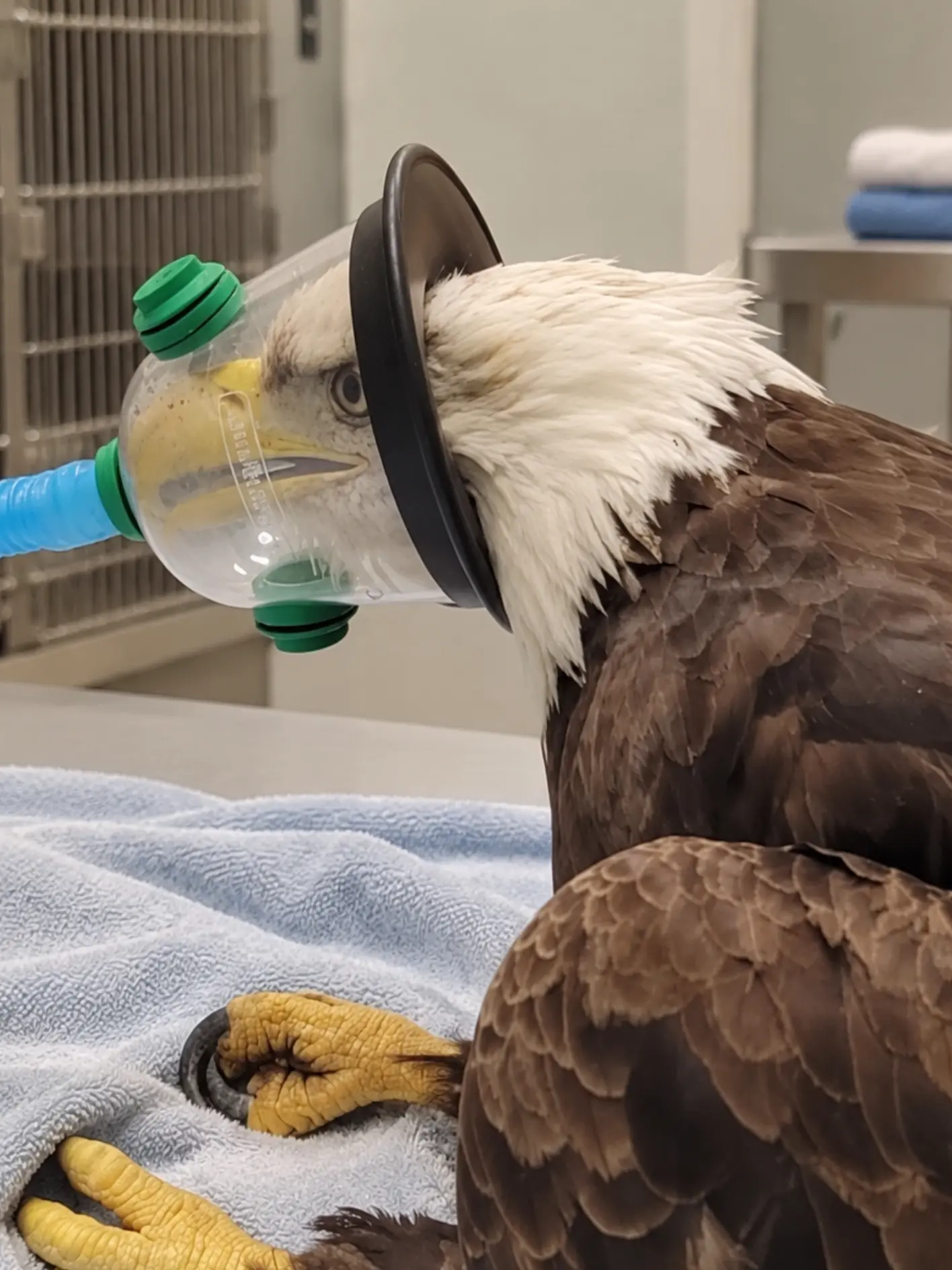
The bird had been found along the shoulder of the roadway unable to fly normally. Its breathing was rapid, its posture was weak, and although it remained conscious and visually responsive, it appeared too compromised to defend itself with the strength expected from a healthy adult eagle.
The initial concern was straightforward: internal trauma, concussion, a fractured wing, or another injury caused by the collision.
But within hours, routine blood testing revealed that the accident was only part of the problem.
Cedar was also carrying a clinically significant concentration of lead in its bloodstream.
“We realized very quickly that we weren’t treating one emergency,” a member of the veterinary team said. “We were treating two.”
The collision injuries needed time and supportive care.
The lead exposure required treatment of its own.
And because lead can affect coordination, strength, reaction time, and neurological function, the finding raised a second question that could never be answered with certainty: had Cedar already been impaired before the vehicle struck?
There was no evidence strong enough to say that lead poisoning caused the collision.
But veterinarians could not ignore the possibility that a weakened or neurologically compromised eagle might have been less capable of escaping an approaching vehicle.
For Cedar, the distinction mattered less than the immediate medical reality.
Both problems had to be treated before the bird could safely return to the wild.
Found Along the Roadside
The call came after a motorist noticed a large bird lying near the edge of a rural roadway.
At first, the driver was not certain whether the eagle had survived the impact.
The bird remained low to the ground with its wings partially spread. It made little attempt to move when vehicles passed nearby.
Only after stopping at a safe distance did the observer see the eagle lift its head.
Wildlife authorities were contacted.
By the time a responder arrived, Cedar was still conscious but unable to launch into flight.
The bird attempted to reposition itself, but movement was slow and uncoordinated.
There was no large open wound.
No obvious exposed bone.
No dramatic bleeding.
Still, the combination of roadside location, impaired flight, and abnormal posture made a vehicle collision the leading concern.
The responder approached carefully.
Even a badly injured Bald Eagle can strike with considerable force.
The talons were controlled first, the wings were supported close to the body, and Cedar was placed inside a padded transport crate for the drive to veterinary care.
No one attempted to “test” the bird by forcing it into the air.
That decision was important.
If Cedar had sustained a spinal, shoulder, or internal injury, an unnecessary flight attempt could have made the condition worse.
Emergency Stabilization Came Before Diagnosis
At the hospital, Cedar was transferred to a padded treatment area and immediately evaluated for shock, respiratory distress, and major orthopedic trauma.
The bird remained alert but subdued.
Its breathing was faster than expected.
Grip strength was reduced.
Cedar did not maintain the strong upright posture typical of a healthy Bald Eagle.
During the early phase of treatment, supplemental oxygen was provided through a veterinary mask while the team worked to stabilize the bird and complete the first examination.
Photographs from that period show Cedar resting on folded towels with a transparent oxygen mask positioned over the beak and face.
The bird’s eye remains open and watchful.
That alert appearance was encouraging.
It did not mean the eagle was stable.
Wild raptors often conceal illness remarkably well, and a bird can remain visually attentive while carrying serious internal injuries or toxic exposure.
The veterinary team therefore proceeded systematically.
The Trauma Examination Did Not Fully Explain the Weakness
Cedar’s head, eyes, neck, spine, wings, chest, pelvis, legs, and feet were examined carefully.
There was bruising consistent with recent trauma.
The chest and shoulder regions were tender.
A mild concussion was considered possible.
But there was no obvious catastrophic skeletal injury.
Radiographs were obtained to look for fractures that could not be detected reliably by palpation alone.
The images provided the first major piece of good news.
No severe wing fracture was found.
The major flight bones remained intact.
There was no obvious spinal fracture.
No major pelvic injury appeared on the radiographs.
That significantly improved Cedar’s orthopedic prognosis.
Yet the result created another problem.
The bird still looked weaker than the visible trauma seemed to explain.
“The collision accounted for some of what we were seeing,” the veterinarian said. “But the reduced grip and overall weakness seemed disproportionate to the orthopedic findings.”
That observation prompted the team to look more closely at systemic causes.
Bloodwork Revealed the Hidden Problem
Blood samples had already been collected as part of the intake evaluation.
The veterinary team assessed general health parameters and screened for lead exposure, a common consideration in Bald Eagles admitted with unexplained weakness or neurological signs.
The lead test came back elevated.
Not merely detectable.
Clinically significant.
The result meant Cedar had accumulated enough lead to require medical treatment.
Suddenly, the case made more sense.
Lead toxicosis can affect the nervous system, gastrointestinal tract, and overall muscular function.
Affected birds may become lethargic.
Grip strength can decline.
Coordination can worsen.
Reaction time may become slower.
Some eagles lose the ability to stand or fly normally even when their wings are physically intact.
Cedar had been admitted because of a vehicle strike.
But the blood test revealed that another threat had already been circulating through the bird’s body before or around the time of the collision.
Did Lead Contribute to the Crash?
It was an obvious question.
It was also one the medical team could not answer definitively.
A Bald Eagle may be struck by a vehicle even when completely healthy.
Eagles frequently feed on road-killed animals.
Large birds require space to launch, especially from level ground.
If a vehicle approaches while an eagle is feeding near a roadway, the bird may not gain altitude quickly enough to avoid impact.
That alone could explain the accident.
But lead exposure introduced another possibility.
If Cedar had been neurologically impaired, weaker than normal, or slower to respond, those changes may have reduced the bird’s ability to escape danger.
Veterinarians documented the possibility without presenting it as fact.
The evidence established two diagnoses:
recent traumatic injury compatible with a vehicle collision,
and clinically significant lead exposure.
It did not establish which came first in a causal sense.
For treatment purposes, both had to be addressed.
Why Bald Eagles Encounter Lead
Bald Eagles are skilled hunters, but they are also opportunistic scavengers.
Carrion can be an important food source, particularly during colder months when fish or other prey may be less accessible.
That scavenging behavior can bring eagles into contact with lead ammunition fragments.
When a deer or other game animal is shot with lead ammunition, the projectile may fragment on impact.
Some fragments can remain in tissue.
Others may remain in organs or gut piles left in the field.
Many fragments are extremely small.
A scavenging eagle cannot identify them visually.
It simply consumes the tissue.
Once swallowed, lead can be absorbed into the bloodstream.
The amount required to cause illness varies according to exposure, individual physiology, timing, and other factors.
Some birds arrive at rehabilitation centers with low-level exposure and no obvious clinical signs.
Others arrive unable to stand.
The Concern Is the Toxic Material, Not Hunting Itself
Wildlife veterinarians are careful when discussing this issue.
The problem is not lawful hunting as an activity.
Hunters have played a substantial role in wildlife conservation in the United States through licensing, excise taxes, habitat programs, and direct stewardship.
The concern is the toxic material that can remain in animal remains when lead ammunition is used.
That distinction matters.
Lead is not necessary for hunting.
Non-lead alternatives, including copper-based ammunition, are available for many commonly used firearm types and hunting situations.
When hunters choose non-lead ammunition, they reduce the chance that scavenging wildlife will ingest toxic fragments from carcasses or gut piles.
Cedar’s case became a clear example of why that choice can matter.
Chelation Therapy Began
Because the blood lead concentration was high enough to be clinically concerning, the veterinary team began chelation therapy.
Chelating medications bind to lead and help the body eliminate it.
Treatment is not instantaneous.
The bird still requires time.
Hydration.
Nutrition.
Rest.
Monitoring.
And, depending on the severity of exposure, repeat treatment may be necessary.
Cedar continued receiving fluid support and remained in a quiet intensive-care setting.
The trauma from the collision also required observation.
Bruising and soft-tissue pain were monitored.
The team watched for changes in respiratory effort that might suggest chest injury.
Neurological status was reassessed repeatedly.
The first 24 to 48 hours remained guarded.
Cedar Was Too Weak for a Normal Perch
During the earliest phase of hospitalization, Cedar spent most of the time on padded flooring.
High perches were avoided.
A debilitated eagle can fall and create a second injury.
The bird’s wings were kept in a natural folded position whenever possible, and unnecessary handling was minimized.
Staff relied heavily on observation.
Could Cedar hold the head upright?
Did the bird respond when someone entered?
Was grip getting stronger?
Was appetite improving?
Did breathing remain stable?
These small observations provided important information between formal examinations.
The First Changes Were Subtle
Recovery did not begin with a dramatic transformation.
Cedar simply started holding the head up for longer periods.
The eyes remained open more often.
The toes began closing with greater force.
The bird became increasingly attentive to activity outside the enclosure.
Later, Cedar began reacting more strongly when staff approached.
For a wild animal, resistance to handling can be a positive medical sign.
The quietest Cedar had been the sickest Cedar.
As strength returned, cooperation declined.
That was welcome.
“The first day the bird really started fighting us during an exam, we were relieved,” one rehabilitator said. “That’s closer to how an adult eagle should behave.”
Appetite Returned
Lead poisoning frequently affects appetite and gastrointestinal function.
Cedar initially showed limited interest in food.
As treatment continued, that began to change.
Small portions were offered once the team was confident that neurological function and swallowing were adequate.
The bird began feeding voluntarily.
Then food intake increased.
Cedar used the feet to hold food normally and tore pieces with the beak.
Maintaining body condition was important for two separate reasons.
The eagle needed energy to recover from trauma.
It also needed enough nutritional reserve to rebuild strength once flight rehabilitation began.
One Improved Lead Test Was Not Enough
Blood testing was repeated during the course of treatment.
The lead concentration began declining.
That was encouraging.
But clinicians did not assume one lower value meant the problem was completely resolved.
Lead can redistribute between body compartments, and blood concentrations may change after chelation therapy ends.
The team therefore continued monitoring Cedar after the initial treatment period.
They wanted to see that:
neurological signs resolved,
blood lead remained at an acceptable level,
and clinical improvement persisted without immediate rebound.
Only then could the toxicology portion of the case be considered under control.
The Collision Injuries Were Healing at the Same Time
While the medical team addressed lead exposure, the trauma from the vehicle collision also had to resolve.
Chest bruising gradually improved.
The shoulder became less painful.
Cedar began extending both wings more symmetrically.
There was no persistent wing droop.
No delayed fracture became apparent.
That combination was encouraging.
The bird had survived a collision without catastrophic structural damage.
Now it needed to prove that the lead exposure had not left lasting neurological deficits.
Standing Was the First Functional Test
As Cedar became stronger, the bird began spending more time upright.
Both feet were placed normally beneath the body.
Balance improved.
The wings no longer needed to be extended for support.
Grip strength returned.
These changes suggested that neurological coordination was improving alongside general strength.
A low perch was eventually introduced.
Cedar climbed onto it and remained balanced.
Both feet gripped securely.
That was another important milestone.
Why Perching Matters After Lead Poisoning
Perching may appear simple, but it is a useful neurological test.
A bird must coordinate:
toe flexion,
balance,
postural control,
vision,
and continuous small muscular adjustments.
An eagle can look relatively normal while sitting on the floor and still reveal weakness once asked to remain balanced on a narrow branch.
Cedar managed the low perch successfully.
The next challenge would be far greater.
Flight.
Flight Testing Could Not Be Rushed
The fact that Cedar’s wings were structurally intact did not automatically mean the bird was ready to return to the sky.
Lead toxicosis can impair coordination.
A bird may be strong enough to flap but too neurologically compromised to turn or land accurately.
That is why flight testing was delayed until Cedar had:
normal posture,
strong grip,
good appetite,
improving bloodwork,
and no obvious neurological deficit during routine examination.
Only then was the eagle moved to a larger rehabilitation enclosure.
The First Flights Were Closely Watched
Cedar initially made short movements between low perches.
Both wings opened fully.
Wingbeats appeared symmetrical.
The bird generated lift without obvious difficulty.
That was good.
But the veterinary team paid particular attention to landing.
A bird can launch successfully yet remain unsafe for release if coordination or reaction time is impaired.
Cedar had to judge distance accurately.
Extend the feet at the correct moment.
Control wing braking.
Close the talons securely around the perch.
Repeated landings looked appropriate.
That reduced concern for a significant residual neurological problem.
Endurance Came Next
One short flight is not enough for a Bald Eagle.
The team gradually increased the amount of exercise.
Cedar flew longer distances within the enclosure.
Turns became tighter.
Takeoffs remained strong.
Landings stayed controlled.
There was no unusual fatigue after moderate exertion.
Most importantly, Cedar did not begin showing the abnormal posture or weakness that had been present at admission.
The bird was beginning to function like a healthy adult eagle again.
Final Bloodwork Was Part of Release Planning
The team did not rely only on flight behavior.
Blood lead concentrations were reassessed before release was seriously considered.
Cedar needed a combination of medical and functional clearance.
The bird had to show:
lead levels no longer requiring treatment,
no significant neurological signs,
normal food intake,
appropriate body condition,
strong grip,
normal wing movement,
and consistent flight performance.
Only after those conditions were met could the team reasonably conclude that both emergencies had resolved.
The Car Accident Brought Cedar Into Care — The Blood Test Found What No One Could See
This became the defining lesson of the case.
The traumatic injury was visible in the circumstances.
Cedar had been struck on a road.
The bird was grounded.
Bruising was present.
Everyone expected the veterinary workup to focus on collision trauma.
But the hidden problem was discovered because the team looked beyond the obvious.
“The car brought Cedar to the hospital,” one veterinarian said. “The blood test revealed the danger we couldn’t see.”
Had the lead test not been performed, the bird might have improved from its bruising while still carrying a neurological toxin burden significant enough to compromise survival after release.
That possibility is why lead screening has become an important part of many raptor intake protocols.
Lead Exposure in Eagles Is Not Rare
Bald Eagles are particularly vulnerable because of their feeding ecology.
They scavenge.
They consume wounded or dead animals.
They may feed at carcasses left in fields.
During hunting seasons, those opportunities increase.
Research and rehabilitation experience have repeatedly shown that many eagles encounter lead at some point in their lives.
Not every exposed bird becomes critically ill.
But the prevalence is enough that wildlife veterinarians take the risk seriously.
Symptoms can include:
weakness,
lethargy,
loss of coordination,
reduced grip,
gastrointestinal dysfunction,
neurological abnormalities,
and inability to fly.
Severe poisoning can be fatal.
Non-Lead Ammunition Offers a Practical Prevention Tool
One reason this environmental problem receives so much attention is that it is partly preventable.
Hunters who choose non-lead ammunition can reduce the amount of toxic metal left in carcass remains.
Copper and other non-lead options are increasingly available for many common hunting applications.
The objective is not to remove carrion from the ecosystem.
Carrion is natural food for eagles and many other scavengers.
The objective is to prevent that food from containing a neurotoxic metal.
That is a meaningful distinction.
Carcass Management Can Help Too
Where practical and consistent with local regulations, managing carcass remains can further reduce exposure.
Gut piles and heavily fragmented wound channels may contain lead particles.
If these remains are left where scavenging birds can access them, exposure becomes possible.
Using non-lead ammunition removes much of that concern at the source.
Where lead ammunition is still used, thoughtful carcass management may help reduce risk.
Wildlife agencies and conservation organizations often provide region-specific recommendations.
Cedar Eventually Met the Release Standard
By the final stage of rehabilitation, the eagle looked very different from the bird photographed under oxygen support.
Cedar stood tall.
Both feet gripped strongly.
The eyes remained bright and responsive.
Appetite was normal.
Wing extension was symmetrical.
Flight was powerful.
Blood lead concentrations had declined sufficiently.
There were no persistent signs suggesting that the collision or the poisoning had left a functional impairment.
The veterinary team approved release.
Returning to the Wild
Cedar was transported to appropriate habitat in the same broader river region where the bird had originally been found.
The carrier was placed with a clear path toward open terrain and mature trees.
People stepped back.
The door opened.
Cedar looked outside for several moments.
Then the eagle moved forward.
Both wings opened.
The bird launched strongly and climbed.
There was no obvious hesitation.
No uneven wingbeat.
No immediate return to the ground.
Cedar continued toward the trees and gradually moved farther from the people who had spent weeks monitoring every detail of its recovery.
That was exactly what everyone wanted.
The Best Wildlife Rehabilitation Ending Is a Bird That No Longer Needs You
The staff did not expect recognition from Cedar.
A wild animal does not understand the medical process in human terms.
It does not know what chelation therapy is.
It does not understand radiographs, oxygen masks, blood chemistry, or rehabilitation protocols.
That does not matter.
The objective of wildlife care is independence.
The bird should leave.
It should avoid humans.
It should resume the life it had before admission.
Cedar did.
Two Human-Created Hazards Nearly Converged on One Bird
The case remains important because Cedar was not dealing with a single threat.
One human-created hazard was obvious:
a vehicle.
The other was almost invisible:
lead.
A roadside collision can kill immediately.
Lead poisoning can weaken an animal slowly and quietly.
Whether those two hazards were directly connected in Cedar’s case cannot be proven.
But both were present.
And both had to be overcome.
There Is a Practical Way to Reduce One of Those Threats
Road collisions involving wildlife are difficult to eliminate entirely.
Lead exposure from ammunition is different.
There is a direct prevention option.
Non-lead ammunition reduces toxic fragments entering carcass tissue.
For hunters who want to protect scavenging wildlife while continuing lawful hunting, choosing an effective non-lead alternative is one practical step.
It does not require abandoning hunting.
It does not require changing the natural behavior of eagles.
It simply changes what remains behind after a shot.
A Second Chance That Started With a Blood Test
When Cedar first reached the hospital, the most obvious medical story was the collision.
That story turned out to be incomplete.
X-rays helped rule out catastrophic skeletal trauma.
Bloodwork uncovered the second emergency.
Lead treatment allowed neurological function to recover.
Supportive care helped Cedar heal from the impact.
Rehabilitation proved the wings, feet, balance, and reaction time were ready for the demands of the wild.
Only after all of those pieces came together did the carrier door open.
The lesson left behind is straightforward.
A Bald Eagle found after a vehicle strike may have more than one problem.
A bird that survives trauma may still carry a hidden toxin.
And one of the most common environmental toxins affecting scavenging raptors can be reduced through a decision made long before an eagle ever reaches a veterinary hospital:
choosing non-lead ammunition and keeping lead-contaminated carcass remains out of the food chain.
For Cedar, that lesson came with a successful ending.
The vehicle did not end the bird’s life.
The lead did not either.
The eagle recovered from both.
And when the time came, Cedar did what every rehabilitation team hopes its patient will eventually do.
It opened its wings and left.